5 Old Mill Towns To Visit In Michigan
Rivers throughout Michigan once helped grow the local economy by providing power to sawmills and gristmills. These mills allowed small-town communities to thrive. Before the highways and interstates were constructed, and when steam power became a thing, some mill settlements slowly faded away. But other mill communities preferred to stay put, adapted to their changing circumstances, and continued to flourish. Today, there are several old mill towns in Michigan that you can still visit. Some are centered around their milling history, while others focus more on tourism. Either way, the following old mill towns are among the most charming and photogenic in the state and are worth a visit.
Frankenmuth

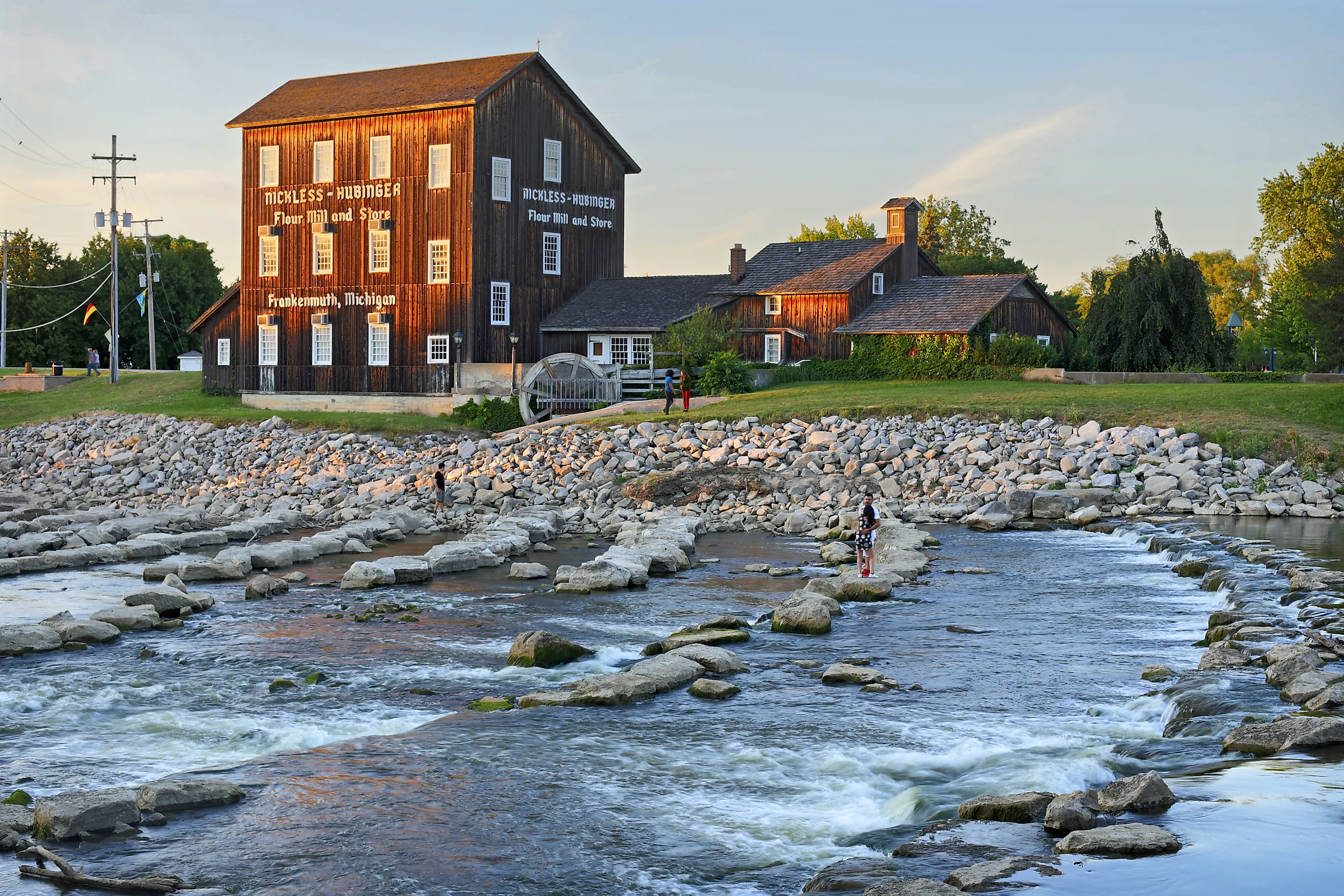
The Bavarian town of Frankenmuth was settled in 1845, and the township of Frankenmuth was created in 1854. By 1874, the Star of the West Milling Company found a place here, joining hundreds of other flour mills that had sprung up across the state. Along with just a few others, Star of the West still operates in Frankenmuth today. The town is also home to the Frankenmuth Woolen Mill, which opened in 1896. It is now a mini-museum featuring historical equipment and several exhibits on weaving and wool. There are plenty of other things to see and do besides the mills, however.

You can visit the River Place Shops situated downtown in a ‘German Plaza’ setting. Or you can try your hand at finding precious stones courtesy of Thunder Bay Mining. You get a rough bag to run through a stream, and whatever you find, you keep. After you are done finding gems, you can take a water tour on the Bavarian Bell paddle wheeler, which takes tourists down the Cass River. While you are on the water, keep an eye out for the Holz-Brücke, a stunning wooden bridge that spans the river.
Linden

The Linden Mill was built in 1871 on the banks of the Shiawassee River and remained in operation until the 1950s, when the Village of Linden purchased it. The community restored the mill and transformed it into a civic center. The structure was listed on the National Register of Historic Places in 1972. In 2025, a new restoration project was started that will cost nearly $6 million and include new supports and an elevator. The building is scheduled to reopen just before the end of 2026 and will have a museum on the fourth floor and a library on the first floor. While the renovations are ongoing, you can view the mill from the outside and then head to the park across the river that houses the Linden Mill Pond Gazebo. Here you can have a picnic or stroll along the water. If you visit on a Wednesday, you can catch a free live music performance as part of the Music by the Mill concert series. Other fun activities include fishing, swimming, and kayaking on the Shiawassee River and the Heritage Water Trail. You can also visit the Linden City Park, where you will find a bike path and trail.
Dexter

On the northern side of the town of Dexter, at the spot where the Huron River reaches the town limits, is the oldest cider mill that is still in use in Michigan. Peninsula Mills began grinding flour at the site in 1836, and by 1838, a wool plant and a sawmill were added. The cider mill was erected in 1886, and the cider produced here was sent to market via the railroad. In 2026, you can still enjoy a cold apple cider thanks to this historic mill. And, if you visit during the fall, you can enjoy the incredible foliage too, as you explore the rest of the town. If you take a walk down Main Street in downtown Dexter, you will find Monument Park, which features a great view of Mill Creek. The creek is part of Mill Creek Park, where you can get out on the water in a boat or on a paddleboard. You can also go for a bike ride or a walk on the paved paths. When you get hungry, you can stop by the historic A&W Restaurant and have your meal brought right to your car.
Saline

Long before mills were built in Saline, prehistoric animals, including mastodons, crisscrossed the landscape here. Thousands of years later, the first flour mill was built on the west side of the Saline River in 1845. Afterwards, a windmill factory, a blacksmith shop, and a sawmill were added. Yet, it was not the mills that allowed the village to grow. The railroad was instrumental in its growth.

If you visit Saline today, you can learn more about its history at the Saline History and Depot Museum. The museum is open on Saturdays and displays the town’s local and railroad history inside a historic depot. If you make the trip during winter, you can enjoy indoor games at Otto’s Arcade and Club or go bowling at Station 300 Saline. You can also catch the Harvest of the Arts Oktoberfest or, if you prefer, visit in the summer for the Saline Summerfest.
Bellevue

Bellevue is a tiny village famous for housing one of the most unusual-looking mills in the state. The Bellevue Gothic Mill was built in the 1800s in the Gothic Revival design style. This architecture choice is a far cry from the typical milling structure you will see around Michigan. The mill produced grist from 1854 until 1958 and was listed on the National Register of Historic Places in 1975. The Stockhausen family bought the property in 1977 and restored it. You can visit the mill today to learn more about how the water-powered milling process worked years ago. If you prefer learning new skills instead of history, head to Haigh’s Sugar House Farm to see how maple syrup is made. If you visit during October, you can join the Sandhill Crane Festival, which celebrates thousands of sandhill cranes gathering in Bellevue.
Explore Michigan’s Historic Milling Heart
Many people travel to Michigan to explore the Great Lakes. But, at the state’s inland rivers, there are just as many sights to see and stories to hear. The above five towns alone will tell you several stories of how the spirit of communities endured once the milling era passed. It is not about getting a history lesson, but about seeing first-hand how some of these towns have had to reinvent themselves. If you are looking to go on a meaningful trip and go back home with more than just mementos, these riverside mill towns are the perfect place to start.