This Missouri Downtown Is Made For Strolling
The peaceful town of Hermann sits quietly in the Missouri River valley with a population of 2,200, roughly 80 miles west of St. Louis. As you stroll through town, you'll notice the red-brick buildings, many dating back to the 1830s when German immigrants first settled here. Each October, the streets fill with Oktoberfest festivities that celebrate its heritage. Your walk through Hermann won't follow a single main street. Instead, the town works with the hillside and the river, so you'll find yourself turning corners, climbing gradual inclines, and discovering the next block organically. This is Missouri wine country, thanks to the German immigrants who brought winemaking expertise with them and turned Hermann into a major wine-production hub by the 1850s. Besides the wineries, you'll stroll past boutique shops and bed-and-breakfasts housed in older homes. A visit to Hermann is perfect for a laid-back weekend. It’s slow-paced, walkable for those that don’t mind hilly terrain, and has enough variety to appeal to both wine lovers and history enthusiasts alike.
The Riverfront And Wharf Street: Where Hermann Begins

Start your walk on Wharf Street, which runs parallel to the Missouri River. Although railroad tracks still run between the town and the water, a reminder that Hermann’s growth was dependent on both rail and river, the riverfront doesn't feel cut off. Open sightlines and pedestrian crossings keep the connection between downtown and the water open. The buildings on Wharf Street are mostly brick and stone, originally warehouses and commercial structures from when shipping and trade drove the local economy.

Worth taking a pause at is the Wharf Street Riverfront Inn. The two-story structure is actually two buildings joined together, featuring red brick on one side and deep blue clapboard on the other, topped with a distinctive red metal roof. This was once the Leimer Hotel, named for August Leimer, an early settler who arrived with the first wave of German immigrants. After the Pacific Railroad reached Hermann in 1855, the building operated as a dining room for rail passengers and even once functioned as a saloon and a temporary hospital. Standing here, you get a sense of how the town's identity formed at the intersection of the river that brought the first settlers and the railroad that carried commerce in and out of Hermann for decades after.
Schiller Street: A True Walking Street

Walk uphill one block and you'll reach Schiller Street, the town's commercial corridor. There’s a shift in the feeling of town density here, as the buildings stand two or three stories tall and cluster closely together, with their facades facing the street directly. Schiller Street has the rhythm of a typical Main Street, with narrow sidewalks and short blocks that are ideal for exploring on foot. Stop first at Espresso Laine, a local coffee shop where you can order from an extensive drink menu or pick up gourmet beans by the pound. If you're interested in the town's background, continue up Schiller Street to the Historic Hermann Museum, housed in the 1871 German School Building. Before going inside, admire the still-functioning Clock Tower that sits atop the building, a 1890 German-made clock that is still wound by hand. In the museum, you'll find exhibits on the original German settlement, artifacts from Hermann's river trade and railroad era, and displays documenting how the wine industry took root here. From the museum, continue south on Schiller Street as it transitions further into the historic center of town.
The Hermann Historic District And Hermannhof Winery

From Schiller Street, turn east onto East 3rd Street. You're now in the core of Hermann's designated historic district, a five-block area that holds over a hundred buildings on the National Register of Historic Places. The street narrows here, and brick and stone structures from the 1840s and 1850s line both sides, most still serving as homes. Take a moment to reflect that the buildings around you are remarkably well-perceived for structures pushing 180 years.
When you’ve finished exploring the town’s historic district, make a left on Gutenberg Street and turn right on East 1st Street to find the Hermannhof Winery, a small outfit dedicated to quality over quantity. The building dates to 1848, with ten stone wine cellars tunnelling into the hillside. You can tour the cellars and do a tasting in the main building, and there’s also an on-site deli that serves German sausages, pretzels, and sandwiches for those looking for a snack. From the winery, continue strolling west on East 1st Street.
Deutschheim State Historic Site: Living History On West 2nd Street

Turning off East 1st Street and briefly onto Market Street, you’ll come across the Deutschheim State Historic Site on your right. It’s a state-run property that preserves two mid-19th-century homes, offering the opportunity to explore the traditions and daily life of German immigrants. The Pommer-Gentner house went up in 1840, making it one of Hermann's oldest buildings, while the Carl Strehly house followed in 1842.

The Strehly house has some additional history worth noting, as until 1854, it operated as a printing business that produced the first German-language newspaper west of the Mississippi. Behind the Pommer-Gentner house, there's a timber-frame barn with tools and artifacts to discover, with a German four-square period garden offering a lovely place to stroll with views of the Missouri River.
From the Deutschheim State Historic Site, the route heads uphill.
Stone Hill Winery And A Panoramic View Of Town

From West Second Street, walk south and uphill toward Stone Hill. It’s a longer distance up a steep incline, but well worth the trip to Missouri’s oldest winery. Dating back to 1847, Stone Hill Winery was one of the largest wineries in the country. An interesting fact about the winery is that during Prohibition, the owners converted the underground cellars to mushroom farming to keep their business running.

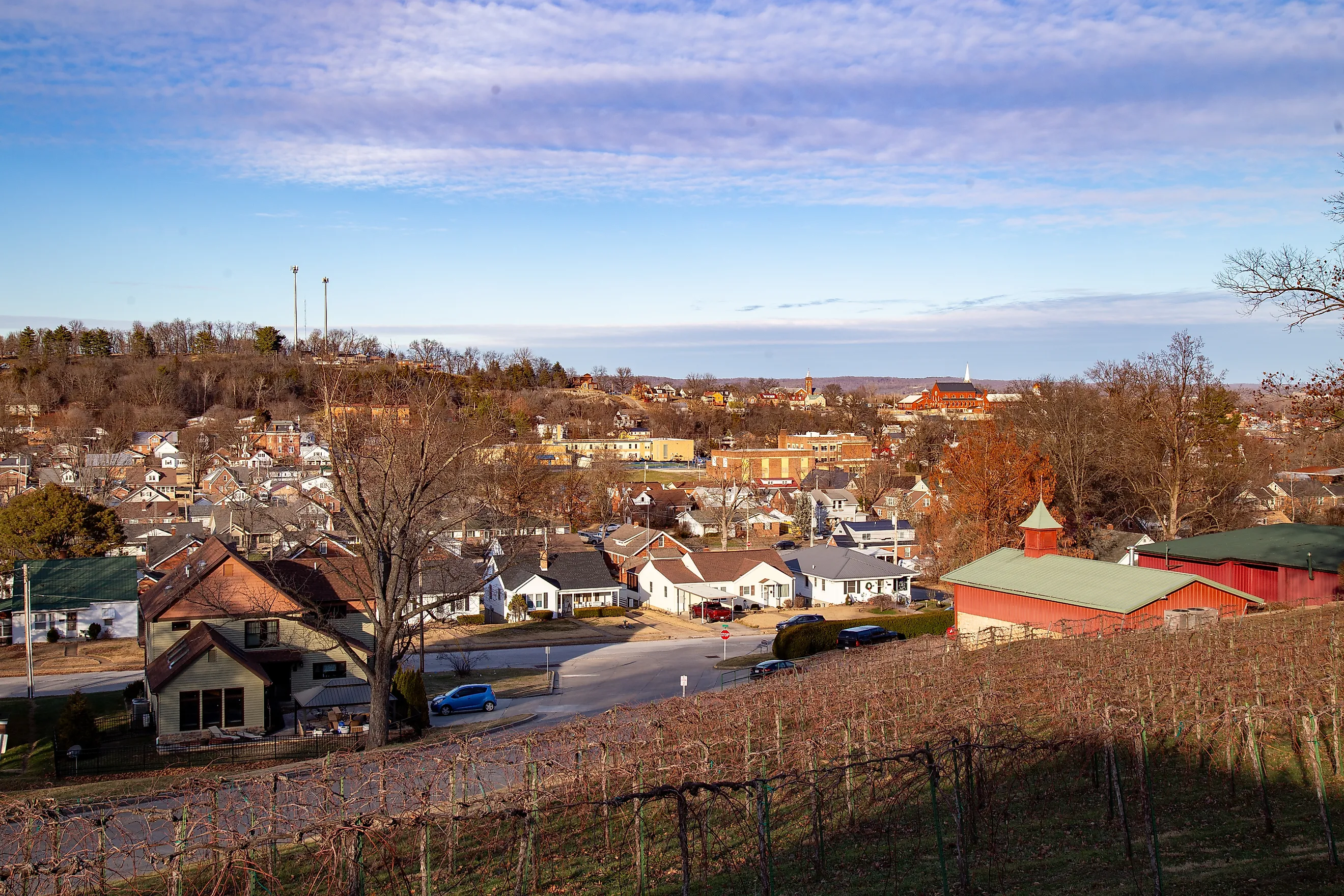
From up here, the panoramic view down towards the river is spectacular. You can see the town spread out beneath you, with rooftops, vineyards on the surrounding hillsides, and the river forming the northern boundary. It’s a reminder of how compact Hermann is, and how the hilly terrain has shaped the town. After wrapping up at the winery, enjoy the downhill stroll using Market Street, which will bring you back to Wharf Street and the riverfront. You've just traced how Hermann was built, from the river that brought settlers in, to the commercial center they established, to finally the hillside vineyards that made the town what it is today.
Other Missouri River Towns With A Similar Look And Feel

If you appreciate Hermann’s layout, there are two other Missouri River towns that are just as historic and walkable. Weston, a town of around 1,700, sits about 50 miles northwest of Kansas City. Its downtown runs along a single main street, lined with brick commercial buildings from the river trade and tobacco warehouse era that now house shops and restaurants. Weston’s buildings are well-preserved and there’s a lot to explore, especially if you’re interested in 19th-century architecture and wineries.

Ste. Genevieve, a town of 5,000 residents, is about 60 miles south of St. Louis. Founded by French Canadian settlers in the mid-1700s, it’s one of Missouri’s oldest permanent settlements. The downtown features fenced gardens and vertical, hand-hewn log French colonial buildings that feel different from Hermann's brick-lined German grid. Ste. Genevieve’s narrow streets are easy to explore on foot, and the town is notably flatter than the hilly downtown of Hermann.
Discovering Hermann By Foot
A stroll through Hermann’s downtown is an exploration into how a Missouri river town was built, and how it still operates. This route takes you from the river at Wharf Street, up through Schiller's commercial corridor, and into the historic residential blocks above, all in one continuous climb. Along the way, there are historic buildings, wineries, museums, and shops, each contributing to an exciting and diverse itinerary, if you choose to follow it. So start at the riverfront, cross the railroad tracks, and let the hilly streets of Hermann set the pace.