5 Oldest Incorporated Towns In Tennessee
From frontier settlements to courthouse squares that have existed for centuries, Tennessee's oldest incorporated towns tell the story of the state's earliest days. Towns, like Jonesborough, were established long before Tennessee became the 16th state in the Union in 1796. These communities served as centers of trade, government, and daily life in a growing frontier. Their preserved architecture, historic streets, and enduring traditions are showcased at famous sites like the Andrew Johnson National Historic Site and the International Storytelling Center, offering a glimpse into how early Tennesseans lived and worked.
Jonesborough

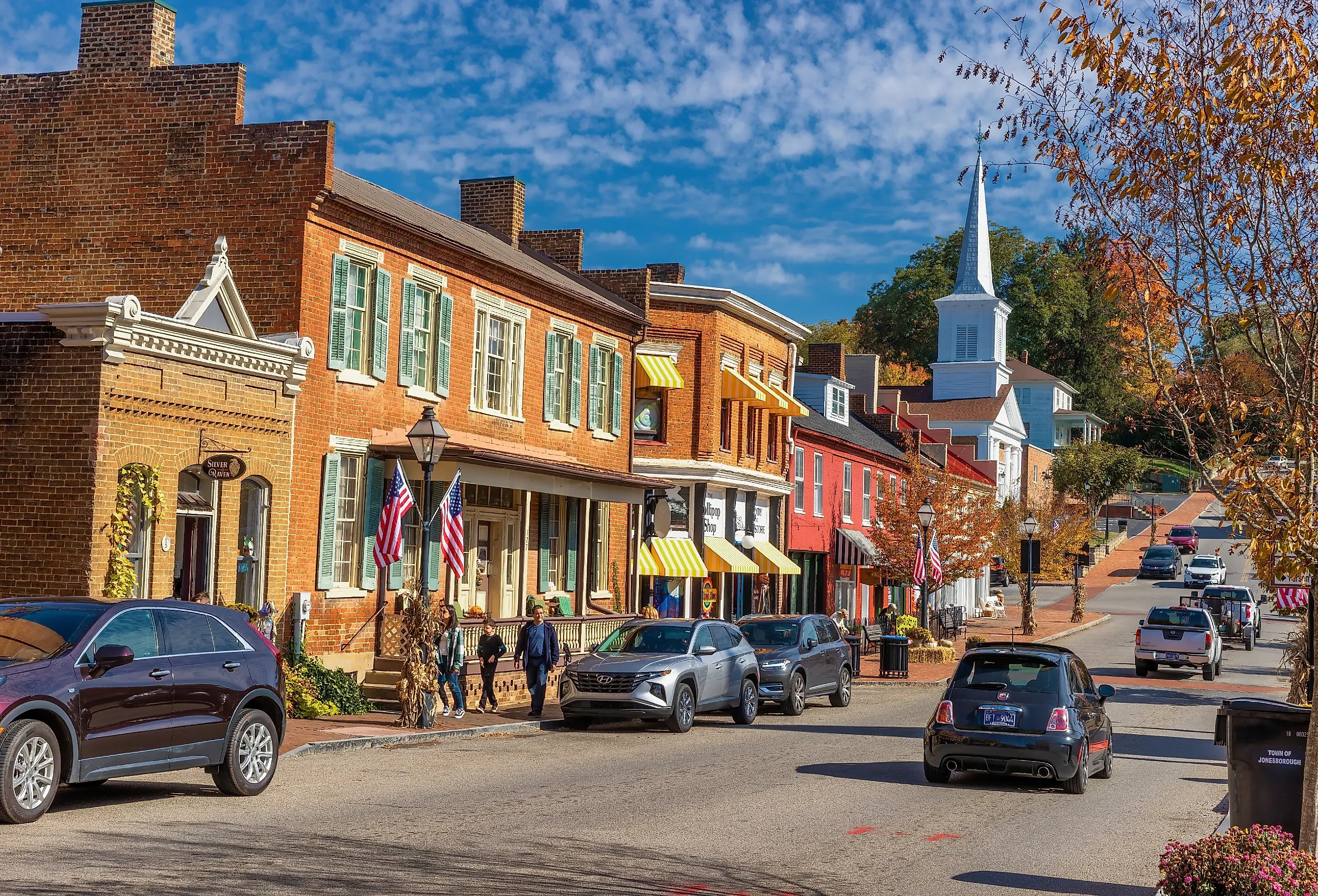
The oldest incorporated town in Tennessee, Jonesborough, was founded in 1779. Originally founded in the state of North Carolina, Jonesborough was incorporated twice: in 1815 as the seat of government for Washington County, NC, and again in 1903, as "Jonesboro," by the Tennessee General Assembly. Jonesborough, located in the northeastern region of the state, was founded before Tennessee even became a state, and was named after North Carolina legislator Willie Jones.

In addition to being Tennessee's oldest town, Jonesborough is also the Storytelling Capital of the World, as the first National Storytelling Festival was held there in 1973. Today, the public can visit the International Storytelling Center in Jonesborough's downtown area. The Historic Jonesborough Visitors Center and Old Town Emporium welcome visitors to the town. In addition to being a visitors' center, this establishment is also a bookstore and a shop selling local artisans' wares. Jonesborough is also notable for being the site of the first publication calling for the abolition of slavery, "The Emancipator." In addition, the history of the town is told at the Chester Inn Museum, the oldest commercial building in town, built in 1797.
Greeneville

The county seat of Greene County, Greeneville, was founded in 1783 and officially incorporated in 1903. Greeneville is named for Nathanael Greene, a local who served in the Revolutionary War, and is the only city in the US spelled this way. Sitting at the foothills of the Appalachian Mountains, Greeneville is also notable for being the place where the 17th US President, Andrew Johnson, began his political career.

Visitors to Greeneville today can visit the Andrew Johnson National Historic Site, a National Park preserving his two homes, a tailor shop, and Johnson's grave. "A Walk With the President Tour" of Greeneville's downtown historic district stops at 36 locations, such as The Big Spring, which served as Greeneville's water supply for more than 150 years. Civil War history can be learned on the Greeneville Civil War Trail, including the Dickson-Williams Mansion, built between 1815 and 1821, which served as the headquarters for both Union and Confederate officers. Don't miss Viking Mountain Overlook, also known as Camp Creek Bald, a 4,844-foot-tall peak in the Bald Mountains of the Appalachians that offers panoramic views of Tennessee and North Carolina.
Elizabethton

Founded in 1799 and incorporated in 1905, Elizabethton, the county seat of Carter County, is known as the birthplace of the first American government, the Watauga Association, in 1772 (in what was then North Carolina). Elizabethton, in northeastern Tennessee, was founded by Samuel Tipton and was originally called Tiptonville, but was renamed Elizabethton (after Elizabeth Carter, wife of landowner Landon Carter) when Tennessee became part of the United States. Today, the public can visit the town founder's grave, the gravestone of Samuel Tipton, at Green Hill Cemetery on West Mill Street.

The Sycamore Shoals State Historic Park preserves land that was the first free, independent community in North America. The Transylvania Purchase, the largest private real estate transaction in North America, occurred at the edge of the park in 1775. A historical marker today marks the site of the sale of 20 million acres between the Kentucky and Cumberland Rivers. The Carter Mansion, the home of settlers Landon and John Carter, was built between 1775 and 1780 and is just a few miles from Sycamore Shoals. Tours and events are held here throughout the year.
Maryville

The town of Maryville, the county seat of Blount County, was founded in 1795 and incorporated by an act of the General Assembly of the Territory South of the Ohio River. Revolutionary War veteran John Craig donated 50 acres of land for Maryville's town square. Maryville, in the Great Smoky Mountains, was named for Mary Blount, wife of Governor William Blount. Today, Maryville is a suburb just south of the city of Knoxville.

A historical marker marks the spot where John Craig's Fort was erected in 1785 when the town was established. In 1793, almost 300 men, women, and children lived in the fort for months and survived an attack by 500 Native Americans. Maryville was important to the abolitionist movement in the Civil War, and Maryville College was founded by abolitionist Isaac T. Anderson, opening as the Southern and Western Theological Seminary in 1819. The Freedmen's Institute was built in 1872 at the current site of Maryville High School, and a historical marker now marks its location. Another famous historical landmark in Maryville is the Blount County War Dead Memorial, in front of the Blount County Courthouse. This honors all from the county who have died in wars from 1812 to the present day.
Sevierville

Founded in 1795 and incorporated in 1901, the town of Sevierville is named for John Sevier, the first governor of the State of Franklin, which later became part of North Carolina and then Tennessee. Sevier was the first governor of Tennessee from 1796 to 1801, and from 1803 to 1809. Today, the town of Sevierville is the county seat of Sevier County, between Asheville, North Carolina, and Knoxville, in the Great Smoky Mountains' Forks of the Little Pigeon River valley.

The Sevier County Courthouse, built in 1896, is a historical landmark in the Beaux-Arts architectural style. It is famous for its clock tower and is constructed of locally-made bricks. The most famous landmark in Sevier is the Dolly Parton Statue, created in 1987 to honor the country singer, who is from Sevierville. The Historic Harrisburg Covered Bridge is another must-see landmark. This 88-foot-long tinplate bridge crosses the Little Pigeon River and has been standing since the late 1800s. Sevierville lies at the foothills of the Great Smoky Mountains National Park, the most visited park in the US. It features 850 miles of trails, including 70 miles of the Appalachian Trail. The park also contains three of eastern North America's highest peaks.
Old, But Not Outmoded
These five Tennessee towns are among the oldest incorporated towns in the state, but that does not mean they are outdated. Historic Tennessee towns like these offer visitors a window into the state's founding and history, and can enlighten newer generations about what life was like before Tennessee became a state. Check out these long-standing Tennessee towns to learn more not only about the beginnings of Tennessee, but also about the history of the United States, and of the continent of North America.