3 Snake Hotspots In Louisiana
Known for its sultry evenings, shrimp gumbo, and endless acres of snake-infested swamps, Louisiana is a hot spot for many things - some more inviting than others. But whether you have a phobia of or fascination with the serpents of the Deep South, it is helpful to know exactly where in the state they are most frequently found. So let us wade into America's largest surviving river swamp, explore a massive national forest, and plod into a lesser-known preserve to meet some of Louisiana's 47 species of snakes (seven of which are venomous).
Atchafalaya Basin

Spanning nearly one million acres of southern Louisiana, the Atchafalaya Basin is the largest river swamp in the country and, if the peripheral watershed is included, the largest floodplain swamp on the continent. Beginning near the town of Simmesport, the Atchafalaya River's dynamic ecosystem carves an approximately 15-mile-wide, 140-mile-long course on its way down to the Gulf of Mexico.
In addition to its primary waterway, the Atchafalaya Basin constitutes a labyrinth of bayous, backwater lakes, marshes, swamps, and the largest remaining contiguous tract of bottomland hardwoods in North America. The collage of plants and animals attracted to these habitats is protected by the Atchafalaya National Wildlife Refuge, Atchafalaya National Heritage Area, and other federal and state-level sites. As a result, dense concentrations of bald eagles can nest freely alongside over 200 other species of birds (the basin is, after all, part of the Mississippi Flyway); hundreds of unique aquatic animals can flourish; foxes, beavers, and even black bears can shelter beneath the forests, and of course, scores of reptiles can set up shop.

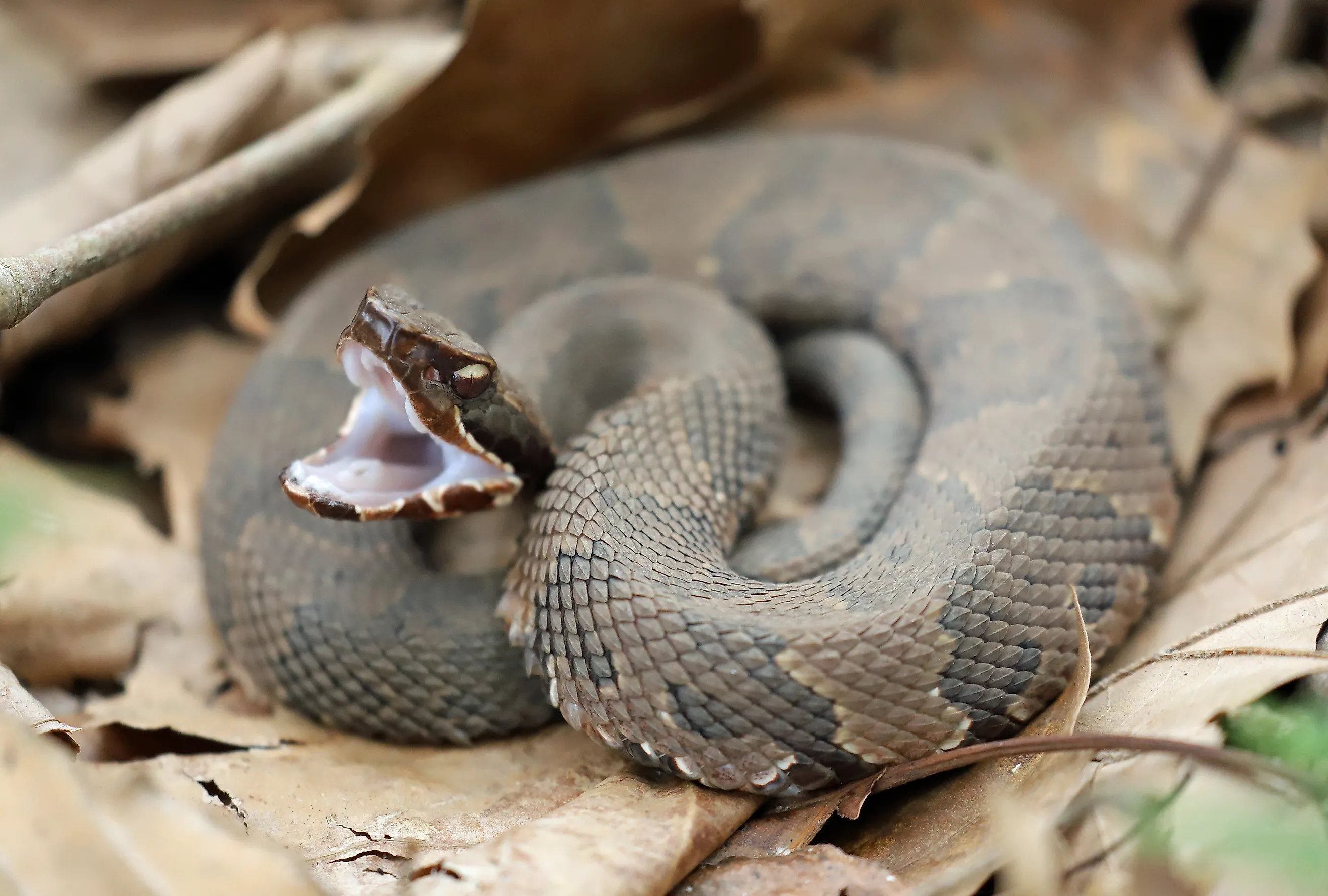
Louisiana's state reptile, the American alligator, is certainly the most arresting of Atchafalaya's cold-blooded creatures, but upon closer examination, the extent of the local snake population is also quite striking. Given its semi-aquatic, fish-and-frog-eating nature, the notorious northern cottonmouth (Agkistrodon piscivorus), also known as the water moccasin, is quite comfortable in this part of Cajun Country. Look for its brown, dark tan, or even black body and, most notably, the white mouth flesh that is shown upon provocation (so hopefully you don't actually see this signal) and after which this venomous snake takes its common name.
Other venomous residents of the Atchafalaya Basin include the beige and blotchy eastern copperhead (Agkistrodon contortrix), the hardwood-preferring timber rattlesnake (Crotalus horridus), and isolated populations of the pygmy rattlesnake (Sistrurus miliarius). Noteworthy non-venomous neighbors include the North American racer (Coluber constrictor), black ratsnake (Pantherophis obsoletus), ring-necked snake (Diadophis punctatus), and speckled kingsnake (Lampropeltis holbrooki).
Kisatchie National Forest

Kisatchie National Forest spans 604,000 acres across five ranger districts and seven parishes of central and northern Louisiana. Here, amongst the cypress, pines, and bayous, visitors will find some of the best fishing and hunting grounds the state has to offer (which is really saying something, given Louisiana's reputation as the "Sportsman's Paradise"), in addition to four off-highway vehicle (OHV) trails and regular hiking routes.

Along with a diverse cast of reptilian characters, Kisatchie National Forest is a vital sanctuary for one of the rarest snakes in the United States: the Louisiana pinesnake (Pituophis ruthveni). This reclusive, non-venomous constrictor reaches between 48 and 59 inches in length, and when it isn't occupying gopher burrows or hollowed out stumps, can be identified by its light base-tone (i.e., beige, pale-tan, or dull-yellow) and large dark blotches (30 to 37 of them, to be precise). The Louisiana pinesnake is also known for its exceptionally loud hiss, and for laying the largest eggs of any snake in the U.S.
Since 2010, the Memphis Zoo, Audubon Zoo, Ellen Trout Zoo, and Fort Worth Zoo have been breeding this imperiled species (listed as S2 locally and Threatened under the Endangered Species Act) and releasing them within Catahoula Ranger District. This section of the Kisatchie National Forest is particularly conducive to the hundreds of captive-bred Louisiana pinesnakes because of its longleaf pine forests, sandy soil, grassy, flower-filled forest floor, and abundance of pocked gophers - their main food source.

Though the Louisiana pinesnake is clearly the star serpent, Kisatchie is home to a plethora of other non-venomous species. The plain-bellied water snake (Nerodia erythrogaster) and southern watersnake (Nerodia fasciata), also known as the banded water snake, take to its bayous, while the coachwhip (Masticophis flagellum), red-bellied snake (Storeria occipitomaculata), western ratsnake (Pantherophis obsoletus), western ribbonsnake (Thamnophis proximus), prairie kingsnake (Lampropeltis calligaster), and flat-headed snake (Tantilla gracilis) all thrive in this land-locked territory.
Barataria Preserve

Our third and final Louisiana snake hot spot can be found in the 26,000-acre Barataria Preserve. This section of wetlands, swamps and hardwood forests sits just south of New Orleans - bounded by the Mississippi River to the east, Lake Salvador to the west, the broader Jean Lafitte National Historical Park & Preserve to the north, and a thick, southward marshy buffer leading to the Gulf of Mexico.
The Barataria Preserve is another haven for hunters, hikers, and anglers, but also anyone interested in viewing all sorts of swimming, slithering, and soaring wildlife. Once again a part of the Mississippi Flyway, Barataria is a birder's paradise. Just don't spend too much time with your eyes on the sky, as you wouldn't want to accidentally step on a nine-banded armadillo, wander within reach of an American alligator (large populations are known to occur here), or disturb some of the unique native snake species.

Speaking of which, the copperhead and western subspecies of the cottonmouth (Agkistrodon piscivorus leucostoma) join the Barataria Preserve party. And the list of novel, non-venomous characters includes: the black-masked racer (Coluber constrictor lantrunculus), Texas rat snake (Elaphe obsoleta linsheimeri), mud snake (Farancia abacura reinwardtii), speckled kingsnake (Lampropeltis getulus holbrooki), ribbon snake (Thamnophis proximus orarius), western green water snake (Nerodia cyclopion), and Louisiana milksnake (Lampropeltis triangulum).
Slithering Snakes in Louisiana
Perhaps reading about these three Louisiana snake hot spots makes you want to steer clear. But it should be noted that each ecosystem has a wealth of other wildlife, stimulating natural features, and endless opportunities for outdoor recreation. Besides, though snakes are present in significant numbers, they are not always active, and they are certainly not actively looking for trouble. In Louisiana, spring and summer are when encounters most commonly occur - more specifically, during the bookends of the day (even cold-blooded reptiles can't handle the peak heat). So if you adjust your activities accordingly, watch where you step, and respect any rattling, hissing, or squirming beings you do come across, then your adventure should be hassle-free.