12 Storybook Towns In Michigan
Michigan is full of storybook towns, thanks to its Great Lakes harbors and many old downtowns shaped by shipping and resort history. Petoskey and Harbor Springs share Little Traverse Bay and have beautiful downtown shopping districts and classic northern Michigan resort scenery. In Frankenmuth, the Bavarian Inn Restaurant and the Holz Brücke Covered Bridge give Main Street its distinctly European look. And Mackinac Island, with its horse drawn carriages along Main Street, remains one of the state’s most distinctive island destinations. If that sounds like your kind of getaway, these Michigan towns belong on your list.
Frankenmuth

Main Street in Frankenmuth is lined with half-timbered buildings, flower boxes, and familiar stops like Zehnder’s of Frankenmuth and the sprawling Bavarian Inn Restaurant, both known for traditional chicken dinners. Near the river, the Holz Brücke Covered Bridge links downtown with River Place Shops, where colorful storefronts and bakeries add even more visual charm. Bronner’s Christmas Wonderland remains one of the town’s most memorable attractions, packed with giant ornaments and holiday displays in every season. When the busiest parts of downtown start to feel crowded, the Cass Riverwalk offers a quieter change of pace, following the water past gardens and green spaces.
Mackinac Island

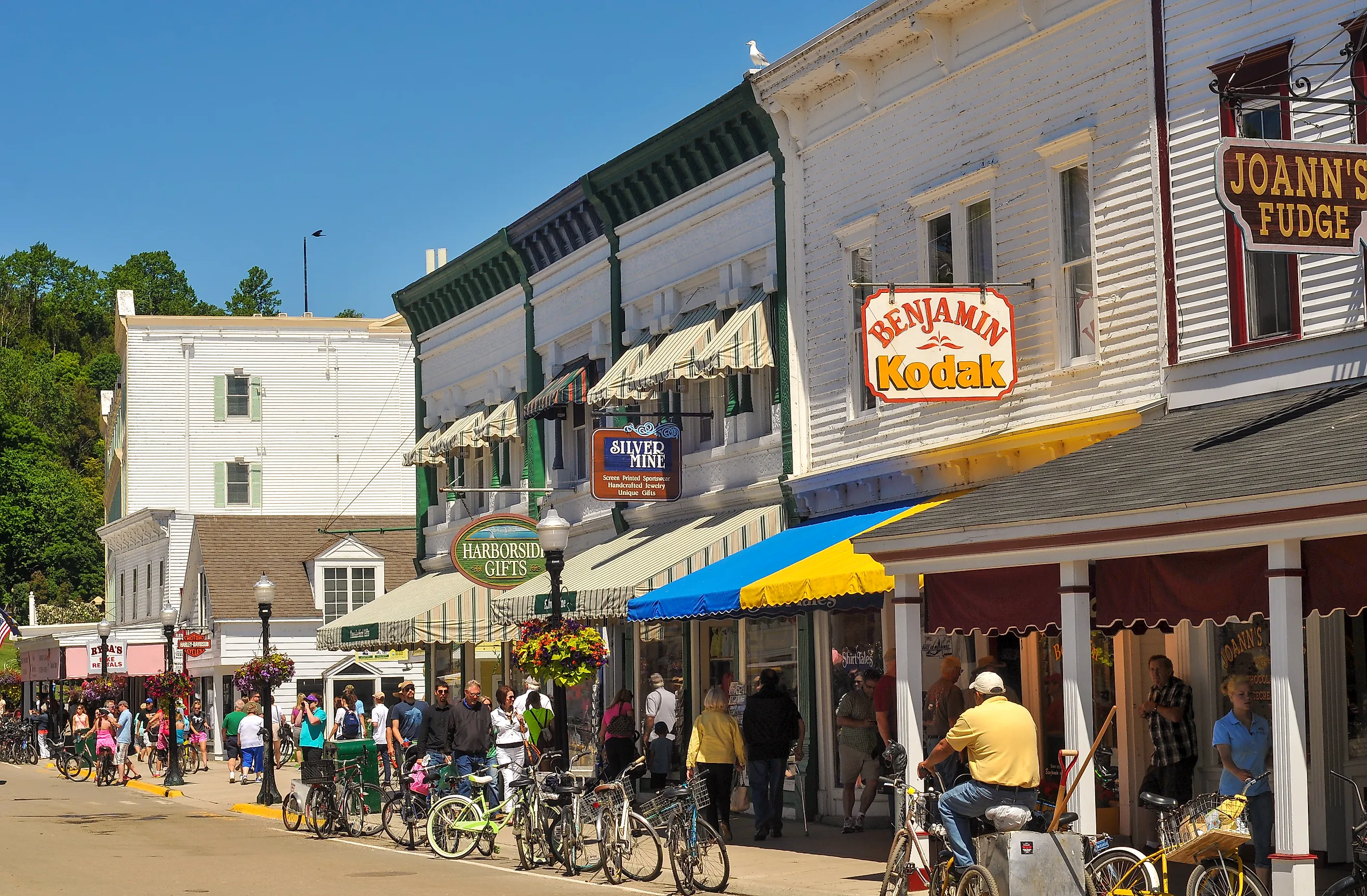
The harbor sets the tone on Mackinac Island, where horse-drawn carriages pass fudge shops, inns, and old storefronts along Main Street. Rising above it all is the Grand Hotel, whose long porch looks out over the Straits of Mackinac and remains one of the island’s signature sights. Inland, Fort Mackinac preserves barracks, cannon positions, and blufftop views that connect the island to its military past. Another classic outing follows M-185, the car-free road encircling the shoreline, to Arch Rock. The limestone formation towers above the coast and frames broad views over Lake Huron, giving visitors one of the island’s most dramatic natural landmarks after the bustle of the waterfront.
Saugatuck

Along the Kalamazoo River, Saugatuck pairs its waterfront setting with a compact downtown full of galleries and shops. One of the most distinctive local experiences is the hand-cranked Saugatuck Chain Ferry, which carries passengers across the river to the stairway up Mount Baldhead. At the top, the lookout opens onto sweeping views of Lake Michigan and the dunes. Back on Butler Street, historic storefronts hold cafés, boutiques, and art spaces that keep the center lively. Farther west, Oval Beach draws visitors for its wide sandy shoreline and sunset views, while Saugatuck Dunes State Park adds forested trails and towering dunes for those wanting a longer walk away from town.
Petoskey

High above Little Traverse Bay, Petoskey’s Gaslight District brings together Victorian architecture, independent shops, and water views in one of northern Michigan’s prettiest commercial areas. Pennsylvania Park sits at the center with benches and open green space, giving the district a natural gathering point. From there, it is an easy walk downhill to Petoskey Bayfront Park, where paths, a marina, and shoreline access put the bay close at hand. Many visitors also scan the beach for Petoskey stones, the fossilized coral that has become a local signature. A short drive away, Bay View Association offers a different setting altogether, with gingerbread cottages and historic Hall Auditorium anchoring its summer community.
Charlevoix

Few places in Michigan combine water and architecture quite like Charlevoix. Near downtown, Earl Young’s famous Mushroom Houses stand out for their curved roofs, stone walls, and whimsical design, making them some of the town’s most unusual landmarks. Closer to the channel, Round Lake Harbor fills with sailboats beside the marina and the red Charlevoix South Pier Lighthouse. East Park adds an open stretch of green for festivals and concerts right by the water. Just beyond that, Michigan Beach Park offers a sandy shoreline within walking distance of downtown, so it is easy to pair a stroll through the harbor district with broad views across Lake Michigan.
Leland

Fishtown gives Leland its most distinctive look, with weathered fishing shanties, narrow docks, and working waterfront buildings stretching along the Leland River. Some of those old structures now hold smokehouses and shops, including Carlson’s Fishery, where smoked whitefish remains a longtime favorite. Boats move through the channel toward Lake Michigan and Lake Leelanau, keeping the connection to the water visible throughout the district. Up the hill, Main Street shifts the mood slightly with galleries, cafés, and historic storefronts. Those wanting an even wider view often continue to Leelanau State Park, where Grand Traverse Lighthouse stands at the tip of the Leelanau Peninsula with views of Lake Michigan and Grand Traverse Bay.
Munising

Boats leaving Munising Bay head straight toward one of the Upper Peninsula’s most striking landscapes: the cliffs and rock formations of Pictured Rocks National Lakeshore. Cruises from town pass multicolored sandstone walls, sea caves, and landmarks like Miners Castle, giving visitors a close look at scenery that has made the region famous. On land, Wagner Falls Scenic Site offers one of the easiest nearby waterfall stops, with a short boardwalk trail leading to a mossy cascade just south of Munising. Back near the marina, docks and shoreline paths keep Lake Superior in view, with room to watch kayakers, fishing boats, and tour vessels coming and going.
South Haven

The bright red South Haven Lighthouse remains the defining sight at the mouth of the Black River, where boats pass between the piers and out onto Lake Michigan. From there, Phoenix Street leads back into downtown through a stretch of historic storefronts filled with cafés, ice-cream shops, and other longtime stops. Along the river, the Michigan Maritime Museum highlights Great Lakes shipping history and sometimes sends tall ships out from its docks. South Beach lies only a short walk away, adding a broad sandy shoreline with lighthouse views. Many visitors finish the day by walking the pier itself, where the open lake, passing sailboats, and evening light make the waterfront especially memorable.
Harbor Springs

Sailboats clustered in the marina give Harbor Springs an elegant waterfront look, especially where Main Street meets the edge of Little Traverse Bay. Zorn Park Beach sits close to downtown, making it easy to step from the commercial district to a sandy stretch with wide bay views. A few blocks inland, the Harbor Springs Lyric Theatre keeps its vintage presence with a marquee that has drawn moviegoers since 1936. The Harbor Springs History Museum, located in the former city hall, adds another stop with exhibits focused on local resort and maritime past. Outside town, the Tunnel of Trees along M-119 offers a memorable drive through dense forest and along high overlooks above Lake Michigan.
Grand Marais

At Grand Marais, the harbor is the first thing many people notice: a curved breakwater, small boats, and the bright red Grand Marais Harbor of Refuge Inner Lighthouse standing out against Lake Superior. The setting feels compact and remote in the best way, with open water stretching well beyond the protected bay. Nearby, the Pickle Barrel House Museum adds an offbeat landmark tied to illustrator William Donahey. For bigger scenery, the Log Slide Overlook in Pictured Rocks National Lakeshore reveals towering dunes and a long sweep of shoreline far below. Sable Falls offers yet another contrast, with water descending over sandstone ledges in a wooded setting not far from the lake.
Marshall

Marshall’s historic core centers on Michigan Avenue, where rows of preserved 19th-century buildings guide visitors toward the courthouse square. The Honolulu House Museum is one of the town’s standout landmarks, instantly recognizable for its unusual Gothic Revival design and details inspired by Hawaiian architecture. Not far away, Brooks Memorial Fountain adds ornate cast-iron decoration and sculpted figures to the center of town. Marshall also has one of its most unexpected attractions in the American Museum of Magic, whose collections include Houdini posters, props, and memorabilia from stage performers. Another worthwhile stop is the Governor’s Mansion Museum, a restored 19th-century home that adds one more layer to the town’s architectural appeal.
Calumet

Fifth Street in Calumet still reflects the town’s copper-boom years, with tall sandstone and brick buildings forming one of the Upper Peninsula’s most distinctive historic districts. The Calumet Theatre, opened in 1900, remains a centerpiece thanks to its ornate interior and active performance schedule. A short walk away, the Keweenaw National Historical Park Visitor Center explains how mining and immigration shaped the area. Coppertown Mining Museum builds on that story with large drills, machinery, and tools from the surrounding mines. To see the industrial landscape on a larger scale, many visitors continue south to Hancock, where the Quincy Mine Hoist Association offers tours of one of the region’s most important copper operations.