11 Storybook Towns In North Carolina
North Carolina is full of small storybook towns set along its beautiful barrier-island harbors and Blue Ridge slopes, with colonial-era and antebellum history still visible on the streets. In Blowing Rock, Main Street and the cliffside overlook at the Blowing Rock create a cute mountain setting. In Edenton, the 1767 courthouse and the Cupola House shape one of the state’s most complete colonial centers. Below are 11 of the state’s most unforgettable towns for anyone drawn to idyllic settings.
Beaufort

Beaufort has one of the strongest waterfront settings in coastal North Carolina. Taylor’s Creek stays at the center of the town’s identity, and the old houses, shaded streets, and harbor-facing blocks behind it still carry the feel of a long-established port. The town does not depend on one pretty view. Its appeal comes from how the street plan, the water, and the surviving historic core still work together.
The Beaufort Historic Site gives that history real weight. Its restored buildings include the 1796 Carteret County Courthouse, the 1829 Old Jail, the 1859 Apothecary Shop and Doctor’s Office, and several early houses that help explain the town’s long life on this stretch of coast. Front Street keeps the harbor in view and remains one of the clearest public edges in town. The Old Burying Ground adds another memorable stop, with graves dating to the 1700s. Across Taylor’s Creek, the Rachel Carson Reserve keeps a chain of marsh islands open and undeveloped, while nearby Shackleford Banks is home to wild horses and a broader sense of the barrier-island landscape.
Bath

Bath has an unusual quiet for a place with such deep historical importance. As North Carolina’s first town and first port, it carries more colonial history than many larger places, yet the surviving center still feels small enough for that early period to remain legible. Bath does not impress through scale. It works through age, restraint, and the fact that parts of the town still look shaped by the 18th century.
Bath Historic District gives the town its strongest architectural anchor. The Palmer-Marsh House, built around 1740, stands out for its form, chimney, and exceptional level of preservation. The 1790s Van Der Veer House adds another early landmark, with its gambrel roof and Flemish-bond chimneys reinforcing the place's colonial character. St. Thomas Episcopal Church, completed in 1734, gives Bath one of the state's oldest church buildings, and its churchyard enhances the atmosphere around the center. On a different note, Bonner’s Point opens the town toward Bath Creek, giving it a broad river edge that keeps the historic district from feeling closed in.
Blowing Rock

Blowing Rock earns its place through a village center that still fits its mountain setting. Main Street remains compact and walkable, with inns, storefronts, and public spaces that feel scaled to the ridgelines around them rather than oversized for a resort town. The mountains do not sit in the background. They stay close enough to shape the whole impression.
The Blowing Rock itself gives the town its best-known landmark, a cliffside overlook above Johns River Gorge tied to the local legend of wind rising beneath the rock. The formation rises over 1,500 feet above the gorge, creating a view straight out of a storybook. Bass Lake offers a quieter landscape just outside the center, with an easy walking path and long views toward the slopes. On a historic note, Moses H. Cone Memorial Park broadens the setting with Flat Top Manor, carriage roads, orchards, and one of the region’s most substantial historic estates. The roads span 25 miles, creating an experience reminiscent of the past.
Brevard

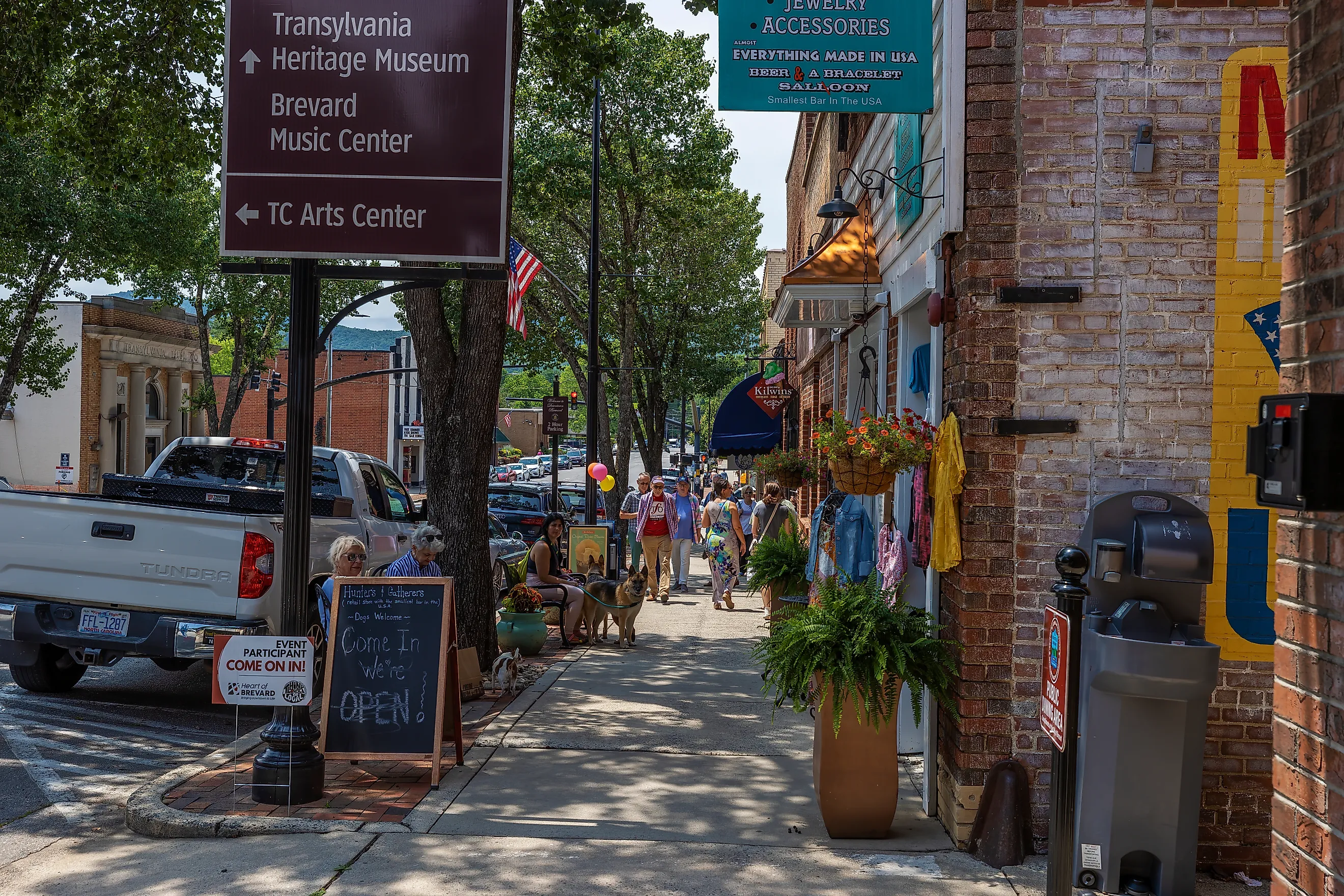
Brevard appears appealing at first glance because of its waterfalls and mountain setting, but its strength comes from how those features connect to a real town center. Downtown Brevard still has older commercial blocks, local shops, and galleries that give the place a visible core. Spots like The Square Root create a unique eating experience, with a restored building and exposed brick complementing the Art Deco bar’s ambiance.
The landscape around Brevard does much of the rest. Looking Glass Falls remains one of the area’s easiest and most rewarding waterfall stops, while Looking Glass Rock serves as the region's broad granite landmark, visible from both trails and overlooks. The Brevard Music Center adds another dimension by bringing a long-running summer institute and performance season into the woods outside town. That combination gives Brevard more shape than a simple mountain gateway.
Bryson City

Bryson City has one of the most dramatic settings of any town in western North Carolina, but it never loses its small-town feel, with a clear middle. Great Smoky Mountains National Park, which spans over 520,000 acres and is the most visited national park in the United States, along with the Nantahala area, place mountains and water at the edge of everything here, yet the downtown remains compact enough to keep Bryson City from dissolving into scenery alone.
The Great Smoky Mountains Railroad is central to that effect. Its excursions leave directly from town and tie the depot, the river, and the surrounding gorge country into one experience, with most round-trip rides lasting around 4 to 4.5 hours through the Nantahala Gorge or along the Tuckasegee River. Just outside town, Deep Creek draws visitors with tubing and a short network of trails leading to Tom Branch Falls, Indian Creek Falls, and Juney Whank Falls.
Edenton

Edenton has one of the most complete historic centers in North Carolina. Albemarle Sound gives the town light, space, and a graceful waterfront edge, but the real strength lies in how many important buildings still stand close together near the bay. The 1767 Chowan County Courthouse remains the town’s best-known landmark and gives Edenton an unusually strong civic centerpiece. The 1758 Cupola House adds one of the clearest colonial survivals in the state, with its form and setting reinforcing the town’s long history. The restored 1886 Roanoke River Lighthouse on the waterfront brings a maritime note that fits naturally with the soundside location. The lighthouse is the only surviving example of a screw-pile foundation in the state, making it ideal for history enthusiasts.
Highlands

Highlands has a mountain setting that feels immediate from the moment the town comes into view. Sitting at an elevation of around 4,000 feet, the cooler air and surrounding ridges give it a distinct Appalachian character, but the center stays compact enough to hold its own. It still reads as a small mountain town, not a resort district that has spread too far.
The Highlands Heritage Walking Trail helps make the older core easier to understand on foot, linking more than 40 historic sites throughout downtown. Dry Falls gives the area one of its strongest natural landmarks, with a path that passes behind the roughly 75-foot cascade, allowing visitors to walk directly behind the water. Bridal Veil Falls adds another memorable stop along US 64, where vehicles can pass beneath the falls themselves, while Sunset Rock provides an overlook just a few miles from downtown, keeping the mountain setting closely tied to the town.
Hillsborough

Hillsborough has one of the state's strongest inland historic districts, and it avoids looking staged because the center still functions as a living town. The streets hold a high concentration of 18th- and 19th-century buildings, giving the place real weight, while shops, civic uses, and daily activity keep it from feeling fixed in the past. The Eno River showcases another layer by giving the town a green edge that breaks up the architecture and introduces quieter natural space close to downtown.
The 1840s Orange County Courthouse anchors the center and helps organize the historic district around a visible civic landmark. Ayr Mount adds one of the best-known Federal-era houses in the region, set on a 265-acre property with walking paths that extend beyond the house itself. Riverwalk shifts the mood by following the Eno for nearly two miles, with wooded walkways and open clearings that keep Hillsborough from feeling entirely urban. The Burwell School Historic Site is one more direct link to the town’s early life as a 19th-century school for young women.
Manteo

Manteo works so well because its waterfront, town center, and island setting all stay close together. Roanoke Island gives the town a natural frame of marsh, sound, and causeway crossings, but Manteo itself remains compact and clear in form. The harborfront boardwalk, low-rise buildings, and tight center make it one of the easiest towns on this list to picture as a complete place.
The waterfront is the logical place to begin, especially around the harbor and boardwalk, where the town’s maritime setting is most obvious. Roanoke Island Festival Park expands on that setting with exhibits, reconstructed dwellings, and the Elizabeth II, a replica of a 16th-century sailing ship, bringing one layer of local history directly into the harbor area. Island Farm offers a different historical texture through its farmstead interpretation of 19th-century life on the island, set across a working rural landscape with historic buildings and open fields. Nearby, the Elizabethan Gardens showcase a more formal contrast, with 10 acres of landscaped grounds, planted paths, and seasonal blooms. Those interested can join in on an audio tour of the storybook-esque environment.
Mount Airy

Mount Airy offers a different kind of storybook setting, from the coast to the mountains, but it still earns its place through a strong center and a recognizable landscape. The town’s appeal comes from its main street, older façades, and early 20th-century commercial blocks, which still make the downtown feel coherent. It looks like a small Piedmont town that kept its shape.
The Andy Griffith Museum serves as Mount Airy's best-known cultural anchor. It ties the town to one of the most recognizable names associated with small-town American television, with exhibits covering his life, career, and connection to the town. The Historic Earle Theatre dates back to the 1930s. It is another landmark, with both architectural significance and musical importance, as the Old-Time Music Heritage Hall, which highlights regional string music traditions. Those looking for natural scenery will adore Pilot Mountain State Park, home to the quartzite mass, Big Pinnacle, which rises over 2,200 feet and is one of the most recognizable natural landmarks in the region.
Southport

Southport's waterfront still feels central to the town rather than decorative. The Cape Fear River gives the place a broad edge and a sense of openness, stretching over a mile wide at this point. The nine-acre Waterfront Park and Riverwalk keep the harbor and river in view and make the town’s maritime setting easy to experience on foot, with benches, shaded areas, and clear sightlines across the water. Historic landmarks such as the 1904 Old Brunswick County Jail and Fort Johnston-Southport Museum strengthen the center by tying the riverfront to older civic and military history. The Southport-Fort Fisher Ferry is a great way to take in the sights, running a 30-minute route across the Cape Fear River, reinforcing the town’s working connection to the wider estuary rather than leaving the waterfront as a static scene.
Where North Carolina Feels Like A Story
These towns do not share a single style, but they do share a similar clarity. In each one, the setting and the center still convey the same impression, whether that means harborfront streets in Beaufort, a colonial core in Bath, a mountain-village scale in Blowing Rock, or a boardwalk harbor in Manteo. The strongest picks here are easy to picture because their landmarks are not scattered, and their landscapes still feel connected to the towns themselves. That is what gives them a distinct appeal. They look shaped rather than accidental. Old houses, courthouses, churches, waterfronts, mountain streets, and public landmarks still hold together in ways that make each place feel distinct and complete.