11 Picture-Perfect Main Streets In South Dakota
The old main streets in South Dakota are still standing. Miners who struck gold put up the brick storefronts that still line downtown Deadwood. Builders in Hot Springs worked in local pink sandstone block after block. The people of Mitchell went further and covered a downtown palace in corn. The history is right there on the street where people still shop and gather. Across the eleven towns below, that past looks a little different in each South Dakota downtown.
Deadwood

Deadwood's whole Main Street is a National Historic Landmark, and the brick facades make the designation obvious the moment you look up. The Adams Museum sits right on the street and lays out how gold money built the place, from the first strikes to the saloons. A few doors down, the Silverado Franklin still has its early-1900s hotel front. Walk fifteen minutes uphill to Mount Moriah Cemetery and you reach the graves of Wild Bill Hickok and Calamity Jane, who both spent their last days in this gulch. Come back down to Outlaw Square when you want room to breathe and a spot to sit.
Custer

Custer is the oldest town in the Black Hills, founded in 1875 after prospectors hit gold in French Creek, and its main drag still runs wide enough to turn a wagon team. That street is Mt. Rushmore Road, lined with low storefronts you can browse in an afternoon. The 1881 Courthouse Museum stands just off it and holds the early records of the whole county. French Creek itself threads through town, and following it south leads you toward Custer State Park, where bison graze on open range. The painted bison statues along the sidewalks are a hint of what waits out there.
Spearfish

In Spearfish, the creek runs a few steps off Main Street, and that is the town's best feature hiding in plain sight. Walking paths trace the water, so you can drift between downtown shops and a shaded bank without ever getting in the car. The Matthews Opera House has stood on the street since the 1900s, and it still books live theater and music through the year. Follow the creek a little farther and you reach the D.C. Booth Historic National Fish Hatchery, where you can watch trout crowd the viewing pond. Its lawns and footbridges extend well past the last storefront, so the walk keeps going.
Brookings

Brookings is a university town, and Main Avenue stays busy with the steady foot traffic that comes with it. The Children's Museum of South Dakota sits a few blocks off the avenue and turns a rainy afternoon into an easy family stop. Walk a little farther and you reach McCrory Gardens, a South Dakota State University site where the flower beds change with the season. Pioneer Park sits close to the same corridor, with shade and open grass for a break. The whole loop is short enough to link into one unhurried visit on foot.
Keystone

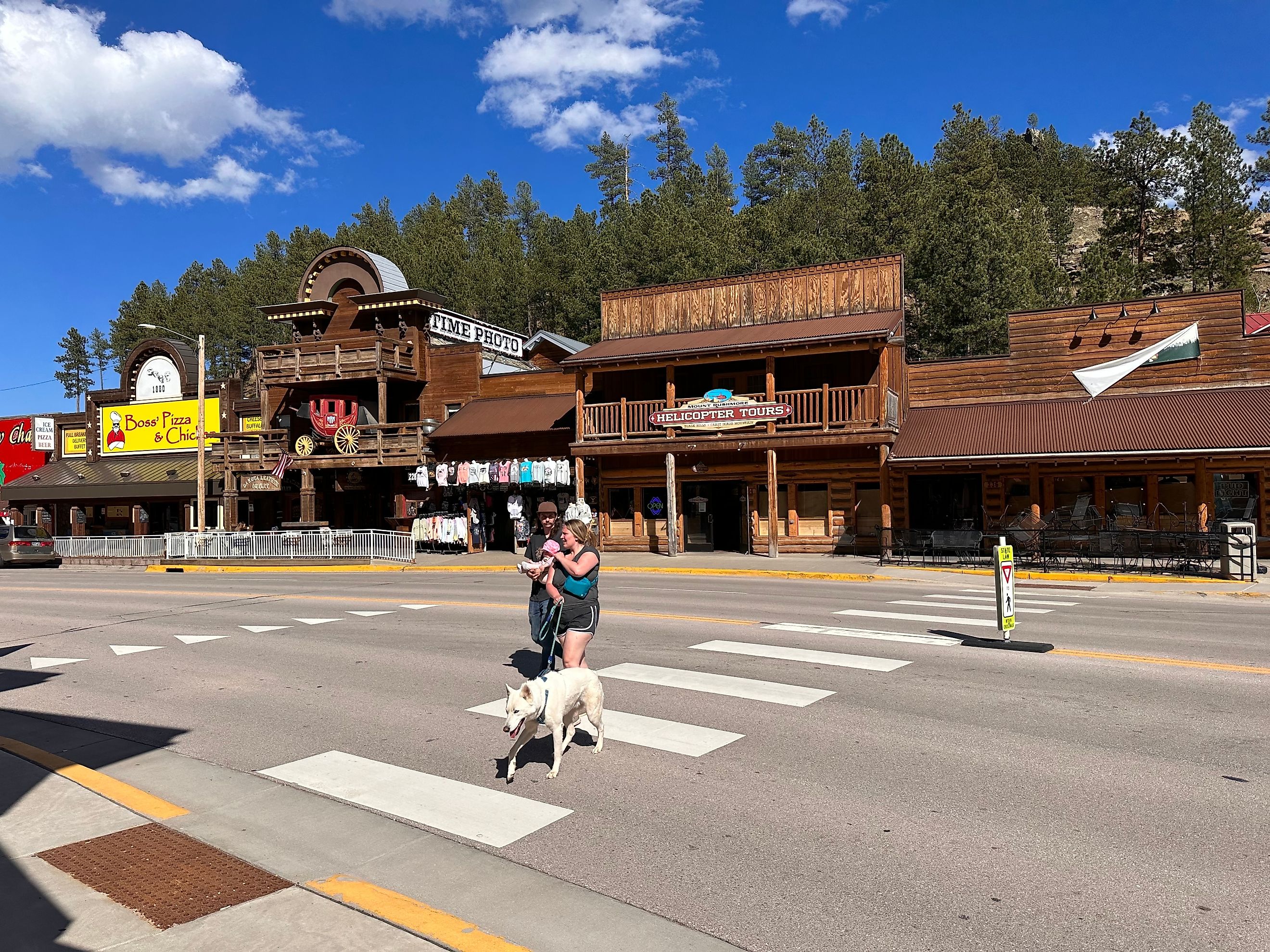
Prospectors founded Keystone in 1883 after they hit gold in the surrounding hills, and the mining-era storefronts still stand along the main street. Wooden boardwalks run beside those buildings, so a stroll through downtown has the feel of the frontier era that built it. When crews began carving Mount Rushmore in the 1920s, most of the workers lived right here, and locals still call the place the Home of the Carvers. The Rushmore-Borglum Story museum on Winter Street lays out how the monument came together, sculptor and all. Mount Rushmore itself stands just a couple of miles up the road, so the main street is the last stop before you reach the presidents.
Mitchell

Mitchell has the only building in the world that gets a new coat of corn every year. The Corn Palace stands at the center of Main Street, and its outer murals are built from thousands of ears in a fresh design each season. The Carnegie Resource Center stands close by, a reminder of the era when a prairie town proved itself with a library. Hitchcock Park is a short stroll away, with shade and open lawn for a pause. The Dakota Discovery Museum stands a few minutes from the main street, with regional history that fills out the visit.
Vermillion

Vermillion is home to the University of South Dakota, and the student crowd keeps Main Street lively through the school year. The real surprise sits a short walk away at the National Music Museum, which holds thousands of instruments gathered from around the world. The Clay County Courthouse stands at the center of downtown, historic front and steps included. Prentis Park lies nearby, a patch of open grass for slowing down between stops. The Missouri River lies just past the edge of town, close enough to reach once you have seen the streets.
Pierre

Pierre is one of the smallest state capitals in the country, so the government buildings and the everyday downtown sit within the same few blocks. Capitol Avenue runs as the ceremonial spine, ending at the State Capitol that workers finished in 1910 under its copper dome. In front of the building stands the Fighting Stallions Memorial, a tribute to eight South Dakotans lost in a 1993 plane crash. The South Dakota Cultural Heritage Center fills in the state's fuller history a short walk on. From there a riverwalk runs down to the Missouri, a few minutes on foot.
Hill City

Locals know Hill City as the Heart of the Hills, and its galleries and small shops sit within a couple of walkable blocks on Main Street. The Black Hills Institute Museum sits along that street, with fossils dug out of the surrounding rock, including some famous dinosaur finds. From the depot in town, the 1880 Train pulls out on a twenty-mile round trip to Keystone, one of the oldest steam railroads still running in the country. The Mickelson Trail also touches the edge of downtown. You can step off the sidewalk and onto more than a hundred miles of rail-trail without a car.
Hot Springs

Hot Springs built its downtown out of local pink sandstone, so the whole main street glows the same warm color. Evans Plunge sits within easy reach of the core, fed by the mineral springs that gave the town its name and its first tourists. A short distance away, the Mammoth Site sits over a working dig where crews still uncover the bones of Columbian mammoths that fell into an ancient sinkhole. The Fall River runs through the middle of it all, with paths that follow the water past the sandstone storefronts. Between the science and the stonework, the district has a character all its own.
Chamberlain

Chamberlain sits high on the east bank of the Missouri, and Main Street sits above water that widens into Lake Francis Case. From that height you get some of the broadest river views in the state. On a bluff nearby stands Dignity of Earth and Sky, a fifty-foot stainless steel sculpture of a Lakota and Dakota woman receiving a star quilt. The Akta Lakota Museum just off the main street covers more of that story through Indigenous history and art. More viewpoints sit near the Chamberlain-Oacoma Bridge, within an easy walk.
The Street Is Only the Beginning
What ties these eleven towns together is the handoff. You come for a compact main street, and in each town you can walk from the last storefront to something larger. In Spearfish and Hot Springs that next step is a creek or a river you can follow on foot. In Hill City it is a steam train and a rail-trail that leave straight from downtown. In Chamberlain and Yankton it is the wide-open Missouri at the end of the block. Park once, walk the street, and see the rest of South Dakota from there.