10 Small Towns in Michigan With Big Charm
Michigan keeps its best small towns close to the water. Up in the Keweenaw, Calumet still carries the wealth of the copper boom in an opera house that opened in 1900. Three hundred miles south, Charlevoix sits between two lakes, its downtown dotted with stone houses that look grown rather than built. A few of these towns run on Lake Michigan beaches, others on working fish docks or copper history, and a couple trade the shoreline for a college green or an inland lake. Each one fits a lot into a few walkable blocks, and every one is worth the drive.
Bay City

Bay City grew up on the Saginaw River, a few miles before it widens into Saginaw Bay and Lake Huron. The east-side downtown was spared the wrecking ball during the urban-renewal years, so block after block of 19th-century brick still stands, much of it now given over to antique shops. The town carries a reputation as one of the state's largest antique-hunting grounds, with the Bay City Antiques Center at the middle of it. When you need a break from the hunt, Populace Coffee roasts its own beans a short walk away.
Wenonah Park runs along the river downtown, with a bandshell for summer concerts and the tall ship Appledore IV setting out for sails into the bay. St. Laurent Brothers, billed as Michigan's oldest candy store, still grinds its own peanut butter a few doors from Herman Hiss and Co., a jeweler the same family has run since 1867. Dinner might be at Old City Hall, set inside the actual 19th-century city hall.
Calumet

Calumet ran the Keweenaw copper boom. At its peak the Calumet and Hecla company pulled fortunes out of the rock here, a few miles inland from Lake Superior, and the money built a downtown far grander than a village of a few hundred people would put up today. The Calumet Theatre, which opened in 1900, was one of the first municipal theaters in the country, and it still stages around 60 shows a year under its restored ceiling.
The town also holds a harder memory. The Italian Hall, built in 1908, was the site of the 1913 disaster, when a false cry of fire during a strikers' Christmas party set off a stampede that killed about 70 people, most of them children. The hall came down in 1984, and its surviving doorway now frames a small memorial park. For lighter days, the Swedetown Trails open up for skiing and mountain biking just past downtown, the George Gipp arena sits in neighboring Laurium, and the Keweenaw National Historical Park ties the whole copper story together.
Charlevoix

Charlevoix sits on a narrow neck of land between Lake Michigan and Lake Charlevoix, with Round Lake and its drawbridge in the middle of downtown. Round Lake has been called the best natural harbor on Lake Michigan, and on a summer afternoon the bridge stops traffic every half hour to let the boats through. Out where the channel opens onto the big lake, the Charlevoix South Pier Light marks the gap, and Michigan Beach Park spreads along the sand beside it. The town takes its name from Pierre Francois Xavier de Charlevoix, a French Jesuit who traveled the Great Lakes in the early 1720s and, the story goes, waited out a storm overnight on nearby Fisherman's Island.
What people drive in for are the mushroom houses. Earl Young, a self-taught builder who never bothered with blueprints, spent the decades after 1918 making around 30 stone houses and shops out of boulders he hauled from the lakeshore, each one capped with a wavy cedar-shake roof. The doorways sit low because Young stood barely five feet tall. Most of the houses cluster within walking distance of downtown, and two of his buildings still earn their keep: you can eat at the Weathervane Restaurant or stay the night at Hotel Earl.
Hillsdale

Hillsdale sits in the far southern corner of the state, where the farmland rolls up into low hills near the Indiana and Ohio lines. The town grew up around Hillsdale College, founded in 1844, and the college's classical brick campus still sets the tone for the streets below it. Downtown keeps its 19th-century brick storefronts around the county courthouse, Victorian houses line the side streets, and the college's lectures and concerts are open to anyone who wants to walk in.
For green space, the Slayton Arboretum at the north end of campus winds past stone gazebos, a couple of ponds, and a small waterfall on its nature trails. A few minutes out of town, Baw Beese Lake covers 414 acres and takes its name from a Potawatomi chief; the roughly five-mile Baw Beese Trail runs along it to the swimming beach at Sandy Beach Park. It is a quiet kind of town, and summer is the season that suits it best.
Leland

Leland has fewer than 500 year-round residents and one of the last working fishing villages on the Great Lakes. Fishtown lines the short Leland River where it empties into Lake Michigan: a row of weathered shanties, smokehouses, and docks where the fish tugs Joy and Janice Sue still tie up. Carlson's Fishery has sold smoked whitefish from the same spot since 1904, and the ferry to the North and South Manitou Islands leaves from these docks all summer.
Many of the old shanties now hold shops. The Village Cheese Shanty sells its sandwiches and dozens of cheeses right on the boardwalk, and Verterra Winery pours award-winning whites a few steps away. Leland Gal stocks the kind of clothes and home goods you do not find in a chain. When the light goes gold, walk over to Van's Beach for the sunset and hunt the blue slag stones that wash up here, left over from the town's old iron smelter.
Ludington

Ludington spreads along the mouth of the Pere Marquette River where it reaches Lake Michigan. Its best-known resident is the S.S. Badger, a 1953 car ferry that still crosses to Manitowoc, Wisconsin in about four hours and remains the last coal-fired passenger steamship running in the United States; it earned National Historic Landmark status in 2016. Stearns Park puts a wide beach, a playground, and a skate park right at the edge of downtown, and the cast-iron North Breakwater Light has marked the harbor entrance since 1924.
Two museums tell the rest of the story, both run by the Mason County Historical Society: the Port of Ludington Maritime Museum, set in the old 1934 Coast Guard station, and Historic White Pine Village, a cluster of preserved buildings. Just north of town, Ludington State Park runs trails out to the Big Sable Point Lighthouse. It is the rare lake town that hands you a working steamship and a state park in the same afternoon.
New Buffalo

New Buffalo sits at the mouth of the Galien River on Lake Michigan, close enough to the Indiana line that it has long drawn weekenders driving up from Chicago. The town keeps a deep harbor, a public marina and boat launch, a wide beach, and more restaurants and lodging than its small population would suggest, with southwest Michigan's wine country starting just inland. The Four Winds casino resort, run by the Pokagon Band of Potawatomi, opened here in 2007, and its Silver Creek Event Center books national touring acts most weekends.
Petoskey

Petoskey curves along Little Traverse Bay, and its name belongs to a rock as much as a town. The Petoskey stone, a fossil coral from the Devonian period, is the Michigan state stone, and people still comb the beach at Petoskey State Park to find one. Above the water, the Gaslight District fills a brick downtown with more than 170 shops and restaurants; Stafford's Perry Hotel has anchored the corner since 1899, Kilwins started here in 1947, and American Spoon still sells its preserves a few doors down.
Ernest Hemingway spent his boyhood summers nearby on Walloon Lake, and the Little Traverse History Museum, set in the old railroad depot, keeps a collection of his early work. The wine scene has taken root just outside town at Petoskey Farms Vineyard and at Maple Moon Sugarbush, which calls itself the country's first maple winery. When you want to move, the paved Little Traverse Wheelway runs 26 miles along the bay, and the Bear River Valley Recreation Area keeps trails closer to downtown.
South Haven

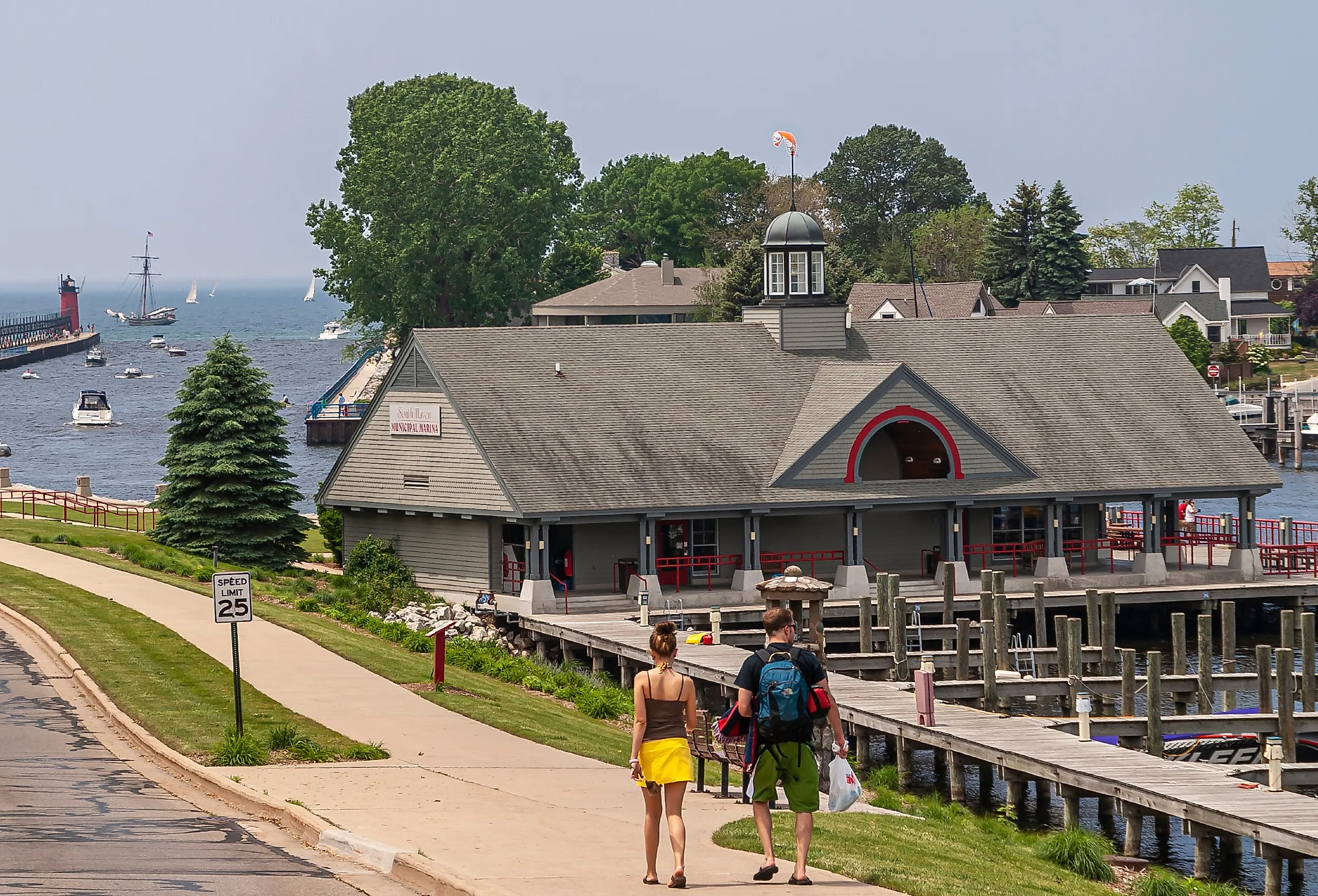
South Haven lines the Lake Michigan shore where the Black River runs out to the lake. Its signature sight is the South Pier Light, a bright red cast-iron tower from the early 20th century, reached by a catwalk off South Beach. A set of blue stairs over the dune has become a local landmark in its own right. The Michigan Maritime Museum sits on the harbor and sails the Friends Good Will, a replica of an 1810 sloop, through the season.
Downtown, Clementine's serves perch and steaks inside the 1896 Citizens State Bank building, two of the original vaults still standing among the antiques. The Michigan Theatre, a restored 1920s movie house, runs films and live shows year-round. Time a visit for August and you land in the middle of the National Blueberry Festival, which the town has thrown for decades.
St. Joseph

St. Joseph runs along a bluff where the St. Joseph River meets Lake Michigan, which is how it picked up the nickname Riviera of the Midwest. The bluff-top downtown keeps brick streets and Lake Bluff Park, a long green strip with a bandshell, a sculpture walk, and a straight drop to the water. Down below, Silver Beach draws the crowds, and the Silver Beach Carousel turns just back from the sand with 48 hand-carved figures. Across the street, the Whirlpool Compass Fountain doubles as a splash pad that kids run through all summer.
The Curious Kids' Museum and its Discovery Zone keep younger visitors busy, while the Krasl Art Center and the Heritage Museum and Cultural Center cover art and local history. For the best view of the water, walk out to the twin century-old North Pier lighthouses from Tiscornia Park. Eat at Silver Beach Pizza by the Amtrak depot or Silver Harbor Brewing downtown, and in winter the town strings Lake Bluff Park with lights for the Luminary Lakefront and pours samples at the Winter Beer Fest.
Which One To Pick
The thread running through these ten is water and history more than size. Calumet and Charlevoix lean hardest on the past, one on copper, the other on a self-taught builder's stone houses. Leland and Ludington still work their harbors and run their boats. Bay City and St. Joseph pack the most into a walkable downtown, while Hillsdale trades the big lake for a college green and a quieter inland one. Pick the town that matches the trip you have in mind, and go before the summer crowds beat you to it.