10 Prettiest Downtown Strips In Minnesota
Halloween was practically invented on the streets of Anoka, where the country's first citywide celebration still draws costumed crowds down Main Street every October. That is the kind of story Minnesota's downtown strips carry block by block. New Ulm built a working German town around a copper statue and a chiming Glockenspiel. Hastings kept a whole row of cast-iron storefronts that other towns tore down in the 1960s. Winona turned lumber money into stained glass that still catches the afternoon sun. These ten downtowns each hold onto something specific worth the walk.
New Ulm

Popularly known as "The Most German Town in America," New Ulm blends its traditions and attractions with European flair built by the German immigrants who established the town in the 1850s. The Hermann Monument, a 102-foot structure topped by a copper statue and dedicated in 1897 in Hermann Heights Park, sits on the National Register of Historic Places and was designated by the 106th US Congress as a national symbol of German American heritage. An interior staircase leads up to an observation platform with a view of the Minnesota River Valley. The 45-foot Glockenspiel near North 4th and Minnesota Streets rings at noon, 3 pm, and 5 pm every day, with 37 bells playing and 12 rotating figurines representing local history. The August Schell Brewery, established in 1860, is open daily for tours of its mansion, museum, and beer hall. The annual Oktoberfest celebrations transform downtown New Ulm into a Bavarian festival with polka music, German food, and traditional competitions.
Lanesboro

Parkway Avenue in Lanesboro is one of the prettiest downtown strips in Minnesota, lined with art galleries, boutiques, and live theaters set in 19th-century architecture. Parkway Avenue is listed on the National Register of Historic Places for its well-preserved limestone and brick storefronts that have operated for more than 100 years. The strip follows the South Branch of the Root River, while the Root River State Trail cuts across the Elmwood Street intersection. Public art runs through the streetscape, including the glass mosaic mural at the Pedal Pusher Cafe. Lanesboro Arts keeps a gallery at 103 Parkway Avenue that features regional artists throughout the year. The Root River State Trail, a 60-mile paved path along the old Milwaukee Road railroad right-of-way, fills the downtown with visitors every summer weekend. The Minnesota legislature designated Lanesboro the "Rhubarb Capital of Minnesota," celebrated each June with the Rhubarb Festival in Sylvan Park.
Winona

Winona is a river town set between the Mississippi River and the high limestone bluffs. It is known as the "Stained Glass Capital of America," with a collegiate arts scene, summer festivals, outdoor recreation, and 19th-century Victorian architecture. Third Street is the backbone of the Winona Commercial Historic District, a collection of 65 buildings constructed between the 1880s and 1890s in Italianate, Queen Anne, and Romanesque Revival styles by lumber barons who were among the nation's wealthiest. The street keeps its preserved 19th-century architecture, vintage storefronts, and stained glass. The Tiffany stained glass in the WNB Financial Building lights up from the street when the sun hits it. Third Street carries an active nightlife and dining culture, with venues such as The Lafayette that feature live music. The Minnesota Marine Art Museum at 800 Riverview Drive holds more than 600 works in six galleries on a seven-acre Mississippi River campus, including a Vincent van Gogh painting and pieces from the Hudson River School.
Grand Marais

Downtown Grand Marais is an artsy harbor town that runs along Wisconsin Street on the North Shore of Lake Superior, above a cobblestone harbor. The strip is known for its arts scene and as a gateway to the lakes, canoe routes, and forest of the Boundary Waters Canoe Area Wilderness (BWCAW). At the harbor is the Cook County Historical Society Museum, housed in the 1896 Lightkeeper's House and listed on the National Register of Historic Places.
The North House Folk School offers classes in boat building, blacksmithing, and timber framing from its downtown location and holds Winter and Summer Solstice festivals on the harbor each year. Every summer, the Grand Marais Arts Festival fills Wisconsin Street with juried artists over a long weekend, organized by the Grand Marais Art Colony, which was founded in 1947. Artist's Point, a rocky lighthouse spit at the east end of the harbor, is a short walk from Wisconsin Street and one of the most photographed locations on the North Shore.
Hastings

Set where the Mississippi, St. Croix, and Vermillion Rivers meet, Hastings is a Victorian river town with 19th-century buildings listed on the National Register of Historic Places. East Second Street anchors a Commercial Historic District of 35 buildings dating from 1860 to 1900. These buildings survived the 1960s urban renewal campaigns that swept through other Minnesota downtowns. The ornate parapets, cast-iron columns, and display windows appear as they did when the district was placed on the National Register in 1978. This old-fashioned main street, wide enough for a horse and buggy, is lined with 19th-century architecture, antique shops, and local boutiques.
In recent years, restaurants such as Lock and Dam Eatery have turned street parking into outdoor dining areas serving Mexican, American, and Italian dishes. The Spiral Brewery taproom opens for pints and live music under large timber and metal ceilings paired with vintage industrial lighting. Thursdays bring live concerts at Levee Park, one block from Second Street along the Mississippi. The LeDuc Historic Estate, listed on the National Register of Historic Places, is a Gothic Revival mansion built in 1866 and open for tours through the Dakota County Historical Society.
Taylors Falls

Bench Street in Taylors Falls sits on sandstone cliffs that drop straight down to the St. Croix River, the most dramatically situated downtown in Minnesota. The Bench Street strip is a historic corridor of 19th-century architecture, boutique shops, and mom-and-pop restaurants. The Taylors Falls Bead Store at 364 Bench Street sells gems and jewelry sourced from around the world, while River Alley Shops carries vintage and repurposed gifts and decor.
The Angel Hill Historic District, listed on the National Register, holds a collection of 1850s Greek Revival houses on the hill above downtown that give the impression of a New England village. The Folsom House, an 1855 lumber baron's mansion, is open for visits through the Minnesota Historical Society. Established in 1895, Interstate State Park was the first park in the country to span two states, and its glacial potholes and columnar basalt formations sit within walking distance of Bench Street. The Taylors Falls Scenic Boat Tours have run from downtown for decades, passing the 200-foot basalt walls of the Dalles gorge.
Park Rapids

Park Rapids is the gateway to the Mississippi River Headwaters at Itasca State Park and the surrounding Heartland Lakes region. Its Main Avenue is lined with 19th-century brick buildings, small shops, and hanging flower baskets on every lamppost in summer. Turtle Town Books on Main Avenue is one of the better-known independent bookstores in northern Minnesota, while Big Axe Brewing and Rafferty's Pizza rank among the favorites in the area. Built to handle summer lake-country crowds, Main Avenue is wide enough for diagonal parking on both sides and a landscaped center median. The Heartland State Trail, a 49-mile paved trail, starts in Park Rapids and heads north to Cass Lake, drawing cyclists through downtown all season.
Anoka

Anoka is nicknamed the "Halloween Capital of the World," recognized as one of the first US cities to host a large-scale Halloween celebration, started in 1920 to give young people something to do other than pranking. The town also keeps one of the more historic Main Street strips in the state, with 19th-century brick buildings, boutiques, and riverfront views. Favorite Things and The Hub along Main Street are among the most visited stores, offering curated gifts, antiques, and home decor. As visitors enter downtown Anoka, the first sound they hear is the Rum River flowing under the Main Street bridge. The water and the brick storefronts on both sides of the approach make for one of the most memorable downtown entrances in the Twin Cities metro.
The Anoka County Historical Society Museum recently moved to the Ticknor Hill mansion, which documents the town's legacy as a fur-trading crossroads and the surrounding communities. Rum River Central Regional Park connects directly to the downtown waterfront, a favorite spot for hikers and bikers.
Stillwater

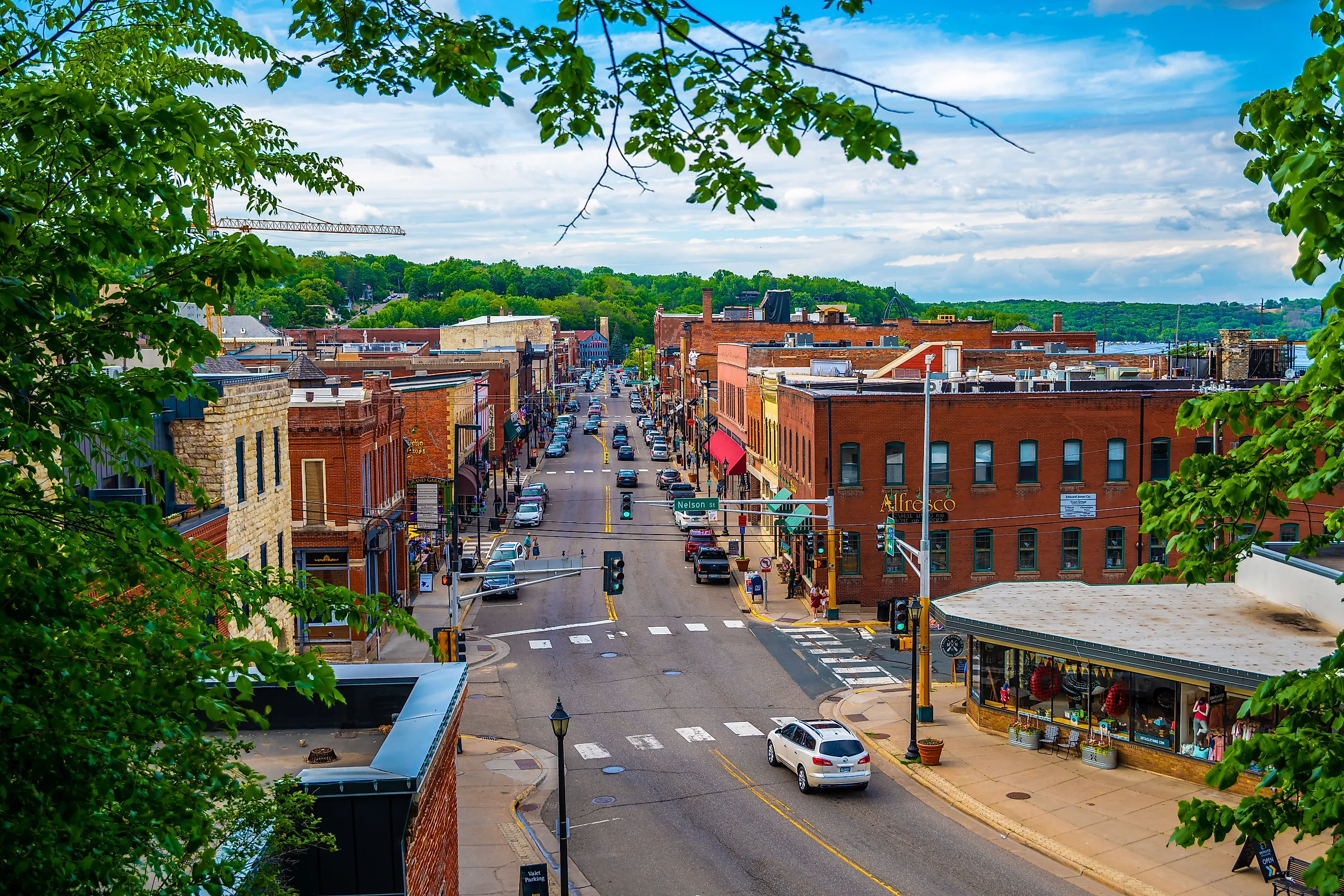
Often called the "Birthplace of Minnesota," Stillwater has one of the most walkable main strips in the state. Stillwater's Main Street is a commercial center of red-brick Victorian and Italianate storefronts, with sidewalks running parallel to the St. Croix River. The Stillwater Commercial Historic District is an 11-block downtown with 63 contributing buildings listed on the National Register of Historic Places. A walk along Main Street takes in dining, shopping, and a river view at Lowell Park. Mon Petit Cheri and the Green Bridge Coffee Shop are among the better eateries on the strip. Shops, boutiques, and antique stores such as Tremblay's Sweet Shop and Midtown Antique Mall sit on nearly every block. The Stillwater Lift Bridge, built in 1931, is a Waddell-Harrington vertical-lift bridge that was converted to pedestrian and bicycle use in 2020, carrying walkers and cyclists across the St. Croix River to Wisconsin.
Excelsior

Excelsior is a lakeside town on the southern shores of Lake Minnetonka, with a Water Street strip of antique shops, art galleries, and eateries and a 13-acre lakeside park at its edge. Water Street earns its place among the prettiest downtown strips for its tree-lined sidewalks and 19th-century Victorian storefronts along the water. Excelsior Commons and the Port of Excelsior have anchored this downtown since 1854. The park is a favorite spot for picnics and summer concerts, with food trucks serving snacks and drinks.
On a hot summer day, Adele's Frozen Custard and Tommy's Tonka Trolley serve desserts and ice cream along the strip. A restored streetcar run by the Minnesota Streetcar Museum gives a tour of the historic downtown, stopping at the Carbarn for a recap of the trails, paddleboats, hotels, and landmarks of the 19th century.
What Makes A Minnesota Downtown Worth The Walk
The common thread across these ten strips is preservation with a purpose. Winona and Hastings kept their lumber-era storefronts intact while other towns demolished theirs, and Taylors Falls and Grand Marais built their downtowns around the geology and water that surround them. New Ulm and Anoka turned a single tradition, German heritage in one case and Halloween in the other, into the identity of an entire main street. Each downtown rewards a slow walk with something the others cannot claim.