Maps of Italy
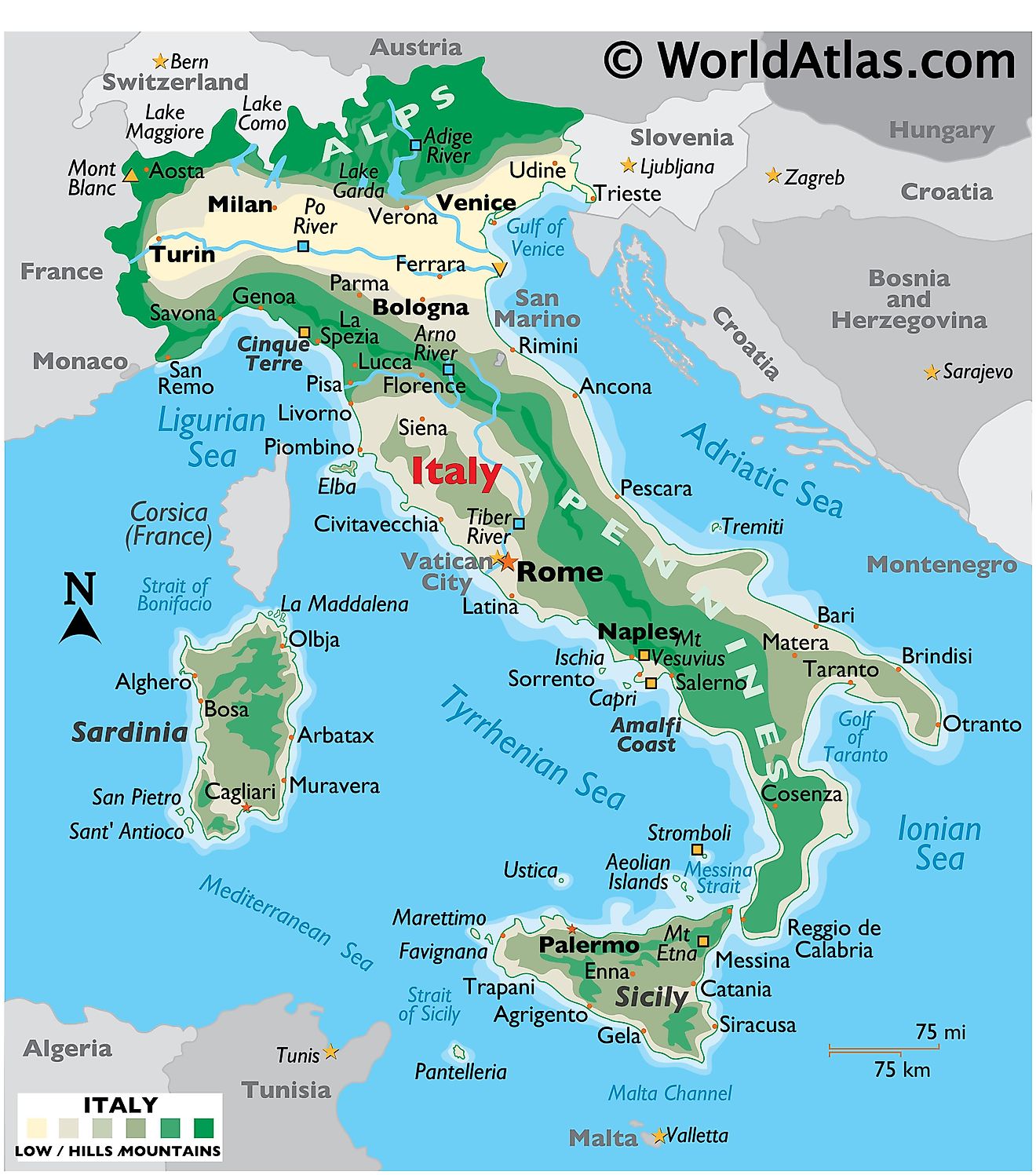
Italy is a sovereign country covering approximately 301,340 square kilometers (116,350 square miles) in southern Europe. Its mainland extends southward into the Mediterranean as a long, boot-shaped peninsula, separating various parts of the sea: the Adriatic to the east, the Ionian to the south, and the Ligurian and Tyrrhenian to the west. Italy shares land borders with France, Switzerland, Austria, and Slovenia to the north and surrounds the independent states of San Marino and Vatican City. The nation also includes Sardinia, Sicily, and numerous smaller islands.
Mountains: The Alps And The Apennines

The Alps run along Italy's northern border as a prominent mountain range shared with France, Switzerland, Austria, and Slovenia, featuring subdivisions like the Graian Alps, Pennine Alps, and Dolomites. Italy's tallest point, Mont Blanc (Monte Bianco), stands at approximately 4,808 meters, though its precise border with France is contested; the highest peak entirely within Italy is Mont Blanc de Courmayeur at 4,748 meters. Overall, about 35% of Italy is mountainous, and roughly 42% is hilly, making flat terrain quite rare.
The Apennine Mountains run along the length of the peninsula as a separate system. Not part of the Alps, they form Italy's backbone, stretching about 1,200 km south from the northwest and crossing the Strait of Messina into Sicily. These mountains serve as the watershed for the peninsula, giving rise to several major rivers like the Arno, which passes through Florence and Pisa, and the Tiber, flowing through Rome.
Rivers, Lakes, And Plains
Italy's longest river is the Po, stretching approximately 652 km. Originating in the Cottian Alps in the northwest, it flows eastward across northern Italy to form a broad delta on the Adriatic Sea. The Po Valley, which the river traverses, is Italy's largest lowland area, known for its highly productive farmland, and makes up much of the country's roughly 23% plains. Additionally, lower marshy regions are found along the Adriatic coast near the Po delta and the Venetian Lagoon.
Italy's renowned Lake District is situated along the southern edge of the Alps, featuring a series of deep mountain lakes carved by glaciers. The most famous among them are Lake Como, Lake Maggiore, and Lake Garda, the largest in Italy at approximately 370 sq km. These lakes, fed by alpine rivers and surrounded by resort towns, have attracted visitors for centuries.
Coastline And Islands
Italy's coastline extends about 7,600 km, characterized by numerous bays and gulfs. Notable scenery includes the Amalfi Coast south of Naples and the Cinque Terre in Liguria, where steep cliffs plunge directly into the sea and colorful villages cling to the slopes. The country also features many islands offshore. The largest are Sardinia and Sicily, along with smaller popular islands like Capri, Elba, Ischia, and the Aeolian group. Their origins differ: Sardinia, Capri, and Elba consist mostly of ancient continental and limestone rocks, whereas Ischia and the Aeolian Islands are volcanic.
Volcanoes And Seismic Activity

Italy lies along the boundary between the African and Eurasian tectonic plates, making it highly active in terms of volcanoes and earthquakes in Europe. Sicily's Mount Etna, approximately 3,350 meters high, is the tallest and most active volcano on the continent and is designated as a UNESCO World Heritage Site. In the Aeolian Islands, Stromboli has erupted so frequently that sailors call it the "Lighthouse of the Mediterranean." The most renowned volcano is Mount Vesuvius near Naples, which famously buried Pompeii in 79 CE; it is now closely monitored because many people live nearby.
Regions of Italy Map
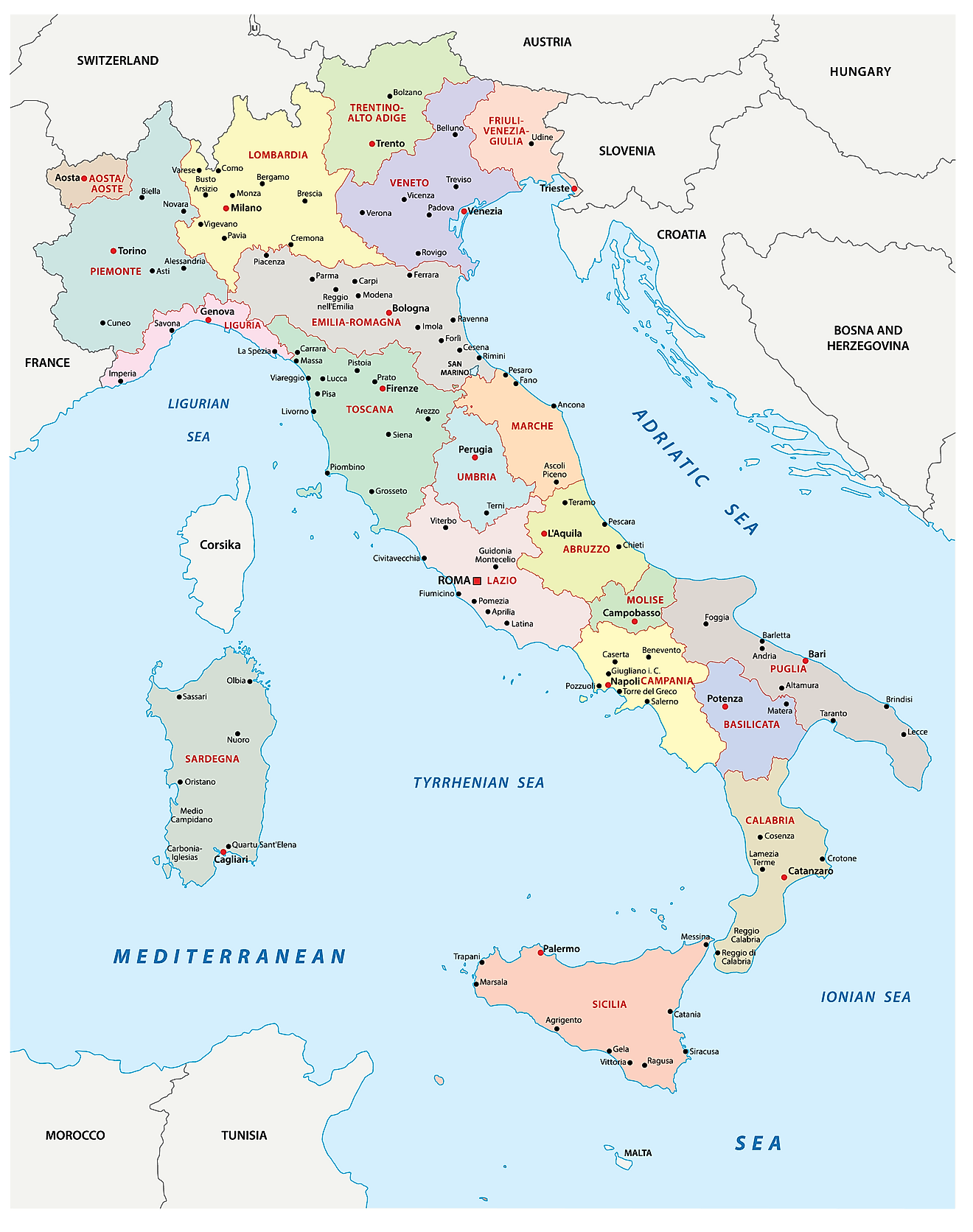
Italy (officially, the Italian Republic) comprises of 15 regions (regioni, singular - regione) and 5 autonomous regions (regioni autonome, singular - regione autonoma). The regions are: Abruzzo, Basilicata, Calabria, Campania, Emilia-Romagna, Lazio (Latium), Liguria, Lombardia, Marche, Molise, Piemonte (Piedmont), Puglia (Apulia), Toscana (Tuscany), Umbria, and Veneto. The autonomous regions are: Friuli Venezia Giulia; Sardegna (Sardinia); Sicilia (Sicily); Trentino-Alto Adige (Trentino-South Tyrol) or Trentino-Suedtirol (German); Valle d'Aosta (Aosta Valley) or Vallee d'Aoste (French).
The regions are further subdivided into 107 provinces, of which 14 are metropolitan cities. The different provinces comprise 7960 municipalities (comuni).
With an area of 301,340 sq. km, Italy is the 3rd most populous member state of EU. Located in the central-western portion of the Italian Peninsula, along the shores of the Tiber River, Rome is the capital and the largest city of Italy. It is also the country’s most populated city and the 4th most populous city in EU. Rome is often referred as ‘capital of two states’ – as Vatican City is an independent state within the boundaries of Rome.
Where is Italy?
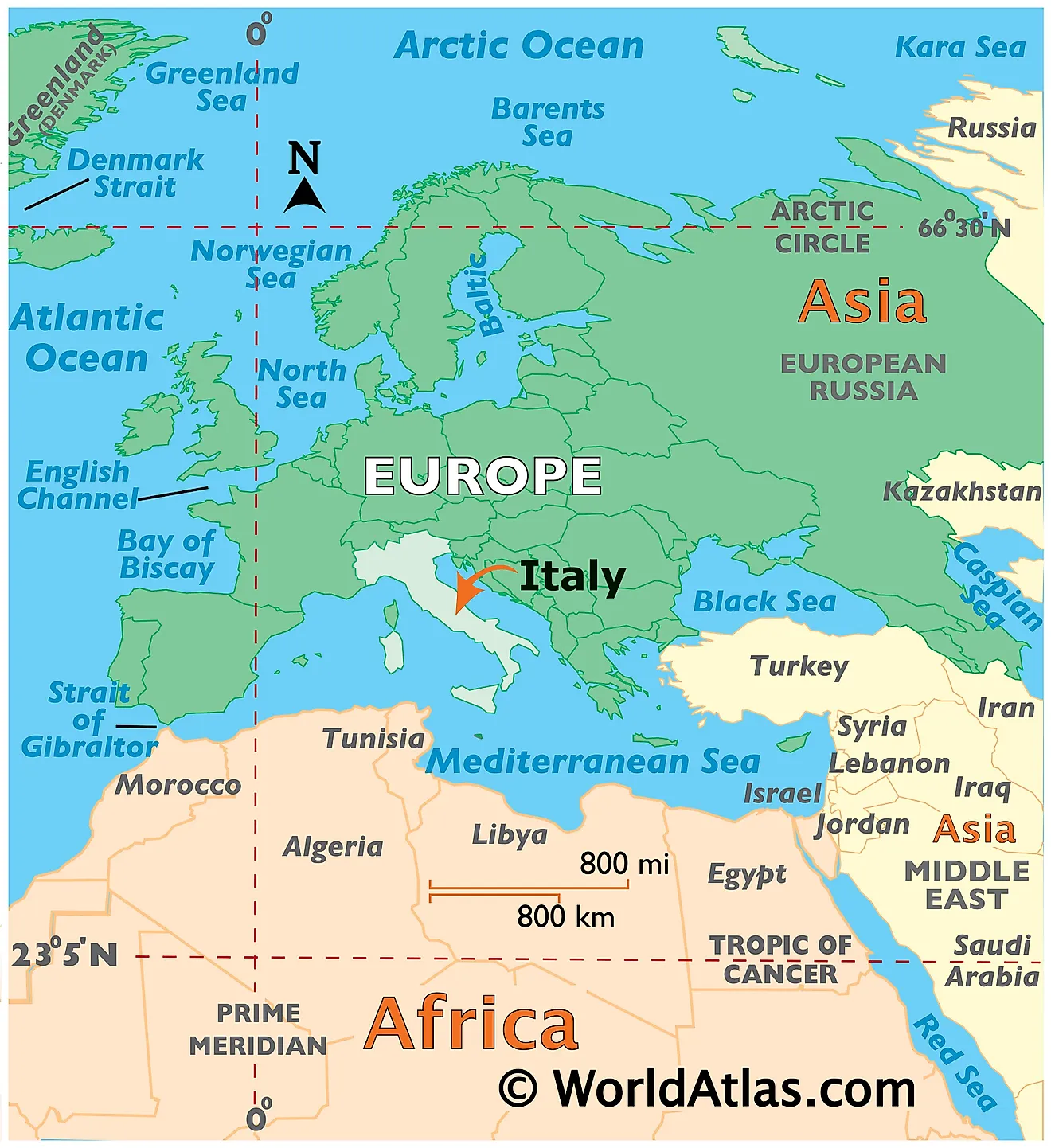
Italy is located in South-central Europe on the Apennine Peninsula. It is positioned both in the Northern and Eastern hemispheres of the Earth. Italy shares its borders with Switzerland and Austria in the north, with Slovenia in the northeast and with France in the northwest. Vatican City and San Marino are the two enclaved sovereign states within Italy. With its southern boundary extending into the Mediterranean Sea, the boot shaped Italian Peninsula is bordered by the Adriatic Sea in the east, the Sea of Sicily in the south, the Ionian Sea in the southeast, the Ligurian Sea, and the Tyrrhenian Sea in the southwest. The two largest Mediterranean Islands -Sardinia is located in the west and Sicily is to the south of Italy.
Italy Bordering Countries: Switzerland, Austria, San Marino, Slovenia, The Holy See [Vatican].
Regional Maps: Map of Europe
Outline Map of Italy
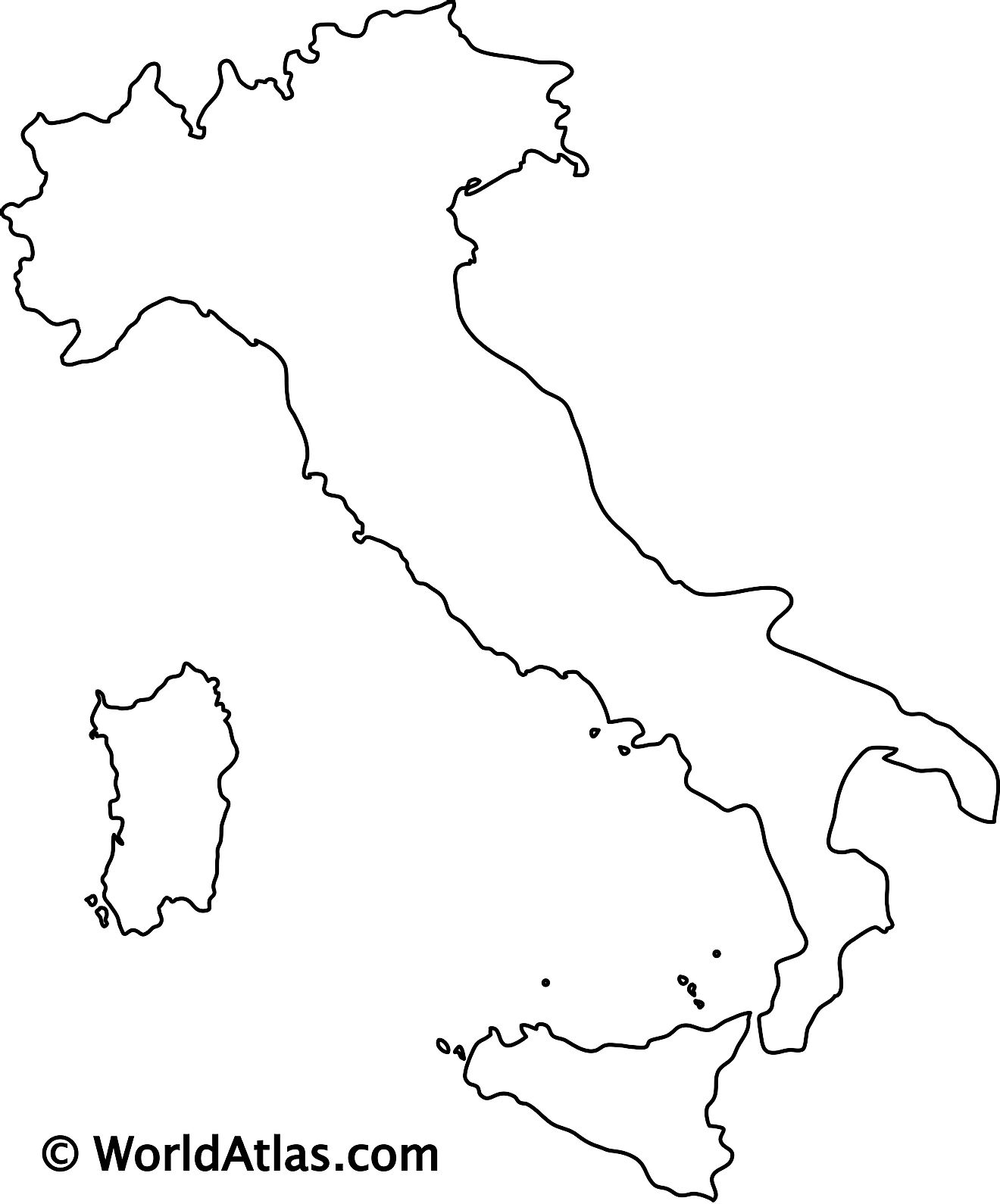
The above blank map represents Italy, a country located in South-central Europe on the Apennine Peninsula. The above map can be downloaded, printed and used for educational purposes like coloring and map-pointing activities.
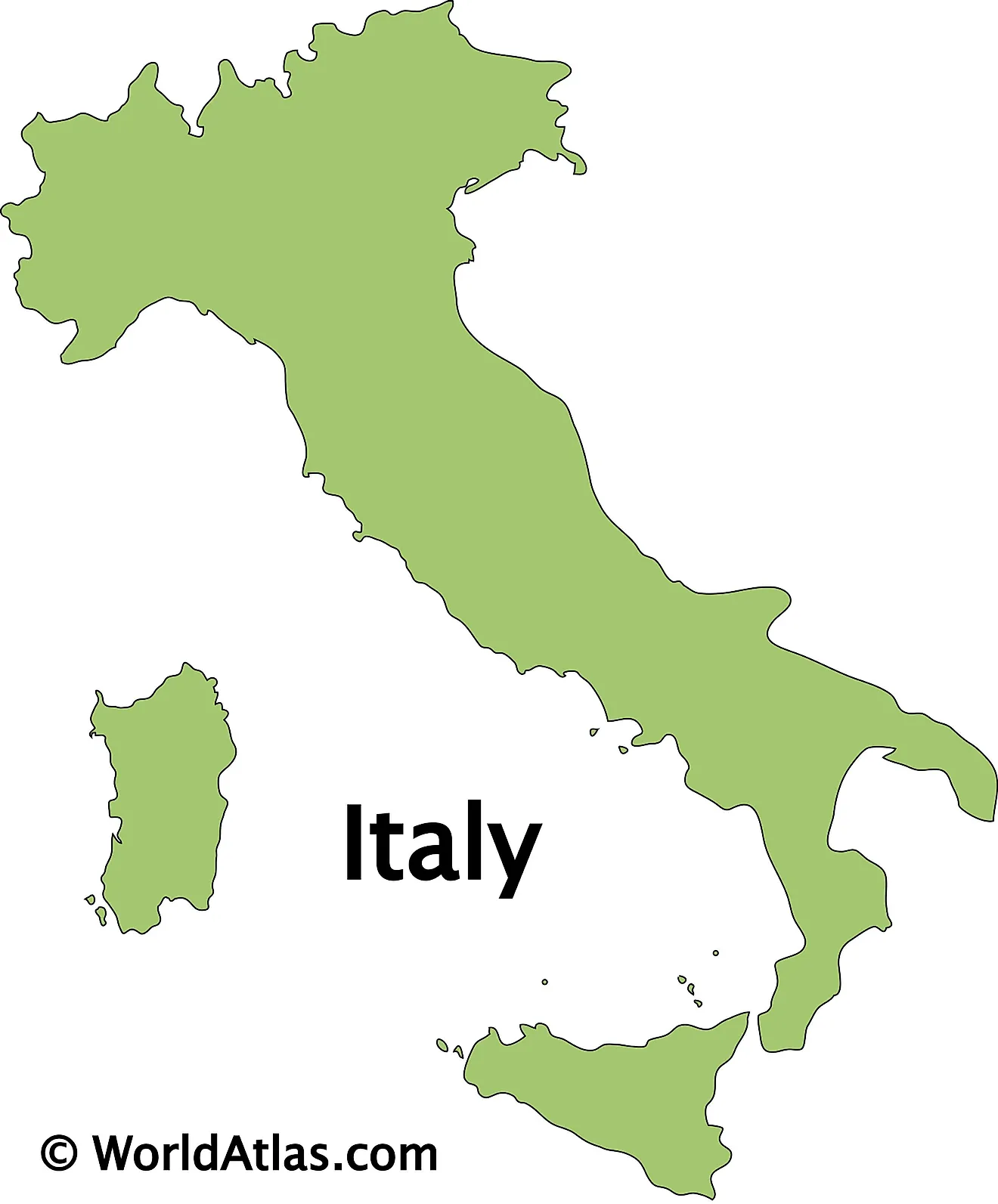
The above outline map represents Italy, a country located in South-central Europe on the Apennine Peninsula. Its distinct shape resembling a large boot-shaped peninsula, makes it easy to recognize on world maps.
Key Facts
| Legal Name | Italian Republic |
|---|---|
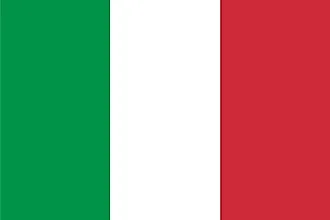
| Flag |
|
| Capital City | Rome |
| 41 54 N, 12 29 E | |
| Total Area | 301,340.00 km2 |
| Land Area | 294,140.00 km2 |
| Water Area | 7,200.00 km2 |
| Population | 60,924,851 |
| Major Cities |
|
| Currency | Euros (EUR) |
| GDP | $2.37 Trillion |
| GDP Per Capita | $38,949.62 |
This page was last updated on August 21, 2026