Which State Has The Oldest State Park System?
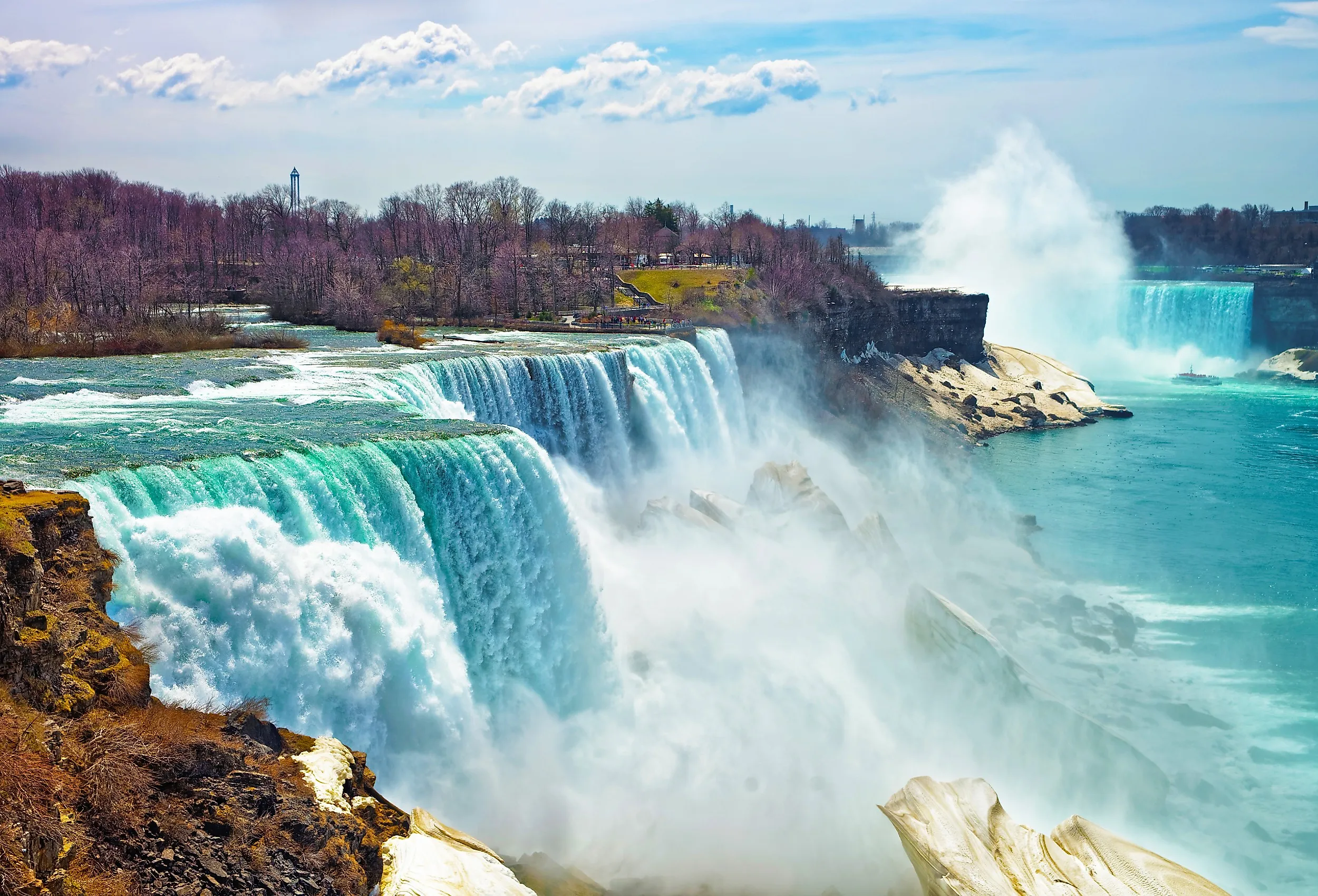
Niagara Falls is widely regarded as a natural wonder and appears on the Seven Natural Wonders organization’s North America list. Sitting on the United States-Canadian border, Niagara Falls is a force of nature. Though it is not the tallest waterfall in the world, it has one of the highest flow rates. At its peak, 2,832 tonnes of water flow over the falls every second.
This powerful geological landform is the centerpiece of America’s oldest state park. Founded in 1885 as the Niagara Reservation, Niagara Falls State Park revolutionized public access to the great outdoors and charted the course for future park systems. In turn, it forever changed the trajectory of environmental conservation in the United States for the better. This park in New York State is part of the oldest state park system in the United States.
The Birth of America's Oldest State Park

Before it became a protected park, Niagara Falls was an industrial powerhouse. New York State sold the land around the falls in 1805, and mills soon lined the bank to draw on the current. By the late 19th century, privately owned mills, factories, and fences crowded the American shore and blocked both the views and public access. Large mills and factories flanked the Niagara River, harnessing the falls' power. The once unobstructed wonder was hidden behind buildings and clouded with air pollution.
Early environmentalists grew concerned about this transformation. In August 1869, landscape architect Frederick Law Olmsted visited the falls with architect Henry Hobson Richardson and Buffalo civic leader William Dorsheimer, and the three were appalled at what they saw. Known for designing Central Park in New York City, Olmsted was inspired to return the landscape to its original glory. He merged his mission with other concerned figures, forming the Free Niagara Movement. The group campaigned against private industrial exploitation and pressed the State of New York to purchase the land for preservation.

The campaign's first victory came in 1883, when Governor Grover Cleveland signed an act authorizing the state to select and appropriate land at the falls. The Niagara Appropriations Bill followed in 1885 and funded the purchase of 412 acres, including Goat Island. The State Reservation at Niagara opened to the public on July 15, 1885, with Thomas V. Welch as its first superintendent. Park commissioners began by removing the buildings that obstructed views of the waterfall, and the number of factories was reduced. Olmsted and his design partner Calvert Vaux laid out the landscaping on the American side, favoring elements that kept the cascades front and center. Walkways and open viewpoints were a simple yet effective addition.
The Lasting Impact

Establishing the reservation set a new standard for environmental preservation. State-owned land had previously been used mainly for commercial purposes such as resource extraction and industrial development. In place of financial gain, the Niagara Appropriations Bill prioritized public enjoyment and natural conservation. New York built the machinery to match, setting up a standing commission for the reservation and setting aside the Adirondack Forest Preserve the same year.
One older claim deserves a mention. Congress granted Yosemite Valley and the Mariposa Grove to California in 1864 to be held for public use and recreation, and Olmsted sat on that grant's first board of commissioners. California returned the land to the federal government in 1906, and it was folded into Yosemite National Park. Niagara is therefore the oldest state park still operating as one, and New York's 1885 commission is the oldest state park system in continuous service.

Other states moved next. In Minnesota, the archaeologist and surveyor Jacob V. Brower led a local campaign to protect the Mississippi headwaters and the region's remaining pines from logging pressure. His efforts led the legislature to establish Itasca State Park in 1891, the state's first and still its oldest, although logging continued on non-state land inside the boundaries until 1920. Minnesota established its side of Interstate State Park in 1895 to deter logging and vandalism. Wisconsin created its adjoining park in 1900. Together, the two properties formed the country's first two-state park, and each state still administers its own side separately.
Depending on the definition, the United States now has roughly 2,500 sites formally named state parks and more than 9,800 state-managed park areas. These state-owned spaces protect historic sites, wildlife, and the nation's geological formations. By funding the first state park, New York set off a chain of preservation efforts that spared long stretches of the American landscape.
A State Park With No Entry Fees

Niagara Falls State Park is open year-round and free to enter on foot, although visitors using its main parking lots must pay a vehicle-use fee. More than nine million people a year come to the New York side of the waterfalls, where there is wide open space to view them. Certain optional experiences require paid tickets, including the Maid of the Mist boat ride and the Cave of the Winds decks. The Free Niagara principle otherwise holds, with no admission or ticket required to enjoy the park's main viewing areas and trails.
The Goat Island Trail is a popular route that leads to Terrapin Point, a viewing spot above Horseshoe Falls. The viewpoint has a wide lawn for parkgoers to relax on, while the paved path provides a close-up view of the falls. On the northern end of Goat Island, Stedman's Bluff provides a different perspective. The historic overlook showcases Bridal Veil Falls and American Falls. From there, parkgoers can cross a bridge to Luna Island, an outcrop suspended between the waterfalls.
Does Niagara Falls Still Generate Power?

The creation of Niagara Falls State Park did not discontinue the falls' role as a power source. In 1895, ten years after the reservation was funded, the Edward Dean Adams Power Plant began operating near the upper Niagara River. It went into service on August 26, 1895. Westinghouse machinery built on Nikola Tesla's polyphase alternating-current designs made it the first large-scale AC hydroelectric plant in the world. In November 1896, it sent power about 20 miles (32 km) to Buffalo, the first long-distance transmission of bulk electricity from a central station. Niagara still generates on a large scale through facilities like the Robert Moses Niagara Power Plant in New York.

Regulations now guard against a repeat of the 19th century. The United States and Great Britain signed the Boundary Waters Treaty in 1909, with Britain acting for Canada. One purpose was to balance hydropower and navigation against the protection of the falls. The Niagara Treaty of 1950 added more detailed rules for scenic preservation, including a minimum flow over the crest. Diversions must leave at least 100,000 cubic feet per second (2,832 cubic meters per second) going over the falls during daylight hours in the tourist season, and half that at night and in the off-season.
The Legacy
By protecting its natural wonder, the State of New York sparked a national movement. Conservation efforts rippled through the country, and new state parks took form as a result. Early conservationists and concerned citizens now had a concrete instrument for protecting their own state's landscapes and landforms. State park systems also became economic infrastructure, supporting local economies through tourism, visitor spending, and employment.
Which state holds the oldest system depends on how strictly the term is read. California held the older grant, and Minnesota built out an early system of its own around the Mississippi headwaters. New York established a park and a standing commission in 1885 and has run both without interruption since. That record is why Niagara Falls State Park is counted as the state park that started it all.