The 10 Largest Sports Stadiums In Europe
Europe builds its stadiums like cathedrals and fills them just as faithfully. Ten of them hold more than 76,000 people, and the largest is being rebuilt to seat 105,000. Almost all are temples to football, the continent's defining sport, though several have also staged Olympics, rugby internationals, and even a papal Mass. Here are the ten biggest by capacity, with a fuller table of the continent's largest at the end.
- Camp Nou, Barcelona, Spain - 105,000
- Wembley Stadium, London, UK - 90,000
- Croke Park, Dublin, Ireland - 82,300
- Twickenham Stadium, London, UK - 82,000
- Signal Iduna Park, Dortmund, Germany - 81,365
- Santiago Bernabéu Stadium, Madrid, Spain - 81,044
- Luzhniki Stadium, Moscow, Russia - 81,000
- Stade de France, Saint-Denis, France - 80,698
- San Siro (Giuseppe Meazza Stadium), Milan, Italy - 80,018
- Ataturk Olympic Stadium, Istanbul, Turkey - 76,761
1. Camp Nou - 105,000

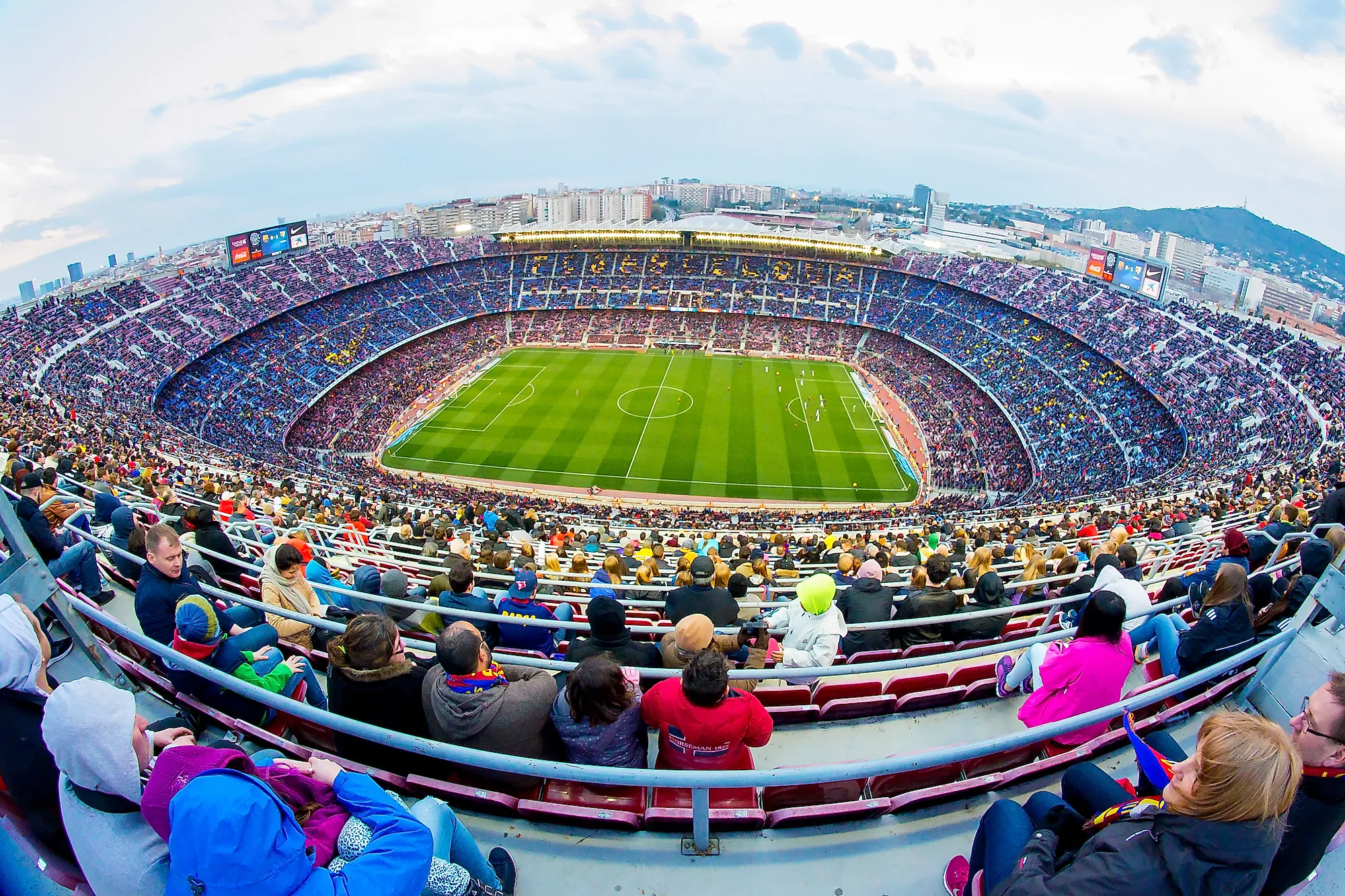
Camp Nou is the biggest of them all, and it is getting bigger. Barcelona's home opened in 1957 and held 99,354 before crews gutted it for a 1.5 billion euro rebuild. The club moved out to the Olympic Stadium on Montjuïc in 2023 and started filtering back into a half-finished ground in November 2025. Now branded Spotify Camp Nou under a naming deal that runs to 2034, it is reopening in stages, with a target of 105,000 seats by 2027 that will keep it the largest stadium in Europe. It has staged World Cup matches, the 1992 Olympic football final, and two Champions League finals, and FC Barcelona has called it home since the day it opened.
2. Wembley Stadium - 90,000

Wembley seats 90,000 beneath the steel arch that has become London's most recognizable sporting landmark. The current ground opened in 2007 on the site of the old Wembley, demolished in 2003. The arch spans the stadium without internal columns and is often called the longest single-span roof structure in the world. England's national team plays here, and the venue has hosted Champions League finals in 2011 and 2013 and the football final of the 2012 Olympics.
3. Croke Park - 82,300

Croke Park, Europe's third-largest stadium at 82,300, is the home of Gaelic games rather than soccer. Hurling and Gaelic football have been played on the Dublin site since the 1890s, and the All-Ireland finals each September fill the place to the rafters. A 1961 football final drew 90,556, still the ground record. For three years starting in 2007, the Gaelic Athletic Association broke with tradition and let Ireland's soccer and rugby teams play here while Lansdowne Road was rebuilt into the Aviva Stadium.
4. Twickenham Stadium - 82,000

Twickenham is the cathedral of English rugby, and at 82,000 it is the largest stadium in the world built specifically for the sport. It opened in 1907 on a former cabbage patch in southwest London and grew through decades of expansion. In September 2024 the Rugby Football Union sold the naming rights for the first time in the ground's history, so it now plays under the title Allianz Stadium, though most supporters still call it Twickenham. The RFU owns it, England's national rugby team plays here, and the South Stand houses the World Rugby Museum.
5. Signal Iduna Park - 81,365

Signal Iduna Park is Germany's biggest stadium and the fifth-largest in Europe, seating 81,365. Borussia Dortmund plays here, roared on by the Südtribüne, the steep standing terrace known as the Yellow Wall that packs in around 25,000 fans and is the largest single-tier stand in European football. The ground hosted matches at the 1974 and 2006 World Cups and the 2001 UEFA Cup final, and it remains one of the loudest venues on the continent.
6. Santiago Bernabéu Stadium - 81,044

Real Madrid's home in the Spanish capital has just emerged from a 1.76 billion euro overhaul that wrapped it in a steel skin, added a retractable roof, and built a pitch that slides into storage underground for concerts. The club trimmed the name to simply the Bernabéu in 2025. All the rebuilding scrambled the seat count, and Real Madrid has not confirmed a firm number; estimates land between roughly 78,000 and 84,000, with most listings near 83,000. The stadium opened in 1947 and has hosted four European Cup or Champions League finals, the latest in 2010.
7. Luzhniki Stadium - 81,000

Luzhniki is Russia's largest stadium, seating 81,000 in southwest Moscow. It opened in 1956 as the Central Lenin Stadium and took its current name in 1992. A reconstruction between 2013 and 2017 stripped out the running track and pushed the stands closer to the pitch ahead of the 2018 World Cup, whose final, France's 4-2 win over Croatia, was played here. The ground also hosted the 1980 Olympics and the 2008 Champions League final.
8. Stade de France - 80,698

The Stade de France, France's biggest stadium at 80,698, sits just north of Paris in Saint-Denis. It was finished in 1998 in time to host that summer's World Cup final, where the host nation beat Brazil 3-0. Home to both the French football and rugby teams, it served as the main athletics and ceremonies venue for the 2024 Paris Olympics.
9. San Siro (Giuseppe Meazza Stadium) - 80,018

Officially the Stadio Giuseppe Meazza but known everywhere by its district, San Siro seats 80,018 and is shared by two Milan giants, AC Milan and Inter. Built in 1926, it has hosted four European Cup or Champions League finals and matches at the 1990 World Cup. Its days are now numbered: in September 2025 the city council approved the sale of the stadium and surrounding land to the two clubs for 197 million euros, clearing the way to demolish most of it and build a smaller 71,500-seat replacement on the site by 2031.
10. Ataturk Olympic Stadium - 76,761

Named for the founder of modern Turkey, Istanbul's Ataturk Olympic Stadium seats 76,761, the most in the country. Construction ran from 1999 to 2002, built around a failed bid for the 2008 Summer Olympics that went to Beijing. It is best known for European football's biggest nights: the 2005 "Miracle of Istanbul," when Liverpool came back from three goals down to beat AC Milan, and the 2023 Champions League final, where Manchester City beat Inter 1-0 to complete the treble.
A Wave Of Rebuilds
Europe's biggest grounds are not standing still. Camp Nou and the Bernabéu have just come through billion-euro renovations, Twickenham has sold its name for the first time in over a century, and San Siro has been signed away to its two clubs to make room for a modern replacement. The pressure comes from every direction: clubs chasing matchday revenue, cities lining up World Cup and European Championship bids, and fans who want comfort without losing the wall of noise that makes these places worth the seat. Expect the order of this list to keep shifting as the cranes move in.
The Largest Sports Stadiums In Europe
| Rank | Stadium | Capacity | City | Country | Built |
|---|---|---|---|---|---|
| 1 | Camp Nou | 105,000 (under renovation) | Barcelona | Spain | 1957 |
| 2 | Wembley Stadium | 90,000 | London | England | 1923 / 2007 |
| 3 | Croke Park | 82,300 | Dublin | Ireland | 1913 |
| 4 | Twickenham Stadium | 82,000 | London | England | 1909 |
| 5 | Signal Iduna Park | 81,365 | Dortmund | Germany | 1974 |
| 6 | Santiago Bernabéu Stadium | 81,044 | Madrid | Spain | 1947 |
| 7 | Luzhniki Stadium | 81,000 | Moscow | Russia | 1956 |
| 8 | Stade de France | 80,698 | Saint-Denis | France | 1998 |
| 9 | San Siro | 80,018 | Milan | Italy | 1926 |
| 10 | Atatürk Olympic Stadium | 76,761 | Istanbul | Turkey | 2001 |
| 11 | Athens Olympic Stadium | 75,000 | Athens | Greece | 1982 |
| 12 | Allianz Arena | 75,000 | Munich | Germany | 2005 |
| 13 | Old Trafford | 74,994 | Manchester | England | 1910 |
| 14 | Olympiastadion | 74,649 | Berlin | Germany | 1936 |
| 15 | Millennium Stadium | 74,500 | Cardiff | Wales | 1999 |
| 16 | Stadio Olimpico | 70,634 | Rome | Italy | 1930 |
| 17 | NSC Olimpiyskiy | 70,050 | Kyiv | Ukraine | 2012 |
| 18 | Olympiastadion | 69,250 | Munich | Germany | 1972 |
| 19 | Baku Olympic Stadium | 68,700 | Baku | Azerbaijan | 2015 |
| 20 | Metropolitano | 67,703 | Madrid | Spain | 2017 |
| 21 | Stade Vélodrome | 67,394 | Marseille | France | 1937 |
| 22 | Murrayfield Stadium | 67,144 | Edinburgh | Scotland | 1925 |
| 23 | Krestovsky Stadium | 67,000 | Saint Petersburg | Russia | 2017 |
| 24 | Estádio da Luz | 64,642 | Lisbon | Portugal | 2003 |
| 25 | Veltins-Arena | 62,271 | Gelsenkirchen | Germany | 2001 |
| 26 | Estadio Benito Villamarín | 60,720 | Seville | Spain | 1929 |
| 27 | MHPArena | 60,469 | Stuttgart | Germany | 1933 |
| 28 | Celtic Park | 60,411 | Glasgow | Scotland | 1892 |
| 29 | Stadio Diego Armando Maradona | 60,240 | Naples | Italy | 1959 |
| 30 | London Stadium | 60,000 | London | England | 2012 |
| 31 | Emirates Stadium | 59,867 | London | England | 2006 |
| 32 | Parc Olympique Lyonnais | 59,186 | Lyon | France | 2016 |
| 33 | PGE Narodowy | 58,580 | Warsaw | Poland | 2011 |
| 34 | Stadio San Nicola | 58,248 | Bari | Italy | 1990 |
| 35 | Estadio Olímpico de Sevilla | 57,619 | Seville | Spain | 1999 |
| 36 | Volksparkstadion | 57,274 | Hamburg | Germany | 1953 |
| 37 | Estadi Olímpic Lluís Companys | 56,000 | Barcelona | Spain | 1927 |
| 38 | Arena Naţională | 55,634 | Bucharest | Romania | 2011 |
| 39 | Stadium Rajko Mitić | 55,538 | Belgrade | Serbia | 1963 |
| 40 | Silesian Stadium | 55,211 | Chorzów/Katowice | Poland | 1956 |
| 41 | Etihad Stadium | 55,097 | Manchester | England | 2002 |
| 42 | Estadi de Mestalla | 55,000 | Valencia | Spain | 1923 |
| 43 | Merkur Spiel-Arena | 54,600 | Düsseldorf | Germany | 2004 |
| 44 | Boris Paichadze Dinamo Arena | 54,549 | Tbilisi | Georgia | 1976 |
| 45 | Friends Arena | 54,329 | Stockholm | Sweden | 2012 |
| 46 | Hrazdan Stadium | 54,208 | Yerevan | Armenia | 1971 |
| 47 | Anfield | 54,074 | Liverpool | England | 1884 |
| 48 | Borussia-Park | 54,067 | Mönchengladbach | Germany | 2004 |
| 49 | Johan Cruyff Arena | 54,990 | Amsterdam | Netherlands | 1996 |