What Are Examples of Traditional Indian Clothing?
Traditional clothing on the Indian subcontinent runs across more than two dozen distinct regional styles built around three broad construction traditions: draped, stitched, and layered. The earliest evidence of woven garments here dates to the Indus Valley Civilization, roughly 3300 to 1300 BCE. References to the draped sari appear in Vedic literature from around the same period. Mughal court dress in the 16th and 17th centuries introduced the tailored coat-and-trouser silhouettes that still anchor formal Indian dress today. British colonial-era tailoring layered another influence on top, producing the Bandhgala (Jodhpuri suit) and the modern Indian formal jacket. The garments below split into three categories. Women's wear includes the sari, the lehenga choli, and several variants of the salwar kameez. Men's wear covers the dhoti and the kurta for everyday use, with the sherwani and the Jodhpuri suit anchoring the formal end. Regional pieces add the southern lungi, the Kerala mundu, and the Kashmiri pheran.
The Sari

The sari is a single length of unstitched cloth, typically 5 to 6 yards long and 2 to 4 feet wide, draped around the body in styles that vary by region and occasion. References appear in the Rigveda, composed around 1500 to 1200 BCE, and depictions of similar draped garments survive on Indus Valley figurines. The most widely seen draping today is the Nivi style, which originated in Andhra Pradesh and was popularized nationally through 20th-century Bollywood. In the Nivi style, the cloth is pleated at the waist, and the loose end (the pallu) is draped over the left shoulder. Regional drapes include the Bengali style (without pleats), the Maharashtrian nauvari (nine-yard, passed between the legs), the Gujarati seedha pallu (draped over the right shoulder), and the Coorg style (with pleats at the back). Cotton dominates everyday wear, particularly in the heat of the southern and coastal regions. Silk saris such as the Banarasi from Varanasi and the Kanjeevaram from Tamil Nadu are reserved for weddings and major ceremonies. National survey estimates put daily sari wear at around 70 percent of Indian women, with the share declining among younger urban populations in favor of the salwar kameez and Western dress.
The Lehenga Choli

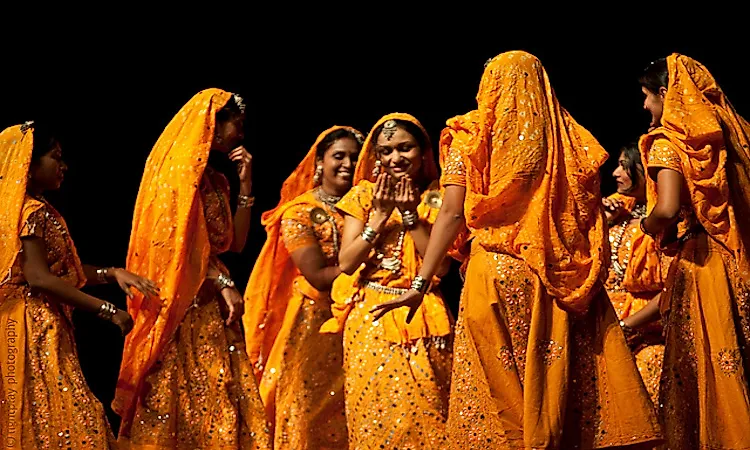
The lehenga choli is a three-piece ensemble worn across northern and western India. The lehenga is a long flared skirt. The choli is a tight-fitted cropped blouse. The dupatta is a sheer scarf draped over the head or shoulder. The set traces to medieval Rajasthan, Gujarat, and the Kutch region, with strong Mughal-era influence visible in the embroidery and the color palette. Modern lehengas are heavily embroidered with zari (gold or silver thread work), zardozi, mirror work, and sequins; the most elaborate bridal pieces can weigh 10 to 20 pounds and cost more than ₹1 lakh (roughly $1,200 US). Bridal wear in northern India still relies heavily on the lehenga, with red and maroon as the traditional bridal colors. Variations include the sharara (with full pants instead of a skirt) and the gharara (with knee-fitted pants that flare at the ankle), both popular for festival and wedding dress.
The Salwar Kameez, Churidar, And Anarkali

The salwar kameez originated in northwest South Asia, in the Punjab and Kashmir regions, and spread across India through the 20th century to become the second most common women's daily wear after the sari. The kameez is a long tunic shirt extending to about mid-thigh or knee. The salwar is the loose-fitting trouser, gathered tight at the waist and the ankles. The churidar is a slimmer variant of the trouser, fitted along the calf and ankle with horizontal folds at the ankle that resemble bangles (the word "churi" means bangle). A dupatta scarf completes the ensemble. The Anarkali suit is a popular variant with a long, full-flared kameez extending to the calf or ankle, paired with a churidar. The name comes from the legendary courtesan in the court of the Mughal emperor Akbar, whose love affair with Prince Salim (later Emperor Jahangir) is one of the best-known romances of Mughal-era folklore.
The Dhoti

The dhoti is the foundational draped garment for men across most of India: typically 4 to 5 yards of unstitched cotton wrapped around the waist and either tied off there or passed between the legs. The garment is paired with a kurta (long shirt) in the north and with an angavastram (shoulder cloth) in the south, and it is worn for both formal occasions and daily life depending on region. Regional drapes differ. The Bengali kachhi style passes the cloth between the legs. The Tamil veshti drapes simply around the waist. The Maharashtrian dhotar is similar to the kachhi but tied differently. Mahatma Gandhi adopted the plain khadi dhoti as his signature dress after 1921, using it as a deliberate symbol of self-rule and the rejection of British textile imports. The dhoti remains standard wear for many Hindu religious ceremonies and is required dress in many temple priests' codes.
The Lungi And Mundu

The lungi is a tube of fabric, generally about 2 yards long, worn wrapped around the waist by men in southern India, Bengal, and parts of the northeast. The mundu, worn primarily in Kerala, is a related single piece of unstitched cloth, traditionally white or off-white with a gold or colored border (the kasavu in Kerala's signature style). Lungis are casual everyday wear in much of the south and the east, often in checked or plaid patterns. The garment also forms the lower half of bhangra dancers' outfits in Punjab. Men working in agriculture or skilled trades across the south wear the lungi the way Western workers wear jeans, with formal occasions still calling for the dhoti or kurta.
The Kurta

The kurta is a long, loose shirt extending anywhere from mid-thigh to knee, traditionally worn by both men and women across northern India and Pakistan. The garment evolved from earlier Persian and Central Asian shirt styles and entered Indian dress through the Mughal court in the 16th to 18th centuries. Men's kurtas pair with either pajama (loose drawstring trousers, the source of the English word "pajamas") or churidar (slim ankle-fitted trousers). The kurta-pajama combination is among the most common everyday outfits across northern India. Women's kurtas pair with leggings, salwar, or churidar, and a dupatta scarf. Cotton and linen are everyday materials. Silk, brocade, and chikankari-embroidered fabrics are reserved for festive wear and weddings, with Lucknow's chikan embroidery the best-known regional craft tradition.
The Sherwani And Achkan

The sherwani is a long buttoned coat extending to the knee or just below, worn over a kurta and either churidar or straight trousers. It evolved during the late Mughal period in the 17th and 18th centuries and was adopted as formal court wear by Indian and Pakistani Muslim nobility through the 19th century. The achkan is a closely related but shorter variant, generally hip- or thigh-length, used for both formal and semi-formal occasions. Both garments are now standard groom's wear at North Indian Hindu, Muslim, and Sikh weddings, often paired with a turban or a saafa headwrap. Heavy embroidery, brocade, and silk dominate the formal end of the price range. Plain cotton or linen sherwanis serve as everyday formal wear for political and ceremonial events.
The Bandhgala (Jodhpuri Suit)

The Bandhgala (literally "closed neck") is a tailored Indian suit jacket with a short stand-up collar and visible buttons down the front, paired with matching trousers. The garment was popularized in the late 19th century by Maharaja Sir Pratap Singh, then Regent of Jodhpur and later Maharaja of Idar. The often-cited origin story places him in London in 1897 for Queen Victoria's Diamond Jubilee, when his luggage went missing and he had a new outfit tailored on Savile Row that combined Indian collar and button details with Western suit cuts. The result is the same Indo-Western silhouette now standard at Indian state dinners, business events, and formal weddings, and the garment is therefore also known as the Jodhpuri suit. The Jodhpur boot and the Jodhpur breeches (now standard in equestrian riding gear worldwide) come from the same court tailoring tradition.
The Angarkha And Jama

The angarkha is a Rajasthani and Gujarati upper garment with a distinctive overlapping cross-front closure tied at the right or left shoulder. A triangular opening cut at the chest reveals an inner panel (the parda) underneath, and the silhouette flares from the waist down. The jama is a related but distinct Mughal-era court robe with long sleeves, a fitted upper body, and a wide flared skirt below the waist, with ties fastened under the arm. Both garments date primarily to the 16th and 17th centuries. Both are now rare in everyday wear, surviving mostly in historical reenactments, certain folk-dance costumes, and traditional weddings in Rajasthan, Gujarat, and the Kutch region. The Kalbeliya dancers of Rajasthan still incorporate angarkha-style silhouettes in their performance dress.
The Pheran

The pheran is the traditional winter garment of the Kashmir Valley, a long loose woolen robe extending from the shoulders to below the knees and worn over warm inner layers through the harsh Himalayan winter. Men's and women's pherans share the same basic silhouette. Women's versions often feature elaborate embroidery (especially the tilla goldwork characteristic of Kashmiri craftwork) at the cuffs and the hem. Pherans are typically paired with the kangri, a small portable charcoal brazier carried under the robe during the coldest months for warmth. The garment dates at least to the Mughal-era governance of Kashmir in the 16th and 17th centuries and likely incorporates older Central Asian influence brought through the high passes.
Turbans And Other Headgear

Indian headgear includes dozens of regional turban styles plus a small set of national caps. The turban is worn by Sikh men as a religious requirement (the dastar or pagri, covering uncut hair) and by Hindu and Muslim men in various regions for ceremonial and cultural reasons. Major regional styles include the Maharashtrian pheta, the Rajasthani safa (especially the brightly tied Marwari and Mewari versions), the Peshawari pugri of the northwest, and the Sikh dastar. The Nehru topi is a small white side-cap popularized by Prime Minister Jawaharlal Nehru in the late 1940s and adopted as near-uniform political dress through the early independence period. The Gandhi cap is an earlier nationalist-era version of the same style, made from hand-spun khadi cloth as a deliberate political statement. Both caps remain in use at political events and on Republic Day and Independence Day.
Indian Dress In The Present Day
Western dress has become standard everyday wear for most working men and a growing share of urban women across India. Most Indian women under 30 in major metros wear salwar kameez, churidar, kurtis, or jeans on most days and reserve the sari for weddings, festivals, and family ceremonies. Men in offices wear shirts and trousers. The dhoti, kurta-pajama, and sherwani come out for weddings, religious occasions, and political settings. Traditional textile and embroidery industries remain central to the Indian economy: the handloom sector employs an estimated 3.5 million weavers, and the country exports more than $35 billion in textiles and apparel annually. Designers such as Sabyasachi Mukherjee, Manish Malhotra, Ritu Kumar, and Tarun Tahiliani have built international brands around contemporary takes on traditional Indian silhouettes. The shift is not a replacement but a layered coexistence: Western dress runs the workday, and traditional dress runs the wedding, the festival, and the religious occasion.