The Oldest Factories Still Running In America
America loves knocking down the old to make room for the new, which makes it genuinely strange that a handful of its factories have been cranking out the exact same products, in the exact same towns, for literal centuries. We are not talking about dusty museums with a gift shop. These are real, working factories, still clocking in every morning, some of them older than the states they sit in. Here are the great American survivors: the oldest factories still running in the country.
Crane Currency, Dalton, Massachusetts
Odds are you are carrying this factory's work in your wallet right now. Crane Currency, founded in Dalton, Massachusetts, in 1801, traces its papermaking roots to 1770, back when the Crane family was selling currency paper to a local silversmith you may have heard of named Paul Revere. Since 1879, Crane has made the very specific cotton-and-linen paper that every US dollar is printed on, and it still cranks it out from the same small Berkshire town. It is quite possibly the most secretive paper mill on Earth, for reasons that become obvious the moment you realize its main customer is the federal government's money printer.
D.G. Yuengling & Son, Pottsville, Pennsylvania

Slap "America's Oldest Brewery" on your beer and you had better be able to back it up. Yuengling can. Founded in the coal country of Pottsville, Pennsylvania, in 1829, it has been brewing on the same hillside ever since, complete with the hand-dug caves it once used to keep the beer cold before refrigeration was a thing. The brewery has stayed in the family for nearly two centuries, which is impressive, but the truly heroic part is how it survived Prohibition: by pivoting to ice cream and "near beer" and simply refusing to die. That is the kind of stubbornness you cannot fake.
C.F. Martin & Co., Nazareth, Pennsylvania

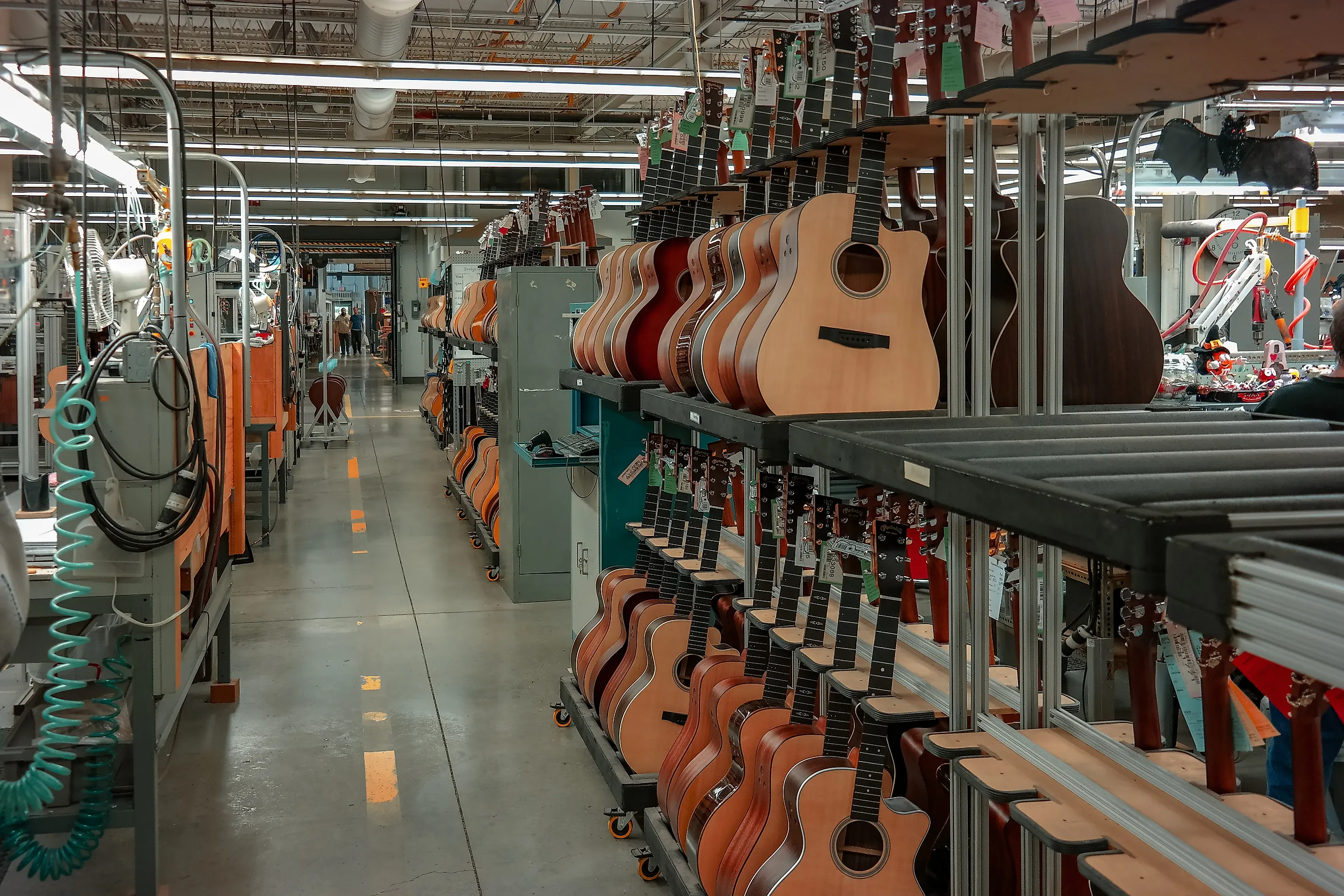
Basically every acoustic guitar you have ever heard owes something to this place. German immigrant Christian Frederick Martin set up shop in 1833 and started building guitars in Nazareth, Pennsylvania, where the company has stayed put, under the same family, for almost 200 years. Martin invented the internal "X-bracing" that gives the modern flat-top guitar its big, ringing sound, which is a polite way of saying they figured out how to make guitars loud before amplifiers existed. From dusty folk clubs to sold-out stadiums, the sound of American music has been quietly leaking out of this Pennsylvania factory for generations.
Steinway & Sons, Queens, New York

Henry Steinway started building pianos in a cramped Manhattan loft in 1853, then got so successful he constructed an entire company town in the Astoria neighborhood of Queens, cheerfully named Steinway Village. That same factory is still hand-building pianos today. Each Steinway grand takes a minimum of nine months to make, with about 80 percent of the work done by hand, meaning a single piano gestates longer than a human baby and arguably gets more attention. There is a reason concert halls the world over will accept absolutely nothing else.
McIlhenny Company (Tabasco), Avery Island, Louisiana

Here is a fact to unsettle you at your next brunch: every single bottle of Tabasco on the entire planet comes from one swampy salt dome in Louisiana. Edmund McIlhenny grew his first pepper crop on Avery Island in 1868 and mailed out 658 bottles the next year, and the recipe has barely budged since. It is still just three ingredients, peppers, vinegar, and salt, with the mash aged up to three years in old oak barrels right there on the island, like a very spicy bourbon. The McIlhenny family still runs the place, and yes, you can tour the factory and watch the world's hot sauce being born.
The Homer Laughlin China Company, Newell, West Virginia

You have almost certainly eaten off this factory's plates at a grandparent's house. Brothers Homer and Shakespeare Laughlin (yes, Shakespeare) founded their china company in 1873, and it is now the oldest china maker in the United States. From its factory in Newell, West Virginia, it still pumps out Fiesta dinnerware, those absurdly cheerful, candy-colored plates that have been brightening American tables since the 1930s. While nearly the entire dinnerware industry packed up and moved overseas, Homer Laughlin stubbornly kept its kilns firing on American soil, and it will happily give you a tour to prove it.
Lodge Cast Iron, South Pittsburg, Tennessee

That indestructible cast-iron skillet lurking in your kitchen, the one you are pretty sure will outlive you, probably came from one small Tennessee town. Joseph Lodge founded Lodge Cast Iron in South Pittsburg in 1896, and it remains America's oldest cast-iron cookware maker, still run by the founder's descendants and still casting the bulk of its skillets and Dutch ovens in Tennessee. The whole point of a Lodge pan is that you buy one, use it for 50 years, and then hand it down to your kids. It is fitting, then, that the company has spent well over a century doing exactly that with itself.