The Largest Shopping Centres In The United Kingdom
The UK shopping centre landscape has shifted significantly since 2018. Westfield London opened its Phase Two expansion in March 2018 and overtook the Metrocentre to become the largest centre in the country (and the largest in Europe). The intu Properties group, owner of four of the country's ten largest centres, collapsed into administration in June 2020 with debts of more than £4.5 billion, and the "intu" prefix was dropped from Metrocentre, Trafford Centre, Lakeside, Merry Hill, and Derby (now rebranded Derbion). Edinburgh's St James Quarter opened in June 2021 as the largest new-build retail development of the past decade. The ten centres covered below are the current top ten by gross retail area, and the table at the end of the article lists the top 20.
1. Westfield London

Westfield London at Shepherd's Bush in west London is now the largest shopping centre in the United Kingdom and the largest in Europe, with a gross retail area of 235,900 m² across approximately 350 stores. The centre opened in October 2008 on the former White City exhibition grounds (the same site used for the 1908 Olympic Games and the Franco-British Exhibition), and its 740,000-square-foot Phase Two expansion completed in March 2018 added a flagship John Lewis department store, around 80 new units, and a luxury district called The Village anchored by Versace, Tiffany & Co, Louis Vuitton, and Gucci.
The centre is owned and operated by Unibail-Rodamco-Westfield (URW), the French commercial real estate group that acquired the Westfield Group in 2018 in a deal worth about $15.7 billion (roughly £12 billion), or $24.7 billion including debt. Westfield London draws around 28 million visitors per year and is anchored by John Lewis, Marks & Spencer, and Primark, with approximately 4,500 parking spaces and direct connections to the Wood Lane and Shepherd's Bush Underground stations.
2. Metrocentre

The Metrocentre in Gateshead, Tyne and Wear, was the largest shopping centre in Europe for much of its 39-year history and remains the largest in the UK by retail area outside London, at 192,900 m². The first phase opened on 28 April 1986 on a former industrial site near the River Tyne, and the centre was developed by Sir John Hall's Cameron Hall Developments at a cost of around £270 million in 1980s money.
The centre houses approximately 340 stores across five colour-coded zones (Red, Blue, Green, Yellow, and Platinum), anchored by Marks & Spencer, Next, and Primark following the closures of Debenhams (which entered administration nationally in 2020) and House of Fraser. Ownership passed to Sovereign Centros and CBRE Investment Management after intu Properties collapsed in June 2020, with the centre acquired for around £35 million in a debt-to-equity swap. The Metrocentre Odeon is one of the largest in the north of England, and the on-site Namco Funscape arcade remains in operation.
3. Trafford Centre

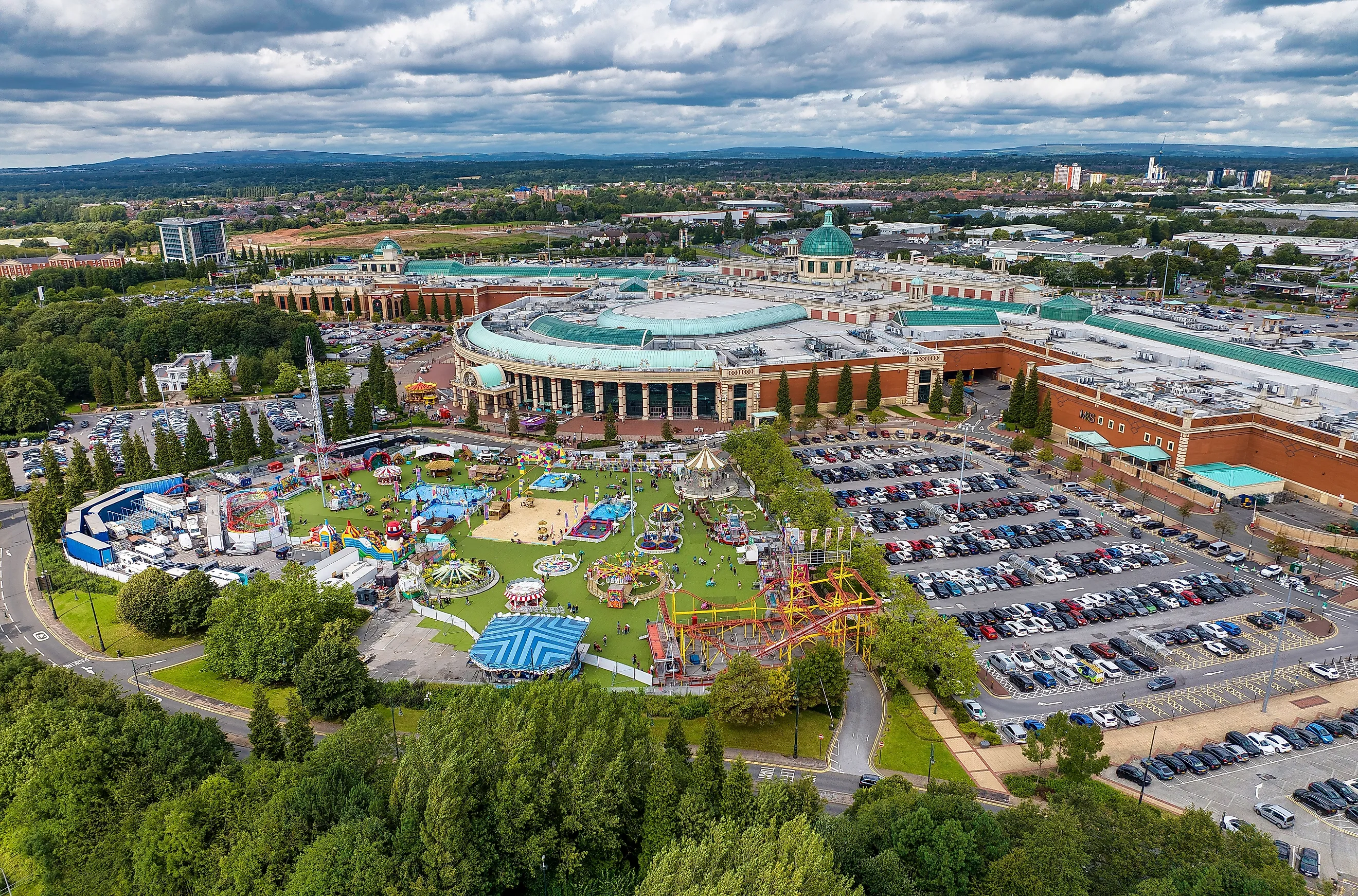
The Trafford Centre near Manchester opened on 10 September 1998 with a gross retail area of 188,000 m² and a total complex size of 207,000 m². It was developed by The Peel Group for around £600 million on land in Dumplington, near the old Trafford Park industrial estate, and its rococo-revival architecture (with marble floors, painted ceilings, gilded statuary, and the steam-ship-themed food court The Orient) was deliberately distinctive in an era of plainer mall design.
The centre houses approximately 200 stores anchored by Selfridges, Marks & Spencer, John Lewis, and Boots, with 11,500 parking spaces and around 30 million annual visitors. The Trafford Centre was sold for £1.65 billion to Capital Shopping Centres in 2011 (later rebranded as intu Properties), then acquired by Canada Pension Plan Investments (CPP Investments) in December 2020 for approximately £800 million after intu's administration. The centre is now managed by Savills under CPP's ownership and has been served since 2020 by a dedicated Manchester Metrolink tram extension.
4. Westfield Stratford City

Westfield Stratford City in east London opened on 13 September 2011 as the main retail anchor of the London 2012 Olympic Park regeneration, with a gross retail area of 184,100 m² and around 280 stores. The development was timed to serve as a key entry point to the Olympic site and remains the primary shopping destination for east London and the Lower Lea Valley redevelopment area.
Anchors include John Lewis, Marks & Spencer, a 60,000 sq ft Waitrose supermarket, and Primark. The centre houses a 17-screen Vue cinema, the largest casino in the UK (Aspers Casino), and two attached hotels (Premier Inn and Holiday Inn). Westfield Stratford City is owned by Unibail-Rodamco-Westfield in partnership with APG Asset Management and CPP Investments, and the centre draws around 47 million visitors per year, making it one of the busiest retail destinations in Europe by footfall.
5. Bluewater

Bluewater in Stone, Kent, opened on 16 March 1999 with a gross retail area of 169,200 m² in a distinctive triangular plan built into a 50-acre former chalk quarry. The centre sits about 28.6 km southeast of central London and is the largest shopping centre in the south east of England outside Greater London, drawing approximately 27 million visitors per year.
The centre houses about 330 stores and 50 restaurants and cafés, anchored by John Lewis and Marks & Spencer. Bluewater also has a 17-screen Showcase Cinema de Lux, around 13,000 parking spaces, and direct rail access via Greenhithe station, around 1.2 km away. The centre is owned by Landsec (Land Securities), one of Britain's largest commercial property companies, which raised its holding to a controlling 66.25 percent in 2024 by buying out other investors, including Singapore's sovereign wealth fund GIC. The remaining stake is held by institutional investors led by Prudential.
6. Bullring Estate (Bullring, Grand Central, and Link Street)
The Bullring Estate in Birmingham combines three connected developments: the original Bullring (opened September 2003), Grand Central (opened September 2015 above the redeveloped New Street railway station), and the Link Street covered walkway connecting the two. The combined complex covers 163,000 m² of retail area and houses around 200 stores.
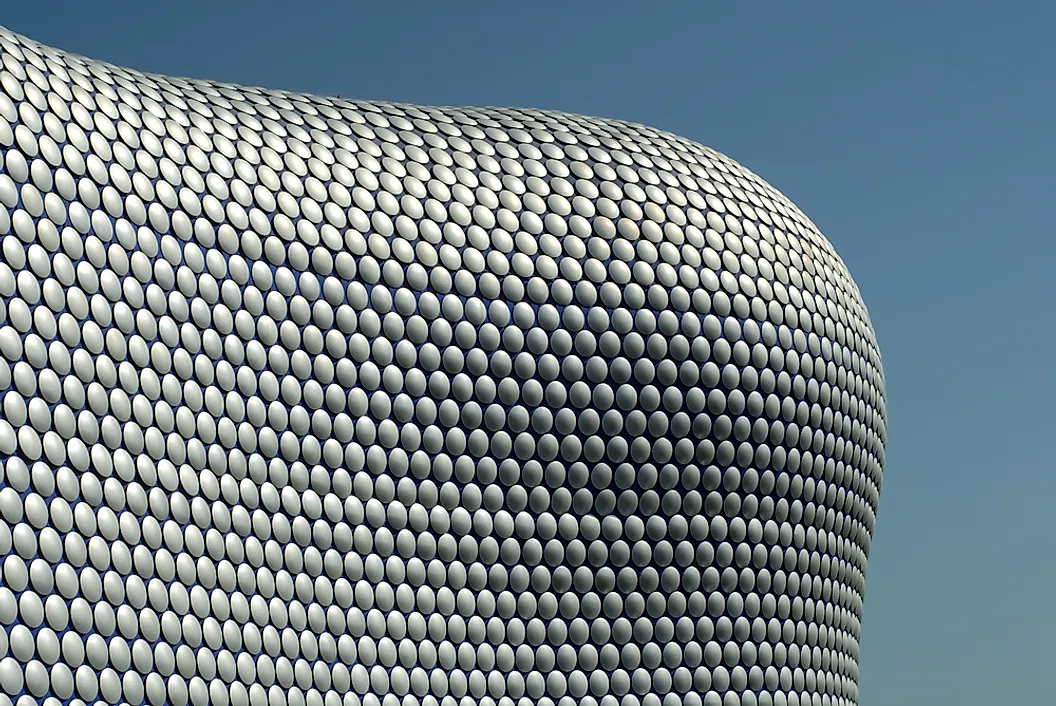
The Bullring's distinctive Selfridges building, designed by Future Systems and clad in 15,000 anodised aluminium discs, has become one of Birmingham's most recognised pieces of contemporary architecture. The Bullring is anchored by Selfridges and Apple, with a Marks & Spencer that opened in 2023 in the former Debenhams space, empty since that chain's 2021 collapse. The estate drew around 40 million visitors a year before the pandemic. Grand Central opened above the station in 2015 with a flagship John Lewis as its anchor, though that store closed permanently in 2020; the centre still adds around 60 stores and direct platform access from New Street station, the busiest rail interchange in the UK outside London. Both centres are owned by a joint venture of Hammerson and Canada Pension Plan Investment Board.
7. Lakeside

Lakeside in Thurrock, Essex, opened in October 1990 with a gross retail area of 161,000 m² across two main shopping levels organised around the man-made lake that gives the centre its name. The development sits about 32 km east of central London just north of the Dartford Crossing on the M25.
The centre houses around 250 stores and is anchored by Marks & Spencer, Next, and Primark, with approximately 27 million annual visitors. Lakeside was one of intu Properties' major assets. After intu collapsed in 2020, the centre passed to the lenders and bondholders of the intu SGS group that owned it, and it is now run by asset manager Global Mutual and property manager Savills, with the portfolio refinanced in 2024. The centre includes a 12-screen Vue cinema, a Hollywood Bowl, around 13,000 parking spaces, and direct rail access via Chafford Hundred station.
8. St James Quarter

St James Quarter in Edinburgh's New Town opened its retail galleria on 24 June 2021 with 79,000 m² of retail space within a total mixed-use district of 158,000 m². The development replaced the brutalist 1970s St James Centre, demolished in 2017, on a 1.7 million sq ft site at the east end of Princes Street.
The galleria houses around 80 retail units and 30 restaurants and bars, anchored by an expanded John Lewis and a five-screen Everyman boutique cinema. The most distinctive element is the W Edinburgh hotel, a 244-room ribbon-shaped building by Jestico + Whiles and Allan Murray Architects that has been variously nicknamed "the walnut whip" and "the golden turd" by Edinburgh residents. The development was built at a cost of approximately £1 billion by a joint venture of Nuveen Real Estate and APG Asset Management, with Unibail-Rodamco-Westfield acquiring a 25 percent stake in October 2025 and announcing plans to rebrand the centre under the Westfield name during 2026.
9. Merry Hill

Merry Hill in Brierley Hill, Dudley, opened in stages between 1985 and 1990 with a current gross retail area of 155,200 m². The centre was built on the former Round Oak Steel Works site at the heart of the Black Country and was the first large-scale out-of-town shopping development in the West Midlands.
The centre houses approximately 200 stores anchored by Next, Primark, Marks & Spencer, and Asda, with around 23 million annual visitors. Sovereign Centros (the same operator that took over Metrocentre) acquired Merry Hill after intu Properties entered administration in 2020. A long-planned £100 million extension to add residential housing and additional retail above the existing centre received outline planning permission from Dudley Metropolitan Borough Council in 2023 and is currently in pre-construction phases.
10. Liverpool ONE

Liverpool ONE opened on 29 May 2008 with 154,000 m² of retail space spread across 42 acres of central Liverpool, making it the largest open-air shopping centre in the United Kingdom. The development was built by Grosvenor on land that had previously been a mix of underused car parks and post-war infill, and was timed to be ready for Liverpool's term as European Capital of Culture in 2008.
The centre houses around 170 retailers anchored by John Lewis and Marks & Spencer, the latter having taken over the former Debenhams in 2023, with brands such as Apple and Hugo Boss among its flagship stores. Leisure facilities include a 14-screen Odeon cinema, an Adventure Golf course, and the Chavasse Park rooftop green space. Liverpool ONE was developed by Grosvenor (the Duke of Westminster's property company), which still manages it, but Landsec acquired a 92 percent controlling stake in December 2024 for £490 million, buying out the Abu Dhabi Investment Authority and Grosvenor. The centre draws more than 20 million annual visitors and has been credited with regenerating a large part of Liverpool's city centre.
The Top 20 UK Shopping Centres By Retail Area
The following table lists the 20 largest UK shopping centres by gross retail area in square metres, per Wikipedia's compiled list and verified against each centre's most recent published figures. Note that "retail area" generally measures leasable retail floor space rather than car parks or surrounding public realm; for some mixed-use schemes, such as St James Quarter, the published figure reflects the total development rather than retail space alone.
| Rank | Shopping Centre | Location | Region | Retail Area (m²) |
|---|---|---|---|---|
| 1 | Westfield London | Shepherd's Bush, London | Greater London | 235,900 |
| 2 | Metrocentre | Gateshead, Tyne & Wear | North East England | 192,900 |
| 3 | Trafford Centre | Trafford, Greater Manchester | North West England | 188,000 |
| 4 | Westfield Stratford City | Stratford, London | Greater London | 184,100 |
| 5 | Bluewater | Stone, Kent | South East England | 169,200 |
| 6 | Bullring Estate | Birmingham | West Midlands | 163,000 |
| 7 | Lakeside | Thurrock, Essex | East of England | 161,000 |
| 8 | St James Quarter | New Town, Edinburgh | Scotland | 158,000 |
| 9 | Merry Hill | Brierley Hill, Dudley | West Midlands | 155,200 |
| 10 | Liverpool ONE | Liverpool | North West England | 154,000 |
| 11 | The centre:MK | Milton Keynes, Buckinghamshire | South East England | 133,416 |
| 12 | Harlequin Watford (Atria) | Watford, Hertfordshire | East of England | 130,064 |
| 13 | Meadowhall | Sheffield | Yorkshire & the Humber | 130,000 |
| 14 | Manchester Arndale | Manchester | North West England | 130,000 |
| 15 | St. David's | Cardiff | Wales | 129,200 |
| 16 | Eldon Square | Newcastle upon Tyne | North East England | 128,700 |
| 17 | Derbion (formerly Intu Derby) | Derby, Derbyshire | East Midlands | 121,000 |
| 18 | East Kilbride Shopping Centre | East Kilbride, Lanarkshire | Scotland | 111,484 |
| 19 | Cabot Circus | Bristol | South West England | 110,100 |
| 20 | Braehead | Renfrew, Renfrewshire | Scotland | 104,300 |