Places In The World Where Lightning Strikes The Most
Lightning occurs unevenly across the Earth's surface, and the most lightning-prone places concentrate in a few specific zones that combine moisture-rich air, mountains or coastlines to lift it, and warm surfaces below to drive convection. The standard global ranking of lightning hotspots comes from a 2016 paper in the Bulletin of the American Meteorological Society by Rachel I. Albrecht (University of São Paulo) and colleagues, which used 16 years of data from the Lightning Imaging Sensor (LIS) aboard NASA's Tropical Rainfall Measuring Mission (TRMM) satellite, in orbit from 1997 to 2015. The satellite covered all latitudes between 38°N and 38°S, which means northern Europe, Canada, and the high-latitude oceans were outside the dataset and do not appear in the top 500. Of those 500 ranked hotspots, 283 are in Africa, 87 in Asia, 67 in South America, 53 in North America, and 10 in Oceania. The single most lightning-prone square kilometer on Earth is in Venezuela, at the southern end of Lake Maracaibo, where the long-recognized phenomenon of Catatumbo lightning produces about 232 flashes per square kilometer per year. The full top ten is below; all rates are flashes per square kilometer per year averaged over the 16-year study period.
Lake Maracaibo, Venezuela (232.52)
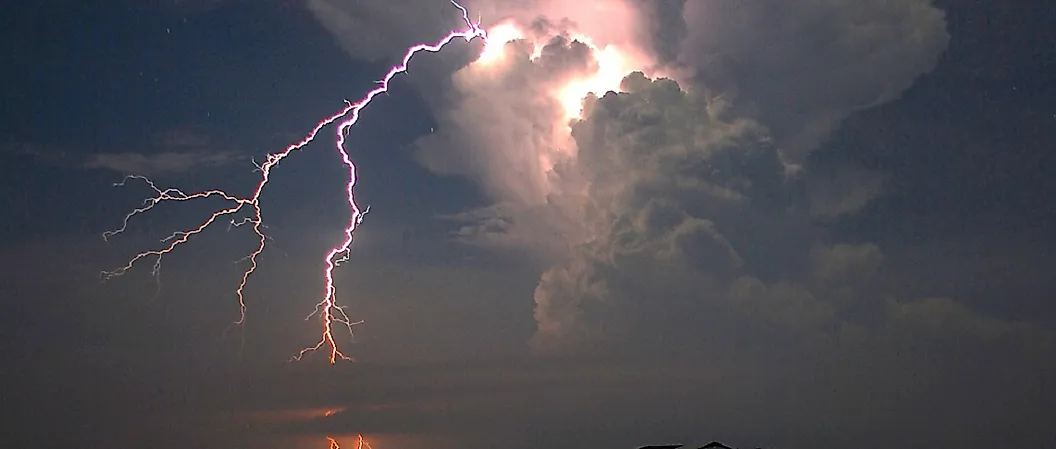
Lake Maracaibo, in northwestern Venezuela, is the largest lake in South America by surface area (approximately 13,210 square kilometers) and the most lightning-prone single location on Earth. The lake is a brackish bay connected to the Gulf of Venezuela through the 3.4-mile-wide Tablazo Strait; its main freshwater source is the Catatumbo River, which enters from the southwest. The Catatumbo lightning phenomenon (also called Relámpago del Catatumbo in Spanish) is concentrated over the southern end of the lake, near the Catatumbo River mouth, and is produced by an unusual convergence of wind systems. Cool air descending the surrounding mountain valleys (the Sierra de Perijá to the west, the Cordillera de Mérida to the southeast, and the Sierra de los Andes more broadly) meets warm, humid air rising from the perennially warm lake surface and the nearby Gulf of Venezuela. The resulting nocturnal thunderstorm activity occurs on an average of 297 nights per year, peaks in September, and is overwhelmingly concentrated between midnight and dawn, with the peak flash rate (about 5.4 flashes per square kilometer per hour) occurring around 3:00 a.m. local time. The phenomenon has been documented for centuries: the Spanish playwright Lope de Vega referenced it in his 1598 epic poem La Dragontea, in which the lightning is credited with foiling a British raid on the city of Maracaibo by Sir Francis Drake, and the lake was historically used as a natural lighthouse by Caribbean sailors. The Catatumbo lightning is overwhelmingly cloud-to-cloud rather than cloud-to-ground, which is why most of the lake's hundreds of millions of flashes have produced relatively few human fatalities despite the population around the lake.
Kabare, Democratic Republic Of The Congo (205.31)
Kabare is a town and administrative territory on the western shore of Lake Kivu in South Kivu province of the Democratic Republic of the Congo, immediately southwest of the regional capital Bukavu. The Kahuzi-Biéga National Park, a UNESCO World Heritage Site known for its eastern lowland gorilla population, lies immediately to the west of the town. Kabare's lightning rate (205.31 flashes per square kilometer per year) is the highest anywhere in Africa, and its position between Lake Kivu (which provides moisture and a warm surface) and the Mitumba mountains (which provide the orographic lift) is the same basic mechanism that drives Lake Maracaibo's lightning at higher intensity. Kabare was historically the principal seat of the Bushi kingdom, one of the small kingdoms of the Great Lakes region before Belgian colonization.
Kampene, Democratic Republic Of The Congo (176.71)
Kampene is a small town in Maniema province of the Democratic Republic of the Congo, on the southwestern edge of the Congo Basin where the basin meets the western edge of the Albertine Rift highlands. The town has been a regional center for artisanal cassiterite (tin ore) and coltan mining since the colonial period. Like Kabare, Kampene sits at the convergence between moist Congo Basin air and the cooler air descending the Albertine Rift, and the resulting nocturnal thunderstorms produce one of the highest sustained lightning rates on the African continent.
Cáceres, Colombia (172.29)
Cáceres is a municipality in the Bajo Cauca subregion of the Antioquia department of Colombia, on the banks of the Cauca River. The town was founded in 1576 by the Spanish captain Gaspar de Rodas, who had been deputized by the colonial governor of Popayán to establish a permanent settlement along the Cauca for gold prospecting and tax collection. The town remains in the country's gold-mining belt today. Cáceres' lightning rate (172.29 flashes per square kilometer per year) reflects its position in the rain-shadow valley where the moist air from the Caribbean meets the rising terrain of the Northern Andes; the same north-Colombian convective regime is responsible for the El Tarra hotspot lower in the top ten.
Sake, Democratic Republic Of The Congo (143.21)
Sake sits at the northwestern tip of Lake Kivu in North Kivu province of the Democratic Republic of the Congo, about 25 kilometers west of the provincial capital Goma. The town has been a strategic crossroads in the eastern Congo conflicts since the mid-1990s and was repeatedly occupied and contested through the M23 rebellion. Geographically, Sake is on the same lake-shore-meets-mountain-rift convergence zone as Kabare, just on the opposite end of Lake Kivu, and the same mechanism produces a similar lightning regime (143.21 flashes per square kilometer per year, fifth globally).
Dagar, Pakistan (143.11)
Dagar is the administrative capital of Buner District in Khyber Pakhtunkhwa province of Pakistan, in the foothills of the western Himalayan range at about 690 meters elevation. The town sits where the broad Indus River plain transitions into the steeper Hindu Kush and western Himalayan topography; humid monsoon air from the south is lifted abruptly by the rising terrain, producing strong summer thunderstorm activity. Dagar's 143.11 flashes per square kilometer per year is the highest rate anywhere in Asia and the highest north of the equator on the continent. The town was briefly held by Taliban forces during the Buner offensive of April 2009 and recaptured by the Pakistan Army the following week; it remains the regional administrative seat.
El Tarra, Colombia (138.61)
El Tarra is a small municipality in the Norte de Santander department of northeastern Colombia, established as a separate municipality on November 26, 1990. The population is approximately 13,000, and the town sits at about 270 meters elevation on the eastern flank of the Catatumbo subregion. The Catatumbo basin (which gives Lake Maracaibo its lightning) extends westward and upward into this part of Colombia, and El Tarra's lightning regime is driven by essentially the same wind-convergence mechanism that produces Catatumbo lightning at the lake. The town has been heavily affected by the long Colombian armed conflict and, more recently, by violence between rival armed groups along the Venezuelan border.
Nguti, Cameroon (129.58)
Nguti is a town in Kupe-Manenguba department of the Southwest Region of Cameroon, with a population of roughly 27,000. The town sits at the southern foot of Mount Manenguba, an inactive volcano that rises to 2,411 meters and forms part of the Cameroon Volcanic Line. The lightning regime at Nguti is driven by the convergence of the cool monsoon airflow from the Gulf of Guinea with the warm continental air rising over the Cameroon highlands; the result is one of the most lightning-prone locations in West Africa, with 129.58 flashes per square kilometer per year.
Butembo, Democratic Republic Of The Congo (129.50)
Butembo is the second-largest city in North Kivu province (after the provincial capital Goma), with a population estimated at approximately 670,000 to over 1 million depending on the source. The city sits in the Mitumba mountain range at about 1,750 meters elevation, on the western flank of the Albertine Rift, and has been one of the major commercial centers of the eastern Democratic Republic of the Congo for a century. The same lake-mountain-rift geometry that produces lightning at Kabare and Sake produces it at Butembo, ranked ninth globally at 129.5 flashes per square kilometer per year.
Boende, Democratic Republic Of The Congo (127.52)

Boende is the capital of Tshuapa province in the central Congo Basin, on the right bank of the Tshuapa River, with a population of about 36,000. Unlike the other African hotspots in the top ten, Boende is not on the Albertine Rift but in the flat heart of the central Congo basin, where the lightning regime is driven by the basin's near-constant high humidity and strong daytime solar heating of the rainforest canopy rather than by mountains. The central Congo Basin had been broadly identified as one of the most lightning-prone regions on Earth in pre-Albrecht satellite studies; the 2016 Albrecht ranking confirmed this and localized the highest single point to Boende. The official language of the town is Lingala.
Why These Specific Places? The Geography Of Lightning Hotspots
Almost every entry in the top ten sits where moist tropical air encounters either steep terrain or a warm body of water (or both) for the wind to converge over. Lake Maracaibo, Kabare, Sake, and Butembo all sit at the meeting of a freshwater lake and a steep mountain front. Dagar sits at the foot of the western Himalayas; Cáceres and El Tarra sit at the eastern foot of the Andes; Nguti sits at the foot of Mount Manenguba on the Cameroon Volcanic Line. Boende and (to a lesser extent) Kampene are the exceptions: both sit in lower-relief terrain, in the heart of the Congo Basin, where lightning is generated more by deep convection over warm wet rainforest than by orographic lift. Six of the top ten are in the Democratic Republic of the Congo specifically because the eastern DRC contains the unique combination of the Albertine Rift (steep terrain), the Great Lakes (warm surface water, including Lakes Tanganyika, Kivu, Edward, and Albert), and the equatorial position that maximizes solar heating. The most lightning-prone single square kilometer in the United States, ranked 122nd globally, is in the Florida Everglades near Orangetree (north of Naples) at 79 flashes per square kilometer per year, well below all ten entries above but well above any other location in North America outside Central America and the Caribbean.