Famous Statues of the United States
A statue, strictly speaking, is a sculpture of a person or animal. The United States has many of those, but the most famous landmarks Americans tend to call statues stretch the definition to include a polished steel sculpture, a 630-foot arch, and the carved presidential faces of an entire mountainside. What follows is a tour of the country's most famous statues, broadly defined, ranging from a weathered copper figure that has stood for well over a century to a mirror-finished sculpture in Chicago that the public knows by a nickname rather than its given name. What unites them is fame more than form.
Statue of Liberty, New York

The most famous statue in the country was not made here. Lady Liberty was a gift from France, designed by sculptor Frederic Auguste Bartholdi, shipped across the Atlantic in 350 pieces, and dedicated on what is now Liberty Island in 1886. She is built of copper sheets roughly the thickness of two pennies, which is why the surface oxidized from shiny brown to its familiar green over several decades of weathering. A detail often misremembered: before the full statue arrived, the torch-bearing arm went on tour, displayed at the 1876 Centennial Exposition in Philadelphia and later in Madison Square Park, where visitors could pay to climb up inside the torch. The torch has been closed to the public since 1916, but the touring arm did its job, helping raise the money to complete the rest of the statue.
Abraham Lincoln, Washington, D.C.

Seated at the west end of the National Mall, the 19-foot marble Lincoln has presided over the Lincoln Memorial since 1922, carved by the Piccirilli Brothers from a design by Daniel Chester French. The statue has collected its share of folklore, the most persistent being that Lincoln's hands subtly form the letters A and L in sign language, a supposed nod to his founding of a university for the deaf. The National Park Service says this was never intended, and the resemblance is coincidental.
Mount Rushmore, South Dakota

Mount Rushmore is a carved relief rather than a freestanding statue, but it is too famous to leave off any list like this. Sculptor Gutzon Borglum and a crew of some 400 workers carved the 60-foot faces of George Washington, Thomas Jefferson, Theodore Roosevelt, and Abraham Lincoln into the granite of the Black Hills between 1927 and 1941, using dynamite for most of the rough excavation. Borglum died months before the work ended, and his son Lincoln saw it to completion. The original design called for the presidents to be rendered down to the waist, but funding ran short, which is why the memorial shows only the four heads.
Cloud Gate, Chicago

The mirror-polished sculpture in Chicago's Millennium Park is officially named Cloud Gate, a title chosen by its creator, British artist Anish Kapoor. To most Chicagoans, though, it is simply The Bean, after its rounded shape, a nickname Kapoor is said to have initially disliked but that has long since stuck. Built between 2004 and 2006 from 168 stainless steel plates welded so that the seams are nearly invisible, its curved surface reflects and distorts the surrounding skyline. It is one of the few entries here that is unambiguously a sculpture in the traditional sense.
Christ of the Ozarks, Arkansas

Rising around 65 feet tall, with an arm span of about the same width, this figure of Jesus with outstretched arms stands atop Magnetic Mountain near Eureka Springs, Arkansas. It was completed in 1966 as the centerpiece of a planned religious attraction. The sculptor, Emmet Sullivan, had earlier worked on dinosaur figures for roadside parks, and critics have long noted the statue's boxy, minimalist form, sometimes likening it to a milk carton. It remains a genuine landmark of the Ozarks and the anchor of a long-running outdoor passion play.
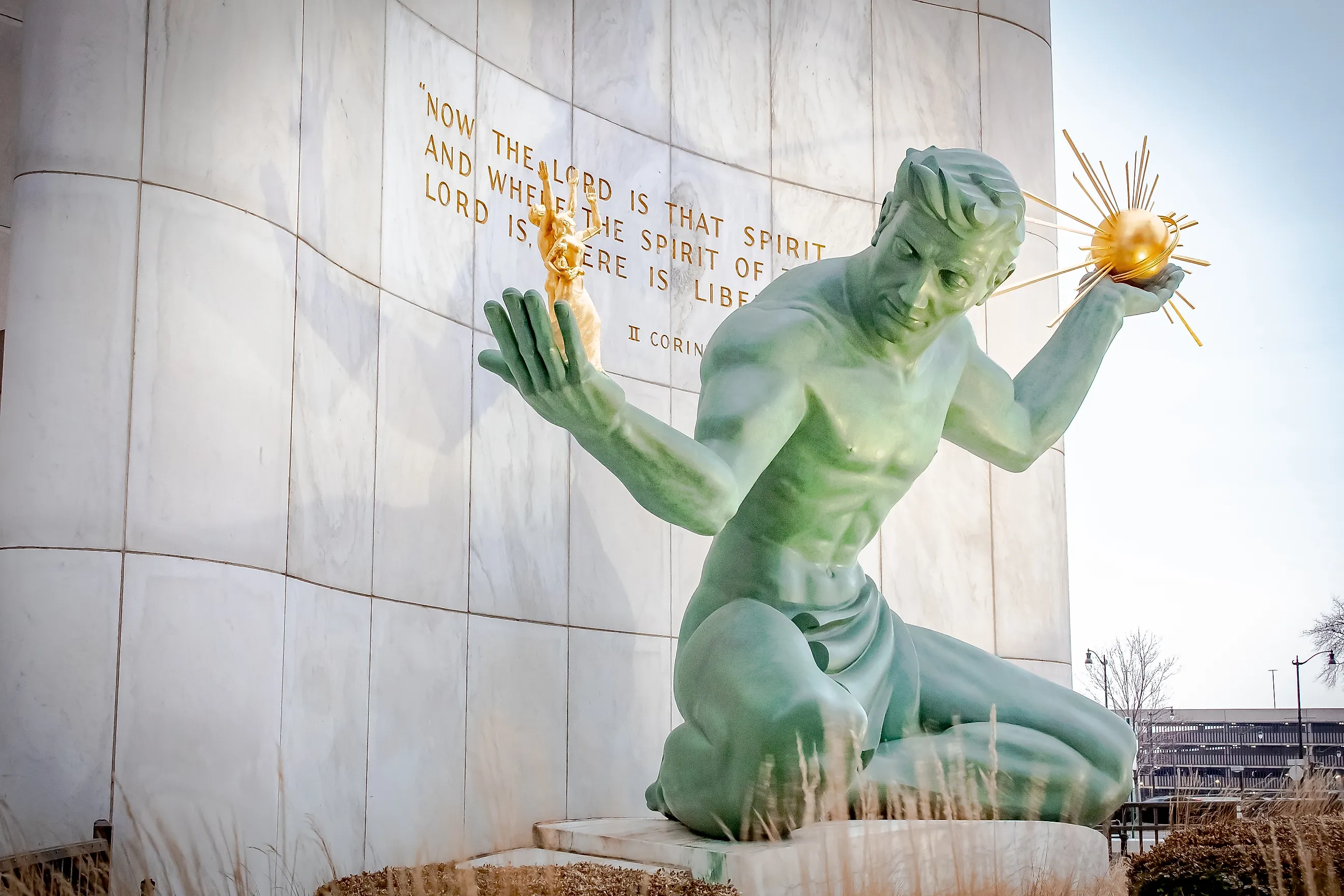
The Spirit of Detroit, Michigan

This 26-foot seated bronze figure on Woodward Avenue, sculpted by Marshall Fredericks and dedicated in 1958, was the largest cast bronze statue made since the Renaissance at the time it was installed. It holds a gilded sphere representing God in one hand and a family group symbolizing human relationships in the other. Detroiters have embraced it as an unofficial symbol of the city, to the point that when a local sports team makes a deep playoff run, the statue is often dressed in an oversized team jersey.
The Library Lions, New York

The pair of marble lions flanking the main entrance of the New York Public Library have guarded the building since 1911, and they have gone through several names over the years. They were first called Leo Astor and Leo Lenox, after the library's founders, then Lord Astor and Lady Lenox, despite both being male. During the Great Depression, Mayor Fiorello La Guardia renamed them Patience and Fortitude, the qualities he felt New Yorkers needed to endure it, and those names have stuck ever since. Carved by the Piccirilli Brothers, they are among the most photographed sculptures in the city.
This Is the Place Monument, Utah

At the mouth of Emigration Canyon on the east side of Salt Lake City stands the This Is the Place Monument, dedicated in 1947 on the 100th anniversary of the Mormon pioneers' arrival in the Salt Lake Valley. The name comes from the words Brigham Young is said to have spoken upon seeing the valley: "This is the right place, drive on." The monument was sculpted by Mahonri Young, who happened to be Brigham Young's grandson, which makes it one of the few major American monuments built by the literal descendant of the man it honors.
Statue of Commodore John Barry, Pennsylvania

Standing behind Independence Hall in Philadelphia, this bronze statue honors Commodore John Barry, an Irish-born naval officer often called the Father of the American Navy for commanding the first US warship commissioned under the new Constitution. The 1907 work is one of several statues around the country dedicated to Barry, who is claimed with pride by both the United States and Ireland. It is also the most conventional entry on this list: a real historical figure, depicted standing, in the traditional form of a commemorative statue.
The Gateway Arch, Missouri

The final entry is the one that stretches the definition furthest. The Gateway Arch in St. Louis, completed in 1965 and designed by architect Eero Saarinen, rises 630 feet, making it the tallest arch in the world and the tallest man-made monument in the Western Hemisphere. A tram inside carries visitors to an observation deck at the top. It was built to commemorate the westward expansion of the United States. It is not a statue in any strict sense, but as one of the country's most recognizable monuments, it belongs in any survey of America's landmark sculpture and memorials.
Landmarks First, Sculptures Second
What stands out about America's most famous statues is how many of them are not statues in the strict sense. A copper figure from France and a bronze commodore fit the traditional definition, while the others stretch it: a mountainside relief of four presidents, an arch tall enough to require elevators, and a steel sculpture better known by its nickname. What ties them together is recognition rather than form. Each has become so closely identified with its city or state that its precise category matters less than its place in the landscape, and the country is more recognizable for all of them.