7 Best Places To Retire In Scotland
Scotland's retirement appeal sits in a few specific places. House prices are far below the UK average across most of the country, and the Lloyds Bank Coastal Homes Review for 2024 found that nine of Britain's ten cheapest coastal towns are in Scotland. NHS-provided healthcare is free at the point of use, and a rail and bus network connects most small towns to the cities with relatively short transfer times. The seven towns below cover the geographic range, from the central Lowlands at Stirling to the Kintyre Peninsula at Campbeltown and Tarbert, the east coast at Montrose, the Borders at Galashiels, and the Ayrshire coast at Irvine and Saltcoats. Each is a working town with a population between roughly 1,000 and 40,000, and each has the basic infrastructure (general practice, secondary school, supermarket, train or bus connection) a retiree needs day to day.
Stirling

Stirling is the smallest by population of Scotland's eight cities (granted city status in 2002 with a current population of about 37,000) and the most central, sitting at the historical narrowest crossing between the Highlands and the Lowlands. The reason every army that mattered in Scottish history ended up at Stirling is the same reason the castle is there: the River Forth narrows here, the volcanic crag dominates the surrounding plain, and whoever holds the rock controls the route north. Stirling Castle, first referenced in a charter of Alexander I around 1110, was the principal royal residence for the Stewart kings and queens through the sixteenth century. The Church of the Holy Rude, on the slope below the castle, is where the infant James VI was crowned king on July 29, 1567 after his mother Mary Queen of Scots was forced to abdicate. The National Wallace Monument on Abbey Craig, a 220-foot Victorian tower commemorating William Wallace's 1297 victory at the Battle of Stirling Bridge, was constructed between 1861 and 1869 and is open year-round. Direct trains run to Glasgow Queen Street (about 30 minutes), Edinburgh Waverley (about 50 minutes), and London King's Cross via Edinburgh. Forth Valley Royal Hospital, the main NHS Forth Valley general hospital, is at Larbert, about 10 miles southeast of the city.
Irvine

Irvine is on the Firth of Clyde in North Ayrshire, about 25 miles southwest of Glasgow by direct train, and is the largest of the towns on this list with a population of approximately 33,000. The town has two parallel histories: the original burgh of Irvine on the Annick Water, which was a major royal burgh and one of medieval Scotland's principal west-coast ports until silting reduced its harbor, and the post-1966 designated New Town that absorbed Irvine and several surrounding villages and was the only Scottish new town actually on the coast. The Scottish Maritime Museum at the old harborside holds the national maritime collection, including the MV Spartan, the last Scottish-built Clyde puffer. Puffers were the small coastal cargo vessels that supplied the west coast and the islands through the early twentieth century. Eglinton Country Park, on the north side of the town, is the former 400-hectare estate of the Earls of Eglinton; the central Eglinton Castle was built between 1796 and 1802 by Hugh Montgomerie, 12th Earl of Eglinton, partly unroofed in 1925, and now stands as a ruined shell within the park. Ayrshire Central Hospital is in the town and provides mental health and older adult services; the main acute district hospital for the area is University Hospital Crosshouse near Kilmarnock. The cost of living in Irvine is approximately 13 percent below the UK average per the ERI Economic Research Institute.
Campbeltown

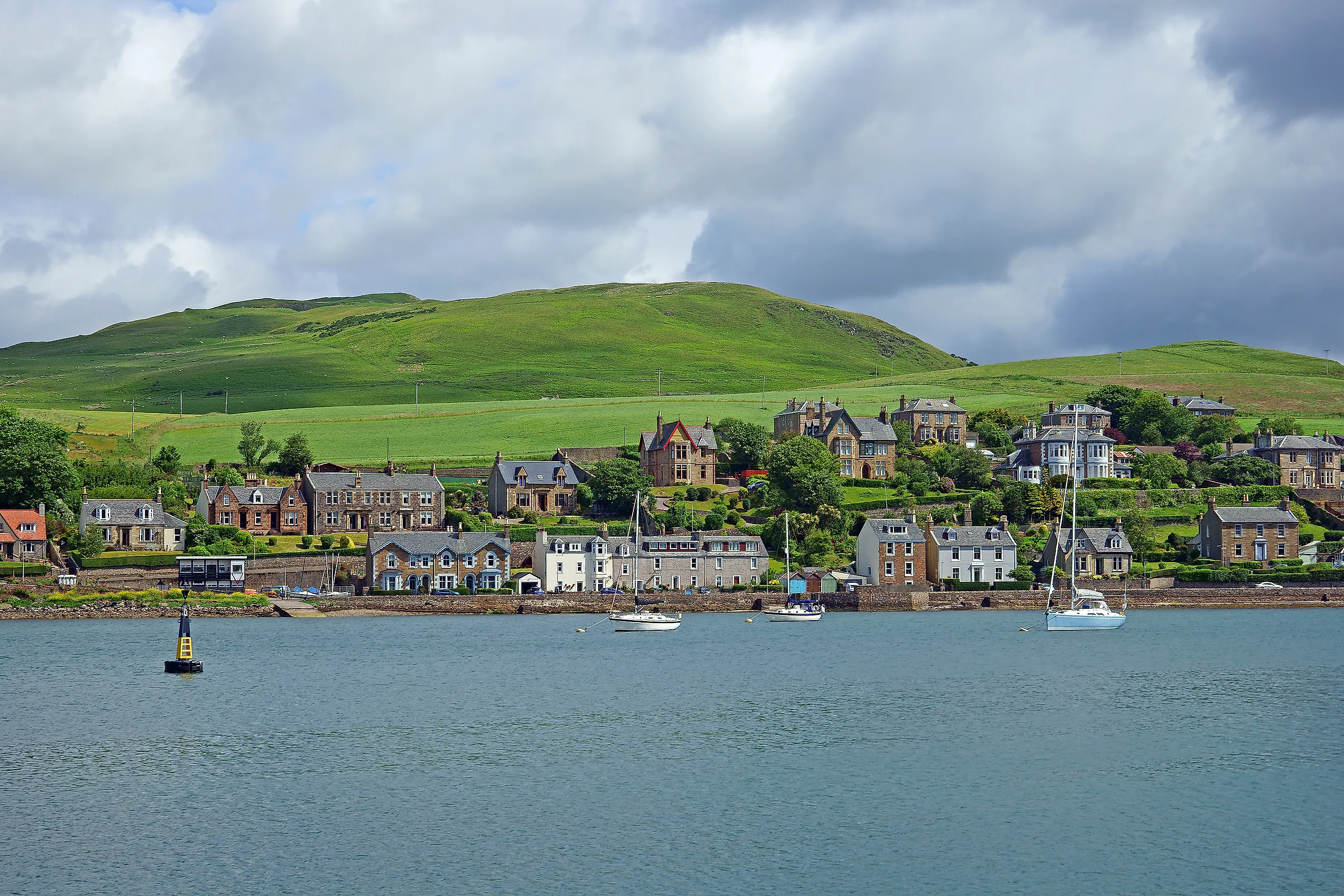
Campbeltown was the cheapest coastal town in Britain in the most recent comprehensive review of UK coastal house prices, the Lloyds Bank Coastal Homes Review published in May 2025, with an average house price of £103,078. That was down about 11 percent year-on-year, against a UK coastal average of £295,991. The town sits near the southern end of the Kintyre Peninsula in Argyll and Bute, about a four-hour drive or three-hour ferry-plus-bus journey from Glasgow, and that remoteness is both the reason house prices are low and the reason the town has held onto its population better than many similarly priced UK coastal towns: the residents who are there have actively chosen the trade-off. Campbeltown was once one of the major whisky-producing centers of Scotland, with more than thirty distilleries operating in the late nineteenth century. Three are still active today: Springbank, Glengyle, and Glen Scotia. Springbank is unusual in still doing every stage of production (floor malting through bottling) on the same site, one of only a handful of Scottish distilleries that still does so. Campbeltown Loch, which the town faces, has Davaar Island at its mouth; the tidal causeway connecting Davaar to the mainland is walkable at low tide, leading out to the 1854 Davaar Lighthouse and to a cave on the south side where local artist Archibald MacKinnon secretly painted a crucifixion scene on the wall in 1887. Campbeltown Hospital provides general medical and emergency services in the town.
Tarbert

Tarbert is a small fishing village at the head of East Loch Tarbert on the northeast side of the Kintyre Peninsula, with a population of approximately 1,300. The over-65 share of the population is well above the Scottish national average of around 19 percent, which makes Tarbert a quietly retiree-heavy community without being one of the more advertised retirement destinations. The harbor is still a working fishing harbor, with langoustine and scallop boats landing daily, and the catch is the basis of the annual Tarbert Seafood Festival in early July. Tarbert Castle, on the hillside above the harbor, has a stone keep dating to the late thirteenth century and accounting records prepared for Robert the Bruce in the early fourteenth that are among the earliest documents in the Exchequer Rolls of Scotland. Two short walking trails lead from the harbor up around the castle: Tarbert Castle Trail for East Loch Tarbert views, and Corranbuie Trail for views of Loch Fyne, one of the longest sea lochs in Scotland at about 41 miles. Shell Beach, north of the village, is a small beach that is genuinely made of broken shells rather than sand. The nearest hospital is the Mid Argyll Hospital and Community Care Centre at Lochgilphead, about 12 miles north.
Montrose

Montrose sits on the Angus coast about halfway between Dundee and Aberdeen, between the North Sea and the large tidal lagoon of Montrose Basin, with a population of about 12,000. The Basin is a Site of Special Scientific Interest and an internationally important overwintering ground for pink-footed geese, with up to 80,000 birds in residence at peak in October and November. Montrose Beach stretches three miles north from the town toward the mouth of the North Esk. The Scurdie Ness Lighthouse, built in 1870 to a design by David and Thomas Stevenson, marks the south side of the harbor entrance. Montrose Air Station, two miles north of the town, is the oldest operational military air station in Great Britain (opened in 1913 as a Royal Flying Corps base) and now houses an aviation museum covering 113 years of military aviation history. House of Dun, four miles west of the town overlooking the Basin, is a neo-Palladian country house designed by William Adam and built between 1730 and 1743 for the Erskines of Dun; the surrounding parkland includes a stand of Wellingtonia (giant sequoia) planted in the 1850s, among the oldest such specimens in Scotland. Average property selling price in Montrose was about £147,000 in mid-2026 per OnTheMarket. Stracathro Hospital, about ten miles west near Brechin, provides general NHS Tayside services.
Galashiels

Galashiels is the principal market and textile town of the Scottish Borders, with a population of about 14,000 and a fifty-minute direct rail link to Edinburgh on the Borders Railway, which reopened in 2015 after the original line had been closed in 1969. The town's textile industry, centered on tweed and tartan production from the eighteenth century onward, supported a dozen mills at its peak; only a few specialist producers still operate, but the buildings still shape the town center. The Great Tapestry of Scotland, permanently exhibited in a purpose-built gallery on the High Street since 2021, is a 165-panel embroidered tapestry depicting Scottish history from the late Devonian period through the present, the work of more than a thousand volunteer stitchers across Scotland between 2012 and 2013. Old Gala House, the former town house of the Lairds of Galashiels, contains a small local-history museum with a painted ceiling dated to 1635. Torwoodlee Tower, on the hill above the town, is a sixteenth-century tower house built in 1601 on land that the Pringle family had owned since 1501 and that the Pringles still hold. Borders General Hospital, the main NHS Borders acute hospital, is three miles east of the town at Melrose. Average property selling price in Galashiels was about £152,000 in mid-2026 (compared to about £344,000 in Edinburgh).
Saltcoats

Saltcoats is a small coastal town in North Ayrshire on the Firth of Clyde, immediately south of Ardrossan, with a population of about 10,000. The name reflects the medieval salt-panning operations on the shore that produced the town's first economy. The principal contemporary draw is the direct ferry from Ardrossan harbor (a ten-minute walk from Saltcoats) to Brodick on the Isle of Arran, which makes Saltcoats one of the most affordable Scottish coastal towns with a regular ferry link to a major island. The Isle of Arran is sometimes called Scotland in miniature for its variety of landscapes within a small area: granite peaks in the north, sedimentary geology in the south, and the Highland Boundary Fault running diagonally through the island. From the Saltcoats and Ardrossan shore, the granite peaks of Arran and the small lighthouse on Pladda Island (off Arran's south coast) are visible across the firth. Direct trains run to Glasgow Central in about 43 minutes. Portencross Castle, a red sandstone tower house with a hall-house core dating to the mid-fourteenth century, stands about four miles north of Saltcoats at West Kilbride. University Hospital Crosshouse near Kilmarnock is the main acute hospital for the area. The 2024 Lloyds Coastal Homes Review listed Saltcoats among the more affordable Scottish coastal towns alongside the Kintyre and Bute towns.
Retirement Costs And Tax Treatment
The cost picture for retirees in Scotland differs in a few important ways from the rest of the UK. Scottish Income Tax has different bands and rates from the rest of the UK and is set by the Scottish Parliament rather than Westminster. The personal allowance and the rates that apply to UK-wide income such as pensions remain devolved at the UK level. Council tax in most of these towns sits in Bands A through D, which puts the typical annual bill in the range of about £1,200 to £2,200, broadly comparable to the equivalent English bands. House prices in all seven of these towns sit well below the Scottish average, and Scotland's average sits well below the UK average; the Land of Burns and Borders is one of the cheapest places in the UK to buy property of any kind. Healthcare is provided through NHS Scotland and is free at the point of use, including hospital treatment and most prescriptions; dental and ophthalmic services have some patient charges. The most relevant climate consideration for retirees is that Scotland is wet and grey rather than cold. Stirling averages about 1,300 mm of rainfall a year and Tarbert about 1,500 mm, against London's roughly 600 mm. The west-coast towns are warmer in winter than their latitude would suggest, because of the North Atlantic Drift.