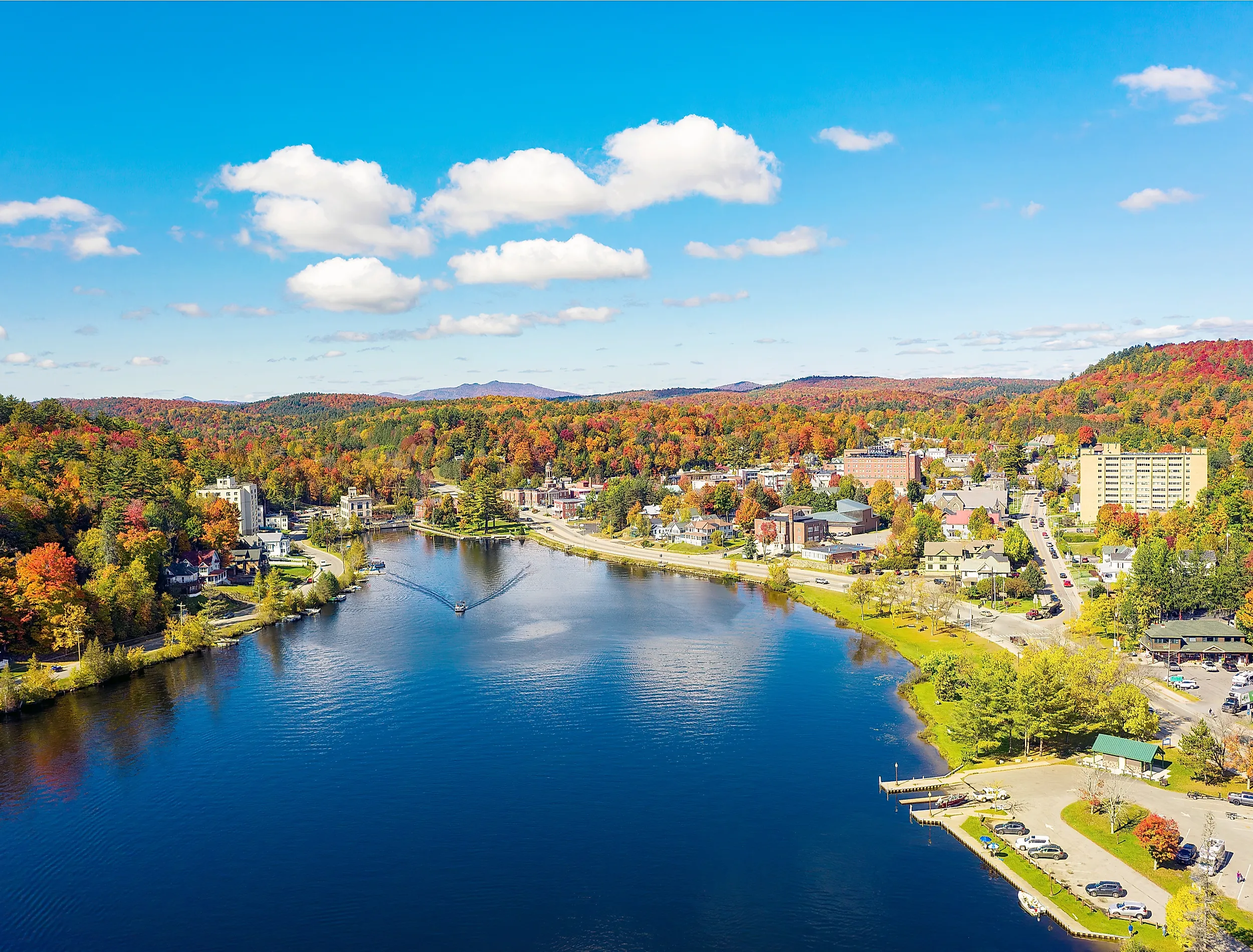
5 of the Most Charming Small towns in The Adirondack Mountains
Walk around Saranac Lake and you will notice the porches. They are too big for the houses, wrapped around corners, glassed in on one side. They were built that way on purpose, back when doctors sent tuberculosis patients up here to sit outside in the cold and get better.
That is the sort of thing the Adirondack Mountains are full of. The villages inside Adirondack Park are small, a few hundred to a few thousand people, and each one has held onto its own personality. Here are five worth the drive.
Saranac Lake

Saranac Lake spent about a century as a health resort, and the whole village is shaped by it. Dr. Edward Livingston Trudeau opened his tuberculosis sanatorium here in the 1880s, patients arrived by the thousands, and the town built hundreds of cure cottages with those porches to house them. You can still pick them out on a walk through the residential streets.

The Saranac Laboratory Museum is the best place to understand it. The building is Trudeau's own 1894 laboratory, the first in the country built to study tuberculosis, and it has been restored with the original equipment. Robert Louis Stevenson came for the cure in the winter of 1887, and the cottage he rented is now a small museum full of his things, cigarette burns on the mantel included.
Then there are the trails. Baker Mountain starts practically in the village and takes under an hour, and Ampersand and Scarface are close by for something longer. The Adirondack Rail Trail now runs a paved corridor out of town toward Lake Placid and Tupper Lake, which has made the whole area a great deal easier to bike.
Lake Placid

Fewer than 2,500 people live in Lake Placid, which is a strange fact about a village that has hosted the Winter Olympics twice, in 1932 and again in 1980. The Olympic Center on Main Street still has the arena where the US hockey team beat the Soviets, and the museum inside covers both Games.

Most of the venues are still running, and most of them will let you have a go. You can ride a bobsled down the track at Mount Van Hoevenberg with a professional driver, take the elevator up the ski jump tower for the view, or ride the gondola at Whiteface. One thing worth knowing: Whiteface Mountain is not actually in Lake Placid. It sits about 13 miles northeast in Wilmington, which is a short drive but not a walk.
In the village itself, Mirror Lake is the water you see from Main Street, and you can paddle it, swim it, or walk the loop around it in about an hour. Lake Placid proper is the larger lake just behind.
Old Forge

Old Forge sits at the southwestern corner of the park, at the bottom end of the Fulton Chain of Lakes, and it is the gateway most people from Utica and Syracuse come through. About 750 people live here. Inlet, another small hamlet worth a stop, is roughly 12 miles further up Route 28, and the two are often mentioned together, though they are separate places.
The Fulton Chain is the draw. Eight connected lakes run northeast from town, and you can paddle a good stretch of them without portaging much, which is why Old Forge anchors the start of the 90-mile Adirondack Canoe Classic every September. In winter the town becomes a snowmobile hub, with hundreds of miles of groomed trail leaving from the middle of the village.
For families, Enchanted Forest Water Safari has been operating since 1956 and is the largest water theme park in New York. McCauley Mountain handles the skiing, with a chairlift that runs in fall for the foliage.
Long Lake

Long Lake is barely a town at all, with something under 800 residents spread along a lake that runs about 14 miles and is rarely more than a mile wide. It is really a widening of the Raquette River, which is why it works so well for paddling: you can put in at the town beach and keep going for days if you want, all the way to Tupper Lake through a chain of waterways.
The floatplane is the local landmark. Helms Aero Service has flown sightseeing trips off the lake for decades, and twenty minutes in the air over the High Peaks is the single best way to understand how much forest is out there. Buttermilk Falls, a few miles north on the North Point Road, is an easy stop with a short walk to the water.
One correction worth making if you have an old guidebook: the museum people mean when they say the Adirondack Museum is now called the Adirondack Experience, and it is not in Long Lake. It is in Blue Mountain Lake, about 12 miles south, spread over 23 buildings and 121 acres, and it is open from late May to mid-October. It is absolutely worth the drive.
Tupper Lake

Tupper Lake has the Wild Center, and that alone justifies the trip. It is a natural history museum on an 81-acre campus that opened in 2006, with live otters and trout inside and, outside, the Wild Walk: more than a thousand feet of bridges and platforms that climb into the treetops and finish at a four-story treehouse and a spider's web you can lie down in. Readers of USA Today voted it the best science museum in the country in 2024.

The other thing here is the sky. Tupper Lake is dark enough that the Adirondack Sky Center and Observatory runs public viewing nights through the year, and you do not need a telescope of your own to join.
Beyond that it is a working town of roughly 3,500 with a Main Street of small businesses, a municipal park with a beach and picnic pavilions, and trails in every direction. Coney Mountain, just south of town, is a short climb with an open summit and a view over the whole lake basin.
In Summary
These five sit inside a park of about six million acres, which is larger than Yellowstone, Yosemite, Grand Canyon, Glacier, and Great Smoky Mountains combined, and roughly half of it is privately owned. That is the thing that makes Adirondack towns different from towns in other mountain regions: people actually live here, year-round, inside the park boundary, and have for generations. Saranac Lake and Tupper Lake are the ones with something to see indoors when it rains. Lake Placid has the Olympic machinery. Old Forge and Long Lake are where you go to get on the water. Any of them makes a decent base for a weekend, and they are close enough together that you do not have to pick just one.