10 Amazing Montana Day Trips That Are Worth The Drive
Within a short and scenic drive from Montana's major airports, national parks, Rocky Mountain subranges, and dinosaur-laden badlands await. An early start from Glacier might find you driving along a ridge on the Going-to-the-Sun Road or dipping a paddle in Flathead Lake. Bozeman is the gateway to Big Sky, where you can choose between exploring mountain peaks and rafting through canyons, and it is also a great home base from which to visit some of Yellowstone National Park's most iconic sights. Meanwhile, aspiring paleontologists can check out the Museum of the Rockies or go big on the Montana Dinosaur Trail. No matter your preference or starting point, these ten amazing day trips cover all four seasons and showcase some of the very best of Montana's historic, cultural, and natural wonders.
Glacier Day Trips
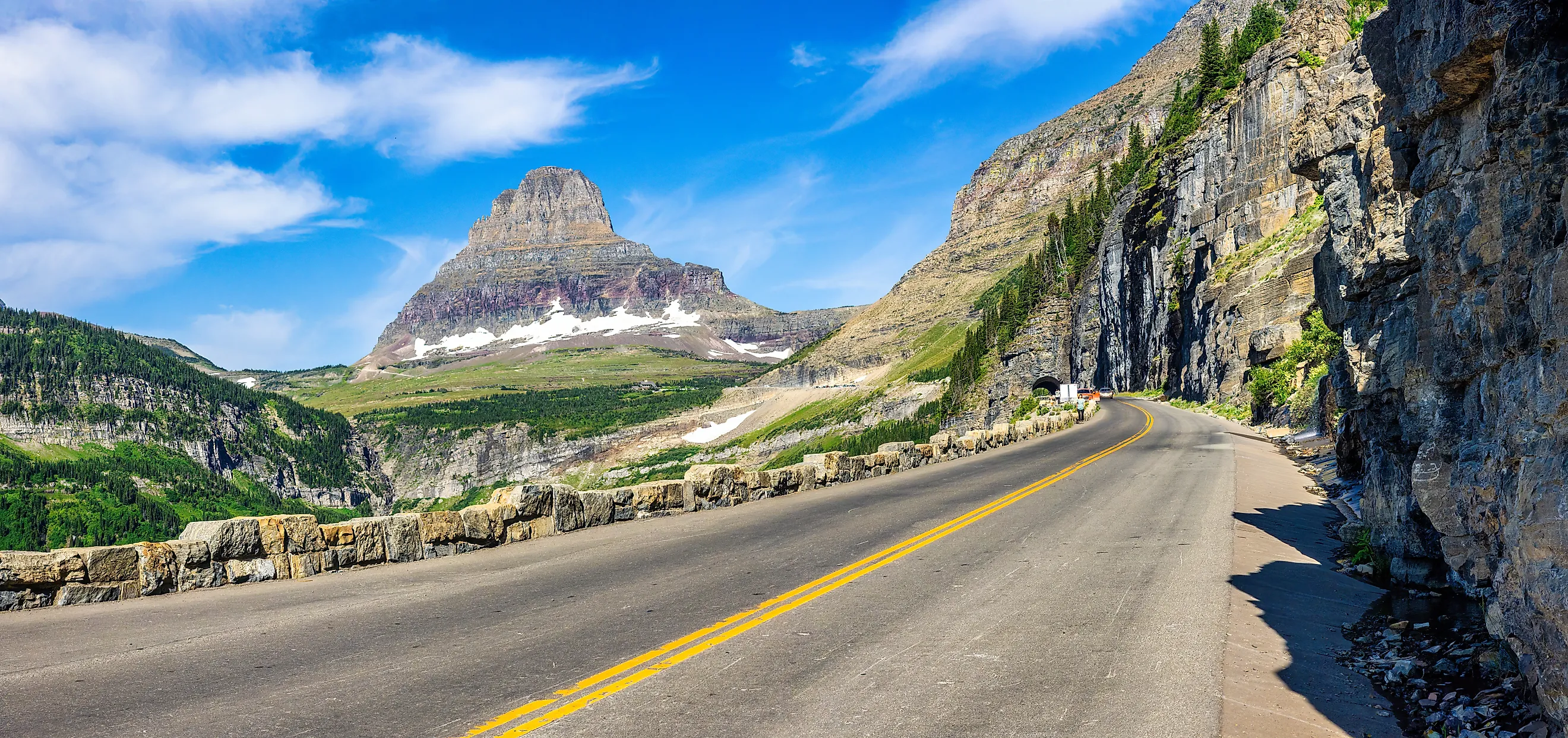
Going-to-the-Sun Road

The Going-to-the-Sun Road bisects Glacier National Park, taking motorists up and over the Continental Divide. Throughout this 50-mile journey, alpine lakes, cedar forests, glacier viewpoints, waterfalls, and panoramic vistas dominate the view through the windshield. Given the winding nature of the road and leisurely pace of traffic, GTSR takes about two hours to complete, but longer if you decide to stop for photo breaks, which you definitely will, or for the boardwalk hike atop Logan Pass, which you definitely should.
Glacier Park International Airport is the closest transport hub, sitting approximately 25 miles southwest of the West Entrance to the park, and equidistant from the towns of Whitefish and Kalispell, which are both excellent base camps for out-of-towners. Upon reaching the St. Mary Entrance/Terminus, you'll have your choice of doubling back on the road or taking the Montana Scenic Loop, which is over double the distance but takes roughly the same amount of time.

Note that the entirety of GTSR is only open during the fair-weather season, which is typically late June through October, and while vehicle reservations have historically been required, Glacier is doing away with these for 2026. Instead, the park will be enforcing a three-hour parking limit at Logan Pass. The park also offers regular shuttles for anyone wanting to simply enjoy the views with a hop-on, hop-off approach to popular stops.
Flathead Lake

With Glacier Park International Airport as a continued base, day-trippers can delve deep into another of northern Montana's premier natural attractions, Flathead Lake. At nearly 30 miles long and 15 miles wide, this natural freshwater body is the largest of its kind west of the Mississippi. Along with its four surrounding mountain ranges, Flathead Lake is graced by several magnetic towns and state park units. Linking Montana Highway 35 and US Route 93 ensures that all of the key attractions are seen, while delivering a 2+ hour shoreline drive that is a worthy undertaking unto itself.

Going clockwise from the airport, the artsy and nature-based community of Bigfork will be the first stop. Do a bit of boutique shopping along Electric Avenue or hike the Swan River Nature Trail and then head next door to Wayfarers State Park for a bit of swimming, paddling, or cliff diving. Wayfarers is actually a unit of Flathead State Park. Next up, we have Yellow Bay, another scenic swimming area, followed by Finley Point, and lastly, West Shore, with its wide open mountain views and glacially-carved rock formations.
The southern half of Flathead Lake dips into the Flathead Reservation, with the shoreline community of Polson acting as the commercial focal point for the Bitterroot, Salish, Kootenai, and Pend d'Oreilles tribes. Polson is also known for its cherry orchards and annual Cherry Festival — a great excuse for a different kind of pit stop (get it?). On the western side of the lake, Wild Horse Island is exactly what it sounds like. If you've got the time and access to a boat, it's worth the trip.
Lone Pine State Park & Kalispell

One last day trip worth taking before flying out of Glacier Park International Airport is to Lone Pine State Park. Just a quick drive from Kalispell via Foys Lake Road, Montana's second-oldest state park sits atop a panoramic bluff with a network of multi-use forested trails to boot. Lone Pine State Park affords views not only of the spirited city below, but the lengthy Swan Range, the north end of Flathead Lake, and on a clear day, even a glimpse of Glacier National Park. In short, Lone Pine State Park puts a bow on the three aforementioned day trips, while also offering a unique and hassle-free experience of its own.

When you've had your fill of that fresh mountain air, cap things off with a mini tour of Kalispell. Its rustic sandstone Main Street is contrasted nicely by the opulent and fully restored Conrad Mansion Museum (circa 1895) and complemented by the Northwest Montana History Museum.
Bozeman Day Trips
Big Sky

An hour south of the popular college town of Bozeman, the village of Big Sky introduces an unrivaled blend of manicured recreation and community events. First and foremost, Big Sky's Mountain Village is where wintertime visitors will find one of the biggest ski resorts on the continent. But Big Sky Resort doesn't just prosper in the snow. In fact, there are approximately 50 miles of lift-serviced trails for hikers and mountain bikers to rip, plus ziplines, climbing walls, and restaurant patios for the whole family to enjoy.

Way down below, where Highway 191 hugs the Gallatin River, Big Sky's Canyon Village opens the door to whitewater rafting and horseback riding tours. And in between, Big Sky's Meadow Village is home to the lovely and popular Ousel Falls Trail and hosts the recurring Music in the Mountains concert series, as well as a slew of other summertime festivities.
Yellowstone National Park

Yellowstone National Park sprawls predominantly across the state of Wyoming, but its primary attractions are best accessed via Montana. Having arrived at Bozeman Yellowstone International Airport, there are a few ways to explore the northwest portion of America's oldest national park. It all depends on your personal priorities and allotted time.

For a quick peek at the big hitters, drop down to West Yellowstone via Highway 191, a journey of 90 miles and a little over 1.5 hours. From there, continue on 191 east and then south, which will introduce you to the colorful Grand Prismatic Spring, the Old Faithful geyser, and the roadside Kepler Cascades. All three of these attractions are within 30 miles of West Yellowstone.

The medium loop option would include backtracking on 191 until the intersection with Grand Loop Road that leads first toward the border town of Mammoth, WY, and then all the way up to the lively Wild West city of Livingston, 25 miles east of Bozeman. This add-on will unveil Gibbon Falls, the Norris Geyser Basin, and the Mammoth Hot Springs. Finally, if you're feeling extra adventurous, after passing Kepler Cascades, link up with the east side of Grand Loop Road via Yellowstone Lake and the Continental Divide, for all sorts of additional geothermal features and inspiring viewpoints en route back up to Mammoth, Livingston, and Bozeman.
Hyalite Canyon Recreation Area

As compelling as Yellowstone and Big Sky may be, one need not stray nearly as far from Bozeman to experience some of Montana's raw wilderness. Case in point, the Hyalite Canyon Recreation Area awaits just minutes south of the city. Part of the broader Custer-Gallatin National Forest, this Bozeman-centric subregion is the most visited Forest Service area in the entire state. With that said, because of the numerous campgrounds and trailheads leading up to and beyond the park's focal point, Hyalite Reservoir, it is easy to spread out and find your own best adventure.

Having parked at the reservoir's day-use area on the north side, I enjoyed a tranquil meander along the Blackmore Lake Trail. All the while, I could see anglers taking full advantage of Hyalite's stocked waters (namely, cutthroat trout and arctic grayling), and vehicles pushing further up Hyalite Canyon Road, towards the next, locally-insisted-upon attraction, Palisade Falls.
Museum of the Rockies

While there are endless outdoor recreation opportunities across Big Sky Country, you don't have to be a nature nut in order to reap all of Montana's rewards. So before doubling back to the Bozeman Yellowstone International Airport, consider taking the shortest detour of all, a mere 15-mile drive to the Museum of the Rockies (MOR) on the south side of town. This multifaceted facility boasts one of North America's most extensive displays of dinosaur fossils, including a massive T. rex, but also explores other aspects of Montana's natural and cultural histories. If you can, plan to spend the better part of a day here.

Along with traveling exhibits that will vary, MOR houses a Native American exhibit, a mid-20th-century technology exhibit, an homage to Yellowstone, and, as you'll probably notice on your way into the museum, a Living History Farm centered around the original 1889 Tinsley family homestead. And finally, the 110-seat Taylor Planetarium goes above and beyond (literally) to highlight the "Big Sky" side of Montana's personality. I walked into the 40-foot dome with fairly muted expectations, but was genuinely blown away by the space-themed show.
Missoula Day Trips
Bitterroot Valley

Putting Bozeman in the rearview, let's shift our base of operations back to Montana's Northwest region in order to partake in dual Missoula day trips. The state's second-largest city sits within striking distance of eight smaller communities strung together along southbound Highway 93, in a scenic enclave known as the Bitterroot Valley.

The 90-mile drive from Missoula down to Sula follows the Bitterroot River on its course between the Bitterroot and Sapphire Mountains, introducing motorists to continual 19th-century charms. For instance, Stevensville was built on the back of the St. Mary's Mission circa-1841, now a museum, and marks the oldest permanent European settlement in Montana. Hamilton, the largest of the Bitterroot's towns, was the creation of copper magnate Marcus Daly, whose mansion also acts as a museum, and now thrives thanks to its regular fairs and festivals. And lastly, Darby's preserved Old West architecture harkens back to the state's licentious gold rush days.
Butte & Anaconda

Speaking of Montana's formative mining era, Missoula sets us up for a day trip to two historic copper communities. A couple of hours southeast on I-90 brings us first to Anaconda, formerly Copperopolis, and soon after into Butte, once regarded as the "richest hill on earth."
The enigmatic city of Anaconda is at once recognized by its defunct smokestack, now enshrined by the Anaconda Stack State Park, as well as the bold white "A" set into the surrounding hills. Anaconda owes its name, and its very founding, to the aforementioned Marcus Daly, one of three "Copper Kings," and though its century-long smelting legacy ended in 1980, the quirky downtown now enjoys a healthy influx of tourism.

Next up, Butte stands as the state's first major city, and with over 4,000 participating structures, one of the largest National Historic Landmark Districts in the country. Organized by the three Copper Kings at the start of the 20th century, and flooded with an eclectic mix of working immigrants soon after, Butte bears a ubiquitous rusty aesthetic punctuated by a unique cultural flair. Excellent festivals, such as the An Ri Ra Montana Irish Festival, roll out each summer, but for a deeper historical dive on any given day, check out the World Museum of Mining, the Mineral Museum, and/or the Mai Wah Society.
Billings Day Trip
Montana Dinosaur Trail

Before settling on your preferred Montana day trip(s), it is only fitting that we leave off with something based out of Billings, the state's largest city. Anyone whose interest was piqued by the 65+ million-year-old fossils found in Bozeman's Museum of the Rockies will be all the more delighted by the 15-stop Montana Dinosaur Trail. This statewide affair is a bit too much to tackle in a single day, but thankfully, by basing out of the south-centrally located city of Billings, we can concoct a quintessential micro-itinerary.

A committed three-hour drive east on I-94 is required to reach Makoshika State Park, but as the largest of Montana's state parks, and one known for its fossil cache, the juice is well worth the squeeze. Situated next to the Yellowstone River and the small community of Glendive, the park's name is derived from the Lakota term meaning "bad land," which perfectly encapsulates this remnant landscape of the Cretaceous-era Hell Creek Formation. Ten dinosaur species have been uncovered here, including the Triceratops skull that is now on display in the park's Visitor Center. Additionally, locally-sourced fossils can be found at Glendive's second Dinosaur-Trail-designated destination, the Frontier Gateway Museum.
There's Always More Montana
Montana goes by many nicknames, but after sampling these ten amazing day trips, "The Treasure State" feels ever more appropriate. With so many viable base camps, it's already hard enough to decide which aspect of Montana's natural landscape or layered history to investigate. The good news is, Montana's mountains, dinosaurs, and museums aren't going anywhere, so there is always the next day trip to look forward to, and the one after that, too.