The National Park Where Wild Burros Roam
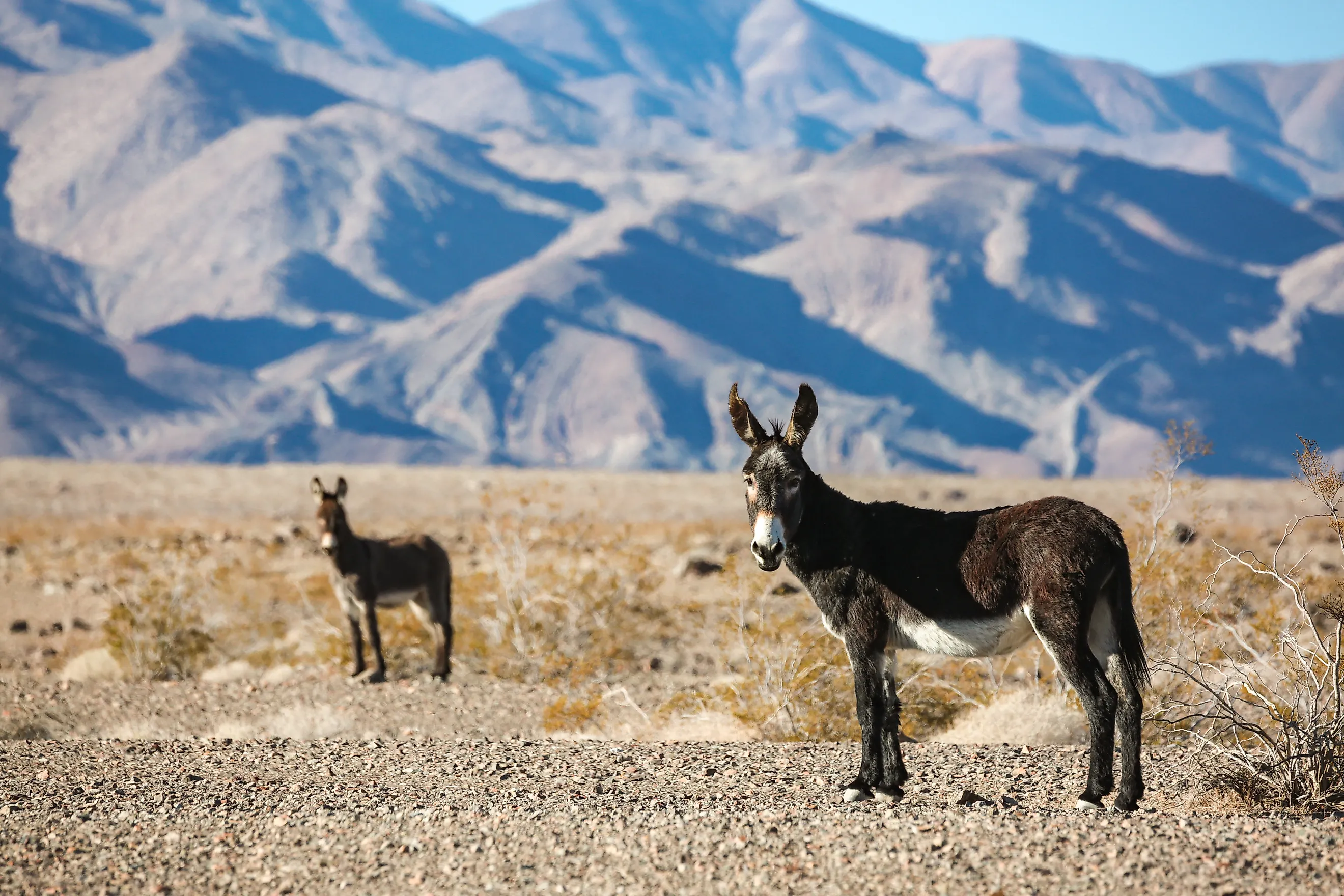
Wild burros still roam Death Valley National Park on the border of California and Nevada. Descended from the African wild ass, these free-roaming donkeys are not native to North America. They were first introduced to the Americas through Spanish colonization in the 1400s and 1500s, though the specific populations in Death Valley largely stem from escaped or abandoned pack animals used by 19th-century gold miners and prospectors.
Wild burros have a complicated reputation, regarded as an invasive species by the National Park Service but a protected species under the Bureau of Land Management. In some national parks, wild burros used to roam but have been removed entirely.
Wild burro history in the US

Wild burros are descended from Equus asinus (or Equus africanus asinus), a species within the genus Equus. The ones introduced to America originally came from Africa, where they were first domesticated. However, the horse family (Equidae) first developed in North America around 55 million years ago, while the specific genus Equus emerged there much later, about 4 million years ago. By the end of the last Ice Age, all of these horses and donkeys had gone extinct in the Western Hemisphere.
In Asia and Africa, meanwhile, burros continued to evolve and develop, such as the African wild ass (Equus africanus), a species of the grassy plains. Horses and burros would be reintroduced to the Americas through Spanish colonization.
In 1493, Christopher Columbus brought donkeys to the Caribbean, importing them from North Africa. Horses and burros followed the Spanish conquests of the New World, including Hernando Cortés' arrival in the Aztec Empire in 1519. Horses served as an important strategic element, as Native populations had never seen mounted cavalrymen before. Burros meanwhile could act as pack animals and be used to breed mules.
As the Spanish expanded west, the burros went with them, reaching the American Southwest in the 17th century. However, not all of these burros stayed in captivity. Some were traded with southwestern tribes, escaped, or were released.
By the 19th century, wild horses and burros had an estimated population of two million and were also used by prospectors who traveled to the West, bringing burros with them. Through these routes, burros entered areas that would later become national parks, including Death Valley National Park.
The debate over calling them invasive

The National Park Service designated wild burros as an invasive species in Death Valley National Park. Due to their heritage as desert horses, they are uniquely suited to survive in the arid, hot environment of Death Valley, but they also consume a great deal of resources.
They first reached Death Valley during the Gold Rush of 1849 along with subsequent gold rushes as pack animals. Many were abandoned by the miners or escaped, explaining their presence in the valley.
Namely, burros live off the sparse grass, shrubs, and desert plants in the park, with one burro able to consume 6,000 pounds of foliage per year. They also take up rare water sources and can overgraze.
Burros are a threat to bighorn sheep, a species native to the region. Burros can be very aggressive and attack sheep that try to drink from the spring water. In addition, their large appetite reduces the amount of seeds available for native seed-eating birds.
Even so, wild burros are a federally protected species under the Bureau of Land Management (BLM) and the U.S. Forest Service. This means it is illegal to kill or harm one of these animals on designated public lands. However, this specific protection act does not apply to National Park Service lands like Death Valley National Park. Instead, the National Park Service is legally mandated to protect native ecosystems and has the full authority to set its own strict policies to remove invasive burros from the park. To do this humanely, the Park Service rounds up the burros and transfers them to the BLM to be placed into federal adoption programs.
Some organizations do dispute the claim that wild burros are invasive. For example, the American Wild Horse Conservation points to the wild burros' habit of digging wells in dry riverbeds, and those wells provide more water for other species. They also argue that they act as prey for mountain lions, and that pressure keeps them from grazing too long in one spot.
The Wild Burro in the Grand Canyon National Park

Burros were eliminated in the Grand Canyon National Park due to policies enacted by the National Park Service. As early as 1924, the NPS had identified wild burros as a damage to the environment as they consumed great amounts of foliage, water sources, and allegedly eroded canyon cliffs. Rangers were given authority to shoot any wild burro on sight. The National Park Service itself referred to burros as a "veritable pest."
In the 1960s and 1970s, this policy of elimination in the national parks, especially the use of helicopters to chase them down, led to controversy, with animal advocacy groups arguing that such efforts were animal cruelty and ignored the historical importance of burros.
The Wild Free Roaming Horses and Burros Act did little to stop public outcry, as it allowed the NPS to make its own policies. In 1979, the NPS announced plans to eliminate all of the estimated 577 wild burros from the park by shooting them. It planned to kill all of them by the end of summer 1980.
Following public pressure, the NPS revised its plans. For one, park rangers were instructed to shoot burros in the neck to limit suffering. In addition, a third party would be allowed to enter the park to remove the animals without killing them. The Fund for Animals would serve that purpose, airlifting many of the burros from the canyon. The effort in the end was a success, and there are no more burros in the Grand Canyon National Park.
Efforts to eliminate the burro in Death Valley

The National Park Service has carried out similar culling efforts in Death Valley National Park, with 400 of them being shot in the years between 1987 and 1994.
The NPS's official policy is still to eliminate the burros, with a long-term goal of making Death Valley a "no burro zone." Rather than shooting them outright, the NPS partnered with the Peaceful Valley Donkey Rescue in 2018 and tasked it with removing some 2,500 wild burros from the park without killing the animals.
This is one of several wild burro removal projects that the Peaceful Valley Donkey Rescue is carrying out, including with the Mojave National Preserve and private ranches. The nonprofit uses self-catching traps at water sources. Once captured, the donkeys are evaluated to see if they can be adopted, sent to a sanctuary, or receive medical treatment.
The rescue was given a 5-year contract and removed 256 burros by September 2024. The roundups resumed in 2026.
Seeing wild burros in Death Valley today

As of September 2026, wild burros can still be found in Death Valley National Park, such as in the southwestern section of the park in Butte Valley. Officially, the NPS still wishes to remove them entirely from the park, but those efforts have not been completed. While the NPS considers them invasive, other organizations point to their historical importance as a pack animal and their benefits to the environment. Ultimately, wild burros present many ethical questions, such as what divides a native and invasive species, especially one that has been in the territory for so long, and how wildlife authorities should balance concerns of animal cruelty versus ecological protection.