5 Most Beautiful Gothic Churches In Washington
Washington’s landscapes are matched by a notable architectural history that includes several Gothic-style churches. Featuring pointed arches, ribbed vaults, and large windows, these buildings reflect the faith, artistry, and community spirit of early settlers. From large cathedrals in major cities to smaller chapels in rural towns, each structure tells a distinct story and remains a landmark of spiritual and historical importance.
This list highlights five architectural examples, including St. Paul's Episcopal Church in Seattle and the Cathedral of St. John the Evangelist in Spokane. These churches combine Gothic design with local materials and regional influences, offering insight into Washington’s past. Whether viewed for their architecture or historical role, they continue to function as places of worship and community gathering while preserving a significant built heritage.
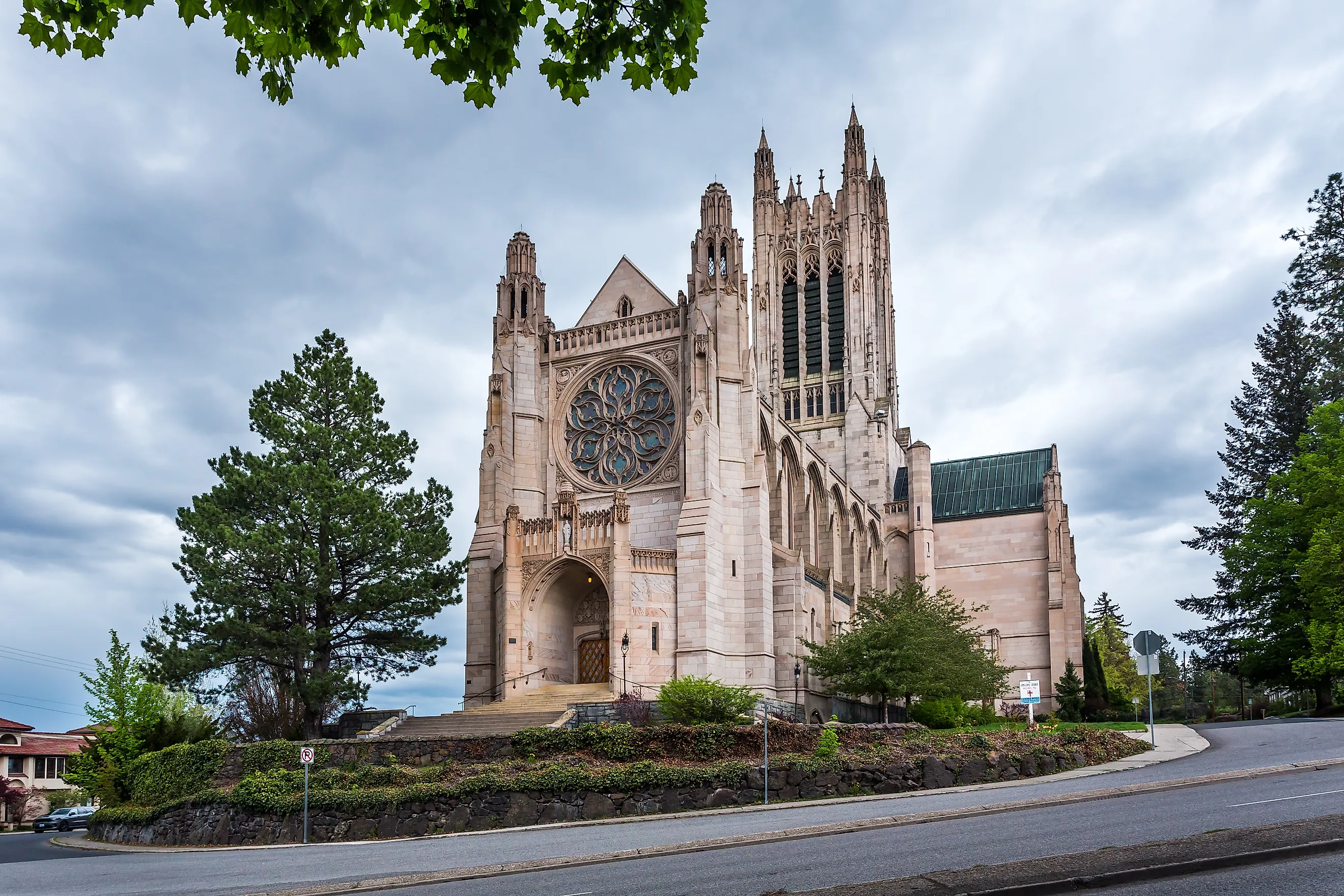
Cathedral of St. John the Evangelist, Spokane

The Cathedral of St. John the Evangelist, constructed beginning in 1925, is a prominent example of Gothic Revival architecture. Designed by local architect Harold Whitehouse, it was realized through the combined efforts of three Episcopal congregations. Sandstone was sourced from Tacoma and Boise, while limestone carvings were brought in from Indiana. Construction began with the nave, completed in 1929, but the Great Depression halted further work. Building resumed in 1948, with most of the work completed by 1954. By 1961, the transepts, tower, and chapels were also finished.
Inside, the cathedral’s 173-foot axis and high Gothic arches draw the eye upward. Stained glass and symbolic artwork fill the interior with narrative detail. Notable features include the rose window representing the Holy Trinity, nave windows depicting Biblical figures, and chancel windows illustrating scenes from the life of Jesus. The high altar features a Resurrection cross, sculptures of Christ the King and the four evangelists, and imagery drawn from the Book of Revelation. Angels and saints are also depicted throughout the space.
Proto-Cathedral of St. James the Greater, Vancouver

Finished in 1885, the Proto-Cathedral of St. James the Greater is one of the earliest examples of Gothic Revival architecture in Washington, and a symbol of the Catholic Church’s early presence in the Pacific Northwest. The brick exterior features pointed arches and lancet windows, with a central bell tower rising 150 feet and two flanking towers reaching 80 feet. The design reflects influences from churches such as St. Patrick’s Cathedral in New York and Notre-Dame Basilica in Montreal, adapted for a frontier setting.
The interior includes ribbed plaster vaulting, gold-leaf capitals, and a painted ceiling of white stars against a blue background. Local brick and stone were used in the structure, while stained glass and the carved oak altar were imported from San Francisco and Belgium. Mother Joseph of the Sacred Heart contributed to the design alongside Portland architect Donald McKay, resulting in a landmark that continues to serve the Vancouver community.
Deep River Pioneer Lutheran Church, Deep River

Located in the community of Deep River, this historic church is an example of Gothic Revival architecture in rural Washington. Built by Finnish settlers between 1898 and 1902, the design reflects the group’s European heritage. The church features pointed arches and a fortress-like appearance, making it a distinct local landmark. Its architectural and historical importance was formally recognized in 1974, when it was added to the National Register of Historic Places.
Although the congregation ceased regular services in the 1930s, the interior has remained largely unchanged. A restoration completed in 2012 focused on the exterior, removing moss buildup and repainting the white siding and peach-colored trim to maintain the building’s historic appearance. The church stands as a preserved example of early settlement-era construction and the lasting influence of Gothic Revival design in a rural setting.
St. Joseph Parish, Seattle

St. Joseph Parish in Seattle combines Art Deco with early Gothic Revival influences. Built in 1930 during the Great Depression, it replaced a wooden church constructed in 1907 and was designed by architect Abraham H. Albertson. The building was constructed using reinforced concrete, a cost-effective method at the time, which contributes to its substantial appearance. The church measures 250 feet in length and 110 feet in width and includes a 225-foot bell tower that was described for many years as one of Seattle’s highest geodetic points. The exterior features terracotta reliefs of the twelve apostles and copper doors decorated with fleur-de-lis and cross motifs.
Designated a Seattle Landmark in 1980, the interior includes a glass mosaic altarpiece of Christ the King, stained-glass windows depicting biblical narratives, and painted Art Deco columns with grapevine designs. The eastward-oriented nave allows natural light to fill the space, supporting both liturgical use and acoustics.
Trinity Episcopal Church, Seattle

Trinity Episcopal Church is one of Seattle’s earliest examples of Gothic Revival architecture. Trinity Parish was established in 1865, and the stone church at its current site opened in 1892, designed by architect Henry Starbuck. It was subsequently rebuilt and enlarged after a 1902 fire. The stone church reflects the Early English Gothic tradition through its pointed arches, narrow lancet windows, and restrained vertical emphasis. Built as the city transitioned from a frontier settlement to an established urban center, the church reflects a period of institutional growth.
The exterior is defined by rough-cut stone masonry and a compact, rectilinear form typical of Gothic Revival churches in the American West. Inside, the sanctuary features exposed timber elements, stained-glass windows, and a clear axial layout that emphasizes procession and light. Decorative detailing remains limited, supporting the building’s structural clarity. As both an active parish and a designated Seattle landmark, Trinity Episcopal Church remains a late 19th-century example of Gothic Revival design adapted to local materials and regional conditions.
Gothic Church Architecture Across Washington State
Washington’s Gothic-style churches are more than historic structures. They serve as physical records of the state’s development and the communities that built them. From the masonry work of the Proto-Cathedral of St. James the Greater to the more modern spin of St. Paul's Episcopal Church, these buildings reflect sustained dedication, faith, and craftsmanship. Their pointed arches and towers continue to shape both urban and rural settings.
Today, these churches remain active as places of worship and community use while maintaining their architectural integrity. They illustrate how historic religious buildings can adapt over time without losing their original character. For those interested in architecture or regional history, they provide a direct connection to Washington’s past and its built environment.