5 Most Beautiful Gothic Churches In Louisiana
When the itinerant traveler goes looking for a sense of awe and atmosphere, often the first place they seek out are the architectural jewels of the Gothic style. They wouldn’t be the first; in the 1800s, many architects turned back to the Gothic style of the past in what swiftly became known as the Gothic Revival movement.
Originating in England, the Gothic Revival was a popular alternative to the more Greek-focused revivals which swept through America just before the midpoint of the nineteenth century and was popular in the South, particularly Louisiana. With the style’s Christian influence, it was a popular style for churches, and Louisiana’s French connections meant it already had a strong grasp on the Gothic style.
Today, many of Louisiana’s most beautiful examples of Gothic churches, those built both before and during the Gothic Revival movement, are open to the public and offer the itinerant visitor can find awe and atmosphere aplenty.
St. Mary's Chapel, New Orleans

Naturally for the Paris of the South, New Orleans has countless churches and cathedrals which offer visitors a plethora of architectural embellishments to choose from in search of experiencing beautiful buildings. Some, like St. Mary’s Chapel on Jackson Street, may seem small but have a unique historical importance.
St. Mary’s not only served as the original church in the St. Alphonsus Parish but was also the first church built in Louisiana for German-speaking Catholics. Today, St. Mary’s small, cozy size and white-washed walls make it an ideal wedding venue or other smaller gatherings or simply seeking a classic example of an 1800s community center with an extra dash of historical relevance, and its beauty makes it a perfect photo-op.
Grace Memorial Episcopal Church, Hammond

While the Gothic style gives any building a strong grasp on aesthetic, a sense of history can broaden and emphasize the beauty of a building, as is the case with the Grace Memorial Episcopalian Church in Hammond, Louisiana. In addition to its classic Gothic arches, the distinctly wooden clapboard siding makes Grace Episcopal a prime example of “Carpenter Gothic,” and the church’s brush with fiery destruction give it a strong sense of Gothic beauty in both the traditional and modern sense of the word. The church is one of the oldest buildings in Hammond because its location spared it from a fire which destroyed much of the downtown district. Today, the church remains in use and is located within Hammond’s historic downtown district. It has even been a shooting location for movies, which helped share its beauty with a wider audience.
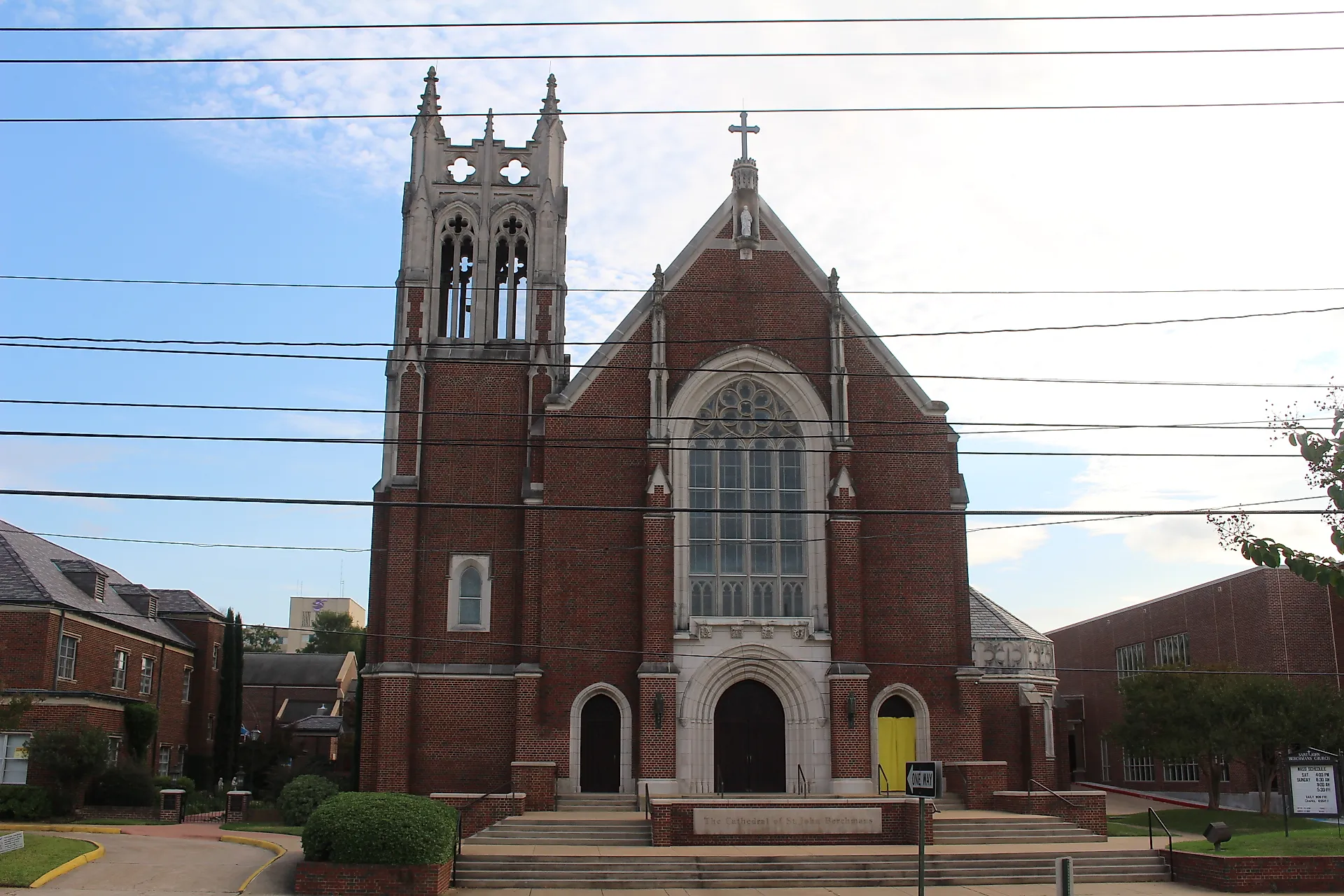
Cathedral of St. John Berchmans, Shreveport

While many of the beautiful Gothic buildings in Louisiana have a history reaching back almost two centuries, some of the most beautiful ones are less than a century old, such as the Cathedral of St. John Berchmans in Shreveport, Louisiana. With a cornerstone laid in 1927, the Cathedral is not purely Gothic Revival but instead contains elements of both the Gothic and the older Tudor style.
Despite this slightly modern mixture, the Cathedral’s soaring ceilings, stunning stained glass, and high arches blend with the more rustic redbrick walls to grant the Cathedral a unique beauty which befits its similarly unique name. Pope Leo XIII canonized the Cathedral’s namesake, St. John Berchmans, in 1888, and he serves as both the patron Saint of Altar Boys and as the patron Saint of the Shreveport Diocese.
Although born in Holland in the 1600s, St. John Berchman has a unique connection to the state, as one of his reported miracles is the healing of a nun in a convent in Grand Coteau, Louisiana in 1866. His Feast Day on November 26 makes a perfect time to visit the Cathedral.
Basilica of the Immaculate Conception, Natchitoches

While the most famous basilica in Louisiana may be St. Stephen’s in the Crescent City, Louisiana has more than one beautiful basilica. Located in Natchitoches, the Basilica of the Immaculate Conception was elevated as a minor basilica in 2010. A minor basilica is a church that is both historically and architecturally significant and played an important part in its community. This church was constructed in the mid 1800s, and its varied and quirky history makes its status well-earned.
The current church, built in 1857 as the sixth on this site, followed earlier churches that began as St. Francis (circa 1728-1729) and later became St. Mary’s in 1853, before taking its present name. However, the church wasn’t considered finished until 1892 when the vibrantly verdant green dome was added to the tower. While the church’s exterior is a stunning example of Gothic architecture with its focus on verticality, the church’s furnishings are equally beautiful, as many of them were imported from France, such as the hand-carved Baptismal font.
St. Mark's Episcopal Cathedral, Shreveport

Many of the brightest Gothic gems in Louisiana started as diamonds in the rough, for while Shreveport had an early reputation as a rougher trade town, one of the brightest examples of Gothic architecture can be found there: St. Mark’s Episcopal Cathedral. One of Shreveport’s earliest documented church congregations, it was designated the Cathedral of the Diocese of Western Louisiana in 1990.
Today, this vibrant building, a Shreveport landmark in its Highland neighborhood, is easily spotted thanks to its gorgeous white walls and high arched ceilings. Its bell tower may look familiar to the itinerant visitor, as it was based on the bell tower of Oxford’s Magdalen College by its architect, Shreveport local and parishioner Jack Annan, who also designed the Shreve Memorial Library which today houses the Shreveport Chamber of Commerce. Annan’s efforts made St. Mark’s one of finest examples of the Gothic style in Louisiana.
With its vibrant and varied history, Louisiana encompasses a medley of influences which melt and mix into an intricate individualism without abandoning its roots. As a result, you can find countless examples of the best its many cultures bring to it, and even when those highlights seem unexpected, such as an architectural alternative which originates in England’s medieval past, Louisiana shines with a bounty of beauty, particularly with its high-reaching churches. Each has its own unique place both in its community, in the state’s history, and the faith which binds them together, and this dizzying blend of history, culture, and geometry creates a serene and heady atmosphere in which an itinerant traveler can find what they are looking for and more besides.