6 Most Beautiful Gothic Churches In Massachusetts
Massachusetts keeps a long architectural memory, and a tour of its Gothic churches offers a clear window into the state’s 19th-century taste for soaring spires, pointed arches, and carved stone. Some of its most beautiful churches once anchored maritime communities, served industrial towns, and now host active congregations, concerts, and civic events. Throughout the state’s churches, one can find High Victorian Gothic stonework, wood-framed structures with Gothic elements, and examples where prominent architects contributed to Massachusetts’s ecclesiastical landscape. Each of these Gothic churches reflects a deeper narrative of the Commonwealth’s colonial past, maritime influence, and artistic ambition that continues to shape the intersection of religion and civic culture in Massachusetts today.
First Church in Salem, Salem

In Salem, the congregation that formed the First Church in Salem gathered in 1629, and the church building that stands today was built in the early 19th century. The present structure was designed in the Gothic Revival style and was constructed to convey vertical emphasis, pointed windows, and buttressed massing. The church interior contains tall, lancet windows, and a nave that directs the eye upward toward ribbed vaulting and ornamental woodwork. Architects and parishioners adapted medieval motifs into local materials, producing a stone and wood ensemble that blends regional craft with Gothic style. The congregation has served the civic life of Salem for generations, and the building now functions as an active Unitarian Universalist congregation, hosting regular worship services, lectures, and community events. Visitors can attend choral concerts and take guided tours that explain the building’s long history, which dates back to the colonial era.
First Church of Christ, Northampton

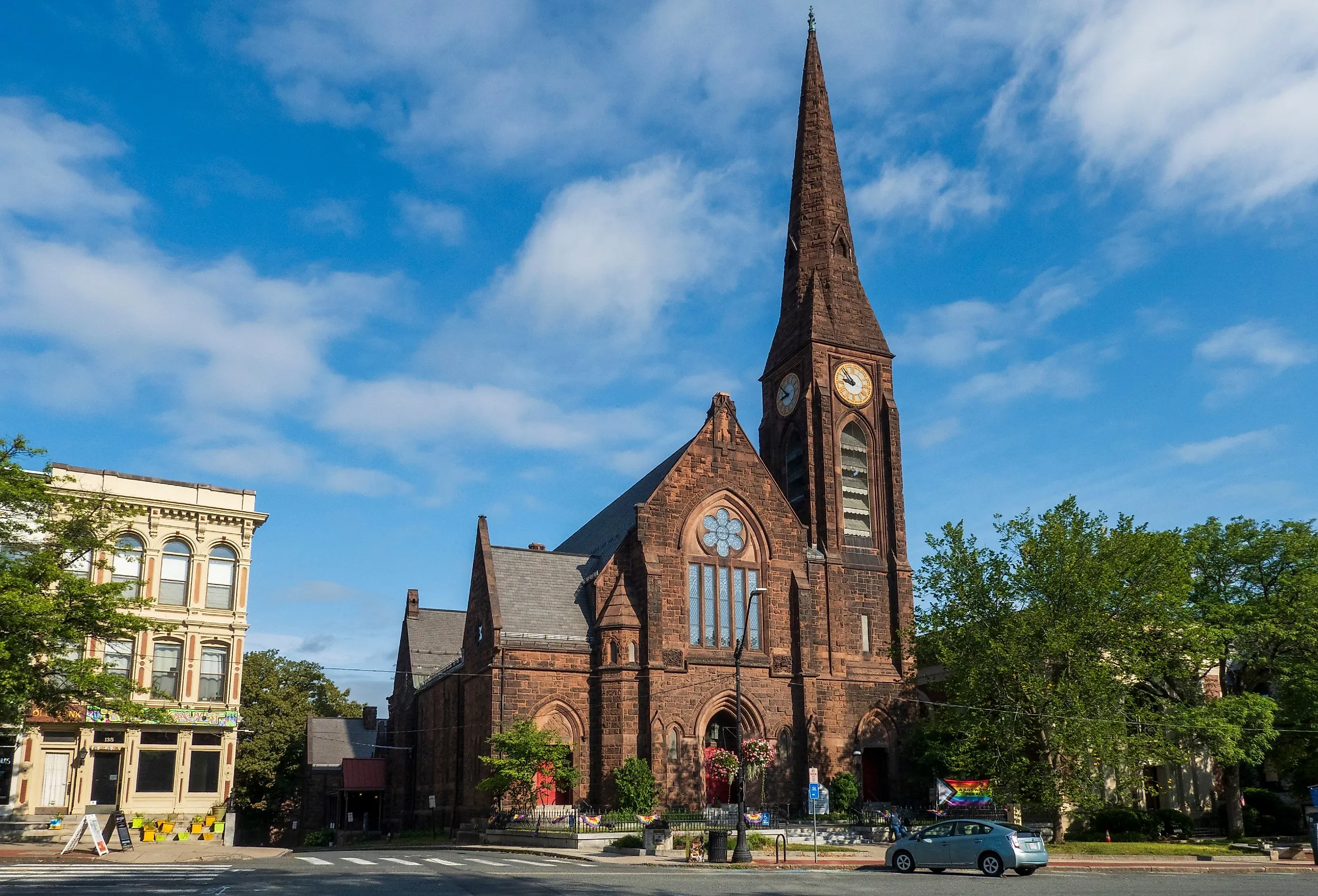
The First Church of Christ in Northampton occupies a commanding location at Main and Center Streets and was completed in 1878 to a design by the Boston firm of Peabody and Stearns. The masonry building exemplifies High Victorian Gothic with its quarry-faced Longmeadow brownstone walls, slate roof, and a buttressed bell tower crowned by a broach spire. The tower rises sharply above the downtown, and a green-and-gold enameled E. Howard clock sits below the steeple.
Internally, the church features a wide nave flanked by cross-gabled wings, richly carved woodwork, and significant stained glass installations that punctuate the clerestory. The congregation has adapted the site for contemporary parish and civic life, and the church now hosts worship services, music recitals, and lectures, while preserving its historic fabric. Architectural historians praise the building as an outstanding regional example of Gothic Revival translated into heavy, stone-built Victorian form, and preservationists have chronicled its role within Northampton’s downtown historic district.
St. Stephen’s Episcopal Church, Pittsfield

The congregation that became St. Stephen’s Episcopal Church began in the early 19th century, and the parish first erected a stone Gothic building in 1832 before commissioning a larger sanctuary late in the century; the present church was rebuilt in 1889-1890 to accommodate a growing downtown congregation. Architects Peabody and Stearns, a prominent Boston firm, designed the new edifice in a robust Gothic Revival style, and builders executed the design in Longmeadow sandstone to produce a stout, fortress-like tower and deeply set, pointed-arch openings.
Interior timber trusses, stained glass, and carved wood detail emphasize vertical rhythm while the heavy masonry conveys late Victorian massing that is often described as Richardsonian in its muscular texture. The church has served Pittsfield’s spiritual life continuously since the 19th century, and it now hosts Sunday worship, concerts, community outreach, and historic tours that highlight its stained glass and bell tower.
First Baptist Church of Scituate, Scituate

The First Baptist Church of Scituate erected its present sanctuary between 1869 and 1870, and the congregation dated back to the early 19th century. The building displays an eclectic Victorian character with pronounced Gothic Revival motifs, including lancet windows and a square tower that rises to an octagonal spire. The exterior wood framing and carefully composed window groupings produce the vertical emphasis typical of Gothic sources while retaining local building traditions.
In the late 19th century, the church served as a center of parish and neighborhood life in Scituate, where maritime trade and small-scale industry shaped daily rhythms. The building now receives visitors for regular worship services, community memorials, and occasional concert programming. Local preservation has noted the sanctuary’s architectural merit during its nomination to the National Register of Historic Places, and contemporary photographic collections capture both the tower silhouette and the ornate fenestration that define its street-facing elevation.
Osterville Baptist Church, Osterville (Barnstable)

The Osterville Baptist Church stands on Osterville’s Main Street and was built in 1837 for a congregation formed two years earlier. The structure embodies a Greek Revival plan with Gothic Revival elements applied to windows and decorative trim, producing an elegant wood-frame church whose white clapboard exterior reads as much like a New England meetinghouse as a Gothic ecclesiastical building. The gable-front facade, three-part round-arch window, and a square tower rising to an octagonal spire create a distinctive profile on the village street.
The congregation has used the building continuously for worship, and the church also hosts events like prayer groups, grief support, and even infant childcare. Preservationists have recognized the structure’s historic value, and the church appears in national and state registers as an enduring example of stylistic transition in 19th-century New England religious architecture.
Holy Trinity Episcopal Church, Southbridge

Holy Trinity Episcopal Church in Southbridge was built in 1869, and the structure displays both Romanesque and Gothic Revival features as part of its architectural vocabulary. The congregation has used the building since the early 20th century as its Episcopal house of worship, and the sanctuary has hosted industrial era families and civic events tied to Southbridge’s manufacturing history. The building’s red brick and stone trim, round-arched openings combined with pointed-arch fenestration, and richly articulated tower massing reveal an architect’s willingness to blend revivalist motifs for visual effect.
The church remains active in parish life, offering worship, outreach programs, and occasional concerts that showcase the sanctuary’s acoustic qualities. The Massachusetts Historical Commission cites Holy Trinity for its hybrid stylistic expression and for the way it reflects the social history of a New England mill town.
Gothic Majesty Across Massachusetts
From the granite facade of St. Paul’s Episcopal Church in Newburyport to the broach spire and E. Howard clock at First Church of Christ in Northampton, these six buildings trace how Massachusetts communities expressed civic pride through sacred architecture. First Church in Salem has anchored Salem’s civic rituals since colonial times, and its stained glass installations and choral concerts remain cultural draws. On the South Shore, the octagonal spire of the First Baptist Church of Scituate and the three-part round-arch window of Osterville Baptist Church mark long histories of village worship. In Southbridge, Holy Trinity Episcopal Church records the town’s manufacturing era in brick and stone. Visitors should plan visits around the bustling Sunday services or arrange a tour from a local historian to soak in all these Gothic churches have to offer.