5 Most Beautiful Gothic Churches In Connecticut
Connecticut has a notable architectural legacy, especially in its churches, but it is most known for its New England scenery and universities. In particular, the Gothic tradition has made a strong impression throughout the state and is undoubtedly visually and culturally significant.
From some of the earliest Gothic Revival churches built in the United States during the early 19th century to later, more elaborate stone edifices and intimate Carpenter Gothic chapels, Connecticut offers an unusually complete timeline of Gothic expression. These churches reflect not only evolving architectural tastes but also the social, religious, and industrial histories of the communities that built them, making them enduring landmarks of both artistic achievement and local identity.
Trinity Church
Trinity Church on the Green in New Haven, Connecticut, is a Gothic Revival Episcopal church built between 1814 and 1816 and designed by architect Ithiel Town. Located on the historic New Haven Green, it is considered one of the earliest actual examples of Gothic Revival architecture in North America.
Made from locally quarried traprock, the church features arches, tall stained glass windows, and richly detailed interior elements, including Tiffany glass and rose windows. Today, Trinity remains an active parish and cultural landmark, hosting worship services, concerts, meditation, and community outreach in the heart of a university city.
Christ Church

Christ Church, in the town of New Haven, is classified as a Gothic Revival church with English influences. The church was constructed in 1898 and designed by the famous architect Henry Vaughan. The interior has intricate wood carvings by craftsman Johannes Kirchmayer and stained glass by artist C. E. Kempe, creating a layered and reflective design.
The stone tower, however, truly shows the impact of collegiate churches in England. Christ Church remains a vibrant Episcopal parish that attracts both worshippers and tourists, captivated by its architecture and music.
The Church of the Good Shepherd

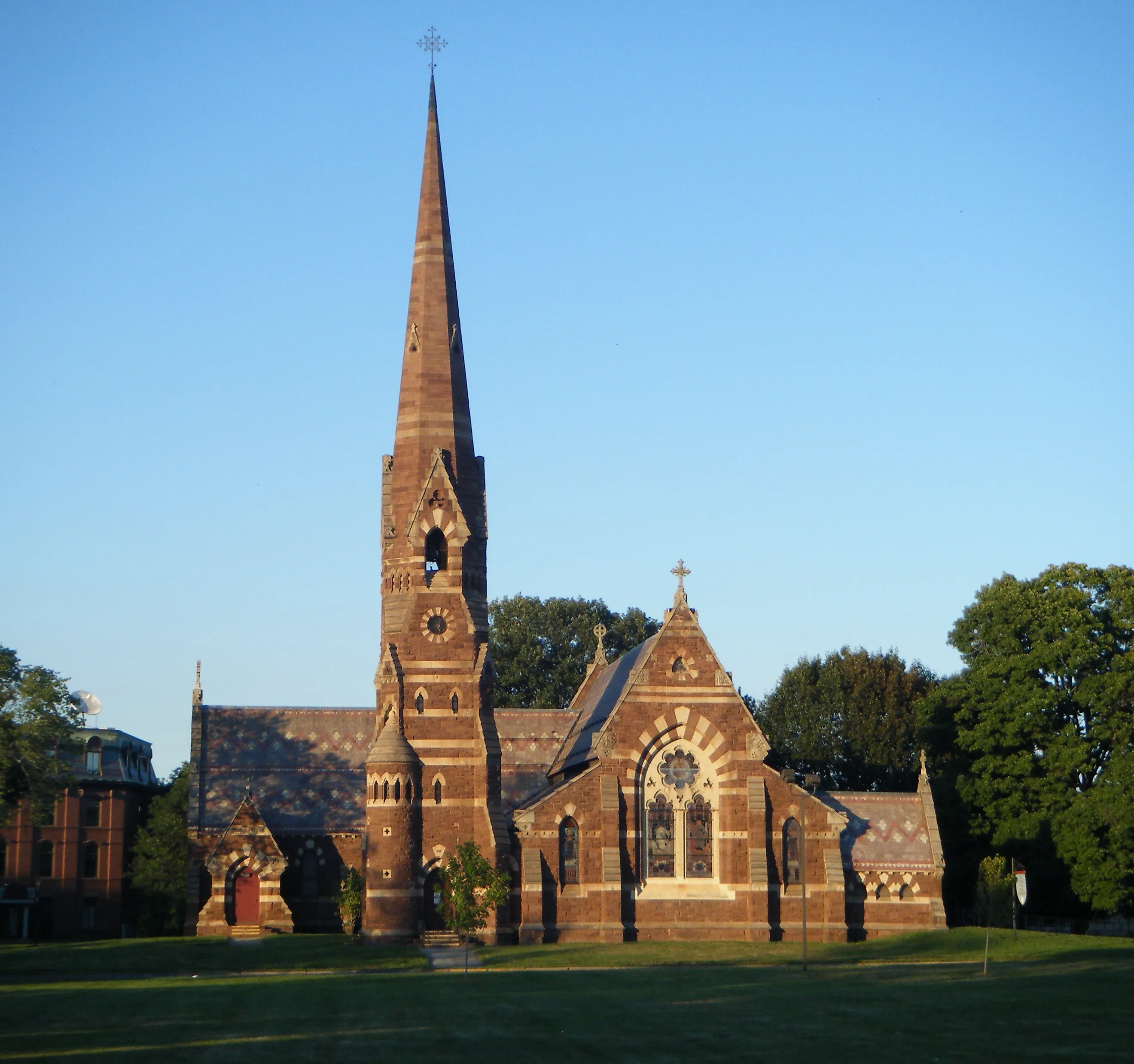
Completed between 1867 and 1869, the Church of the Good Shepherd is a prominent landmark in Hartford's historic Colt Industrial Village. The church's distinctive Gothic style is characterized by its masonry and stone/stone Gothic Revival features, including pointed arch windows and a towering steeple. Beyond its overall design, the church's features display a deeper connection to Hartford's industrial past.

At the Armorer’s Entrance, the stonework incorporates revolver parts, a subtle reference to the nearby Colt firearms factory and the community that grew around it. The Church of the Good Shepherd remains an active Episcopal parish, welcoming visitors from outside the community.
Calvary Episcopal Church
Richard Upjohn created the Calvary Episcopal Church in Stonington, which was built between 1848 and 1849. Interestingly enough, the church is a reflection of Upjohn's fascination with English Gothic ideations. It combines a sensibility for coastal New England architecture with verticality and restraint inspired by the Middle Ages.
An adjacent board-and-batten chapel, constructed in 1859, adds an intimate Carpenter Gothic counterpoint to the main building. Its internal hammer-beam ceiling, lancet windows, and stone walls provide an ordered yet attractive environment. Since it is located in a town celebrated for its maritime heritage and preserved 19th-century character, it is no surprise that the church remains an active parish serving the Stonington community through worship and outreach.
The Merryall Union Evangelical Society Chapel

Merryall Union Evangelical Society Chapel, New Milford, Connecticut. Wikimedia Commons.
An excellent example of a Carpenter Gothic design from 1890 is the Merryall Union Evangelical Society Chapel in the town of New Milford. The wood-framed chapel replaces the grandeur of stone cathedrals with a more modest design, characterized by a steeply pitched roof, pointed arch windows, and simple wooden clapboards.
These components blend seamlessly with the surrounding landscape, offering tourists and locals a glimpse of the Gothic heritage's significance. The chapel remains a beloved community icon, occasionally hosting summer worship services, weddings, and private parties.
Within the larger Gothic tradition, Connecticut's Gothic churches have a remarkable variety of forms, ranging from the imposing stone structures of New Haven and Hartford to the modest carpenter-crafted beauty of New Milford.
Each church tells the story of its origin and the aesthetic ideals of its town, whether it is based on early American Gothic Revival architecture or on wood-framed Carpenter Gothic design. Visiting these sites not only promotes spiritual enlightenment but also a deep respect for the architectural legacy.