This Iowa Downtown Is Made For Strolling
It’s hard to believe you’re in south-central Iowa when you first step into Pella’s downtown. The Central Park square could have been lifted straight from the Netherlands, with brick storefronts, windmills, and tulip gardens pressing up against one another. A few short steps away is the Molengracht Plaza and Canal, a 5,700-square-foot Dutch-style waterway lined with restored historic buildings and even a drawbridge. Most of the town’s strongest Dutch influences, along with its best restaurants and shops, are clustered around Central Park and the walkable streets that branch out from it, making downtown feel complete, thematically focused, and easy to explore on foot.
A Walkable Downtown Core

Downtown Pella centers on Central Park at Broadway and Main, with the commercial district stretching along Main, Franklin, and Broadway and bounded roughly by Liberty, Union, and 2nd Streets. The blocks here are short, the streets narrow, and the layout keeps everything tightly packed, so walking from one corner to the next never feels like much of a chore. Brick storefronts, Dutch-influenced façades, and heritage buildings line the streets. Step past the square, and you’ll find Jaarsma Bakery with its morning rush of Dutch letter pastries, then the Vermeer Windmill towering over the Historical Village, surrounded by tulip beds and Windmill Mall Antiques.
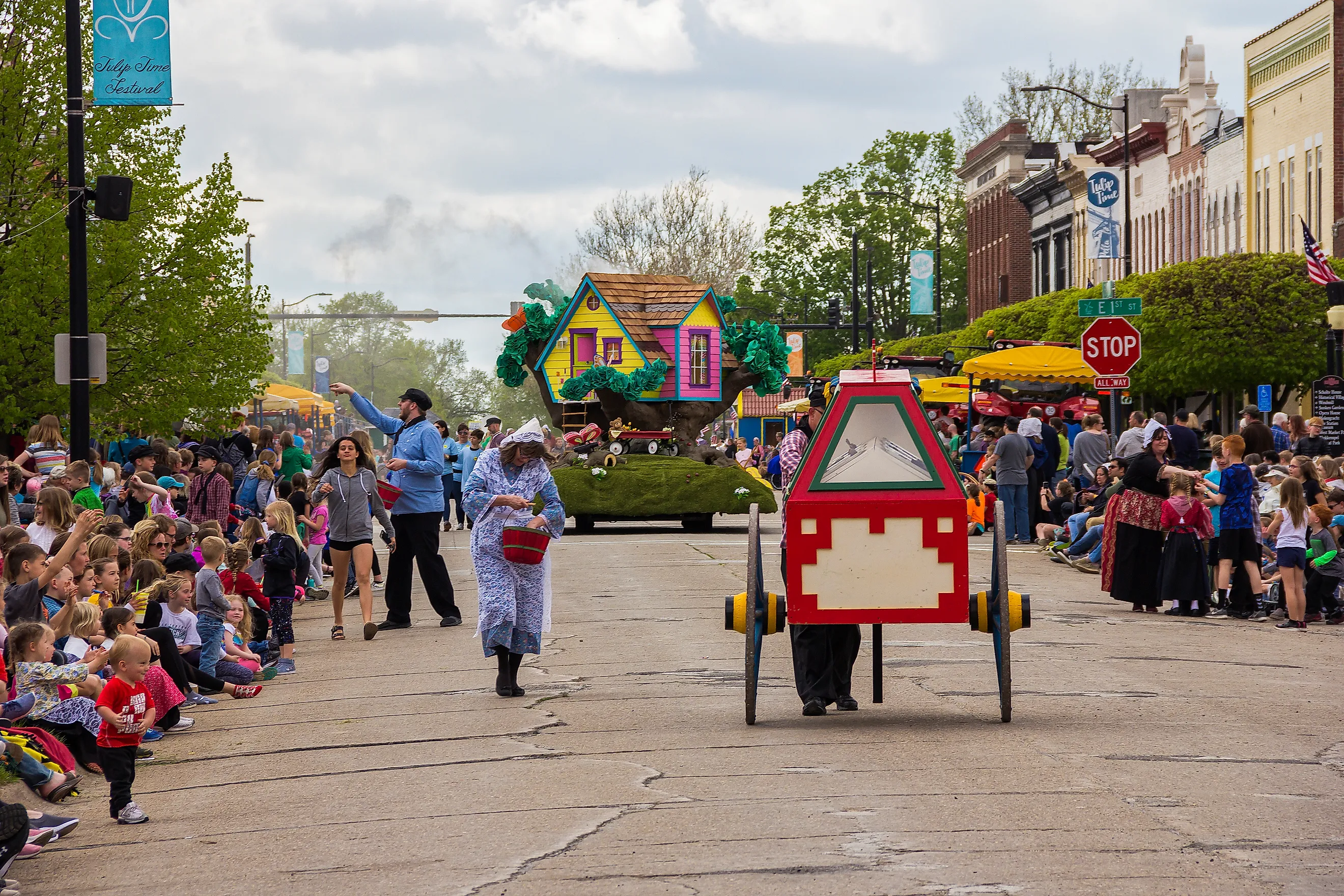
Central Park itself is much more than just a town square. It features the Tulip Tower, a 1900s fountain, a Civil War statue, a sundial, and thousands of tulips that bloom for the annual Tulip Time Festival each May. A short walk down Franklin leads to the Pella Opera House, with its ornate tin ceiling and 1928 Barton theater organ. This is just one of the many stops in downtown Pella that help illustrate its unique history.
A Brief History

In 1847, a group of Dutch immigrants led by Pastor Hendrik Pieter Scholte arrived on the Iowa prairie, seeking religious freedom. They staked claims along the divide between the Des Moines and Skunk rivers, building log cabins and dugouts amid endless waves of grass and wildflowers. From the beginning, the settlers imagined a town with order and purpose. The streets they created were laid out in a grid, with names reflecting faith, patriotism, and civic pride. Central Park became the heart of that design, surrounded by the blocks that now form the walkable downtown core.
Finding Dutch Landmarks

To walk between the most significant Dutch landmarks found in downtown Pella, it's best to start at Central Park. Directly across the street from the park is the Scholte House Museum and Gardens, where you can learn about the man who is directly tied to the town's origin. From the park, head east along Franklin Street, about half a block from the square, and you’ll reach the Klokkenspel. Mechanical figures emerge throughout the day to perform alongside a 147-bell carillon, first visible from the sidewalk, then again from the courtyard behind it. Continue east and you’ll arrive at Molengracht Plaza, accessed mid-block, where the canal runs through the center of downtown. One block farther east sits Pella Historical Village and the Vermeer Windmill, where log cabins, a general store, and the towering windmill visually encapsulate the town’s Dutch past in one highly photographable space.
From there, loop back toward Central Park. Directly across the square is Vander Ploeg Bakery, an easy stop for fresh bread and pastries. To reach the oldest site in town, head north on Main Street, then turn left onto Lincoln Street. A brick path leads to the Tuttle Cabin, believed to be the oldest remaining structure in Marion County, with interpretive signs tracing Pella’s early settlement. Just behind it is Sunken Garden Park, known for its wooden-shoe-shaped pond, formal tulip beds, windmill, and historic benches.
Restaurant Hopping
Not every one of downtown’s best places to eat retains the town’s Dutch influence. However, on the south side of Central Park, the aforementioned Jaarsma and Vander Ploeg take visitors to the “old country” with their sugary baked treats and breads. On the east side of the park, along Main Street, is In’t Veld’s Meat Market, a successful business since 1941, known for its bologna Reubens, dried beef sandwiches, and in-house cuts that are used upstairs at Butcher’s Brewhuis and The Asylum Bar, where brick walls and old artifacts frame nights spent enjoying craft cocktails.
Downtown Pella’s culinary diversity can best be found along Franklin Street within the two blocks east of Central Park. Within a few steps, you’ll find Smokey Row Coffee, George’s Pizza & Steakhouse, The Cellar Peanut Pub, and de Kelder Speakeasy.
Where To Shop
Located in a 1860 church just half a block west of Central Park, Pella Books is the type of discovery that’s harder to come across if you’re traveling by car. Once you cross the threshold onto its creaking floors, you’ll find an impressive assortment of rare, out-of-print, and used books.
Turn back toward the park, and Franklin Street pulls you along with a tight row of red-brick storefronts. Many of these shops focus on clothing, including The HallTree and 9Lilas Boutique, while The Wild Bramble is a candy store for all ages with its own “make your own soda” bar. Cross to the east side of the square, and you’ll spot The Funky Zebras boutique and the gift-wrapping and stationery store, Pella Paperie.
Back down on Franklin Street, toward the Vermeer Mill, pedestrians will enjoy one-stop gift shops like Silver Lining, Blush by Simple Treasures, Simple Treasures, and The Work of Our Hands, a nonprofit fair-trade store whose sales support artisans in developing countries.
Downtowns Like Pella

Two of Iowa’s best downtowns share more with Pella than just its walkability. Decorah and Orange City both have strong European influences that have contributed to the pedestrian-friendly culture that big American cities often neglect. Beyond that, Decorah’s Norwegian heritage is the core of the town’s biggest annual draw, Nordic Fest. Just like Pella’s Dutch-inspired Tulip Time festival, Nordic Fest brings Norwegian traditions like fiddlers, folk dancers, and Viking reenactors into its downtown streets. This riverside downtown also features red-brick buildings similar to Pella's along its restaurant-filled Water Street. While a Norwegian vibe can be found throughout downtown, including at Heavenly Made Gifts & the Gnome Store, Decorah has greater diversity in terms of its cuisine, with Koreana Japanese, Don Jose Family Mexican, and Water Street Deli all within a few minutes' walk of each other.

Orange City’s downtown is even closer to Pella’s, as they both share a Dutch immigrant story. Its downtown is compact, linear, and centered around Central Avenue, where stepped-gable façades and brick storefronts house retail, bakeries, and markets that resemble those found in Pella. Orange City even has its own Tulip Festival, which happens right on the streets around Windmill Park, which features similar architecture to Pella’s Central Park. A few blocks south of the park, visitors can delve even deeper into the settler history thanks to the Dutch American Heritage Museum.
More Than Just A Walkable Town
Pella's tight grid around Central Park traces back to Scholte's original Dutch vision. But it's the way this Iowa town has maintained this European heritage that makes it such a draw for visitors. Downtown Pella isn't just great for travelers who love to explore on foot, but also for those keen to transport themselves to another country without ever leaving South Central Iowa. Dutch letter pastries, rows of tulips, and windmills are just the beginning of the Dutch-inspired treasures to be found here. The rest is waiting for you to discover yourself.