The Most Picturesque Towns In Iowa
Iowa's scenic byways and the rolling hills of the Driftless Area make it one of the Midwest's best states for finding picturesque small towns. In Pella, that means a 124-foot working windmill, colourful tulip displays, and Dutch-style architecture that gives the town a look unlike anywhere else in Iowa. Over in Winterset, covered bridges and a hillside city park help explain why the town remains one of the state's most recognizable small-town destinations. If you are heading to Iowa soon, make sure you stop by the seven stunning towns below.
McGregor

One of Iowa's most beautiful areas is the Driftless Region, an unglaciated pocket of the Upper Midwest that the last Ice Age glaciers bypassed entirely. While ice sheets flattened the surrounding states, the Driftless kept its deeply cut river valleys, limestone bluffs, and rugged terrain. The region is full of picturesque towns, and the first on our list is McGregor. This charming community is home to one of Iowa's premier nature destinations: Pikes Peak State Park. Nestled next to the Mississippi River, the park is noteworthy for its tall river bluffs, including a 500-foot overlook at the confluence of the Mississippi and Wisconsin Rivers.

In the park, you can also find Bear Mound, a Woodland-era burial mound shaped like a bear. A pleasant boardwalk trail leads to Bridal Veil Falls. A few miles north, Effigy Mounds National Monument preserves 206 prehistoric Native American mounds. Of those, 31 are effigy mounds shaped like bears, birds, and other animals. In downtown McGregor, you will find a lovely variety of art shops and stores ranging from The Left Bank Shop and Gallery to Rivertown Fine Books.
Decorah

Decorah is another Driftless town well worth a visit. Norwegians travelled here in large numbers in the mid-1800s to find their Vesterheim, or "Western home." They believed they found it in the ravines, caves, and fertile soil of the surrounding hills. You can discover many different ecosystems in the parks and nature preserves around town. Barbara Barnhart Van Peenen Memorial Park climbs through tallgrass prairie and hardwood forest. Dunning's Spring Park holds a 200-foot spring-fed waterfall within easy walking distance of downtown.
The most interesting natural feature in Decorah is the Decorah Ice Cave State Preserve. Unlike most caves, it forms ice in spring that often lasts through August, the reverse of the usual cave temperature cycle. You can feel the cold air flowing out of it just by stepping up to the entrance. The Norwegian immigrants to Decorah brought their folk arts and crafts with them, and their descendants still proudly display that heritage at the Vesterheim, the largest Norwegian-American museum and folk art school in the country.
Sabula

Sabula stands out in Iowa as the only island town in the landlocked state. It was initially a Mississippi River town on the mainland, until the completion of Lock and Dam No. 13 in 1939 raised water levels enough to surround the townsite on all sides. Residents have embraced the "Island City" nickname ever since. The town lives up to its name with Island City Harbor, a beach and marina, and South Sabula Lake Campgrounds. One of the quietest spots to go boating or fishing is Driscoll's Island, a half-acre peninsula reaching out into Sabula Lake. The tiny community has a lovely one-stop shop for meals at the Island City Cafe, which serves breakfast, lunch, and dinner. Next to it are a locally owned coffee shop called Sip and Stitch and the Korner Stop Ice Cream Shop.
Okoboji

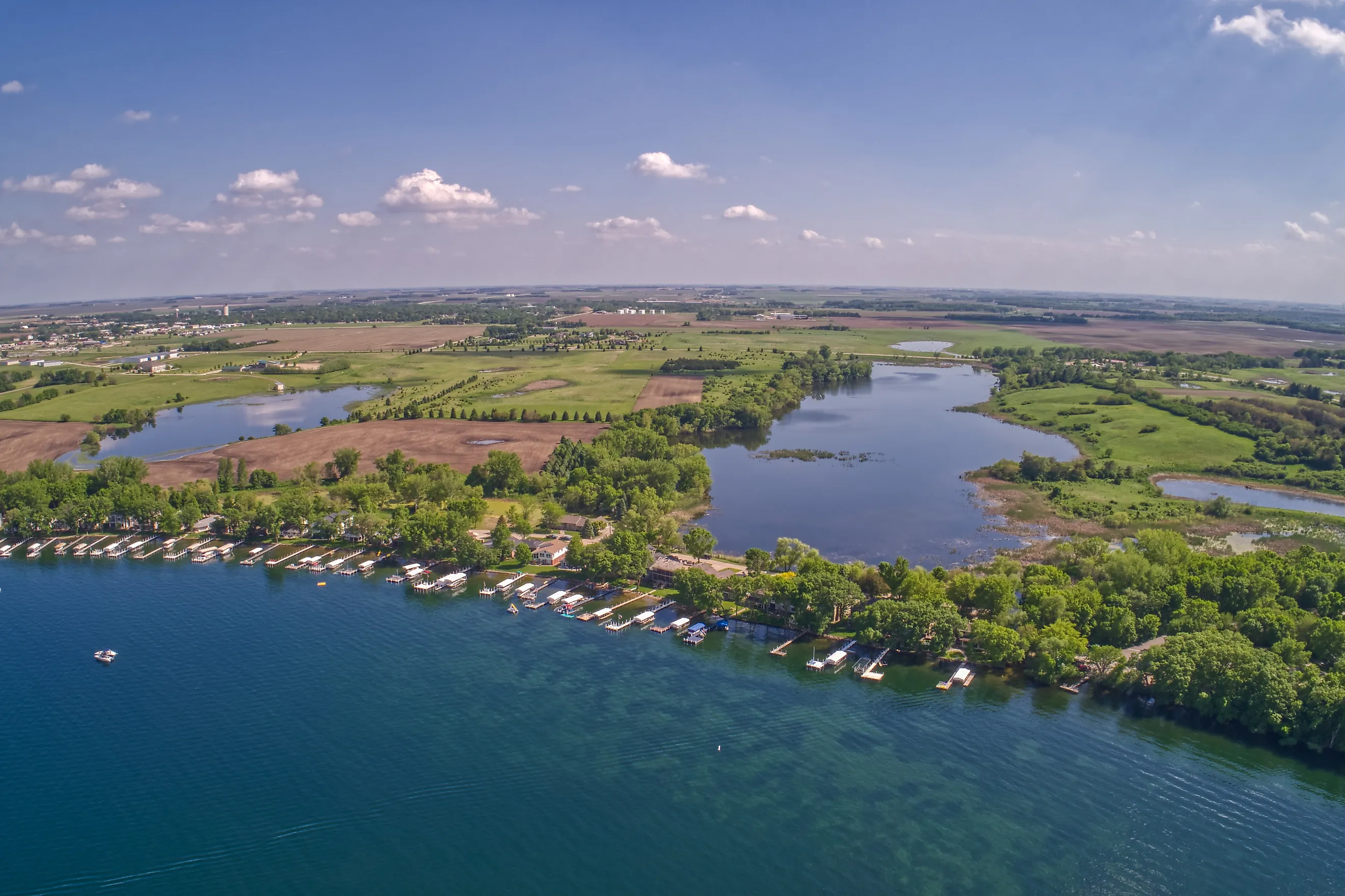
Okoboji is a picturesque lakeside town in the Iowa Great Lakes region. These lakes were carved by glaciers during the last Ice Age and cover roughly 12,700 acres. Okoboji sits between West Okoboji and East Okoboji Lakes. Big Spirit Lake, just to the north, is the largest natural body of water in Iowa at 5,684 acres. The town sits at the centre of many beautiful beaches. Brooks Beach is right in town, while Pikes Point State Park in nearby Spirit Lake has boat access onto West Okoboji. One of the best ways to explore the Iowa Great Lakes region is to take the Iowa Great Lakes Trail. This paved path winds from Milford north to the Minnesota state line, with adjoining loops around West Okoboji and Big Spirit Lake. It is an ideal biking trail.
Pella

Pella was founded by Dutch immigrants in 1847, led by pastor Hendrik Scholte. They created a town that feels like the Netherlands while remaining quintessentially Midwestern. Pella overflows with lovely tulip fields and magnificent Dutch-style windmills. The crown jewel is the 124-foot Vermeer Windmill, one of the tallest working windmills in North America. It was actually built in 2002 in the authentic 1850s Dutch style, crafted by Dutch millwrights in the Netherlands and then shipped to Iowa for reassembly on site. Smaller windmills and tulip displays appear throughout the town's parks, including Brinkhoff Park and Sunset Gardens Park, which also has a sunken pond shaped like a Dutch wooden shoe. Pella sits by the Des Moines River, which you can access via the Volksweg Trail, a paved 12-mile path that runs through the North Overlook woods and into rare prairies and pine plantations.
Amana

Amana's history could fill multiple books, as one of the longest-lasting utopian communities in the U.S. A group of German Pietists called the Community of True Inspiration arrived in 1855, looking to establish a community where they could live in peace and practice their highly regimented communal meals, work, and religious practices. The experiment lasted until the "Great Change" of 1932, when the communal way of life ended but the cultural and architectural heritage was preserved. The Colonies stand today as a beautiful example of rustic German-American architecture, maintained by the Amana Heritage Society. The society owns several buildings, including the Communal Kitchen, where dozens of residents once ate together at long tables. Another highlight is the High Amana General Store, opened in 1857. It still has the same wood floors, pressed-tin ceilings, and kerosene pump it had over a century ago. Amana hosts festivals year-round. One of the best times to visit is during Christmas, when it fills its Festhalle Barn with decorated trees for the Tannenbaum Forest.
Winterset

Winterset dazzles visitors with its covered bridges, outdoor mazes, nature walks, and star-studded past. It is the county seat of Madison County, famous for the bridges featured in Robert James Waller's novel The Bridges of Madison County and the 1995 Clint Eastwood film. The town goes the extra mile with its City Park, which features limestone shelters, a playground, and an English hedge maze. The park also includes several charming historical sites. The 1870 Cutler-Donahoe Covered Bridge sits in one corner, and the limestone Clark Tower rises nearby. This tower was built in 1926 in honor of the Clark family, the first settlers to Madison County in 1846. Winterset has a tradition of honoring its noteworthy figures, including the star John Wayne. He was born here in 1907 as Marion Robert Morrison. Today Winterset is home to the John Wayne Birthplace Museum, filled with film artifacts, posters, and the Wayne family Bible. After learning about this star, head to Middle River Park for a quiet riverside stroll.
What Makes These Iowa Towns Memorable
These towns show a side of Iowa that comes through best in the details. Think of the river bluffs around McGregor, the cold air at Decorah's ice cave, and the tulips and windmills in Pella. Some are shaped more by the land, others by the people who built them. All of them leave a strong visual impression. Together, they show how much of Iowa's appeal rests in places where scenery, history, and daily life still meet.