The Most Breathtaking Coastal Towns in Florida
Florida still has real small beach towns: low-rise coastal communities where shrimp boats, shell hunters, and courthouse squares matter more than high-rises. If you’re planning a Florida trip and want quiet beaches, walkable downtowns, and independent cafés instead of mega-resorts, this guide is for you.
Here you’ll find some of the best small coastal towns in Florida, from Apalachicola and Cedar Key to Sanibel, and Key West. We’ve split the list by coast, Gulf and Atlantic, so you can quickly find towns near where you’re already heading. The places below keep their buildings low and their relationship with the water high; their shoreline still feels local even when the map says “Florida coast.”
Gulf Coast
Anna Maria Island

The entire city of Anna Maria, located at the northern tip of Anna Maria Island, bans high-rise buildings and fast-food chains, preserving a rare sense of unhurried coastal quiet. Gulf Drive remains the town's spine, with wooden cottages and palms lining its edges, just steps from dune-backed beaches. The Gulf waters here are turquoise and shallow, and the sand is powdery and white, a setting that draws more artists than spring breakers. The town's pier, originally built in 1911, still welcomes walkers and anglers with views of Tampa Bay and the Sunshine Skyway.

At the end of Pine Avenue, the Donut Experiment lets visitors custom-build cake donuts with toppings like maple glaze and bacon. Two blocks away, Ginny's & Jane E's offers breakfast in a converted 1940s grocery, filled with antiques and local crafts. Manatee Public Beach is a rare stretch with restrooms and a café. For sunset, locals gather at Bean Point.
Apalachicola

Apalachicola once shipped more cotton than New Orleans and later became Florida's oyster capital, a history still visible in its brick warehouses, weatherworn docks, and shrimp boats moored along the Apalachicola River. The town sits on a wide bay where freshwater meets Gulf tides, creating one of the most biologically rich estuaries in North America. Its grid of 19th-century streets remains intact, with little traffic and wide sidewalks shaded by live oaks.

The Raney House Museum offers a look inside a cotton factor's life, with original furnishings and Greek Revival architecture. Up the Creek Raw Bar overlooks the Apalachicola River from a stilted deck on Water Street, serving local oysters, Gulf shrimp, and cold beer a short walk from the brick warehouses downtown. Apalachicola National Estuarine Research Reserve features boardwalks and exhibits on coastal ecosystems. Cafe Con Leche serves espresso and Cuban sandwiches from a yellow cottage with a porch out front. Riverfront Park, with benches facing shrimp boats and open water, marks the end of Market Street.
Cedar Key

Cedar Key sits on a cluster of islands where the Suwannee River meets the Gulf, isolated by salt marsh and miles of empty two-lane highway. The town once supplied the nation with cedar slats for pencils, Faber built a mill here in the 1860s, and its old rail terminus is now the Cedar Key Railroad Trestle Nature Trail, a short path where ospreys nest in view of tidal flats. Most buildings stand on stilts over the water, clustered along Dock Street, where pelicans perch on pilings and boats idle in the shallows.

Steamers Clam Bar & Grill on 2nd Street faces the water with a balcony and bar, plating bowls of clam chowder and baskets of local farmed clams in the center of Cedar Key's dockside dining strip. At the Cedar Key Museum State Park, exhibits cover 19th-century life and the town's role in naturalist John Muir's 1867 trek. The Island Hotel's Neptune Bar still displays murals painted in the 1940s. Atsena Otie Key, reachable by kayak, holds the ruins of Cedar Key's original settlement.
Destin

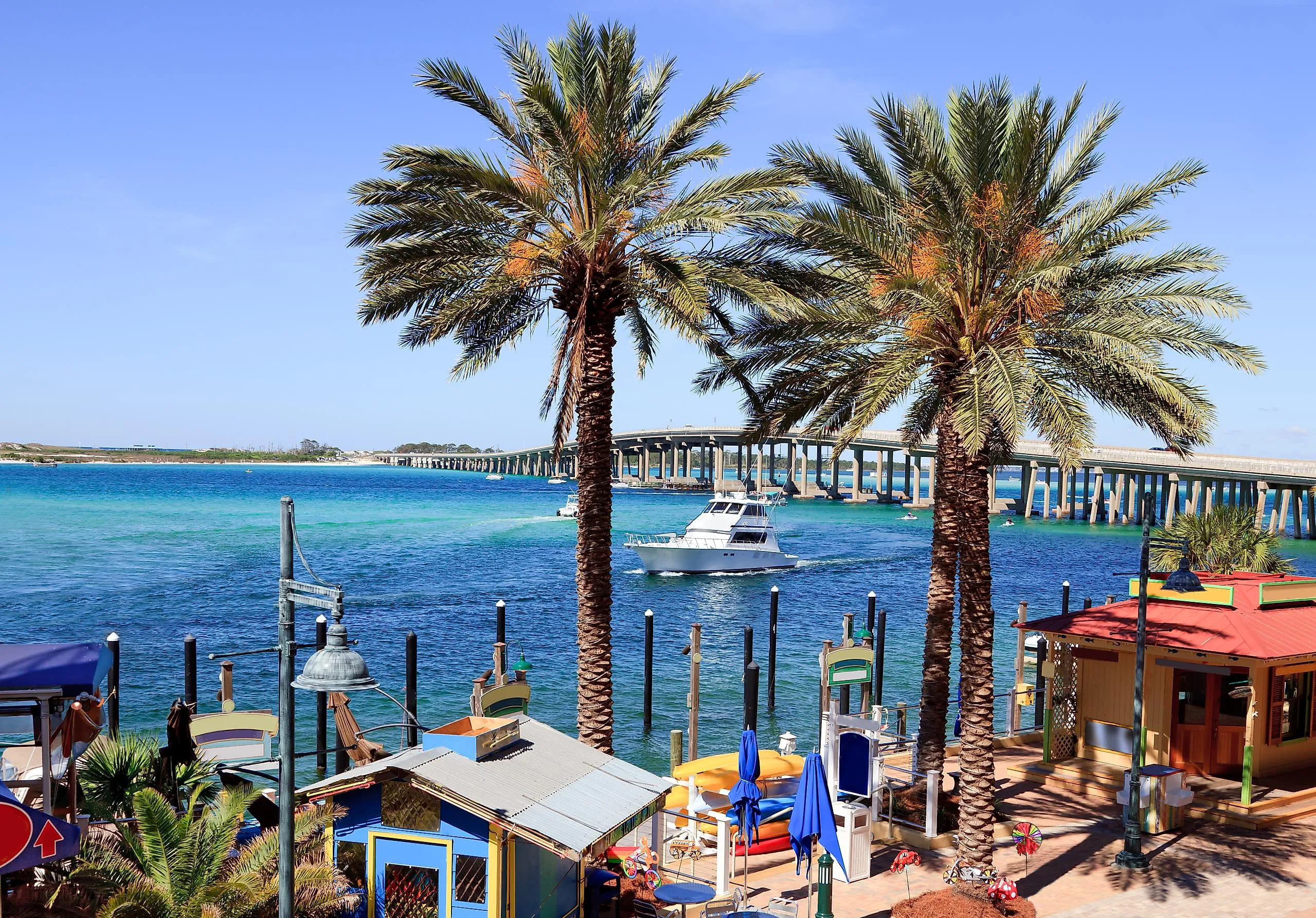
Destin was once a sleepy fishing village at the edge of the Gulf, founded by a New London fisherman who sailed south in the 1850s. Its nickname, "The World's Luckiest Fishing Village", still applies; the Destin Harbor is home to one of the largest charter-fishing fleets in the U.S., often described locally as the largest in North America. The town sits on a narrow peninsula, with Choctawhatchee Bay on one side and the Gulf's emerald water on the other. East Pass creates a natural deepwater channel where dolphins are often spotted near the jetties.

HarborWalk Village is the working heart of Destin, with seafood stalls, charter boats, and McGuire's Irish Pub, known for dollar bills stapled to the ceiling and Senate Bean Soup served since 1977. Henderson Beach State Park offers a one-mile trail through sand pines and protected dunes. The Destin History and Fishing Museum displays antique rods and mounted Gulf fish, including a 300-pound marlin. For sunset views, locals gather along Norriego Point.
Sanibel

Sanibel curves east to west instead of north to south, making its Gulf-facing shoreline a natural net for seashells. More than 250 species wash up here, a fact that draws shell collectors from around the world. The city enforces strict building height limits and bans chain restaurants. Nearly two-thirds of the island is protected land, including the J.N. "Ding" Darling National Wildlife Refuge, where roseate spoonbills and alligators share mangrove lagoons visible from Wildlife Drive.
The Sanibel Historical Museum and Village preserves nine restored historic buildings, including a 1920s post office and the Bailey family’s original general store. The Lighthouse Café serves sourdough pancakes and claims the "world's best breakfast." The Magic Bus Caffeine & Creamery in the lighthouse district serves espresso drinks, waffle-cone sundaes, and candy from a bright storefront on Periwinkle Way, with colorful stools lining its outdoor walkway. Bowman's Beach, west of town, is quiet even in peak season, with shell-laden surf and footpaths through native vegetation. Most visitors travel by bike along the island's 25-mile paved trail system.
Venice

Venice was designed in the 1920s by city planner John Nolen, who blended Mediterranean Revival architecture with a street grid of boulevards lined in palms. The layout remains intact, with Venice Avenue ending in a direct line to the Gulf. The beach is known for fossilized shark teeth, often found after storms, giving Venice its title as the "Shark Tooth Capital of the World." A former rail line now serves as the Legacy Trail, a paved route connecting downtown to Sarasota.

Caspersen Beach offers unspoiled shoreline and tidal flats south of town. The Venice Museum & Archives operates inside a 1927 Triangle Inn and preserves records of the Brotherhood of Locomotive Engineers, who helped fund the city. Croissant & Co. serves French pastries in a stuccoed storefront with arched windows. At Snook Haven, visitors eat smoked mullet under cypress trees along the Myakka River while alligators move in the background.
Vero Beach

Vero Beach sits where the Indian River Lagoon meets the Atlantic, and its oceanfront remains low-rise by ordinance. In 1715, a Spanish treasure fleet wrecked offshore; gold coins still wash up after storms. The barrier island's grid centers on Ocean Drive, a compact stretch of galleries, boutiques, and cafés facing dunes and sea oats. The beaches are uncrowded, with natural sandbars just offshore and sea turtle nests marked by tape and wooden stakes.

The Vero Beach Museum of Art anchors Riverside Park and includes sculpture gardens and rotating exhibits in five galleries. At Casey's Place, locals line up for chili dogs and tuna salad under palm trees beside the beach. The Driftwood Resort, built from salvaged timber in the 1930s, offers rooms above Waldo's, a bar with open decks facing the water. Round Island Beach Park, at the southern edge of town, draws manatees to its brackish coves.
Atlantic Coast
Fernandina Beach

Fernandina Beach is the only U.S. town to have flown eight different national flags, a layered past reflected in its preserved downtown on Centre Street. Brick storefronts, iron balconies, and Victorian homes line a harbor where shrimp boats still dock. The town hosts the Isle of Eight Flags Shrimp Festival each spring, celebrating the industry that once made it the shrimping capital of the East Coast. Fort Clinch, built in 1847, stands at the island's northern tip, surrounded by dunes and live oaks.

The Palace Saloon, opened in 1903, claims to be Florida's oldest bar and still serves bourbon beneath a carved mahogany backbar imported from Europe. T-Rays Burger Station operates inside a converted gas station, where license plates hang over Formica booths. The Amelia Island Museum of History is housed in the old county jail. At Main Beach Park, surf rolls in beside a boardwalk and an old-school putt-putt course.
St. Augustine

Founded in 1565 by Pedro Menéndez de Avilés, St. Augustine is the oldest continuously inhabited European-established settlement in the continental U.S. The Spanish coquina walls of Castillo de San Marcos still face Matanzas Bay, where pirate raids and colonial skirmishes once unfolded. Narrow brick streets radiate from the Plaza de la Constitución, where the Cathedral Basilica's bell tower rises beside palms and cannons. Historic homes, like the González-Alvarez House, reveal layers of Spanish, British, and American rule.

The Lightner Museum occupies Henry Flagler's former Alcazar Hotel, with galleries of Gilded Age art and artifacts above an emptied indoor swimming pool. On Cordova Street, Maple Street Biscuit Company serves biscuit-and-gravy plates, fried chicken biscuits, and coffee to a steady mix of locals and day-trippers from the historic district. The St. Augustine Alligator Farm dates to 1893 and includes a rookery where native birds nest above crocodilian enclosures. Anastasia State Park holds dunes, tidal marshes, and a wide Atlantic beach just east of town.
Lauderdale-by-the-Sea

Lauderdale-by-the-Sea sits on a barrier island just north of Fort Lauderdale, separated by an Intracoastal drawbridge that lifts regularly for boat traffic. The town's offshore coral reef lies only 100 yards from shore, making it one of the few places in Florida where snorkeling begins at the beach. Off the Datura Avenue beach portal, the Anglin's Pier Reef Snorkel Trail marks three shallow coral reefs within about 100 yards of shore, where snorkelers fin past the swim buoys to spot angelfish, rays, and the occasional nurse shark. The walkable downtown is centered on Commercial Boulevard, ending in a beach pavilion with Adirondack chairs facing the surf.

The Aruba Beach Café serves grilled mahi and conch fritters beneath a palapa roof beside the pier. At Bean & Barnacle, housed in a vintage motel lobby, morning regulars order cortados and guava pastries. El Prado Park offers shaded picnic tables just steps from the sand. Gold Coast Scuba rents dive scooters and leads reef tours directly from shore, no boat required.
Palm Beach

Palm Beach was developed by Henry Flagler as a resort for Gilded Age elites, and his former estate, Whitehall, now anchors the Henry Morrison Flagler Museum with marble halls and Beaux-Arts interiors. The town occupies a narrow barrier island, bordered by the Atlantic and Lake Worth Lagoon, with Mediterranean-style mansions behind walls of bougainvillea. Zoning laws keep buildings low and sidewalks quiet. The Lake Trail runs along the Intracoastal, passing banyan trees and yacht docks behind the town's older homes.

The Breakers, founded in 1896 and rebuilt after two fires, still operates as a resort and offers access to its historic arcade and oceanfront lawn. Green's Pharmacy & Luncheonette, in business since 1938, serves egg salad sandwiches and milkshakes in swivel stools beneath black-and-white photos. Worth Avenue features original Mizner-designed courtyards with names like Via Parigi. At Palm Beach Municipal (Mid-Town) Beach near the Worth Avenue clock tower, a guarded strip of public sand fronts the Atlantic along Ocean Boulevard, reached by short walkways over a low seawall and dunes.
Islamorada

Islamorada spans five islands between Key Largo and Marathon, where Florida Bay meets the Atlantic through narrow cuts lined with mangroves. It was the site of one of the strongest hurricanes on record, the 1935 Labor Day storm, which destroyed a railway and left coral rock memorials. The town remains a hub for sportfishing, with dozens of offshore charters running from marinas like Whale Harbor. Tarpon gather at the base of the bridge at Robbie's Marina, where visitors feed them from the dock.

The History of Diving Museum traces undersea exploration with a collection of helmets, rebreathers, and vintage air pumps. At the Morada Way Arts & Cultural District, studios and galleries open during the Third Thursday Art Walk. The Midway Café & Coffee Bar, located on Plantation Key, serves coconut French toast and Cuban coffee on a wraparound porch. Anne's Beach includes a boardwalk through tidal shallows and shaded picnic pavilions.
Key West

Key West sits closer to Havana than to Miami and once declared itself the independent "Conch Republic" in protest of a U.S. Border Patrol blockade. The island's Old Town district remains dense with conch houses, gingerbread trim, and six-toed cats descended from Hemingway's pets. U.S. 1 ends here at Mile Marker 0. Duval Street crosses from Gulf to Atlantic in 1.1 miles, lined with cigar shops, fish joints, and pastel wooden facades that have survived hurricanes, fire, and shipwreck fortunes.

The Ernest Hemingway Home and Museum preserves his writing studio and original furnishings on Whitehead Street. Fort Zachary Taylor Historic State Park offers a Civil War-era redoubt and a beach where the Gulf and Atlantic meet. At Blue Heaven, pancakes and yellowtail snapper are served under banyan trees in a former boxing ring used by Hemingway. The Key West Butterfly and Nature Conservatory houses tropical butterflies beside South Beach and the Southernmost Point marker.