13 Offbeat Towns to Visit in Florida
If you want a different kind of Florida trip, these 13 towns focus less on spectacle and more on what actually defines them. Some revolve around active shrimp docks and sponge boats unloading at the marina. Others are known for annual arts festivals that shut down the main street each winter or seafood celebrations that have run for decades. A few preserve 1920s Mediterranean Revival downtown grids planned before suburban expansion reshaped the state. Each town on this list is here because it feels distinct from the usual Florida routine.
Cedar Key

This small Gulf Coast village offers a slower pace defined by working docks, low-rise historic buildings, and open water views. Cedar Key traces its modern development to the 19th century, when it served as a railroad and shipping hub. Reminders of that era remain in preserved wood-frame structures and community institutions such as the Cedar Key Museum State Park. Built in 1929 as the home of local writer and naturalist Saint Clair Whitman, the property now displays artifacts related to regional archaeology, wildlife, and maritime history. The museum sits on roughly 18 acres overlooking the Gulf.
For broader historical context, the Cedar Key Historical Society maintains exhibits featuring photographs, documents, and materials spanning from Indigenous occupation to the town’s railroad and seafood industries.
Offshore, the Cedar Keys National Wildlife Refuge protects approximately 891 acres across a chain of small islands. Established primarily for bird conservation, the refuge supports nesting colonies of pelicans, herons, and other coastal species. Boating, fishing, and guided kayaking trips provide access to surrounding waters, where oyster beds, marshes, and tidal flats define the landscape more than sandy beaches.
Lake Worth Beach

About an hour north of Miami, Lake Worth Beach feels familiar to Floridians who prefer public shoreline access over gated resort strips. The downtown is compact and walkable, with older storefronts that still house working studios and independent businesses rather than national chains. The Benzaiten Center for Creative Arts anchors much of the arts activity, specializing in glasswork and offering regular demonstrations and classes.
Along the Intracoastal, the Snook Islands Natural Area protects a restored mangrove system with a raised boardwalk. It is a practical stop for shoreline fishing, birdwatching, or launching a kayak without heading deep into the Everglades.
Ocean access runs through Lake Worth Beach Park, where the municipal beach and rebuilt pier serve as everyday gathering points rather than tourist attractions. The pier remains one of the few places in Palm Beach County where you can fish directly over open Atlantic water, and Benny’s On The Beach sits right at the end of it.
St. Augustine

Founded in 1565, St. Augustine is recognized as the oldest continuously inhabited town in the continental US. Its historic core centers on Plaza de la Constitución, where Spanish colonial planning still shapes the street grid.
The most prominent landmark is Castillo de San Marcos National Monument, constructed between 1672 and 1695 to defend the Spanish settlement against British attacks. Built of coquina stone, it remains the oldest masonry fort in the continental US. Nearby, the St. Augustine Lighthouse & Maritime Museum, completed in 1874, interprets the region’s maritime history through exhibits on shipwrecks, navigation, and coastal trade.
Beyond the colonial district, St. Augustine Alligator Farm Zoological Park houses all 24 recognized species of crocodilians, along with birds and other reptiles. To the east, Anastasia State Park protects roughly 1,600 acres of dunes, tidal marsh, and maritime hammock, providing public access to Atlantic shoreline and estuarine habitat.
Fernandina Beach

For those who follow Florida’s layered coastal history, Fernandina Beach stands out for how much of it remains visible. Spanish, British, Confederate, and Union periods all left a mark here, and the street grid and port location still reflect that shifting control. The Amelia Island Museum of History, located inside the old Nassau County jail, documents that transition through guided interpretation and regional archives rather than large-scale exhibits.

Just north of downtown, Fort Clinch anchors the roughly 1,400-acre Fort Clinch State Park. Begun in 1847 as part of the federal coastal defense system, the fort later saw occupation by both Confederate and Union forces. Today, the park’s maritime forest trails, fishing spots, and campground are used as much by North Florida residents as by visitors.
Shrimping remains part of the town’s working identity. Fernandina Beach became one of the country’s leading shrimping ports in the early 20th century, a legacy still marked each spring during the annual Isle of Eight Flags Shrimp Festival, held downtown since 1964.
Apalachicola

On Florida’s Forgotten Coast, Apalachicola developed as a major cotton-shipping port in the 1830s and 1840s, and that maritime identity still defines the waterfront. Commercial fishing, particularly oysters, shaped the local economy for generations, even as harvest levels have fluctuated in recent years.
The Apalachicola Maritime Museum operates out of the riverfront and focuses on working-water education, offering guided boat excursions through Apalachicola Bay and the surrounding estuary. A few blocks away, John Gorrie Museum State Park interprets the life of John Gorrie, who developed an early mechanical refrigeration system in the 1840s while practicing medicine in town.
For a quick look at the harbor itself, the Scipio Creek Boardwalk runs along the water near the marina, providing access for walking and fishing. Community events continue year-round, including the annual Barkus Parade, a locally organized Mardi Gras-style procession that reflects the town’s smaller-scale Gulf Coast culture rather than large commercial festivals.
Mount Dora

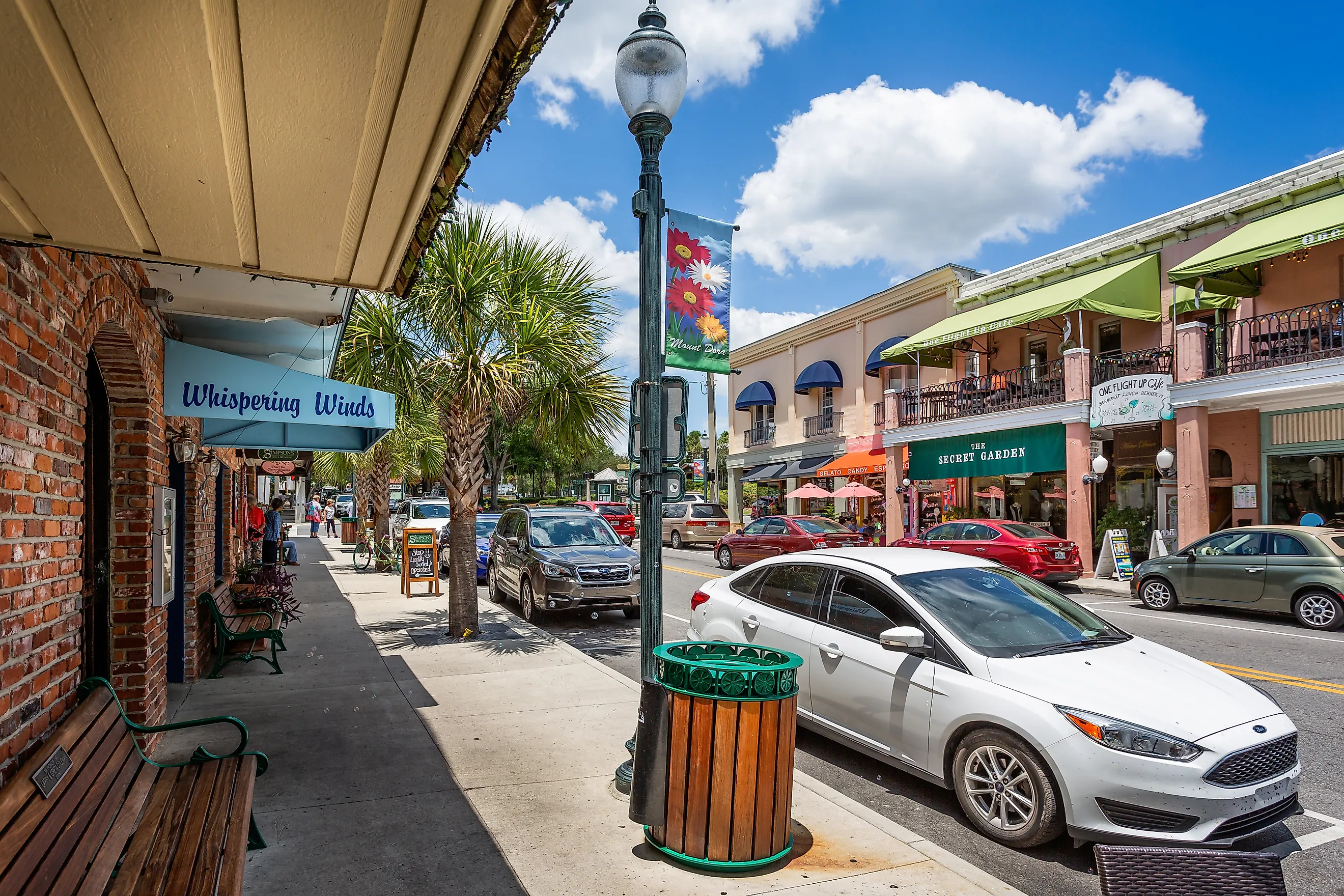
Set along Lake Dora in Lake County, Mount Dora is a small, downtown-driven city known for its concentration of antique shops and independent galleries. The commercial core remains compact and walkable, with storefronts that have operated for decades rather than turning over seasonally.
The Modernism Museum focuses on 20th-century modern design, including furniture and decorative arts, while the Mount Dora History Museum, housed in the city’s 1923 fire station, documents local development from its late-19th-century founding forward.
Each winter, the annual Mount Dora Arts Festival draws hundreds of artists to the downtown streets, reinforcing the city’s long-standing arts orientation rather than introducing something new.
On the lakefront, Palm Island Park protects about eight acres of shoreline habitat. Its boardwalk cuts through cypress and marsh along Lake Dora, offering a direct look at the same water system that shaped the town’s early growth.
Seaside

On the Panhandle’s Scenic Highway 30A corridor, Seaside stands as one of the earliest built examples of New Urbanist planning in the country. Established in 1981, the town was intentionally designed with narrow streets, front porches, and a walkable central square rather than conventional suburban sprawl.
The town center remains compact, anchored by long-operating businesses such as Great Southern Café. A seasonal farmers market draws area residents for regional produce and small-scale vendors rather than large commercial setups.
Just west of Seaside, Grayton Beach State Park protects nearly 2,000 acres of dunes, coastal forest, and Western Lake, one of the rare coastal dune lakes found in only a few places worldwide. Camping, paddling, and trail use keep the park active with Northwest Florida residents throughout the year.
Winter Garden

West of Orlando, Winter Garden maintains one of the more intact historic downtown districts in Central Florida. Plant Street is filled with locally owned shops and long-running businesses occupying restored brick buildings.
The Central Florida Railroad Museum operates out of the 1913 depot and documents how rail lines shaped citrus shipping and regional growth. A few blocks away, the Winter Garden Farmers Market draws regular weekend traffic to the Downtown Pavilion.
Toward the lakefront, Newton Park provides public access to Lake Apopka, including a pier, playground, and open shoreline. Together, these spaces reflect a city that has reinvested in its historic core while keeping the lake accessible to residents.
Yankeetown

On the Withlacoochee River near Florida’s Nature Coast, Yankeetown remains small even by rural standards, with only a few hundred year-round residents. The town functions more as a river access point than a resort stop, with boating and fishing the primary activity.
Bird Creek Beach provides a modest riverside shoreline used for launching small boats and bank fishing rather than traditional Gulf swimming. Nearby, the Withlacoochee Gulf Preserve protects about 413 acres of marsh, wetlands, and tree islands. Trails wind through the preserve, and a 30-foot observation tower overlooks the estuary where freshwater meets the Gulf. Closer to town, Winding River Garden offers a short boardwalk and gazebo along the river. The setting is quiet, with limited commercial development and direct access to the water.
Marianna

As the county seat of Jackson County, Marianna maintains a historic core with several 19th-century buildings and Civil War-era sites. The downtown district includes government offices, small businesses, and locally operated storefronts rather than large-scale retail.
Just outside town, Florida Caverns State Park offers guided tours through limestone caves formed by the Chipola River system. The park also includes walking trails and river access. Along the Chipola, the Hinson Conservation & Recreation Area provides boat ramps, picnic areas, and marked trails.
Within town limits, Marianna Cinemas operates as a multi-screen theater, and John Brewer's Studio functions as a working art studio and gallery.
Tarpon Springs

Along the northern edge of Tampa Bay, Tarpon Springs developed around the sponge industry in the early 1900s, drawing Greek divers who established one of the largest Greek American communities in the state. The Saint Nicholas Greek Orthodox Cathedral parish was founded in 1907, and the current cathedral building, completed in 1943, remains central to the city’s religious and cultural life.
West of downtown, Fred Howard Park provides public Gulf access, including a beach, picnic shelters, and a causeway popular with local anglers.
The Tarpon Springs Sponge Docks district continues to house sponge warehouses, boat slips, and Greek-owned restaurants and markets. The area reflects the city’s early 20th-century maritime economy rather than a recent tourism development.
Venice

On Sarasota County’s Gulf shoreline, Venice is known for its public beaches and 1920s-era downtown plan. Venice Beach provides direct Gulf access near the city center, while nearby Caspersen Beach is often associated with fossilized shark teeth found along the shoreline.
Extending about 700 feet into the Gulf, the Venice Fishing Pier allows fishing without an individual license under its pier permit. The structure also serves as a walking access point over open water.
Downtown Venice was laid out in the 1920s under the direction of planner John Nolen and retains Mediterranean Revival architectural elements along its main corridors. Independent shops and restaurants line the area, including Sharky's On the Pier, located adjacent to the pier.
Naples

On Collier County’s Gulf coast, Naples maintains a small municipal population relative to its regional footprint. The city’s economy centers on residential development, seasonal residents, retail corridors, and arts institutions.
The Naples Botanical Garden spans roughly 170 acres and focuses on subtropical and tropical plant collections suited to Southwest Florida’s climate. Along the shoreline, the Naples Pier remains a focal structure for walking and fishing, though it has undergone repairs following hurricane damage in recent years.
Downtown retail activity concentrates along Fifth Avenue South and Third Street South, while Tin City continues to operate as a waterfront shopping and marina complex. The Naples Zoo at Caribbean Gardens combines animal exhibits with the grounds of a historic botanical site.
Final Thought
Florida’s smaller towns reveal how differently the state developed across its coasts and interior. Built around waterways, rail corridors, and agricultural land, they maintain compact downtowns and direct access to the landscapes that first sustained them.