6 Old Mill Towns To Visit In New Hampshire
Any deep dive into the mill history of New Hampshire starts in the state’s largest city, Manchester, where the massive Amoskeag Manufacturing Company once reigned as the largest textile mill complex in the world. Perched along the Merrimack River, the mill used waterpower to fuel Manchester’s growth and helped define New Hampshire as an industrial powerhouse in the 19th century.
There’s a certain kind of nostalgic charm in the old mill towns of New Hampshire, where brick textile and manufacturing mills that once lined the rivers, powering entire communities in small towns like Harrisville, Claremont, Peterborough, Newport, Portsmouth, and Laconia. Today, many of those historic mills have been revitalized as cultural and community spaces for an entirely new generation to enjoy. Below are six old mill towns where industry once hummed and beauty endured.
Harrisville

One of the most authentic mill towns in New England, the small town of Harrisville hasn’t changed much since the 19th century, when the Harris Mill first began spinning wool, and from which the town gets its name. The Harris Mill was eventually purchased by Cheshire Mills, which operated there from 1852 to 1970, when the woolen business became the town's backbone. Cheshire Mills declared bankruptcy in 1970 and permanently closed its doors, but within a year, the community formed Historic Harrisville, Inc. (HIH) to preserve the town’s history. In 1977, the U.S. Department of the Interior (DOI) designated Harrisville a National Historic Landmark.
Today, the town and its population of about 1,000 residents welcome visitors year-round with an audio walking tour of the historic district to discover 26 sites around town, including the 1842 Community Church of Harrisville and Chesham; the 1851 Cheshire Mills Boarding House, which housed mill workers for over 100 years; and the 1840 Island Cemetery, where many of the original Harris family members are buried. Historic Harrisville operates the Harrisville General Store, which opened in 1838 and today is a nostalgic general store selling local food, groceries, and gifts. It also serves as the community hub, hosting dinners and events throughout the year.
Claremont

For more than a century, the town of Claremont thrived, largely thanks to the Sugar River Manufacturing Company, a cotton and textile mill chartered in 1831. In 1846, the company was renamed Monadnock Mills after nearby Mount Monadnock, an Abenaki name meaning “isolated mountain.” When the mills closed in the 1960s, many of the buildings were abandoned, and the town’s economy suffered. In the late 20th century, the pretty town on the Sugar River began to experience a renaissance, and many of the surviving stone-and-brick mill buildings are now repurposed as businesses like The Common Man Inn & Restaurant, a 30-room pet-friendly boutique hotel and restaurant.
In the town’s historic district, the Claremont Opera House, which first opened in 1897, is once again entertaining the 13,000+ residents of Claremont with a roster that includes live music, comedies, and tribute bands. After closing in 1963, the building was slated for demolition until it was saved and listed on the National Register of Historic Places in 1973. To learn more about the town's industrial and mill history, visit the Claremont History Museum, which is open seasonally and free for all visitors.
Peterborough

In the first half of the 19th century, the prosperous mill town of Peterborough was home to numerous textile and water-powered factories, thanks to its location at the confluence of the Contoocook River and Nubanusit Brook, including the Bell Factory, which was among the earliest cotton mills in New Hampshire, and the second in New England. The more than 200-year-old Noone Falls Mills, the first mill in Peterborough to be powered by electricity, has recently been renovated and now houses a MAxT Makerspace, a 7,000-square-foot collaborative workspace for residents interested in 3D printing, printmaking, metalworking, and, in a nod to its historic past, textiles.
With a population of approximately 6,500 residents, the town is known for attracting writers, artists, and craftspeople and is said to be the inspiration for Grover’s Corners in Thornton Wilder’s Pulitzer Prize-winning play “Our Town,” parts of which were written at nearby MacDowell, the famous artist residency program. Peterborough’s historic downtown is full of brick buildings from its old mill past, now home to eclectic shops like the Toadstool Bookshop, Bowerbird & Friends Antiques, and Ava Marie Chocolates.
Newport

Like many old mill towns surrounding Newport, the town, now home to 6,500 residents, transitioned from farming to industry in the late eighteenth century, with the opening of its first mills along the Sugar River in 1768. The Richards, Dexter & Sons Woolen Mill (also known as the Newport Woolen Mills) first opened in 1905 and was later renamed the Gorden Woolen Mill, which produced wool linings for Army clothing during World War II. In recent years, the well-preserved 4-storey red brick building, listed on the National Register of Historic Places in 1985, has been converted into affordable housing while still maintaining its architectural heritage.
Newport’s rich history is everywhere you look in the pretty town, from the Corbin Covered Bridge, a 96-foot wooden bridge built in 1845, destroyed by fire in 1993, before being rebuilt by the community in 1994. Two other historic covered rail bridges, Wright’s Bridge and Pier Bridge, are now part of the 9.5-mile multi-use Sugar River Rail Trail, with the 216-foot, 7-inch Pier Bridge being the longest covered railroad bridge in the world. The circa-1826 former courthouse building now operates as The Old Courthouse restaurant at 30 Main Street, while the Newport Historical Society Museum is located separately at 20 Central Street. The museum is open seasonally from April through October.
Portsmouth

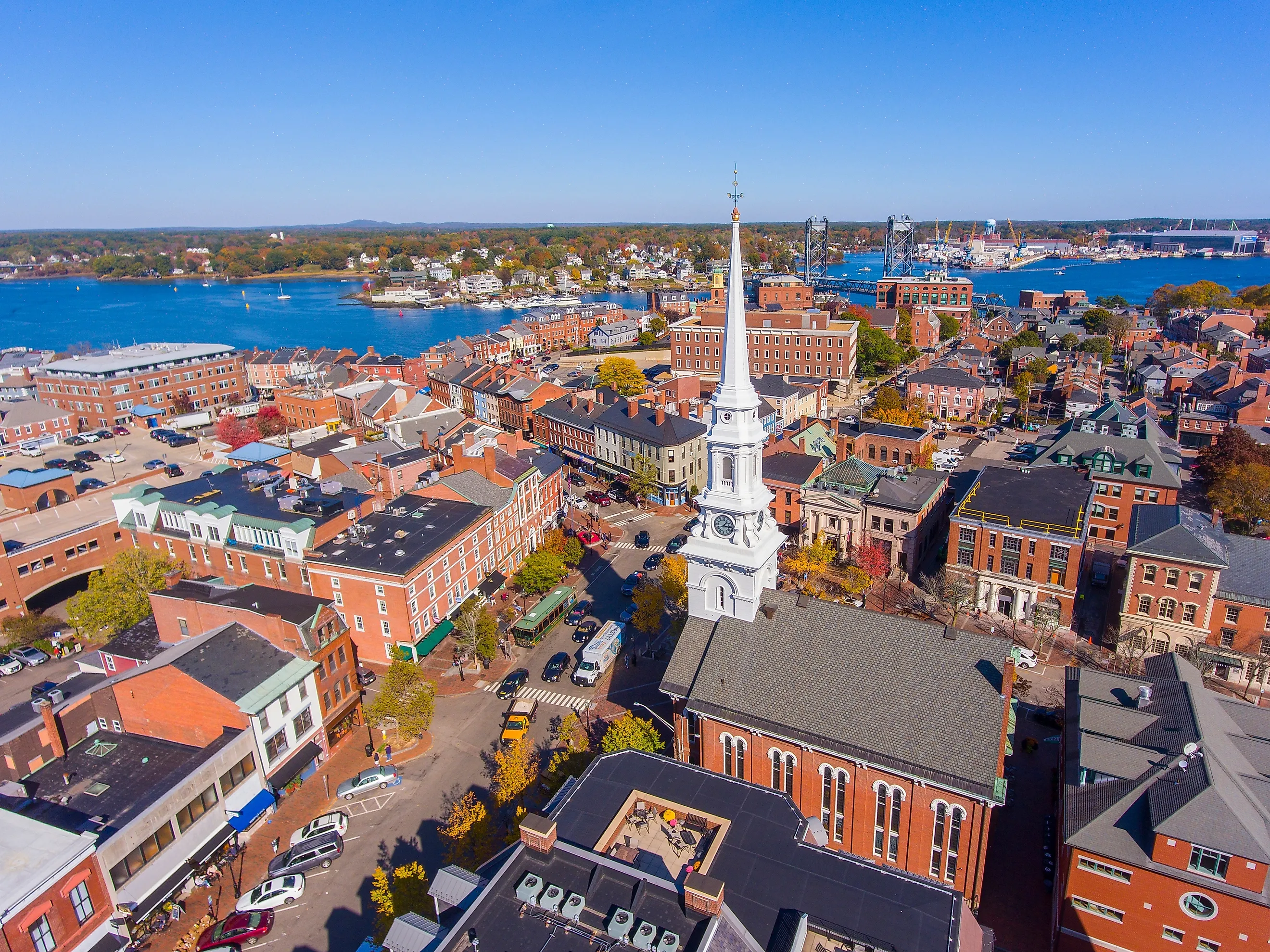
Unlike many of its neighbors, Portsmouth’s milling history is rooted in gristmills, sawmills, and ship-related industries. As one of the oldest port towns in New England, the town relied on milling timber and grain, both for local use and export, to support its maritime industry. Absent in the town’s landscape are the massive red brick buildings seen in many of New Hampshire’s old mill towns, and instead, the town is easily recognized by iconic landmarks like the steeple of North Church and the living history museum known as the Strawbery Banke Museum, and its more than 35 restored buildings from the 17th to 19th century.
Portsmouth Harbor and the walkable waterfront along the Piscataqua River are top destinations for visitors to the over 400-year-old town of about 23,000 residents. While the harbor is a working harbor, where you can watch the iconic tugboats in action, there is no shortage of fresh seafood restaurants to check out, including the casual River House, Old Ferry Landing, and the historic Puddle Dock Restaurant.
Laconia

With a population of 17,500 residents, Laconia has grown considerably since its early days as a busy mill town, centered around textile production and shoe manufacturing on the Winnipesaukee River. Laconia was home to several mills, but the best-known was Belknap Mills, built in 1823. The Belknap Mill is the oldest unaltered brick textile mill in the United States, and houses an intact 1918 hydroelectric power plant and a bell cast by George Holbrook, apprentice to Paul Revere.
Today, the Belknap Mill is a multi-purpose center with multiple galleries and museums, including the Karagianis Gallery devoted to the mill’s 200-year history, the Knitting Museum, the Powerhouse Museum, and more. One of Laconia’s biggest draws isn’t its mill town past, though; it is Funspot, the largest arcade in the world. Founded in 1952, the historic entertainment complex offers over 600 classic games, 1 20-lane bowling center, an 18-hole indoor mini-golf course, a restaurant, a tavern, and more. Another local attraction is nearby Weirs Beach, a classic lakeside destination on Lake Winnipesaukee, with an old-style boardwalk, arcades, and souvenir shops.
Just like the historic mills that once transformed farming communities into industrial powerhouses, New Hampshire’s old mill towns have reinvented themselves for the 21st century. In Harrisville, the community leaned into its historic mill-town past and turned it into a much-visited destination, while Petersborough’s landmark Bell Factory now houses eclectic restaurants, shops, and creative spaces. Newport and Laconia repurposed heritage buildings as museums, much-needed housing, and cultural spaces. Even Portsmouth, with its gristmills and shipbuilding past, mixes historic charm with a busy, energetic waterfront. Today, these six old mill towns honor their industrial roots while embracing the future as modern centers of commerce, art, and community.