Five Classic Americana Downtowns In Oregon
Classic Americana often shows up in the smallest of places. Whether it's classic neon-lit venues, traditional store window displays, or murals of local people and pets, these five Oregon downtowns have all paid attention to the details.
That's what sets them apart. Baker City's theater has kept its original paintwork while Pendleton's saddlery has been in the same premises since 1905. Independence built its Main Street on 1880s hop money, Silverton shows off its history with its more than 30 murals, and Klamath Falls still cranks an old elevator in its heritage bank building.
The shops, pubs, and places of entertainment in each of these downtowns have all retained enough of that certain something to make them truly American.
Baker City

Baker City's historic downtown is one of the largest and most intact turn-of-the-20th-century downtowns in the Pacific Northwest. The Main Street storefronts in the Baker Historic District were paid for by the gold and railroad money that passed through the town from the 1860s onward.
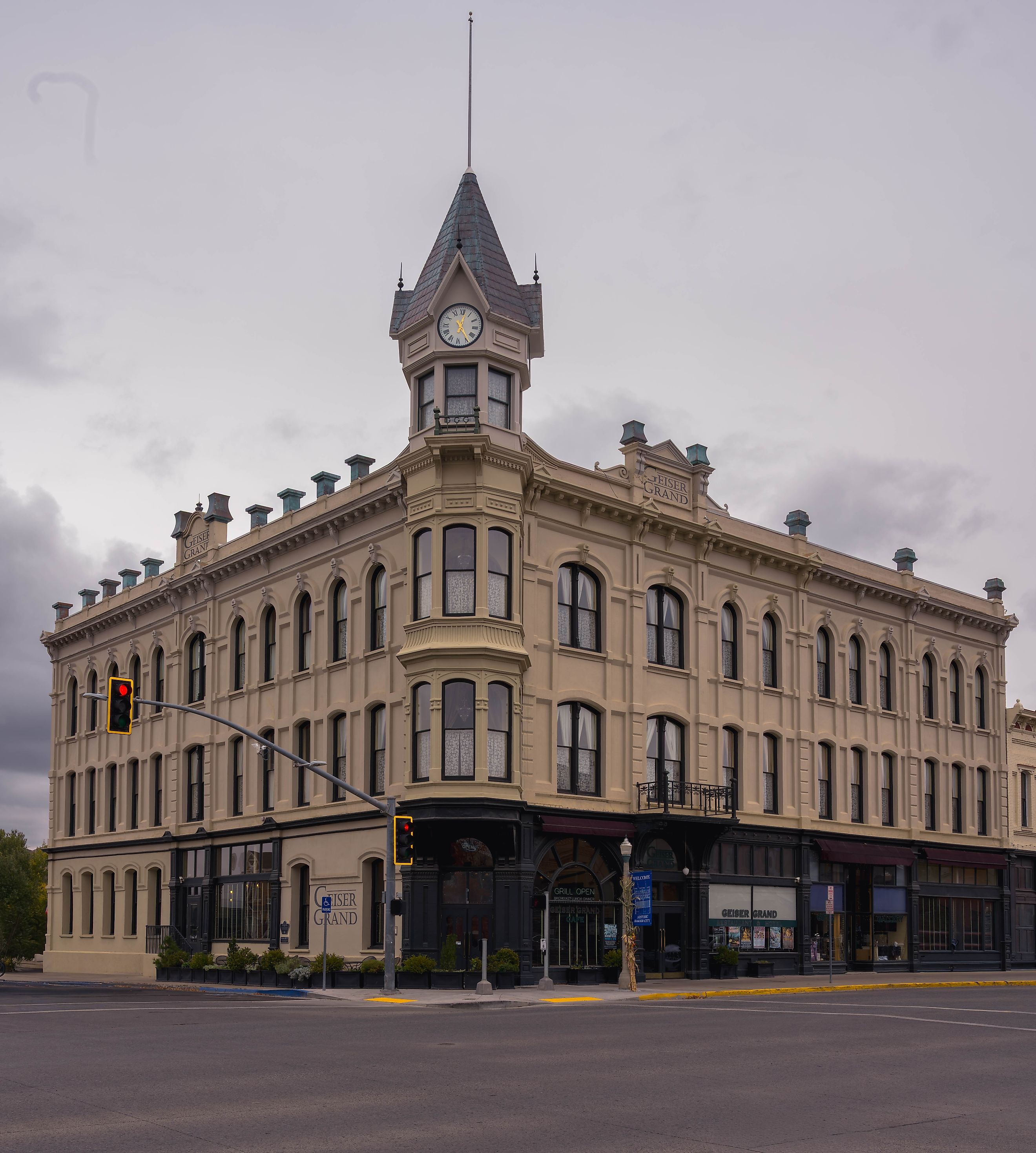
You can still see that opulence in places like the Geiser Grand Hotel, opened in 1889 and restored to its former glory in the 1990s, with its mahogany columns, crystal chandeliers, and stained-glass ceiling all intact.
Baker Tower opened on August 24, 1929, financed by 300 residents who bought stock in what was then the 82-room Baker Community Hotel. At 144 feet to the top of its octagonal dome-like structure, the nine-story Art Deco landmark is still the tallest building in Oregon east of the Cascades, and now contains apartments, offices, and a ground-floor ballroom.
Look for the pairs of four-foot terra-cotta eagles flanking its entrances. A block over, the Eltrym Theater opened in 1940, and its blue and pink Streamline Moderne color scheme is largely unchanged. Subdivided into three screens in 1997, it still shows first-run films.
For a pleasant watering hole set in an architectural gem, head to Barley Brown's. This popular brewpub occupies a single-story brick building built in 1940 as a bakery, and its barstools were made from the jury chairs of the old Baker County courthouse with their taproom is across the street.
Betty's Books is the long-running bookshop on Main, while the Crossroads Carnegie Art Center runs exhibitions and classes in the former Carnegie library. A few blocks from Main Street, the Baker Heritage Museum occupies the Baker Municipal Natatorium, an indoor swimming hall built in 1920, and fills it with mining, ranching, and Oregon Trail exhibits along with the 18-ton Cavin-Warfel rock and mineral collection.
Pendleton

Hamley & Co. was founded in 1883 and moved to a property at the corner of Court and Main in Pendleton in 1905, where it remains today. The company built its reputation on handmade saddles, and founder J.J. Hamley himself helped organize the first Pendleton Round-Up in 1910.
The saddle shop is still open to visitors inside the company's Western store, and the business has expanded to include the Hamley Steakhouse & Saloon, the Hamley Cafe, and the 1883 Wine Bar.
Across the street, the Rainbow Cafe has been around since 1883, when it started as the State Saloon and Banquet. Considered the oldest business in town, it spent the Prohibition years as a cigar shop before relaunching as the Rainbow in the early 1940s, when it picked up the Irish theme and the neon sign it is still known for today, along with its pressure-cooked fried chicken.
Other downtown signs the city recognizes as historic include Hamley's, mentioned above, and Cimmiyotti's steakhouse, now Virgil's at Cimmiyotti's.
Main Street is lined with brick commercial buildings, as well as a series of life-size bronzes. Among them are Jackson Sundown, a member of the Native American Nez Perce tribe and bronc rider, George Fletcher, the first Black bronc rider to compete at the Round-Up in 1911, and Aura Goodwin Raley, known as the Mother of Pendleton.
The Pendleton Bronze Trail links them on a 1.5-mile self-guided route that also takes in the Western heritage mural on the side of the Great Pacific Wine & Coffee Co.
Pendleton Underground Tours offers 90-minute guided walks through the tunnels beneath the downtown core, taking in the former Cozy Rooms bordello and the basement quarters used by Chinese laborers in the late 1800s.
The Heritage Station Museum is housed in the railway depot built in 1909, and Pendleton Woolen Mills has been weaving blankets since the Bishop family opened the mill in 1909 where free mill tours are available. Also worth noting are the Montana Peaks Hat Company, which continues to shape custom cowboy hats with tools from the 1800s, and Staplemans Boots & Leather, which builds boots to order.
Independence

Hops, a key ingredient of beer, built Main Street Independence. From the 1890s to the 1940s, the town called itself the Hop Capital of the World, and the stats from the period prove it. The 1913 harvest weighed in at 4,275,000 pounds and sold at 22 cents a pound, and at the industry's peak in the mid-1940s, the town's population swelled to somewhere between 40,000 and 50,000 during picking season.
Most of the major buildings seen on Main Street date from the 1880s building boom. You'll see some of the best examples in the Independence Historic District, which covers 30 blocks of historic homes and businesses set along the west bank of the Willamette River and was added to the National Register of Historic Places in 1989.
One reason so much survives is that the freeways of the 1960s bypassed the town, so nobody ever pushed to modernize the downtown.
The town's go-to landmark, though, is the J.S. Cooper Building on South Main Street. Built in 1895 for a prominent local banker, its octagonal tower features a cupola that once had a bell that rang each time a boat docked with cargo on the river across the street.
Other highlights include a bank building put up in 1891 and a hardware store that opened in 1902, while the Independence Heritage Museum promotes a walking tour that takes in several more classic Americana heritage buildings.
Silverton

Silver Creek runs straight through downtown Silverton, where cafe seating at the Silverton Coffee Station overlooks the water and a charming covered pedestrian bridge. The town grew on the back of sawmills and flour mills that sprang up, and its commercial district is home to the Palace Theatre, a single-screen Art Deco house built in 1936 that still shows movies.
What sets the town apart, though, is its more than 30 downtown murals, and a free self-guided map available at downtown businesses traces a route past them all.
The best-known and longest is the 70-foot painting on South Water Street telling the story of Bobbie the Wonder Dog, a Silverton collie mix lost in Indiana in August 1923 who turned up on the family doorstep six months later, having covered at least 2,551 miles on foot, the mural society's telling puts it closer to 2,800.
A life-size statue of Bobbie sits nearby alongside a replica of his yellow doghouse. Other murals depict Homer Davenport, the Silverton-born newspaper cartoonist who brought the first Arabian horses to America, astronaut Don Pettit, a Silverton native, and a reproduction of Norman Rockwell's Four Freedoms series.
The Silverton Country Historical Society museum on South Water Street is where you can pick up an informative historic walking-tour guide. Gordon House, designed by Frank Lloyd Wright and completed in 1963, was moved to the Oregon Garden on the edge of town in 2001 and is included in the tour.
Klamath Falls

The timber boom of the 1920s had a significant impact on Klamath Falls, most notably along its historic Main Street. Here, a stretch of early 20th-century commercial buildings includes the Williams Building, built in 1927 with a glazed terracotta facade showing scenes of the Western frontier.
Nearby, the six-story Oregon Bank Building, completed in 1930 and still the tallest building in town, runs one of the last manually operated elevators in the country, with an attendant on board to work the controls and point out the historic photographs lining every floor.
At the west end of Main Street, the Baldwin Hotel Museum started off as a hardware store built in 1905 before becoming a hotel in 1911. The nearby Favell Museum displays more than 100,000 Native American artifacts, including a fire opal arrowhead found in the Black Rock Desert in 1910, alongside Western artworks.
Also worth seeing is the Klamath County Museum that occupies the town's former National Guard armory built in 1935.
Klamath Falls is also home to the Ross Ragland Theater, which opened in November 1940 as the Art Deco Esquire Theater with a screening of The Westerner starring Gary Cooper. Shuttered in 1982 and nearly demolished, it was rescued by a community campaign and reopened in 1989 as a performing arts center, its neon marquee tower still lighting up 7th Street. Its robust program of entertainment includes touring acts, symphony orchestras, and local drama productions.
Oregon's Classic Americana Downtowns
These five Oregon towns share the kind of classic downtowns that define the nation. Their main streets grew from humble dirt roads to stretches of real estate that wouldn't look out of place in a movie like Back to the Future or Pleasantville.
The shops, saloons, theaters, and hotels that still thrive there are independently owned, as they should be in a classic Americana downtown.