9 Prettiest Small Towns In Massachusetts
Salem's Chestnut Street holds one of the densest concentrations of Federal-style architecture anywhere in the Northeast. Stockbridge anchors the southern Berkshires with the Red Lion Inn (a working hotel since 1773) and the Norman Rockwell Museum on the same block. Provincetown caps the outer Cape with the 252-foot Pilgrim Monument and an arts colony that traces back to 1899. Gloucester runs the oldest continuously operating commercial fishing port in the country, founded in 1623. The nine Massachusetts towns ahead each carry a distinct slice of New England's working geography.
Provincetown

Provincetown caps the tip of Cape Cod, the northernmost point in the Outer Cape, with about 3,700 year-round residents that swell past 30,000 in summer. The Pilgrim Monument, completed in 1910 and rising 252 feet, commemorates the Pilgrims' first 1620 landing here (before they continued to Plymouth) and remains the tallest all-granite structure in the United States. The Provincetown Art Association and Museum was founded in 1914, capping an artist colony that began in 1899 when Charles Hawthorne established the Cape Cod School of Art on Commercial Street.
The Lobster Pot on Commercial Street has served as many as 1,400 patrons a day through peak summer weeks. The Race Point Beach section of the Cape Cod National Seashore covers the Atlantic-facing dunes north of town, and Herring Cove Beach faces the bay side for the calmer swimming. The town's narrow streets pack roughly 400 working art galleries, theatres, and seasonal restaurants into a footprint of less than two square miles.
Salem

Salem's Chestnut Street is one of the densest concentrations of preserved Federal-style architecture in the country. The street runs 36 brick and clapboard mansions built between 1796 and 1815, when Salem was the wealthiest city per capita in the United States from the China trade. Pioneer Village, the oldest living-history museum in America (founded 1930), reconstructs Salem as it appeared in 1630 and opens seasonally with costumed interpreters.
Derby Wharf, three blocks from the historic district, extends 2,000 feet into Salem Sound as the centrepiece of the Salem Maritime National Historic Site. The Friendship of Salem, a full-scale replica of a 1797 East Indiaman, ties up at the wharf when not on tour. The 1692 Salem Witch Trials remain the town's strongest tourist draw, with Halloween month drawing more than 500,000 visitors. The rest of the year, Essex Street holds the working downtown including the Peabody Essex Museum, which houses one of the country's most significant collections of Asian export art.
Concord

Concord holds the opening battle site of the American Revolution. On April 19, 1775, colonial militia engaged British regulars at the Old North Bridge, the engagement Emerson later called "the shot heard round the world." Minute Man National Historical Park preserves the bridge along with the five-mile Battle Road Trail between Lexington and Concord. The Ralph Waldo Emerson House on Cambridge Turnpike, where Emerson lived from 1835 until his death in 1882, opens for guided tours through the warmer months. The Orchard House on Lexington Road, where Louisa May Alcott wrote Little Women in 1868, sits half a mile up the road.
Walden Pond, two miles south of the town centre, draws a steady year-round crowd to the spot where Henry David Thoreau lived in a small cabin from 1845 to 1847. A replica of the cabin stands at the parking area, with the original site marked by a stone cairn on the pond's north shore. The 335-acre Walden Pond State Reservation opens for swimming, walking, and ice fishing depending on the season.
Rockport

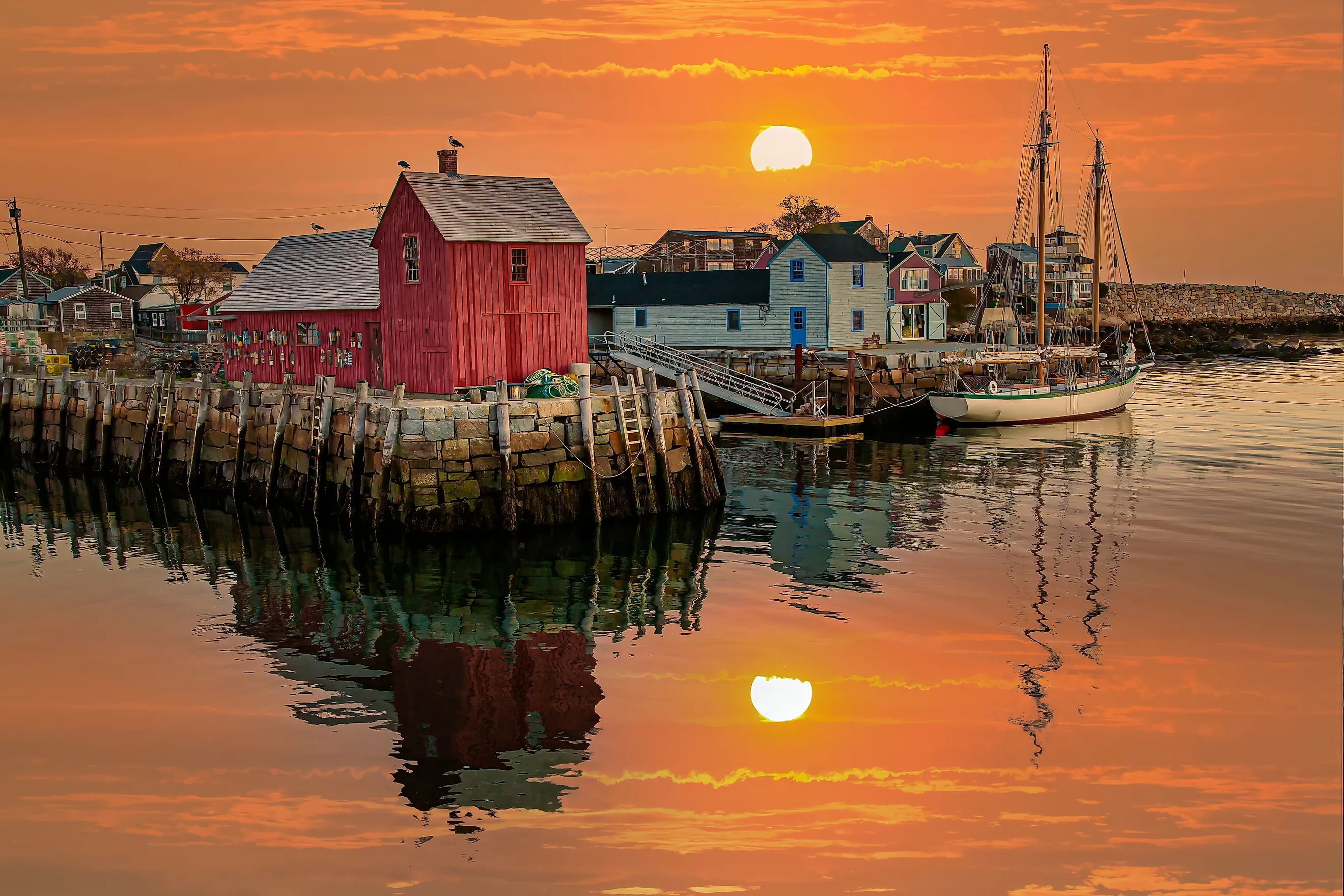
Rockport sits at the eastern tip of Cape Ann, 40 miles north of Boston. Motif No. 1, the red fishing shack at the harbour's edge, is widely cited as the most painted building in the United States. The original 1840s structure collapsed during the Blizzard of '78 and was rebuilt to original specifications later that year, with the replacement still standing at T-Wharf. Bearskin Neck, the narrow granite peninsula extending into Rockport Harbor, holds roughly 20 art galleries, seafood shacks, and working lobster shops along a single quarter-mile lane.
Halibut Point State Park, three miles north of downtown, covers 56 acres of abandoned granite quarries on the Atlantic coast. The Babson Farm Quarry, the largest of the workings, last produced granite in 1929 and now sits as a 60-foot-deep freshwater pool below the visitor centre. Rockport ran as a dry town from 1856 to 2005 (one of the longest such stretches in New England), which still influences the relatively quiet evening pace.
Chatham

Chatham occupies the elbow of Cape Cod, the easternmost point on the south-facing arm. The town runs about 6,100 year-round residents and roughly 18,000 in summer. Main Street holds Chatham Candy Manor (opened 1955) and a working downtown that runs more locally owned shops per block than most Cape towns. Chatham Lighthouse, established 1808 and rebuilt in 1877, still operates as an active aid to navigation and is open for free Coast Guard tours on summer Wednesdays.
The Monomoy National Wildlife Refuge, a 7,604-acre barrier island and salt marsh complex extending south from Chatham, holds one of the largest grey seal colonies on the Atlantic coast (counts have exceeded 50,000 individuals during peak summer hauling). The Chatham Fish Pier on Shore Road remains a working commercial dock where the Cape's day-boat fleet unloads cod, haddock, and skate through the afternoon. Stage Harbor, on the west side of town, runs evening sails and the town's small but active sport-fishing fleet.
Marblehead

Marblehead sits on a rocky peninsula 17 miles north of Boston with about 20,000 residents and one of the highest concentrations of pre-1800 wooden architecture in the country. The Historic District holds more than 200 18th-century homes (the count regularly cited as "300+" includes 19th-century buildings as well), with the 1768 Jeremiah Lee Mansion as the centrepiece. Lee, one of the wealthiest men in pre-Revolutionary America, built the mansion in the Georgian style with hand-painted wallpapers from England that still hang on the original walls. The mansion runs guided tours through the summer season.
Old Burial Hill, dating to 1638, holds more than 600 surviving 17th- and 18th-century gravestones overlooking the harbour. Marblehead has claimed the title "Birthplace of the American Navy" since George Washington commissioned the schooner Hannah from Marblehead in 1775. Chandler Hovey Park on Marblehead Neck holds the working Marblehead Light, and Fort Sewall (built 1644 and modified through the War of 1812) anchors the harbour entrance. The summer schooner When and If, commissioned by General George S. Patton in 1939, runs sunset sails out of the harbour in season.
Stockbridge

Stockbridge anchors the southern Berkshires in western Massachusetts, runs about 2,000 residents, and was founded in 1734 as a Mahican mission village. The Red Lion Inn has operated continuously since 1773 and is one of the oldest continuously running hotels in the country. Norman Rockwell lived in Stockbridge from 1953 until his death in 1978, and the Norman Rockwell Museum on Route 183 holds the largest public collection of Rockwell's original work (more than 700 paintings and drawings) plus his preserved studio.
The 1739 Mission House at the corner of Main and Sergeant Streets is the original home of John Sergeant, the first missionary to the Mahican community, and now operates as a museum under the Trustees of Reservations. Naumkeag, the 44-room Gilded Age summer cottage built in 1885 for New York attorney Joseph Choate, runs guided tours through its terraced Italianate gardens designed by Fletcher Steele between 1925 and 1956.
Lenox

Lenox sits in the Berkshire Hills with about 5,000 residents and the strongest summer cultural calendar in western Massachusetts. Tanglewood, the 524-acre summer home of the Boston Symphony Orchestra since 1937, runs an annual season from late June through August and is the country's most attended summer classical music festival. The Mount, Edith Wharton's 1902 country estate on Plunkett Street, operates as a literary museum with Wharton's original gardens restored to their 1912 design.
The Bookstore and Get Lit Wine Bar on Housatonic Street has run as an independent bookstore for over 40 years and added the wine bar in 2014. Ventfort Hall, the 1893 Jacobean Revival mansion built by J.P. Morgan's sister Sarah Spencer Morgan, operates as a Gilded Age Mansion and Museum with rotating exhibits. Mass Audubon's Pleasant Valley Wildlife Sanctuary, three miles west of downtown, protects 1,400 acres of forests, wetlands, and trails on the eastern slope of Lenox Mountain.
Gloucester

Gloucester is the oldest continuously operating commercial fishing port in the United States, founded in 1623 by English colonists three years after the Mayflower landing. The Gloucester Fisherman's Memorial, the bronze statue locally called "The Man at the Wheel" on Stacy Boulevard, commemorates the more than 5,300 Gloucestermen lost at sea since 1623. The Gloucester Harborwalk runs about 1.2 miles along the inner harbour with 42 granite story posts that trace the seaport's history. The town's commercial fleet still unloads at the Jodrey State Fish Pier on most mornings.
Sebastian Junger's 1997 book The Perfect Storm and the 2000 film adaptation drew national attention to Gloucester's fleet, focusing on the 1991 Halloween Nor'easter that sank the swordfishing vessel Andrea Gail. Good Harbor Beach on the eastern side of the city opens onto an exposed Atlantic shoreline with Salt Island reachable on foot at low tide. Wingaersheek Beach faces the calmer Annisquam River side. Ravenswood Park and Dogtown Common together cover roughly 3,800 acres of inland forest with trails through the abandoned 17th-century settlement of Dogtown.
The Massachusetts Read
These nine towns each carry a specific historical or geographic anchor that the rest of the state shares only in pieces. Salem's China-trade architecture, Concord's Revolutionary battlefield, Provincetown's Pilgrim landing, Stockbridge's Mahican mission origins, Marblehead's pre-Revolutionary shipbuilding, Gloucester's 400-year fishing economy, Lenox's Gilded Age mansions and Tanglewood season, Rockport's granite quarries, and Chatham's working fish pier all add to the regional weight in ways that go beyond rocky harbours and village greens.