9 Offbeat Montana Towns To Visit In 2026
In Anaconda a Jack Nicklaus golf course spreads beneath a 585-foot copper smelter stack. Winifred keeps the world's largest hoard of Tonka trucks inside a town with no traffic light. Ismay once traded its own name to an NFL quarterback and earned a fire truck for the trouble. Terry safeguards nearly 1,800 glass negatives shot by a homesteading British photographer. Virginia City froze in place the year its gold ran out in 1875. These nine towns reward the Montana traveler who chases the odd detail.
Livingston

Livingston started as a Northern Pacific Railway town in Park County in the 1880s. It has since drawn an unlikely mix of artists, writers, and fly fishers who keep returning.
The wind is the first thing anyone will mention. Livingston is the windiest city in Montana, where high-wind days are an almost weekly reality and gusts regularly exceed 75 mph, sometimes climbing past 90. The Absaroka and Gallatin ranges form a natural channel that funnels air at remarkable speeds, and the narrow passage through Paradise Valley accelerates it further. Locals say if it is not blowing at 60 mph, it barely counts.
The Livingston Depot Center is a beautifully restored 1902 railway station operating as a railroad museum from May through September, and far too grand a building for a city this size. The Murray Hotel, open since 1904, has hosted Buffalo Bill, Calamity Jane, Sam Peckinpah, and Anthony Bourdain, who named it one of his top 10 favorite hotels in the world. The Peckinpah Suite is still bookable. The Livingston Center for Art and Culture on South Main Street rounds out the visit with rotating exhibitions year-round.
Terry

Terry sits along the Yellowstone River in eastern Montana, and most people passing through on I-94 have never heard of it, which makes what's here all the more surprising.
In 1893, a British woman named Evelyn Cameron moved to the area and spent the next 35 years photographing everything she saw. A guest at her ranch taught her how to use a camera, and she mastered it, eventually amassing nearly 1,800 glass and film negatives documenting homesteading, ranch life, and wildlife across eastern Montana. Her collection, including personal journals covering nearly every year from 1893 to 1928, sat with a friend after her death until author Donna Lucey discovered it in 1978. The Prairie County Museum and Evelyn Cameron Gallery display her prints today.
The Terry Badlands Wilderness Study Area just outside town covers nearly 48,000 acres. The Calypso Trail, a 5.5-mile primitive driving route, winds through pinnacles, spires, and natural stone bridges that look nothing like the flat prairie surrounding the area. Back in town, the Kempton Hotel has run without interruption since 1902, making it the oldest continuously operating hotel in Montana, and it still takes guests today.
Stevensville

Before Montana was a state, before most of its cities existed, Stevensville was already here, the oldest non-Indigenous settlement in the state, located in the Bitterroot Valley about 30 miles south of Missoula. Fort Owen State Park marks the ground where Montana recorded its first permanent white settlement, first sawmill, first grist mill, first agricultural development, and first school for settlers. Major John Owen purchased the original St. Mary's Mission buildings in 1850 and established the fort, initially as log palisades, before it evolved into the adobe brick structure whose restored East Barracks still stands today.
The history continues at St. Mary's Mission. Founded in 1841 by Jesuit missionaries, the complex includes the original 1866 chapel, Father Ravalli's log house, which served as Montana's first pharmacy, Chief Victor's Cabin, which now operates as a Salish cultural museum, and a cemetery. Father Anthony Ravalli, who arrived in 1845, was simultaneously the state's first physician, surgeon, pharmacist, and architect. For wildlife, the Lee Metcalf National Wildlife Refuge covers 2,800 acres along the Bitterroot River, with over 235 recorded bird species, including ospreys and bald eagles, and walking trails such as the 1.25-mile Kenai Nature Trail and the 1.5-mile River Trail.
Winifred

Winifred is a farming area in north-central Montana, about 40 miles north of Lewistown in Fergus County. It has no chain restaurants and no traffic lights, which makes its museum all the more unexpected. The Winifred Museum holds over 3,000 Tonka trucks and related items dating from 1947, making it one of the largest Tonka collections in the world. The collection belongs to local resident John Thompson, and many pieces remain in their original boxes, including a 1957 truck with two blade attachments valued at around $3,500. Admission is free.
Eight miles outside town, a rancher discovered the fossilized bones of Spiclypeus shipporum, a previously unknown dinosaur species, in 2005. The specimen, nicknamed Judith, was identified and formally described in 2016, then sold to the Canadian Museum of Nature in Ottawa for about $350,000, where it is now on permanent display. The Winifred Museum celebrates the discovery extensively, and local pride for Judith runs deep.
The surrounding Missouri River Breaks stretch beyond town with cut bluffs, badlands terrain, and river access that draws hunters and anglers looking for landscapes most Montana visitors never reach.
Ismay

Ismay sits in the southeast corner of Montana, about 35 miles southeast of Fallon in Custer County. It is the smallest incorporated town in the state, with one business, no bar, no grocery store, and a mayor who has run largely unopposed for decades.
In 1993, Kansas City radio station KYYS contacted the town with an odd request. Would Ismay rename itself "Joe, Montana" to mark the popular NFL quarterback Joe Montana joining the Kansas City Chiefs? Residents voted yes, 21 to 0. The name change drew international attention, and the money raised from merchandise and publicity enabled the town to build a community center, fire hall, and upgrade its fire truck. Joe Montana himself never visited. The word "Joe" is still spelled out in the tile floor of the Joe Montana Community Center, one of the few standing structures in town. The Ismay Jail is also another attraction and is on the National Register of Historic Places.
Anaconda

When Marcus Daly founded Anaconda in 1883 to smelt copper ore from his Butte mines, the smelter became their entire economy. The smoke carried arsenic, and longtime residents say you could taste it on your lips. Nobody complained. As long as the smoke was coming out, money was coming in. When the smelter closed in 1980, it left behind a Superfund site and a town that had to figure out who it was.
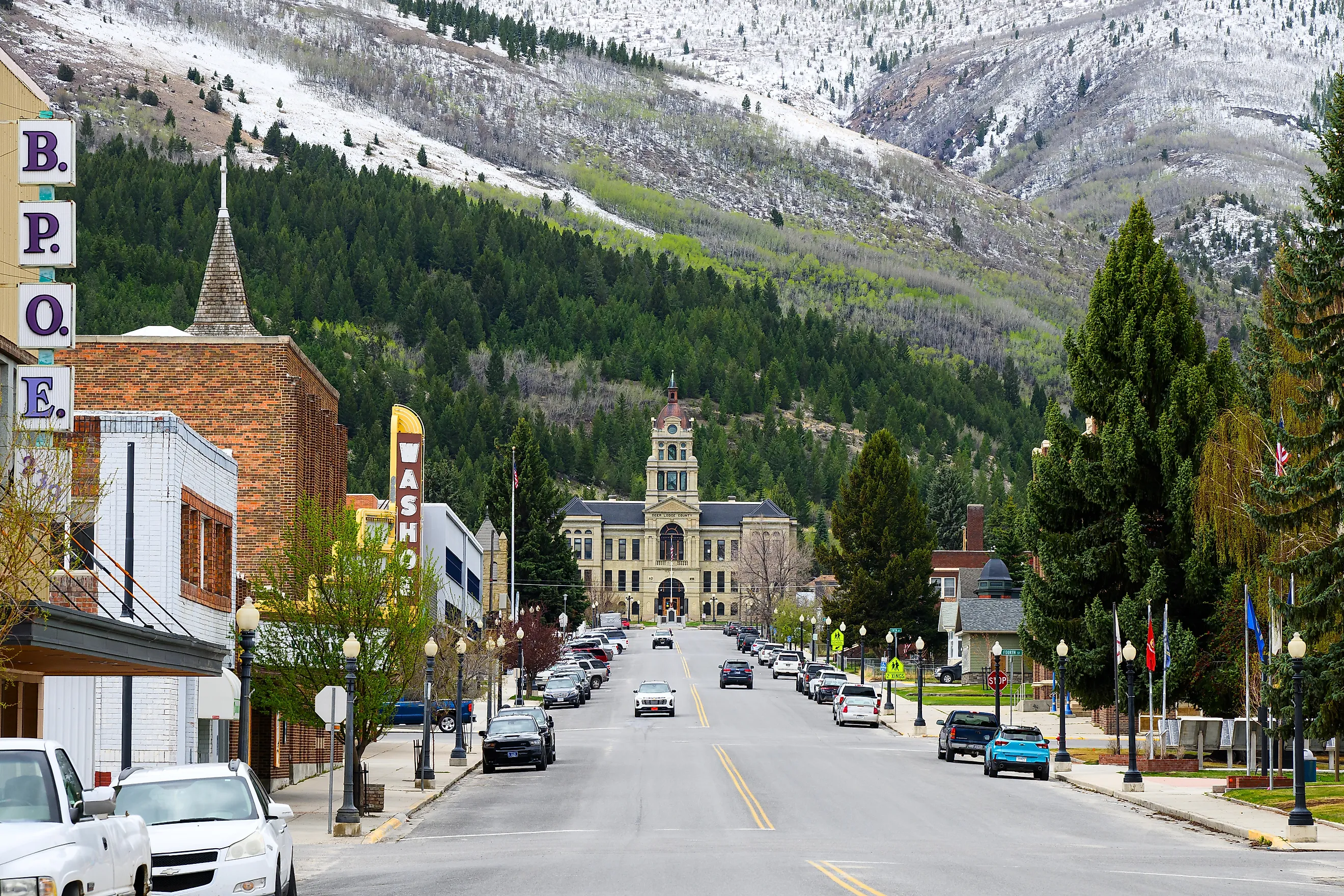
Residents fought to save the 585-foot smokestack when cleanup crews proposed demolishing it. Today, it stands as the centerpiece of Anaconda Smoke Stack State Park, the tallest surviving masonry structure in the world, 30 feet taller than the Washington Monument. The ground is still too contaminated to walk on.
The Old Works Golf Course sits atop the former smelter site, the only Jack Nicklaus Signature course in Montana open to the public, with black slag-filled sand traps and views of the stack from the fairways. The Washoe Theater opened in 1936, one of the last two Art Deco theaters built in the United States alongside Radio City Music Hall. The Smithsonian has ranked it fifth in the nation for architectural value. Adult tickets run $7.
Virginia City

In 1863, miners discovered gold in Alder Gulch in southwest Montana, and Virginia City grew up almost overnight. By 1865, it was the Montana Territorial Capital. When the gold ran out, and the capital moved to Helena in 1875, the crowds thinned, but they never fully emptied. Because people kept living there, the original 1860s buildings were never torn down. That is why Virginia City looks the way it does today.
Over 150 buildings have been certified authentic by the Montana Historical Society, making it one of the most intact gold rush towns in the American West. Walking the main street feels less like a museum and more like a place that simply stopped developing in 1875. The Virginia City Players, performing at the Virginia City Opera House, have been staging melodrama and vaudeville shows every summer since 1949, making them one of the longest-running summer stock theater companies west of the Mississippi.
A mile away, the Nevada City Museum and Music Hall holds a collection of historic buildings relocated from across Montana, with living history events every weekend through summer. Between the two towns, the Alder Gulch Short Line Steam Train connects Virginia City and Nevada City, passing the gulch where the original gold discovery set everything in motion.
Wisdom

Lewis and Clark named the river running through this valley "Wisdom" during their 1805 expedition. The river was later renamed the Big Hole, but they kept the name Wisdom. The valley is sometimes called the "Valley of 10,000 Haystacks" because many ranchers still use the beaverslide, a traditional hay stacking method that has largely disappeared everywhere else. The Big Hole River is also one of the last places in the lower 48 states where the rare fluvial Arctic grayling still lives in its native river environment.
Ten miles west on Highway 43, the Big Hole National Battlefield marks one of the most significant moments of the 1877 Nez Perce War. On the morning of August 9, Colonel John Gibbon's troops attacked a sleeping Nez Perce encampment, killing between 60 and 90 men, women, and children. The Nez Perce had believed they were safe after crossing the Bitterroot Mountains. The site has a visitor center, self-guided trails, and free admission. The Crossing at Fetty's is the town's main bar and grill, the kind of place that tells you more about a town than any landmark could.
Roundup

Roundup was named after the cattle roundups that cowboys held along the Musselshell River in the 1880s, when this stretch of central Montana was open range. When coal was discovered in 1907, and the Milwaukee Railroad arrived, the town added a whole new identity on top of the ranching one, producing an unusual mix of cowboys and coal miners that shaped everything that came after.
That history is preserved at the Musselshell Valley Historical Museum, housed in a former parochial school. The museum includes a replica coal mining tunnel complete with wooden car, carbide lamps, and lunch pails, alongside exhibits on pioneer life, Native American artifacts, and a ranch house built in 1884 for two British cattle lords.
The Bull Mountains rising south of town offer a different reason to linger. Pine-covered and largely unexplored by most visitors, they provide good hiking and a striking contrast to the surrounding plains. Every Fourth of July weekend, the Roundup Rodeo draws crowds from across the region, the kind of event where the town's ranching identity, which predates everything else here, is still very much the main character.
Plan Your Montana Road Trip
These nine towns reward the kind of traveler who reads the small print on a map. You can trace the Nez Perce War along Highway 43, stand below the 585-foot smokestack in Anaconda, or hunt for Ismay six miles off the highway. The detours run long and the payoffs are specific, which is the whole point of an offbeat route through Montana.