8 Utah Towns Where Time Stands Still
Utah is an incredibly beautiful doubly landlocked state in the Mountain West region of the United States. Utah was traditionally inhabited by Indigenous peoples including the Ute, Navajo (Diné), Paiute, Shoshone, and Goshute, with later European American settlement led in large part by Mormon pioneers. The state boasts a cornucopia of small towns where time seems to linger a little longer.
Dotting Utah’s geographically diverse landscape between the attention-grabbing federal parks and bustling metropolises are mesmeric communities where stories are layered, and life moves at a sluggish pace. From Bountiful’s pastoral charm coupled with unrestricted valley views, to the artistic legacy of Springville, these eight Utah towns, artfully meshing pioneer roots and everyday traditions, invite one and all to step into places where the yesteryears feel comfortably close.
Farmington

Primarily settled in 1847 by the Mormon pioneer Hector Caleb Haight as an agricultural community named North Cottonwood Settlement, the community was renamed Farmington in 1852 in allusion to the luxuriant farmlands that helped the settlers flourish. Rimmed by the Wasatch Mountains to the east and the Great Salt Lake to the west, this Davis County seat seamlessly fuses pioneer heritage with an unhurried pace of life, retaining a significant portion of its historic character and family-friendly traditions.
Walk down Farmington Main Street Historic District, past well-preserved pioneer-era properties, such as the 1857-built Hector C. Haight House/Union Hotel and the 1907-built Farmington Tithing Office, currently housing the Farmington Historical Museum. At the S & S Shortline Railroad Park and Museum, enjoy train rides from June to September on the first Saturday of every month, besides checking out the Crown Metal Products constructed two-foot-gauge steam locomotive.
Furthermore, be amazed by the 70 thrilling rides and attractions, live entertainment, more than 40 challenging games, Lagoon-A-Beach Waterpark, and Historic Pioneer Village filled with artifacts at the seasonal family-owned Lagoon Amusement Park. Nature lovers must not miss a tour of the Farmington Bay Waterfowl Management Area, where unobstructed skies, wetlands, and abundant avian fauna create a quiet sanctuary.
Springville

Located at the foothills of the Wasatch Range in the well-watered Utah Valley, generally equidistant from Utah County’s northern and southern boundaries, Springville was once inhabited by the native Ute tribe, who hunted and fished to survive against all odds. Although the tribe made no written record of their lifeways, the first record of these tribes was made in the journal entries of Franciscan priests: Atanasio Dominguez and Silvestre Velez de Escalante.
However, the Utes were soon displaced by settlers led by Aaron Johnson to an Indian Farm at the Spanish Fork River’s mouth, while the Mormon settlers started farming in what the tribes called Hobble Creek. The settlement was later retitled Springville, owing to the sundry freshwater springs north of the town. This perennial water supply and arable lands allowed the area’s accelerated development and its subsequent incorporation on April 4, 1853.
In the course of time, Springville became an Art City, luring art connoisseurs to witness a comprehensive collection of Utah art from the settler period to the present day in the permanent galleries of the Springville Museum of Art. Also, as the homeland of the eminent American sculptor Cyrus Dallin, the Main Street of the town is littered with many noticeable bronze statues made by local sculptors. Every July, try to attend the Annual Springville World Folkfest, a week-long music and folk dance celebration in the outdoor amphitheater of the Spring Acres Arts Park.
Mantua

A teeny mountain community on the Box Elder County’s eastern edge, Mantua was initially settled in the mid-19th century by Church of Jesus Christ of Latter-day Saints (LDS) members sent by religious leader Lorenzo Snow for growing flax in the valley. Christened after Ohio’s Mantua Township, the native land of Lorenzo Snow, this town, situated at the Box Elder Canyon’s head, has remained virtually unchanged, maintaining its tight-knit character.
The town’s centerpiece is the Mantua Reservoir, a 500-acre water body offering visitors fishing, boating, kayaking, birdwatching, and hiking activities. Adrenaline junkies must trek the scenic 4.2-mile-long Mantua Reservoir Trail/Eagle Rise Trail, which circles the reservoir and permits hiking, walking, and mountain biking activities, aside from proffering panoramic vistas of the surrounding mountains and rolling hills.
Bountiful

One of Utah’s earliest Mormon settlements after Salt Lake City, Bountiful, located at the base of the Wasatch Range in Davis County, was first settled by Peregrine Sessions and his family on Sept. 27, 1847. Originally known as Sessions Settlement and later North Mill Creek Canyon, the town was renamed Bountiful in 1855 after a place referenced in the Book of Mormon. Following formal incorporation in 1892, the town's citizens ensured the building of schools, walkways, and a water system, plus illumination with electric lights in 1907.
Nevertheless, from being a sleepy agrarian community for over four decades, the town, in the 1950s, began to develop as an archetypal residential community for suburbanites, thanks to its closeness to Salt Lake City. Today, this city of roughly 45,000 residents invites visitors to explore the Greek Revival-style Bountiful Tabernacle, a prominent historic religious landmark reflecting the town’s spiritual heritage; it's often cited as Utah’s oldest religious structure.
Access the stunning Temple Hike Trail from the Bountiful Boulevard, providing opportunities to behold sweeping views of the entire Bountiful Valley and stopping by the Bountiful Utah Temple at the trail’s terminal. Additionally, get to know more about the storied past of Bountiful through various interactive displays and arresting presentations at the Bountiful Museum & Learning Center.
Spring City

Founded as the Allred Settlement of Springtown in 1852 by a group of Mormon colonists led by James Allred, Spring City is a 949-resident town in Sanpete County, set in the northern portion of Sanpete Valley, roughly 17 miles north of Manti. As Sanpete County’s second-oldest settlement, Spring City swiftly expanded due to the settling of a large number of Danish immigrants, and by the mid-1800s, the northern side of the town came to be referred to as Little Denmark.
Strengthening the town's retro enchantment is the fact that Spring City, in its entirety, has been listed on the National Register of Historic Places. The Spring City Historic District features a wealth of architecturally significant structures, right from the pioneer times to the early 20th century, including the Spring City Meetinghouse of the LDS Church, Bishop’s Storehouse, a historic welfare facility run by the LDS Church, and the two-and-one-half-story stone house of LDS Apostle Orson Hyde. Lay eyes on the outstanding artworks by local artists in the Spring City Arts Gallery, housed in the wonderfully restored 1900s Automobile Showroom & Garage on Main Street.
Parowan

Dubbed “The Mother Town of Southern Utah,” Parowan, the center of administration of Iron County and its premier incorporated settlement, sits at the Parowan Canyon’s mouth on the southeastern margin of Parowan Valley, overlooked by the 8,050 ft high Valentine Peak. Settled hundreds of years ago by the ancestral Puebloans and Fremont people, as substantiated by the myriad petroglyphs and pit-houses, Parowan was founded as the City of the Little Salt Lake in 1851, post the uncovering of iron ore deposits in the Iron Mountain District and planting of a liberty pole at Heap’s Spring.
Start your tour of this enchanting old town from the Parowan Old Rock Church Museum, which stands close to the heart of the original picket fort boundaries. Before the commencement of the Church’s construction in 1863, the picket structure was replaced with an adobe-walled fort. Built using local rock, it took 13 years to complete the Church, and after its completion, the Church started being used as a high school building and as an amusement hall hosting dances and theatrical productions. Close by, the Parowan Gap highlights petroglyphs on the walls, supplementary to dinosaur tracks precisely one mile east of the Gap.
Enoch

Originally baptized as Fort Johnson and Johnson Springs in recognition of LDS missionary Joel Hills Johnson, Enoch, renamed after the Biblical figure Enoch, is an Iron County town occupying the Cedar Valley’s northeastern portion, about seven miles northeast of Cedar City. From its modest beginnings as a quiet farming community, Enoch has progressively grown into an economically stable community with the Utah Southern Railroad linking the town with other transportation networks, facilitating the export and import of goods.
Presently, Enoch is a tranquil haven, where local community parks like the Old Enoch Park are perfect spots for both recreation and relaxation. Just a short drive from Enoch, the Frontier Homestead State Park Museum in Cedar City imparts information via interactive exhibits on the region’s pioneers and iron industrial chronicles.
Helper

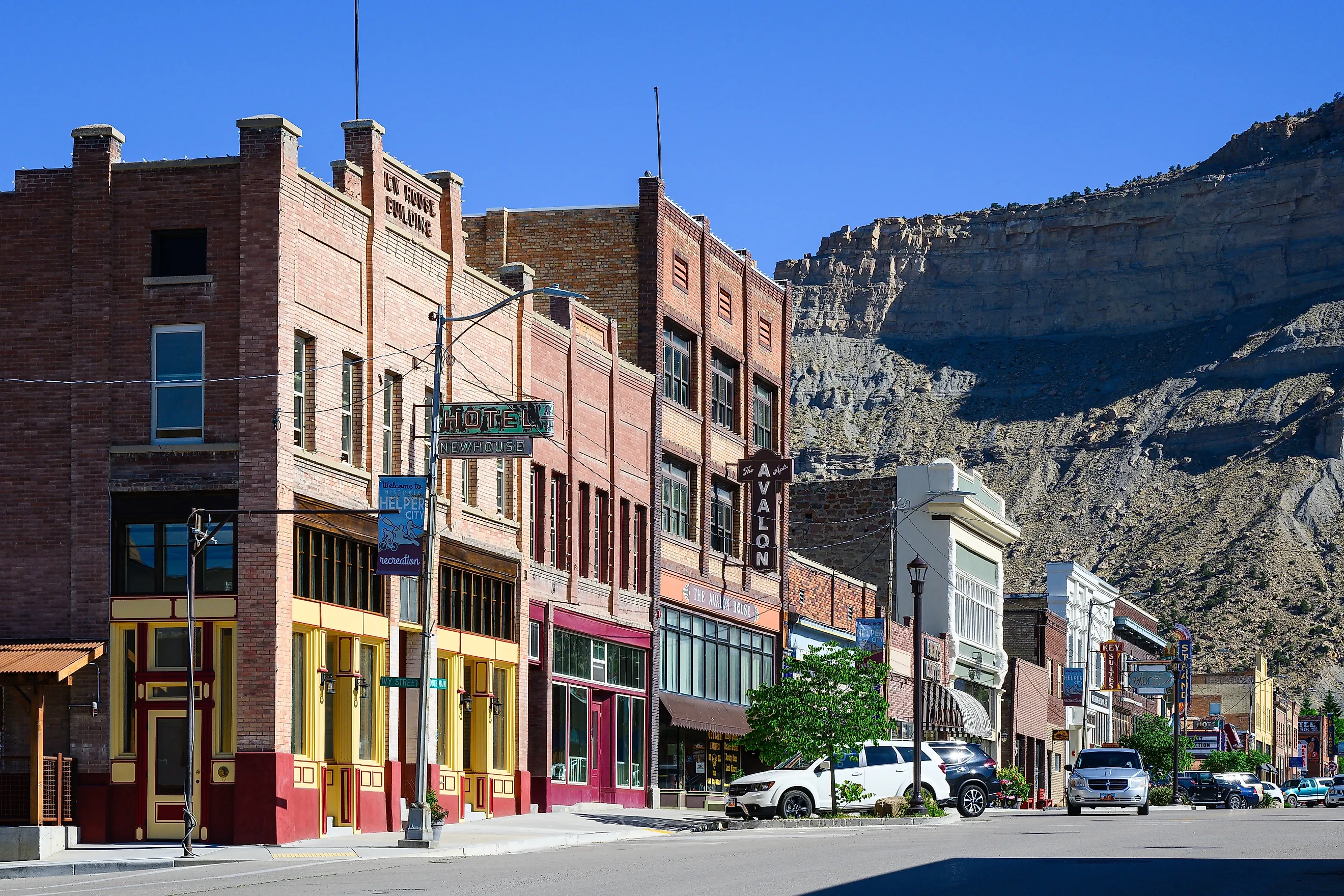
Helper is named in honor of its status as a railroad junction where additional helper engines were added to push the trains up the steep grade of the Price Canyon to the adjacent town of Soldier Summit. This historic Carbon County town set at the western extremity of the Book Cliffs, along the Price River, is about 110 miles southeast of the state capital.
As an important railroad and coal mining community in the late 19th century and early 20th century, Helper drew numerous immigrants from Asia as well as eastern and southern Europe, to work in the mines, which in turn fueled Utah’s industrial growth. Even though mining declined over the years, the town’s brick-built core and ethnically diverse character remained remarkably untouched.
Encompassing the center of Helper is the National Register-listed Helper Historic District, which includes contributing properties like the Helper Auditorium/Helper Civic Auditorium, in addition to early 1900s storefronts that house art galleries like Steven Lee Adams Fine Arts Gallery and antique stores like Outlaw Antiques. Housed in the Old Helper Hotel building, the Western Mining & Railroad Museum tells stories of all miners, railroad workers, and immigrant families who shaped the town. Round out your visit to the town with a walk along the Price River.
From Farmington’s optimal balance of heritage and small-town peacefulness to the resilient spirit of coal miners, railroad workers, and immigrant families in Helper, these aesthetic Utah communities remind excursionists that the most worthwhile adventures happen in locales where the clock seems to tick a little slower. With a fast-paced lifestyle everywhere around the world, these long-established Utah towns stand in stark contrast, where interesting tales and inherent cultures leave indelible imprints on travelers, making them stay here awhile to experience it all.