11 Best Places To Retire In Portugal
Portugal surprises with how much variety it packs into a relatively small country, from the marble-built hill towns of the Alentejo, where medieval castles still crown the skyline, to the thermal-spring retreats of the Monchique mountains. Nazaré, on Portugal’s Silver Coast, brings dramatic Atlantic scenery and a lively coastal atmosphere. Estremoz, in inland Alentejo amid vineyards, olive groves, and white marble quarries, offers a completely different rhythm, pairing royal history with countryside charm. Whether you are drawn to crashing waves or sheltered bays, hilltop castles or UNESCO-listed streetscapes steeped in history, there is a version of Portugal that can match almost any vision of retirement. Better still, it all comes at a cost of living that remains among the lowest in Western Europe. These eleven towns and villages show just how many different ways Portugal can feel like home.
Nazaré (Silver Coast)

Famous for its monstrous waves, Nazaré sits 120km north of Lisbon on the Silver Coast. Surfers flock here between October and February, when waves can exceed 80 feet, but year-round it is home to about 10,000 inhabitants, with a growing community of expats and retirees.
The town has three neighborhoods: Praia, the beachfront, has a long seaside promenade and the town’s fishing harbor, Porto da Nazaré. Fishing remains an important part of daily life here, with locals often seen drying fish out in the sun before selling it at Mercado Municipal da Nazaré. Accessible from the beach by funicular, the neighborhood of Sítio is perched on a cliff and home to several important religious landmarks, including the Sanctuary of Our Lady of Nazaré, the Church of Nossa Senhora da Nazaré, and the Chapel of Memory. Pederneira, the final neighborhood is a quiet hilltop community with a more residential feel. Here, you can take in the beautiful views of the town and sea below at Miradouro da Pederneira and dine at Pangeia, known for its octopus dishes.

The cost of living in Nazaré is 26 percent lower than Lisbon, with housing prices ranging from €100,000 for small apartments to €500,000 for luxury villas. Rental prices here range from €500 per month for a one-bedroom to €1,000 for a larger home.
Nazaré is also an excellent base for exploring nearby towns like Óbidos, a beautifully preserved medieval walled village; Alcobaça, home to a UNESCO-listed monastery; and Fátima, one of the world’s most important Catholic pilgrimage sites.
São Martinho do Porto (Silver Coast)

Also on the Silver Coast, São Martinho do Porto lies 13km south of Nazaré and is home to approximately 2,500 people. In contrast to Nazaré, the sea here is exceptionally calm and ideal for leisurely swimming, thanks to its seashell-shaped bay and rocky headland that blocks strong winds and waves.
A flat, walkable promenade runs along the beach, giving the town a relaxed resort feel. A long-time favorite among Portuguese vacationers, São Martinho do Porto has also attracted British, Dutch, and Scandinavian retirees in recent years, creating a welcoming expat community.
Beyond the beach, the town’s quieter pleasures lie in exploring its natural scenery and old streets on foot. A scenic trail leads up to the São Martinho Lighthouse, where sunsets are particularly striking. The historic upper part of town can be reached by stairs or elevator, opening to old world cobblestone streets and historic landmarks like the Paróquia de São Martinho do Porto. Stop by one of the town’s oldest bakeries, Pastelaria Concha, for traditional pastries like the beloved pastel de nata.

Back at sea level, a walk to the far end of the bay brings you to the famous pedestrian tunnel, which cuts through the mountain, leading out to the open ocean. On the south shore is Salir do Porto, known for its wooden walkways and giant sand dunes.
The cost of living here is affordable compared to other coastal towns, with a wide range of new-build condos available near the beach, including two-bedrooms around €350,000.
Foz do Arelho (Silver Coast)

Heading about 14km further south, you will find Foz do Arelho, nestled between the Atlantic and the Óbidos Lagoon.
For centuries, the locals here have made a living by harvesting shellfish from the lagoon, a tradition that still thrives today. You can buy fresh catches directly from fishermen at the pier near Praia da Foz do Arelho, or visit Decomar, a seafood wholesaler in town. This fishing heritage comes alive during two annual celebrations: the Foz do Arelho Seafood Festival and the Foz do Arelho Beach Party.
The lagoon's sheltered waters are perfect for paddleboarding and canoeing, while the ocean side offers ideal conditions for kitesurfing. Passadiços da Foz do Arelho, an 800m clifftop boardwalk, allows you to safely observe the area's rich biodiversity and birdlife along the lagoon. The Ciclovia da Lagoa de Óbidos, a dedicated bike path, runs along the lagoon's shoreline connecting Foz do Arelho to neighboring villages, and is perfect for gentle cycling.

Foz do Arelho offers housing options across various price points. Two-bedroom properties start around €200,000, while one-bedroom rentals begin at €850 per month. The cost of housing here, and across the SIlver Coast, is a more affordable option than coastal areas near Lisbon.
The town is also just 9km from Caldas da Rainha (The Queen's Hot Springs), best known for its sulphurous hot springs and the historic Thermal Hospital, opened in 1485 and frequently visited by royalty. As the country’s oldest operational thermal baths, you can still receive therapeutic treatments here today.
Estremoz (Alentejo)

Let us venture south to the Alentejo region, which makes up nearly all of southern Portugal aside from the narrow southernmost coastline known as the Algarve. Vast and sparsely populated, Alentejo is home to just seven percent of the country's population. The landscape is defined by wide-open countryside dotted with cork forests, olive groves, vineyards, and farmland.
Alentejo towns are mainly small and spread out, many with medieval walls, Roman ruins, and hilltop castles. Among them is Estremoz, home to about 12,500 people and often called the "White City," reflecting its famous white buildings and white marble that appears everywhere, from churches and fountains to pavements and doorframes.
Overlooking the town is Estremoz Castle, built in the 14th century by King Dinis I for his wife, Queen Isabel, and host to many Portuguese royals over the centuries. Each year, the town honors Queen Isabel with the Festival da Rainha. Estremoz also hosts the centuries-old Mercado de Estremoz, held every Saturday in the central Rossio Marquês de Pombal and bringing together local farmers, artisans, and antique dealers.

Estremoz is an emerging wine destination surrounded by vineyards. A standout winery at the city’s entrance, Tiago Cabaço, has earned national and international acclaim for its bold wines.
While Estremoz has a smaller expat community than more well-known destinations, it offers exceptional affordability for those seeking authenticity and deeper immersion in Portuguese culture. Small fixer-uppers in the historic district start at €20,000, while modern homes begin around €70,000.
Vila Viçosa (Alentejo)

About 20km southeast of Estremoz lies Vila Viçosa, home to approximately 7,300 residents and often called the "Princess of Alentejo." Some even refer to it as the Sintra of the Alentejo, a comparison drawn from its grand Paço Ducal and extensive use of marble.
Like neighboring Estremoz, Vila Viçosa is defined by white marble. With more than 150 quarries nearby, this "white gold" has been extracted for centuries and appears everywhere.
The town’s crown jewel is the Paço Ducal, a 16th-century palace that became the primary residence of the Dukes of Bragança. When the Duke became King João IV in 1640, restoring Portuguese independence from Spain, Vila Viçosa became a royal seat. Later kings used the palace as a retreat. Today, the interior houses fine furniture, paintings, azulejo tiles, and an impressive armory. Before this palace existed, the Bragança family lived in the 13th-century Castelo de Vila Viçosa, which now houses archaeology and hunting museums. Within the castle walls sits the Sanctuary of Nossa Senhora da Conceição, where King João IV placed his crown upon the image of the Virgin Mary in 1646, proclaiming her Patroness of Portugal.

For retirees, Vila Viçosa offers practical advantages. Unlike much of hilly Portugal, the town center is flat and walkable. The Alentejo climate also features very hot summers and mild winters, making it ideal for spending three seasons of the year here. Housing prices mirror Estremoz, with fixer-uppers starting at €30,000 and more modern houses and apartments available around €150,000.
Mértola (Alentejo)

Mértola sits on a rocky perch overlooking the Guadiana River in the Baixo (Lower) Alentejo region of southeastern Portugal. Home to about 6,200 people, Mértola is often called a “museum town”, because the Museu de Mértola is spread across 14 different sites throughout the community. Some highlights include the Casa Romana, located beneath town hall and showcasing Roman-era artifacts; the Forja do Ferreiro, a restored blacksmith workshop; and the Núcleo de Arte Islamica, housing Moorish ceramics, jewelry, and architectural fragments.
Once an important river port in the Mediterranean, Mértola has roots dating back to Neolithic times. The Romans later established a settlement, followed by nearly 500 years of Moorish rule beginning in the 8th century. This layered history left an indelible mark still evident today. The Church of Nossa Senhora da Anunciação, originally built as a mosque, retains its horseshoe arches and mihrab. Above it stands the 13th-century Castelo de Mértola, an important fortress after the Christian reconquest in 1238.

The Parque Natural do Vale do Guadiana surrounds the town with hills, valleys, cork oak forests, and riverbanks that attract serious birdwatchers. Many rare birds nest in the park, including Bonelli's Eagles, Black Storks, and Great Spotted Cuckoos. Spring transforms the landscape with wildflowers and comfortable temperatures perfect for hiking.
Housing is exceptionally affordable, as it is in small towns throughout Alentejo. Two-bedroom homes range from €100,000 to €250,000. The town’s mature population, with an average age of 52, creates a relaxed atmosphere well suited to retirees.
Monchique (Algarve)

Next we travel 125km south, crossing into the Algarve and arriving in Monchique. This mountain town of about 5,400 residents is about 35 minutes from the coast, offering easy access to the beaches without the higher costs of living directly on the water.
With over 300 days of sunshine annually, the Algarve combines a warm Mediterranean climate with rugged cliffs and long white-sand beaches, and draws millions of visitors each year. Monchique, however, offers a different experience. Its elevation brings cooler and more comfortable summer conditions with less tourist traffic.
Just a few minutes outside town is Caldas de Monchique, a historic spa hamlet built around the Algarve’s only thermal springs. Attracting visitors since Roman times, the waters are still used today for relaxation and therapeutic treatments.

The surrounding hills offer plenty of ways to get outside. The Serra de Monchique - Convento da Nossa Senhora do Desterro is a trail that starts and ends in the village, passing by the ruins of a former convent. Parque da Mina is a fun outing with woodland paths, farm animals, a waterfall with suspended walkways, a small museum, and a traditional medronho distillery. For big views, drive the rural roads up to Fóia, the highest point in the Algarve.
Monchique’s average age is 51 years old, and 18 percent of the population is foreign-born, making it a welcoming spot for Portuguese retirees and expats alike. Living here is also very attainable, with modern houses and apartments available for under €250,000.
Carvoeiro (Algarve)

From Monchique, Carvoeiro is about 45 minutes south. With under 3,000 year-round residents and a significant expat population, this former fishing village boasts some of the Algarve’s most iconic and beautiful beaches, including Praia do Carvoeiro, framed by steep golden cliffs.
Carvoeiro occupies a very convenient pocket of the Algarve. Just 15 minutes away is Portimão, with a bustling marina and major annual events like the Portimão Sardine Festival. Silves, once the Moorish capital, sits 20 minutes inland, dominated by the region's largest fortress, Castelo de Silves. About 40 minutes away, Lagos has a centuries-old walled town and beautiful hidden cove beaches. At Portugal's southwestern edge, Sagres is a magnet for surfers and hikers with its untamed cliffs and raw coastal beauty. To the east, Albufeira delivers bigger nightlife and entertainment, and Faro is home to an international airport and a well‑preserved old town.

Carvoeiro’s crystal clear waters allow for all kinds of watersports, including surfing, stand-up paddleboarding, and snorkeling. The Calçadão de Carvoeiro boardwalk stretches over half a kilometer, leading to the Algar Seco rock formations, where erosion has carved pools, caves, and sea-view balconies. The stunning Seven Hanging Valleys Trail is nearly six km between beaches, passing above the famous Benagil Cave, accessible only by boat or kayak.
The climate supports comfortable year-round living, with mild winter temperatures rarely dropping below 10°C (50°F). Housing prices reflect the coastal setting: one‑bedroom apartments range from €200,000 to €500,000, depending on proximity to the water and views.
Tavira (Algarve)

Our final mainland recommendation is Tavira. About 90km east of Carvoeiro, the town sits on the banks of the Gilão River, which flows into the ocean through the protected lagoons of Ria Formosa. Just offshore, the barrier islands of Ilha de Tavira and Ilha de Cabanas feature beautiful, wide Atlantic beaches. Housing prices here are relatively accessible: modern apartments start around €180,000, while larger, detached villas can be found from €500,000.
Tavira has about 24,000 residents, 23 percent of which are foreigners, and is considered one of the most beautiful towns in the Algarve. Both riverbanks are lined with traditional white buildings with wrought-iron balconies, Moorish-inspired pyramid roofs, and walls cascading with bougainvillea. The seven-arched, pedestrian-only Ponte Romana bridge links both sides of the river, and, despite its name, is not Roman at all, dating back to the 12th century during Islamic rule.

For commanding views over the town, climb to the 11th-century Castelo de Tavira ruins. The crumbling castle walls enclose a lush garden, making it one of Tavira's most peaceful spots. By the riverside, the Palácio da Galeria is located on the site of an ancient Phoenician village and houses the Museu Municipal.
Living here means you can skip the big supermarkets and head to the Mercado Municipal de Tavira instead. The fish market comes alive in the early mornings when the fishing boats arrive to sell the day’s catch. You will also find stalls piled with seasonal produce, local honey, and regional specialties.
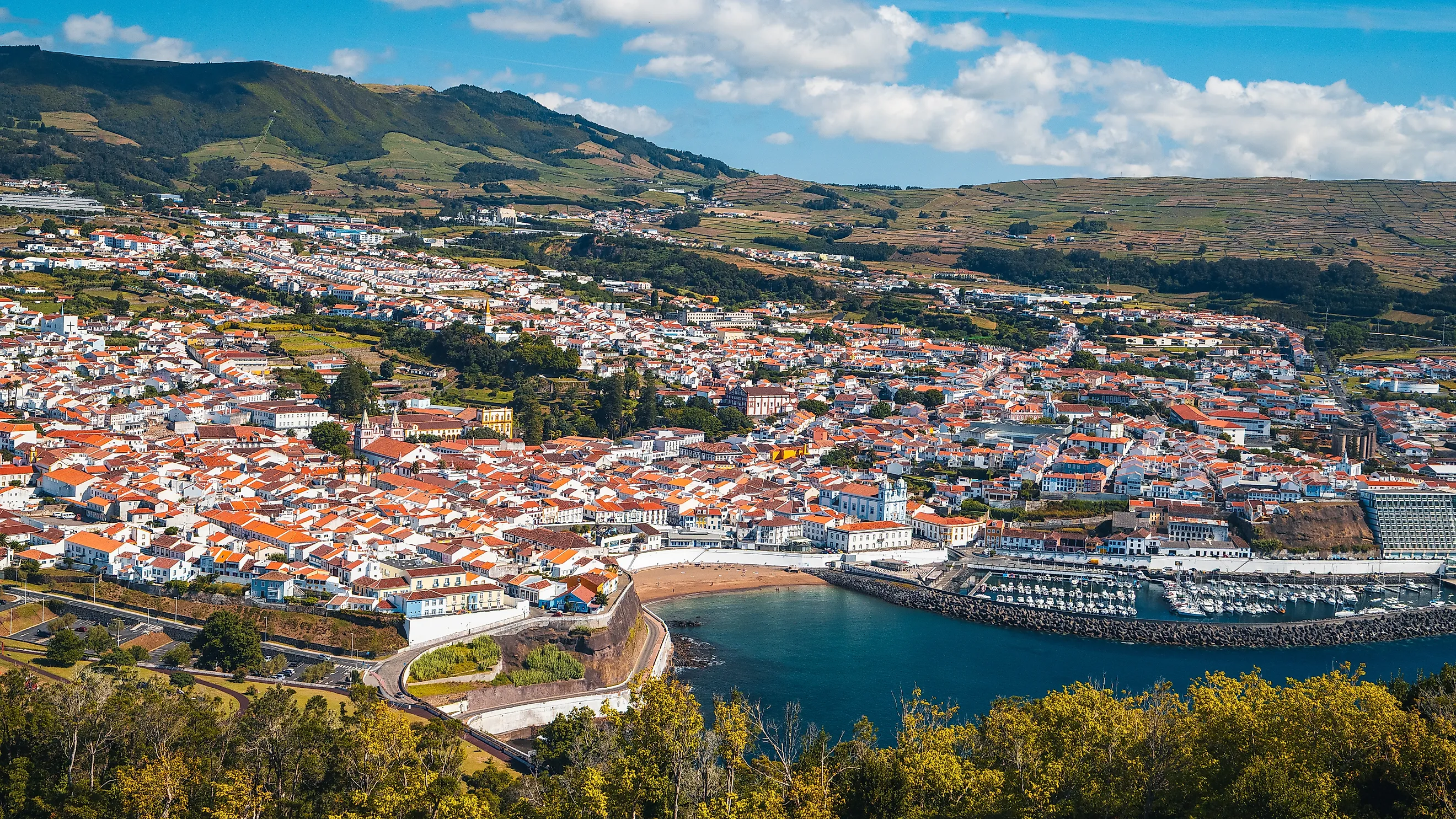
Angra do Heroísmo (Terceira, Azores)

Next, we look to the Azores, a group of nine volcanic islands, renowned for their dramatic landscapes, volcanic caves, and crater lakes, and often called the “Hawaii of Europe.” While São Miguel is considered the main island, Terceira is the second most popular, and home to our next recommendation: Angra do Heroísmo.
Housing about 35,000 people, Angra do Heroísmo was designated a UNESCO World Heritage Site in 1983, one of the first cities in Portugal to receive the distinction, largely due to its Renaissance urban plan, which has remained mostly unchanged since the 1500s. Unlike many Portuguese towns that grew organically up hillsides, this city was deliberately laid out in a flat, walkable grid with Praça Velha as its main square. To the south is the peninsula of Monte Brasil, formed 20,000 years ago from a volcanic eruption and guarded by the 16th-century, star-shaped Fortress of São João Baptista. Hiking trails wind up through forest to the volcanic crater at the summit, where on a clear day you can see neighboring islands.

About 11km from town is Algar do Carvão, a volcanic chimney with a staircase that descends 90 meters to a clear underground lake at the bottom. A bit to the west is Gruta do Natal, a long underground tunnel formed by flowing lava.
Housing options are more limited here, but you can find modern apartments between €130,000 and €260,000, and the cost of living is generally lower than in mainland Portugal’s larger cities.
Ponta do Sol (Madeira)

Our final callout is Ponta do Sol, located on the island of Madeira, about 500 nautical miles south of the Azores, close to North Africa. With a population of about 8,200, it is known for being the sunniest spot on the island, with year-around warmth.
About 30 minutes west of Funchal, the island’s capital, Ponta do Sol maintains a quiet, small-town feel, while still benefitting from quick access to healthcare services, major amenities, and Madeira’s only airport. In recent years, the town has become a digital nomad hub, bringing an international atmosphere to the area. This has also led to free co-working spaces, regular events, and opportunities to connect, ideal for semi-retired folks continuing to work remotely.

Housing prices here are on the higher end, with apartments starting around €310,000 and luxury properties sitting closer to €1,000,000. Rental options are limited, but apartments can still be found for around €1,300/month.
This area is deeply tied to agriculture, particularly bananas and sugarcane. Six minutes west of town, you can walk along the Rota da Banana, which takes you directly through banana plantations. Also close by are the Sugarcane Mill and Museum and the Banana Museum of Madeira. Opportunities to enjoy nature are abundant, too. Hike the challenging but visually rewarding Levada do Moinho, admire the spectacular Cascata dos Anjos, which cascades over an old coastal highway, and relax at the pebble Ponta do Sol Beach, sheltered by a breakwater, making it very safe for swimming.
Your Next Chapter Starts Here
The eleven towns and villages here are just a starting point. Portugal's appeal lies partly in how much variety it packs into a relatively small country, meaning the right fit tends to come down to personal priorities. Some people will want the buzz of an expat community and a beach at the end of the street. Others will trade that for a hilltop village where a glass of local wine costs almost nothing and the Saturday morning market is still the main event. What tends to surprise people is how much the country delivers once they actually arrive. Quiet fishing villages turn out to have more going on than you would think. Inland towns that barely appear on travel maps reveal layers of history and a warmth that is genuinely welcoming to newcomers. Whatever brought you to this list, Portugal has a way of feeling like home not long after you have arrived, making you wonder why you waited so long.