7 Of The Most Welcoming Towns In Oklahoma
Frank Lloyd Wright built one skyscraper in his career. It stands in Bartlesville. Hugo is the off-season home of three traveling tent circuses and the second-largest herd of Asian elephants in the United States. An AP reporter dispatching from Boise City the morning after Black Sunday wrote the term "Dust Bowl" into the language. Seven county seats appear below, each anchored to a distinct piece of Oklahoma history.
Goodwell

Goodwell has about 1,200 residents and one university. Oklahoma Panhandle State University (OPSU) opened here in 1909 as Pan-Tech State School and is the only four-year public institution in the panhandle. The climate is high-plains continental: hot, dry summers reaching above 95°F in July, and cold winters with January average lows around 19°F and regular freezes every month between November and March. The No Man's Land Museum on the OPSU campus is the official panhandle history museum. The region was the only part of the United States with no recognized government between 1850 and 1890. Texas had ceded the strip in 1850 as part of the Compromise, and no state or territory took it on until the 1890 Organic Act incorporated it into Oklahoma Territory. The OPSU rodeo program, one of the top intercollegiate rodeo programs in the country, is the other community anchor.
Perry

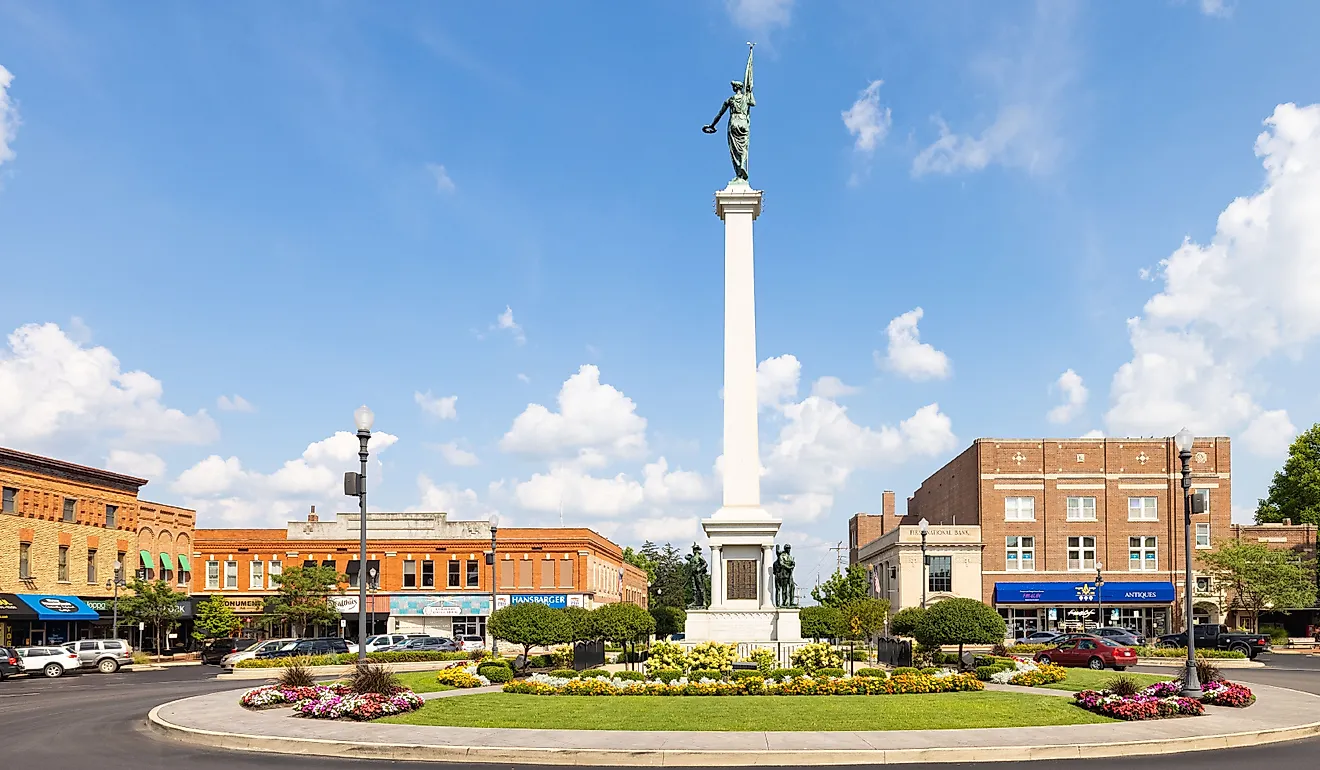
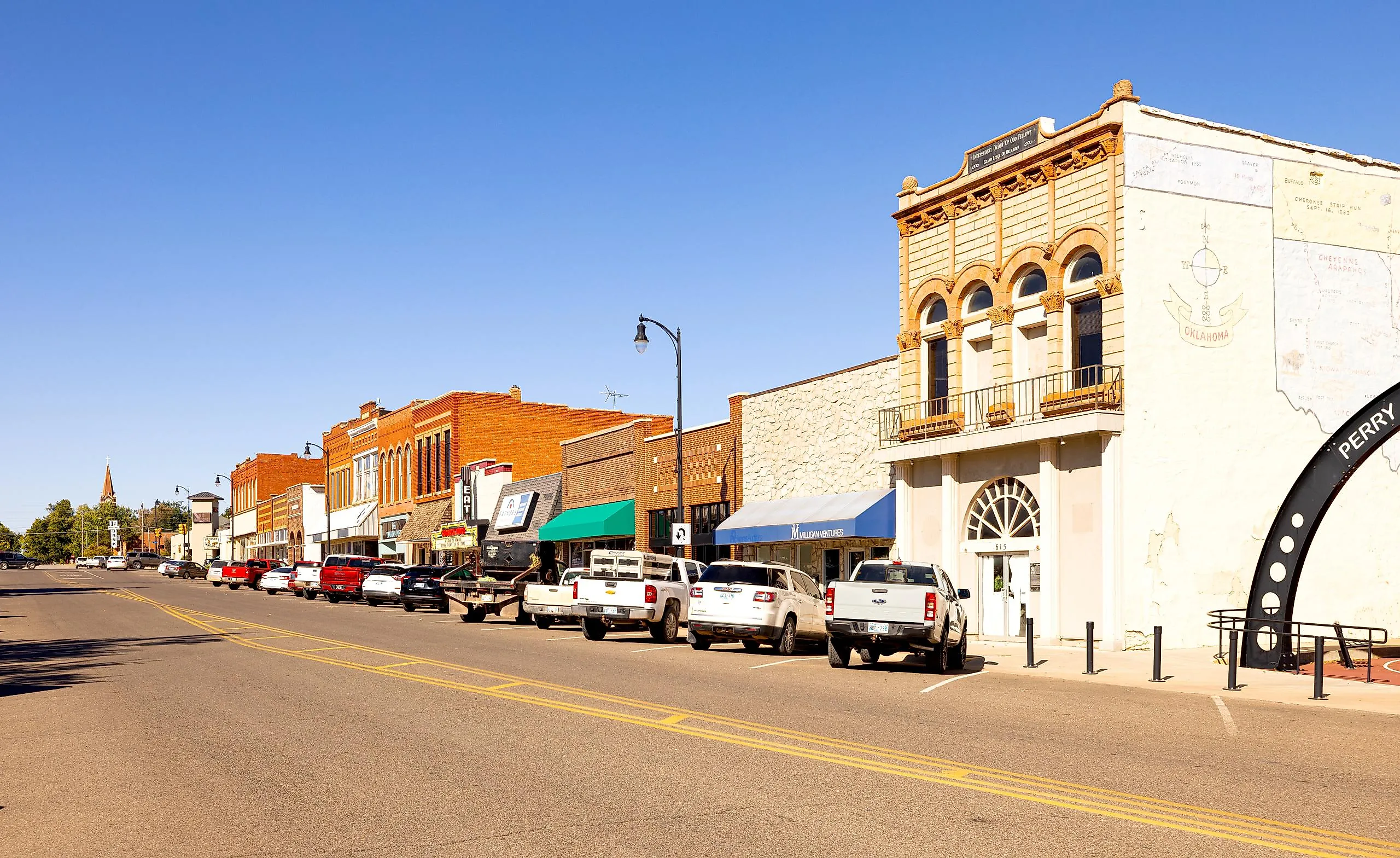
At noon on September 16, 1893, the signal went off and the Cherokee Strip Land Run began. It was the largest of Oklahoma's land runs by area. The Cherokee Outlet covered 6.5 million acres, and over 100,000 participants raced for parcels. Perry was one of four county seats surveyed in advance, and within hours of the noon signal, 25,000 people had thrown up a tent city on the site. The population stabilized at a few thousand once the dust settled, and Perry has been the seat of Noble County ever since. Modern population is about 5,000. The Cherokee Strip Museum on Fir Street holds the principal collection of artifacts and documents from the 1893 run, including original homestead claim records. CCC Lake, built by the Civilian Conservation Corps in the 1930s, is the local fishing and camping resource, two miles east of town. The central square holds a Carnegie library, the 1902 National Bank Building, and a row of historic storefronts, all listed on the National Register of Historic Places.
Boise City

Cimarron County is the only county in the United States bordered by four other states: Colorado, Kansas, New Mexico, and Texas. Boise City is its seat and only incorporated town, with a population of about 1,100. The Black Sunday dust storm overran the town on April 14, 1935 around 5:15 p.m. Winds exceeded 60 mph and visibility briefly dropped to zero. Associated Press reporter Robert E. Geiger filed his dispatch from Boise City the next day. He used the words "Dust Bowl" in the lead. The phrase stuck. Geiger and photographer Harry Eisenhard had been caught six miles outside town and had to wait two hours in their car before they could safely return. The Cimarron Heritage Center Museum on Cimarron Avenue documents the Dust Bowl years alongside paleontological exhibits, including a 35-foot Apatosaurus model based on dinosaur fossils excavated from the Black Mesa area in the western part of the county. The model is locally known as the "Cimarronsaurus." Boise City also holds a more peculiar distinction: it is the only mainland U.S. town accidentally bombed during World War II. On July 5, 1943, a B-17 crew on a training flight out of Dalhart Army Air Base dropped six 100-pound practice bombs on the town after misidentifying the lights around the courthouse square as their target range. No one was killed.
Bartlesville

The first commercial oil well in what would become Oklahoma went in here in 1897. The Atchison, Topeka and Santa Fe Railroad arrived in 1899. In 1917, Frank Phillips and his brothers founded Phillips Petroleum, which became one of the largest oil companies in the world and stayed headquartered in Bartlesville until the merger with Conoco in 2002. The city is the seat of Washington County and, with about 37,000 people, the largest of the towns on this list. Its signature building is the Price Tower at 510 South Dewey Avenue, the only skyscraper Frank Lloyd Wright ever built. H.C. Price commissioned Wright in 1952, construction ran 1953 through 1956, and the building was dedicated on February 10, 1956. The 19-story, 221-foot tower became a National Historic Landmark in 2007 and received the American Institute of Architects' Twenty-Five Year Award in 1983. The Price Tower Arts Center, the Bartlesville Community Center designed by Wright student Wesley Peters in 1982, and the Frank Phillips estate Woolaroc 12 miles southwest of town are the principal cultural anchors. Kiddie Park, a small amusement park operated by volunteers since 1947, is the local family institution.
Woodward

On the evening of April 9, 1947, an F5 tornado nearly two miles wide hit Woodward. It killed 116 people in the city and 181 across three states, and remains the deadliest tornado in Oklahoma history. The same tornado had begun near Canadian, Texas earlier that evening, traveled approximately 100 miles continuously on the ground, and wrecked Higgins and Glazier in the Texas Panhandle before crossing the state line. It was one of the disasters that prompted the modern National Weather Service tornado watch and warning program, established in 1953. Woodward today has about 12,000 people and is the principal regional city of northwestern Oklahoma. The Plains Indians and Pioneers Museum on West 8th Street covers the history of the Comanche, Kiowa, and Cheyenne peoples in the region and the post-1880 settlement of the area. The Old Woodward Post Office and Federal Courthouse, completed in 1916, is on the National Register of Historic Places. Crystal Beach Water Park, operated by the city since 1928, is the local summer institution.
Hugo

Three traveling tent circuses winter in Hugo: Carson & Barnes, Kelly Miller, and Culpepper & Merriweather. The town has gone by Circus City, U.S.A. since the late 1930s. The tradition began in 1937 when Bartlesville fan Vernon Pratt convinced Obert Miller of the Al G. Kelly Miller Brothers Circus to base its off-season operations there. The Endangered Ark Foundation on the south side of town holds the second-largest herd of Asian elephants in the United States and houses retired circus animals. Hugo is the seat of Choctaw County in the Little Dixie region of southeastern Oklahoma, with about 5,000 residents. It was named for the French novelist Victor Hugo on its founding in 1901. The Showmen's Rest section of Mount Olivet Cemetery, established by circus owner D.R. Miller after his brother Kelly's death in 1960, is one of only two cemeteries in the country dedicated to circus performers; the other is in Forest Park, Illinois. The section is marked by granite posts topped with elephant statues and a central monument inscribed "A Tribute to All Showmen Under God's Big Top." The adjacent Bull Rider's Reprieve section holds the graves of rodeo stars Freckles Brown, the first man to ride the bull Tornado, in 1967, and Lane Frost, the 1987 PRCA world champion. Frost was killed at age 25 by the bull Takin' Care of Business at Cheyenne Frontier Days on July 30, 1989. The Frisco Depot, an early 20th-century railroad station, houses the Choctaw County Historical Society Museum.
Guymon

Guymon's school district reports more than 30 languages spoken by students. The town is the largest in the Oklahoma Panhandle with about 12,800 people, and the unusual diversity for a rural high-plains community comes from the panhandle pork industry, which has drawn substantial Latino and Burmese refugee populations since the 1990s. The Seaboard Foods pork plant employs over 2,000 people and is the largest single employer in the panhandle. The other economic anchors are natural gas production and cattle feedlots. The Hugoton Gas Field, which spans the Texas, Oklahoma, and Kansas tri-state area, is the largest natural gas field in the continental U.S. The Pioneer Days Rodeo, founded in 1933, runs each May over the first weekend after the first Friday and is one of the largest rodeos in the central plains. The Optima National Wildlife Refuge, 12 miles northeast of town, was established in 1975 around the Optima Reservoir. The reservoir has never held more than 5 percent of its planned capacity due to groundwater drawdown of the Ogallala Aquifer, but the dry lake bed and surrounding shortgrass prairie provide important habitat for migratory waterfowl and lesser prairie chickens. Phillips Petroleum's Well No. 1, drilled in 1923 and the discovery well of the Panhandle Oil Field, is preserved as a monument in Thompson Park.
What These Seven Have In Common
One single event or institution anchors each of these towns to the wider economy, and the community still organizes around it. Bartlesville has the 1897 oil discovery and Phillips Petroleum. Perry has the 1893 Cherokee Strip Land Run. Boise City has Black Sunday in 1935. Woodward has the 1947 tornado. Hugo has the 1937 circus arrival. Guymon has the 1923 panhandle oil discovery and the gas field. Goodwell has the 1909 founding of OPSU. The seven towns are all county seats in counties with populations under 50,000, and the populations sit in the single-digit thousands except for Bartlesville at about 37,000 and Goodwell, the smallest, at about 1,200.