7 Best Places To Live In Maryland In 2026
Maryland’s best places to live in 2026 succeed for clear, measurable reasons: access to major employment centers, reliable transportation networks, strong public services, and housing markets that support long-term residents rather than short-term growth spikes. The towns below stand out because they are already functioning well, not because they are “up-and-coming.”
Bethesda and Rockville anchor Maryland’s strongest job corridor, with direct Metro access to Washington, D.C., dense concentrations of federal agencies, biotech and healthcare employers, and some of the state’s best-funded public schools. Towson benefits from proximity to Baltimore’s healthcare, education, and corporate offices, while maintaining a walkable town center tied to Towson University.
Further north, Frederick has emerged as a regional employment hub in its own right, combining defense contractors, life sciences firms, and a revitalized downtown with direct highway and MARC rail connections to both Washington and Baltimore. Ellicott City consistently ranks among Maryland’s most stable residential markets, supported by top-tier public schools, access to major employment corridors along I-95 and Route 29, and long-established neighborhoods rather than speculative development.
On the civic and coastal side, Annapolis offers a rare mix of government employment, maritime industries, and cultural infrastructure anchored by the state capital and the U.S. Naval Academy. Ocean City, while best known as a resort town, also supports a year-round population with healthcare facilities, municipal services, and steady employment tied to tourism, hospitality, and local government.
Taken together, these towns represent Maryland’s most dependable places to live in 2026 each backed by established job markets, functioning infrastructure, and communities built for daily life rather than seasonal appeal.
Bethesda

Bethesda sits just northwest of Washington, D.C., roughly seven miles from downtown, and functions as one of the region’s most employment-dense suburbs. The area is anchored by the National Institutes of Health, the largest biomedical research complex in the world, which supports thousands of federal, research, and healthcare jobs and drives demand for highly educated professionals.
Bethesda is also closely associated with several elite private schools in the Washington region, including Landon School and Georgetown Preparatory School, both located in or adjacent to the community. Other well-known institutions, such as Sidwell Friends School, are nearby in Washington, D.C., contributing to Bethesda’s reputation as a hub for families prioritizing education. Combined with consistently low crime rates and strong public services, these factors make Bethesda one of Maryland’s most expensive but also most stable places to live.

Cultural amenities are unusually dense for a suburb. The Strathmore Music Center, a roughly 2,000-seat venue just north of downtown, hosts a year-round calendar of classical, jazz, and contemporary performances. Theatergoers have access to professional productions at Round House Theatre, while monthly events such as the Bethesda Art Walk and the Bethesda Row Arts Festival support a visible local arts economy rather than occasional seasonal programming.
Outdoor space is another practical advantage. Cabin John Regional Park provides year-round recreational infrastructure, including paved and wooded trails, picnic areas, ice skating facilities, and one of the county’s largest dog parks. Unlike many suburban green spaces, the park is designed for regular daily use, not just weekend visits.
Taken together, Bethesda offers a combination that few Maryland towns can match: direct access to federal and research employment, established cultural institutions, reliable public infrastructure, and residential neighborhoods built for long-term living rather than short-term growth.
Annapolis

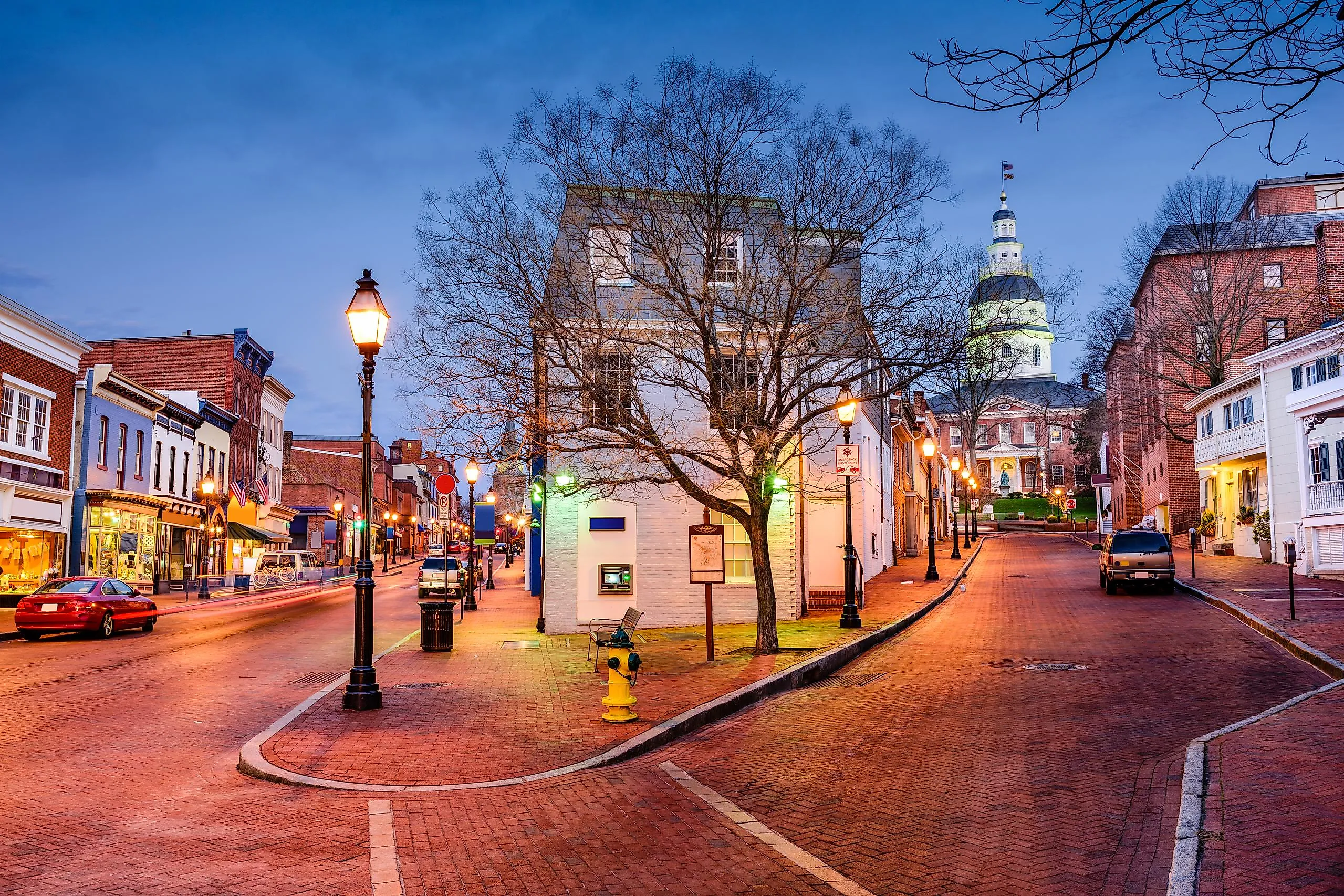
Downtown view over Main Street with the State House in Annapolis, Maryland, USA, at dawn.
Annapolis is Maryland’s capital and one of the state’s most institutionally stable cities, shaped by government, defense, and maritime employment rather than speculative growth. The city briefly served as the capital of the United States from 1783 to 1784 and remains home to the Maryland State House, the oldest state capitol still in continuous legislative use. The building continues to host Maryland’s General Assembly each year and is open to the public for tours outside legislative sessions.
Annapolis’s economic base is anchored by state government, defense, and higher education. The United States Naval Academy is one of the city’s largest employers and supports a broader ecosystem of federal contracting, engineering, and professional services throughout Anne Arundel County. Healthcare, education, and public administration account for a significant share of local employment, contributing to a relatively stable job market compared to tourism-driven coastal towns.

With a population of roughly 40,000, Annapolis maintains a compact, walkable historic core while offering established residential neighborhoods outside downtown. Crime rates are lower than in many similarly sized cities in the Baltimore-Washington corridor, and the city benefits from consistent public investment tied to its role as the state capital.
Public access to the waterfront and green space is a practical draw rather than a novelty. Quiet Waters Park functions as a year-round community park, offering paved trails, water access, seasonal ice skating, and organized programming. Events such as the park’s annual Fairy House Festival reflect its role as a neighborhood gathering space rather than a purely recreational destination.
Overall, Annapolis stands out as a place to live for residents seeking government-anchored employment, a strong civic identity, and daily access to the Chesapeake Bay without relying on seasonal tourism for economic stability.
Frederick

Historic building in downtown Frederick, Maryland, at the Carrol Creek Promenade.
Frederick is one of central Maryland’s most self-contained small cities, combining a walkable historic core with a growing regional job base. Its downtown is not a themed shopping district but an active commercial area anchored by long-standing independent businesses. Local fixtures include Curious Iguana, an independent bookstore known for author events and community programming, as well as small specialty retailers clustered along Market Street and historic Shab Row.
Frederick’s economy has diversified well beyond tourism. The city supports employment in healthcare, biotechnology, defense contracting, logistics, and local government, and it also serves as a commuter hub for Washington, D.C., and the I-270 technology corridor. That balance has helped Frederick maintain steady population growth without the volatility seen in purely bedroom communities.
Residents in the surrounding county enjoy a well-established craft beverage scene that has persisted over time, not just a passing trend. Linganore Winecellars, established in 1976, is known as Maryland’s oldest family-owned winery still in operation and hosts various community events all year. Local breweries like Attaboy Beer focus on neighborhood taprooms with outdoor seating and dog-friendly areas, serving as informal gathering spots rather than destination nightlife.

Outdoor access is a daily convenience rather than just a weekend activity. Catoctin Mountain Park and Cunningham Falls State Park are located just outside the city, offering well-maintained trail networks, year-round hiking options, and public access to one of Maryland’s tallest waterfalls. These areas are popular among residents and enhance Frederick’s reputation as a community where outdoor recreation seamlessly integrates into daily living.
Overall, Frederick stands out as a livable Maryland city because it combines a functioning downtown, a diversified employment base, and immediate access to protected public land—without relying on seasonal tourism to sustain its economy.
Ellicott City

Intersection in downtown Ellicott City, Maryland.
Ellicott City, founded in 1772, is among Maryland’s most historically intact communities and among its most consistently stable residential markets. Built along the Patapsco River, the town developed early as an industrial center and retains a compact historic district that remains active rather than preserved solely for tourism. Main Street remains a walkable commercial corridor, with locally owned businesses integrated directly into surrounding residential neighborhoods.
Ellicott City’s appeal as a place to live is reinforced by low crime rates, a long-established housing stock, and access to some of Howard County’s highest-performing public schools. Its location places residents within a short drive of major employment corridors along Route 29 and I-95, connecting to Baltimore, Columbia, and the broader Washington-Baltimore region without the density or volatility of a core urban center.
The history of the town is tangible. Ellicott City Station, constructed in 1831, stands as the oldest existing railroad station in the U.S., showcasing the town’s early participation in American industrial growth. Close by, the Ellicott City Firehouse Museum illustrates how the area’s steep landscape and densely built 19th-century structures influenced early firefighting methods, factors that continue to impact contemporary flood prevention and planning in the historic district.

Outdoor access is a defining daily amenity. Patapsco Valley State Park extends more than 30 miles along the Patapsco River and includes multiple developed recreation areas across Howard and Baltimore counties. The park offers extensive trail networks for hiking and biking, river access for fishing, and large tracts of protected land that serve as a regional green buffer rather than a destination-only park. For residents, it offers year-round recreation within minutes of home.
Overall, Ellicott City distinguishes itself by offering a vibrant historic center, dependable infrastructure, and proximity to key employment hubs and protected public lands. This combination makes it one of Maryland’s most reliable places to live, not just a destination to visit.
Towson

Sunset sky over Towson, Maryland.
Towson is located immediately north of Baltimore and serves as the administrative and commercial center of Baltimore County. It offers a suburban residential environment paired with direct access to employment, healthcare, and cultural institutions in Baltimore. This balance has made Towson a long-standing choice for families and professionals seeking stability without isolation.
Education plays a key role in Towson. With a sprawling campus of about 300 acres, Towson University is among Maryland’s largest public universities and a significant local employer. Its influence helps sustain a stable housing market, reliable public transit, and a walkable downtown along York Road, while neighboring areas stay mainly residential. Public schools in Towson consistently rank highly within Baltimore County, strengthening its attractiveness for those planning to stay long-term.
Towson’s close proximity to Baltimore offers residents convenient access to major hospitals, universities, museums, and sports venues. It also features lower crime rates and quieter streets compared to many nearby city neighborhoods. For many residents, this easy access to urban amenities is the main reason they choose to live in Towson instead of within city limits.

Access to outdoor spaces further enhances daily life quality. Loch Raven Reservoir, Baltimore County's largest, plays a vital role in the local drinking water supply. Its protected watershed offers over 60 miles of maintained trails used year-round for walking, running, and birding. Strict development restrictions around the reservoir help preserve it as open space rather than turning it into a commercial recreation area. Residents often see wildlife such as ospreys, great blue herons, woodpeckers, deer, foxes, beavers, and muskrats.
Overall, Towson stands out as a place to live because it combines strong schools, institutional stability, access to Baltimore’s job market, and large protected green space within a compact and well-established suburban setting
Rockville

Rockville is one of Montgomery County’s most established residential cities, combining a strong employment base, reliable public infrastructure, and a true downtown rather than a single commercial strip. It is a common choice for families and professionals due to consistently high-performing public schools, multiple Metro stations on the Red Line, and direct access to major job centers in Bethesda, North Bethesda, and Washington, D.C.
Outdoor space is integrated into daily life rather than treated as a destination. Rock Creek Regional Park borders the city and includes Lake Frank, Lake Needwood, and a network of paved and natural-surface trails used for walking, running, and cycling. The park also hosts Go Ape Zipline & Adventure Park, an aerial ropes and zipline course that operates seasonally and is popular with families and older children. These amenities serve residents year-round rather than relying on seasonal tourism.

Rockville’s downtown functions as a civic center as much as a retail district. Rockville Town Square includes a public library, courthouse buildings, apartments, and offices alongside restaurants and small businesses. The square regularly hosts city-sponsored events and includes a seasonal outdoor ice rink that operates during the winter months. This concentration of public services and housing supports regular foot traffic beyond weekends or special events.
Overall, Rockville stands out as a place to live because it combines transit access, a diversified job market, functioning civic infrastructure, and large protected parkland, all within a city built for daily use rather than occasional visits.
Ocean City

Aerial view of the town of Ocean City, Maryland.
Ocean City has a year-round population of roughly 7,000 residents and operates very differently outside the summer season than its national reputation suggests. While the city is best known as a seasonal resort, its permanent community is supported by municipal government, healthcare services, public schools, and a steady employment base tied to tourism management, hospitality operations, and local government rather than short-term visitor traffic alone.
The boardwalk area, though busy in peak season, remains central to daily life for full-time residents during the rest of the year. Local businesses such as the Fractured Prune, operating since the 1970s, and Thrasher’s French Fries, founded in 1929, function as year-round employers and community fixtures rather than novelty stops. Outside summer months, the pace slows considerably, and much of the city reverts to a walkable coastal town where services are oriented toward residents rather than crowds.
Cultural and civic institutions are concentrated along or near the boardwalk. Ocean City Life-Saving Station Museum documents the city’s origins as a lifesaving and maritime community, reflecting its long-standing relationship with the Atlantic rather than its modern resort image. Other attractions remain open seasonally, but residents largely experience the boardwalk as public waterfront infrastructure rather than an entertainment strip.

The Atlantic shoreline is Ocean City’s most reliable asset for daily life, featuring over ten miles of public beach that are all municipally managed and free to access. During off-peak months, residents engage in walking, swimming, surfing, and community events, enjoying much less crowding than in summer. Ongoing city-sponsored activities and beach upkeep ensure a level of public access that is rare in many privately owned coastal communities.
Overall, Ocean City stands out as a place to live for residents seeking year-round coastal access, a small permanent community, and a local economy that supports daily life even when seasonal tourism fades. Its appeal lies less in attractions and rankings and more in the stability of its infrastructure and guaranteed access to the Atlantic Ocean.
Discover Your Ideal Maryland Locale in 2026
Bethesda, Annapolis, Frederick, Ellicott City, Towson, Rockville, and Ocean City collectively stand out as some of Maryland’s most reliable places to live. They are backed by well-established infrastructure, job opportunities, and long-term residential stability, rather than relying on short-term growth or tourism trends.
Although these towns vary in size and environment, they have shared advantages. Robust public services, access to education and healthcare, preserved green spaces, and closeness to key employment hubs influence daily life in meaningful ways beyond appearances. Whether residents live near federal and research jobs, in a historic civic area, next to protected parks, or along the Atlantic coast, they enjoy communities built for year-round living.
Taken together, these towns reflect the breadth of Maryland life in 2026, offering practical options for families, professionals, and retirees who prioritize stability, access, and quality of life over novelty.