6 Tiny Off-Grid Towns In Australia
Across Australia, many remote towns are organized around the challenges of distance, especially in inland New South Wales, inland Queensland, and western Tasmania. For example, Corinna in Tasmania is surrounded by dense rainforest, whose wilderness can be explored along walking tracks starting right from town. Winton in Queensland is another off-grid town where dinosaur enthusiasts can join excavation teams and help uncover ancient fossils. This list of 6 tiny off-grid towns in Australia examines places where limited access and reliance on local resources continue to define how each town functions on its own terms.
Queenstown, Tasmania

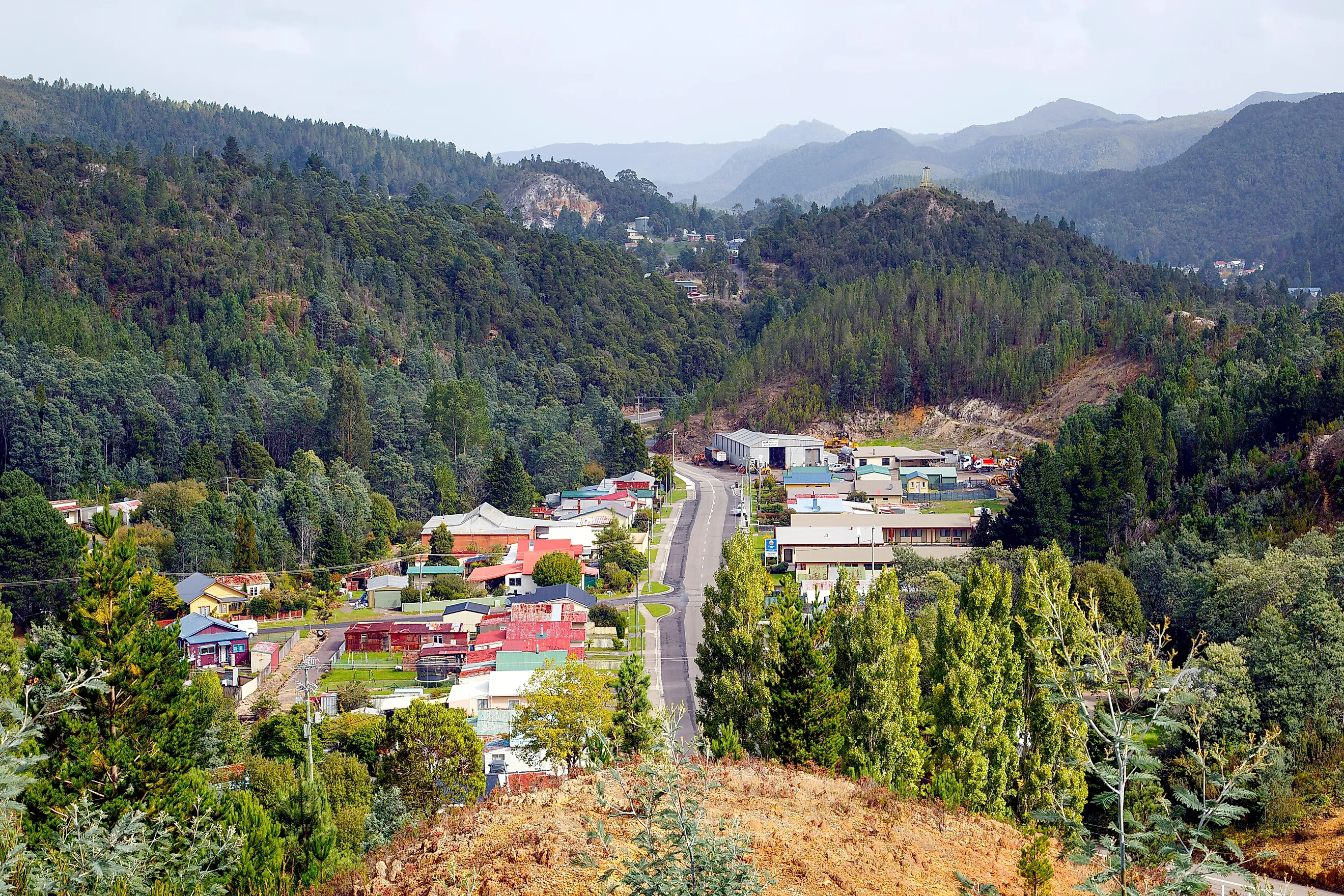
Queenstown is located in a deep valley in western Tasmania, surrounded by hills formed by decades of mining in the region. It was developed as a result of the copper boom in the late nineteenth century, after which it settled into a small town in a contained environment. The West Coast Wilderness Railway follows the original route used to transport copper ore, connecting Queenstown with Strahan. There are walking paths into the ranges, which are covered in regrowth, particularly in the areas further away from Queenstown. The Galley Museum has information on the history of the mining period, which is related to the current environment in the region. The historical Empire Hotel is the best place to stay in the town as it serves as a reminder of the time when the town was at its economic peak. In the evenings, the Moonscape Wine Bar and Cafe is a great place to unwind after a busy day exploring the raw wilderness surrounding Queenstown.
White Cliffs, New South Wales

Set in the far northwest of New South Wales, White Cliffs gives way to an expanse of pale, flat landscape dotted only by scrub and mining mounds. Established in the late nineteenth century following the discovery of opal, the town’s most defining aspect was created as an answer to the heat rather than as an initial design concept. As an answer to the heat, residents dug homes into the earth, and these remain in use today. Visitors are able to enter some of these dugouts, kept cool even in extreme temperatures, and traverse the nearby opal fields, where initial mining efforts are still evident in the landscape. On the outskirts of the town, the White Cliffs Solar Power Station represents the continuation of the concept of self-sustaining environments. As the town remains separated from others by vast distances, it continues to be defined by the isolation that it has experienced.
Corinna, Tasmania

Placed along the Pieman River in the west coast region of Tasmania, Corinna is accessed via a small vehicular ferry that immediately denotes the shift in scale and access that the town represents. Established as a gold mining town in the late 1800s, the town never expanded beyond the small footprint that it originally took up, and today, a small grouping of buildings remains in the midst of dense rainforest, with walking tracks beginning immediately from the town and extending into the wilderness beyond. River cruises also follow the Pieman River through stretches of rainforest that remain inaccessible by road, again illustrating the limited access that remains in the region. As access to the region remains possible only via the single ferry crossing, Corinna continues to remain within the boundaries that the landscape has originally set.
Winton, Queensland

Located in the heart of Queensland's central west, the town of Winton is open grazing country, with distances between towns measured in hours rather than minutes. It was established in the late nineteenth century as a pastoral service town and went on to be recognized as the birthplace of Qantas and the inspiration for the famous Australian song ‘Waltzing Matilda.’ This can be seen at the Waltzing Matilda Centre, with the Australian Age of Dinosaurs Museum located just outside town and still discovering fossils from the area. In addition, Bladensburg National Park offers access to walking tracks and historic homestead sites from the early days of the stations in the area.
Silverton, New South Wales

Silverton, located northwest of Broken Hill, was originally a mining town developed during the late nineteenth-century mining boom, but it has since declined as the mines were exhausted. Today, it is left with a small group of stone structures in the middle of a wide desert. We can see this with the most iconic Silverton hotel, which is the town's primary pub that has been used as a location for various films, such as “Mad Max 2,” as well as “A Town Like Alice” and “Mission: Impossible II.” This gives Silverton an additional dimension, as many directors use it as a location for film props and various items that are on display in various structures in the town. Nearby, Mundi Mundi Lookout also offers views of the plains, especially in the evening. Silverton, despite being in the vicinity of a major town, has been left as a separate entity, especially because of its past and surroundings.
Derby, Western Australia

Derby is located on the edge of King Sound in the Kimberley region, which has the most extreme tidal movements in the country. It was developed as a port in the late 1800s, and it has remained a small town with infrastructure related to its location and distance from other centers. The long jetty at Derby stretches into the tidal flats, which move significantly throughout the day. The nearby Boab Prison Tree is a reminder of the colonial past in the region, having been used in the late nineteenth century as a temporary holding site for Indigenous prisoners during forced relocations across the Kimberley. It is also a starting point for the Gibb River Road, which goes deeper into the remote areas of northern Western Australia.
These towns are examples of how, in Australia, settlement can continue to be related to geography rather than growth. In White Cliffs, Winton, the climate and distance are key factors in the construction and operation of town infrastructure, while in Corinna and Queenstown, access routes and geography continue to limit movement in a practical sense. Silverton and Derby are examples of old systems of economy that continue to shape the way space is used, rather than being replaced by new development patterns. What all seven towns have in common is not simply their size, but the way in which they continue to operate as entities that are somewhat separate, rather than being absorbed into broader patterns of urban operation. In these towns, being off-grid is not a choice, but a reality that shapes the way in which they are.