6 One-of-a-Kind Small Towns in Wisconsin
Wisconsin's landscape holds more than dairy farms and cheese curds. Scattered across the state, small towns celebrate quirks you won't find anywhere else in America, from life-size troll sculptures to the original circus headquarters. These communities turned their unique histories into living museums, where traditions persist, and visitors can step into something genuinely different. Each destination earned its reputation through decades of commitment to preserving what makes it unlike any other place. Let's explore the seven one-of-a-kind small towns that make Wisconsin truly special.
Mount Horeb

Drive into Mount Horeb, and you'll instantly spot what makes this community truly special. Over 36 wooden trolls line Main Street, each with its own personality and backstory. When a highway bypass threatened to divert traffic away from downtown in the 1980s, residents embraced their Scandinavian roots. Local artists began to carve these mythical creatures from wood and metal, helping the community earn its title as the "Troll Capital of the World."
Today, the Trollway (as locals officially call Main Street) draws visitors who hunt for favorite sculptures ike the Chicken Thief and the Accordion Player. Downtown, Makers Market Square sells local crafts and antiques, while the Grumpy Troll Brew Pub (yes, a troll hangs over it) serves Wisconsin classics with a view of the Sugar River. Just outside town, Cave of the Mounds reveals underground limestone caverns that formed over millions of years, allowing visitors to experience one of the oldest cave formations in the Midwest.
Hayward

In Hayward, a four-and-a-half-story fiberglass muskie looms over the landscape. This statue isn't just a roadside attraction. It's the centerpiece of the Fresh Water Fishing Hall of Fame, a museum dedicated to preserving the history of North American sportfishing. Walk up the staircase inside the muskie's body, emerge through its open mouth, and you'll get panoramic views of the surrounding lakes. The Hall of Fame is open during the fishing season and houses more than 50,000 artifacts, including thousands of vintage lures, antique boat motors, and over 300 mounted fish. The museum maintains world records for freshwater catches across 125 species.
In town, Scheer's Lumberjack Show demonstrates traditional logging skills with axe-throwing and log-rolling competitions. Every winter, the annual American Birkebeiner attracts cross-country skiers to trails groomed to world-class standards. Outside town, the Chippewa Flowage ranks as Wisconsin's third-largest lake, drawing anglers year-round.
New Glarus

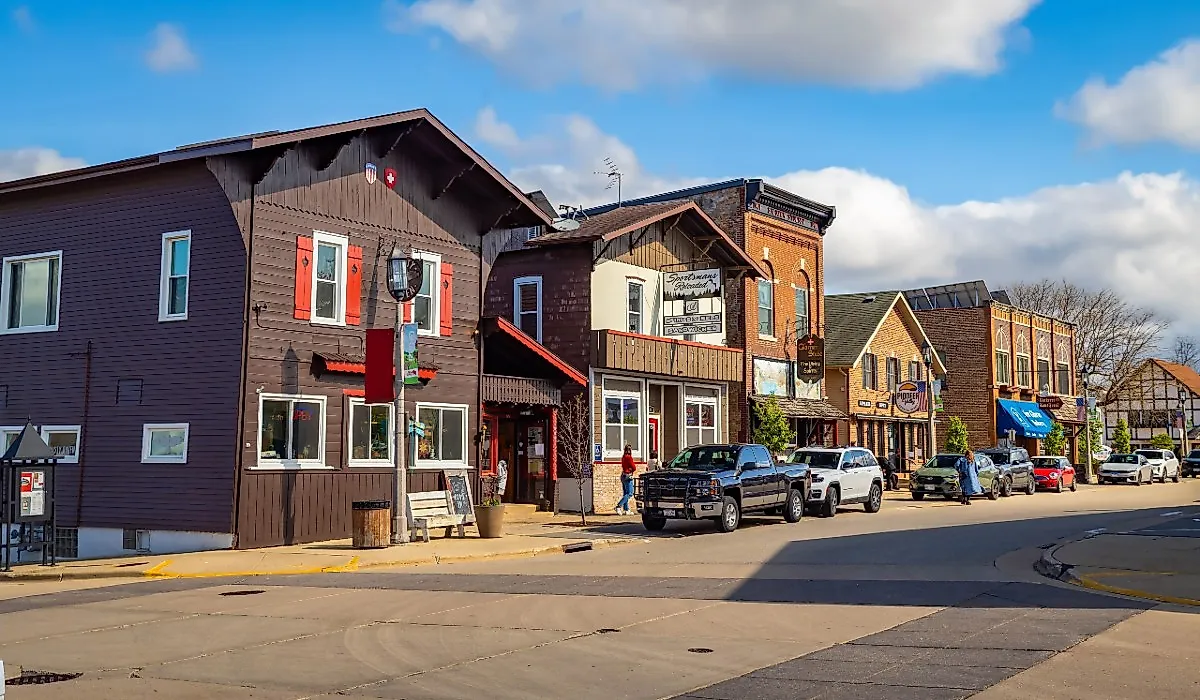
New Glarus doesn't just celebrate Swiss heritage. It legally requires it. The town's architectural code requires that all buildings in the eight-block downtown follow a "Swiss Architectural Theme," featuring chalet-style roofs and traditional detailing. Walk down the streets, and you'll see flower boxes overflowing from every window, Swiss flags hanging from balconies, and facades painted in the distinctive alpine style.
In 1845, 108 Swiss immigrants from the Canton of Glarus founded the settlement during economic hardship. Their descendants maintained traditions that still define the town today. You can explore this history at the Swiss Historical Village Museum, which preserves 14 historic buildings, including an original church, schoolhouse, and log cabins. The New Glarus Brewing Company produces craft beers that it sells exclusively in Wisconsin, a policy that has made its products cult favorites and pilgrimage-worthy for beer enthusiasts. Try authentic raclette and rösti at Glarner Stube, a restaurant that imports ingredients directly from Switzerland to maintain authenticity. Just outside town, the 23-mile Sugar River State Trail follows an old railroad bed through the countryside, passing through covered bridges and offering views of the surrounding farmland.
Baraboo

About 40 miles northwest of Madison, Baraboo served as headquarters for the Ringling Brothers Circus between 1884 and 1918. The circus company grew into the largest circus enterprise the world had known. The Circus World Museum now occupies those original grounds, a National Historic Landmark where seven authentic Ringling buildings preserve the era when circuses toured by railroad and delighted thousands of small-town folks every year.
The museum's collection includes the world's largest array of restored circus wagons, many ornately carved and painted. During summer, daily performances under the Big Top feature trapeze artists, acrobats, and traditional circus acts. Tour Ringlingville to see the Ring Barn, Elephant House, and Wardrobe Department, where workers once sewed and repaired costumes. Downtown, the Al. Ringling Theatre, built by one of the circus brothers in 1915, continues to host performances in its lavishly decorated interior. Just outside town, Devil's Lake State Park, Wisconsin's largest state park, occupies nearby bluffs and offers hiking trails along 500-foot quartzite cliffs.
Spring Green

Frank Lloyd Wright spent nearly five decades refining Taliesin, his 37,000-square-foot home and studio, which he built into the brow of a Wisconsin hillside. The architect used local limestone and sand from the Wisconsin River to construct simple buildings that seem to grow from the landscape. Today, guided tours explore Wright's living quarters, drafting studio, and bedroom terrace, along with other buildings spanning his entire career.
After touring Taliesin, grab lunch at the Riverview Terrace Cafe, the only restaurant Wright ever designed, or stop by the Spring Green General Store, a colorful restored 1910 cheese warehouse. Just outside town, the House on the Rock stands in complete opposition to Wright's minimalist philosophy. Built atop a rock column, this attraction comprises multiple buildings housing the collections of a local builder. Visitors can see the world's largest carousel with over 20,000 lights, rooms packed with automated music machines, and even a recreation of a 19th-century main street.
Sumpter/North Freedom

Sumpter, along Highway 12 in the south-central part of the state, features one of the nation's most extraordinary art installations. Dr. Evermor's Forevertron is the world's largest scrap-metal sculpture, weighing 300 tons, rising 50 feet high, and stretching 120 feet wide. Tom Every (Dr. Evermor) spent decades overseeing the demolition of more than 350 industrial sites nationwide. He salvaged pieces from these demolitions to build this masterpiece in the 1980s.
The sculpture incorporates Thomas Edison dynamos from the 1880s, the decontamination chamber from Apollo 11, parts from 1920s power plants, and components from salvaged industrial equipment spanning a century. Surrounding the main structure, the sculpture park includes the Epicurean Orchestra (musical instruments made from scrap), bird sculptures perched on poles, and dozens of smaller creations. The Forevertron sits on the grounds of Delaney's Surplus Sales, a local institution since 1946 that sells everything from tools to oddities with inventory that changes weekly. Nearby, Natural Bridge State Park protects Wisconsin's largest natural sandstone arch, a 25-foot-high formation that survived the last Ice Age.
Visit These Six One-of-a-Kind Small Towns in Wisconsin
These six Wisconsin towns prove that the most memorable destinations often lie beyond the tourist brochures. Each community took something distinctive and built an entire identity around it, transforming peculiar histories into living attractions. Whether you're hunting for trolls, climbing inside a giant muskie, or marveling at the world's largest scrap metal sculpture, these towns reward visitors who venture off the beaten path. Wisconsin's small-town quirks aren't just roadside curiosities. They're testaments to communities sharing what makes them unforgettable.