4 Kansas Towns Where Famous Movies Were Filmed
Even before Dorothy put on her ruby red slippers and skipped along the Yellow Brick Road, declaring “There’s no place like home,” Kansas was already a popular setting for storytelling. And this Midwest state's endless prairies and quiet towns continue to provide authentic backdrops for everything from romances to murder mysteries.
These locales don’t just appeal to writers and filmmakers. Curious travelers and movie buffs have long been attracted to these small-town film sets, lured by the same appeal that led to their being film stars in their own right. With their historic landmarks and charming main streets, these four Kansas towns where famous movies were filmed are ready for you to pay a visit, too.
Holcomb and Garden City

The small farm community of Holcomb is forever linked to American crime history. Tragedy struck on November 15, 1959, when four members of the Clutter family were brutally murdered in their home by two drifters. It was a crime that shocked the nation. Immortalized in author Truman Capote's chilling book, In Cold Blood, the story was adapted for the big screen in 1967.
Shot at the actual locations where the book’s events occurred, the film’s documentary-style realism earned it four Academy Award nominations and a place in American movie history. The cast and crew spent four weeks at the actual Clutter farmhouse in Holcomb, with items like original family photos making the final cut. Additional Kansas filming took place in Edgerton and Emporia, with the Finney County Courthouse in Garden City serving as the location for trial scenes, just as it had for the actual 1960 proceedings.
Travelers and film fans interested in the story of In Cold Blood can explore several locations in the Garden City area. The Finney County Historical Museum features a "True Crime" exhibit that showcases evidence, artifacts, and information about both the Clutter case and crime gangs that operated in the area during the 1920s.
Halstead

When the decision was made to bring William Inge's Pulitzer Prize-winning play, Picnic, to the silver screen in 1955, the area that had inspired the Kansas-born playwright was a shoo-in for a lead role. Starring legends William Holden and Kim Novak, filming began in Salina with driving scenes along the Smoky Hill River. The Benson mansion exterior and train station sequences were also captured there. The grain elevator rooftop scenes were filmed in Hutchinson, while the movie’s famous swimming scenes took place in nearby Sterling.
But the real stars of the show were the small towns of Nickerson and Halstead. Landmark buildings captured on screen included the high school, along with neighboring homes in Halstead, as well as the town’s Riverside Park. The park’s cable suspension footbridge that spans the Little Arkansas River is instantly recognizable from the film, as is its merry-go-round.
Film enthusiasts interested in Inge's life should include the small town of Independence on their itinerary. Here, you’ll find the William Inge Center for the Arts, located at Independence Community College and home to an extensive collection of the playwright's works and memorabilia. The center also hosts the William Inge Theatre Festival, making April a great time to visit.
Wilson - Paper Moon

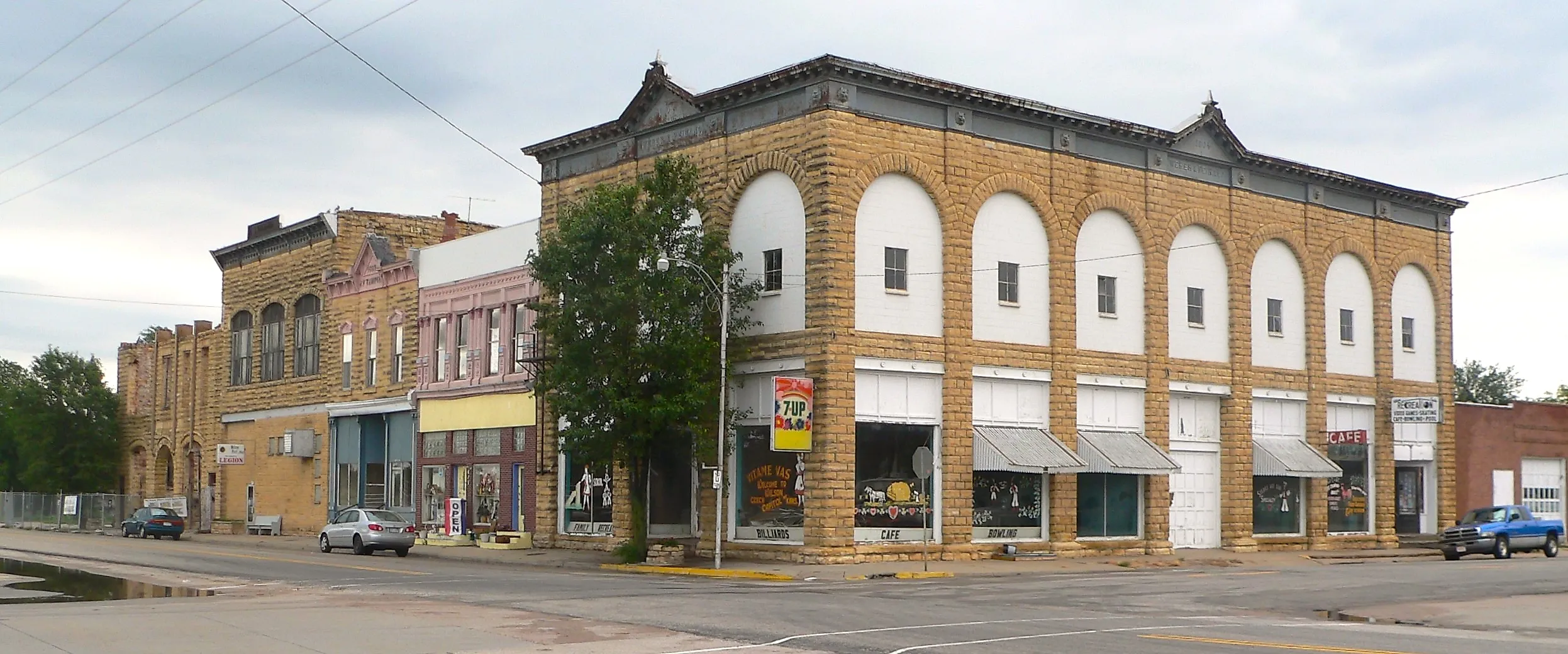
The decision to film the classic Paper Moon in black and white was just one of many choices that lent this 1973 road comedy its distinctive Depression-era atmosphere. Another crucial decision was to shoot extensively in the small towns of western Kansas, where period-appropriate buildings required minimal alteration to portray 1936 America convincingly.
Featuring real-life father and daughter Ryan O'Neal and Tatum O'Neal as a pair of con artists who travel across Kansas running Bible-selling schemes, the film earned Tatum an Oscar for Best Supporting Actress - an incredible achievement for a 10-year-old. The town of Hays served as the film's base of operations, with filming taking place in small Kansas communities, including Wilson, McCracken, Gorham, White Cloud, and Dorrance.
In Wilson, several locations from the movie remain intact. The historic Midland Railroad Hotel, featured as both a filming location and a place of rest for the cast and crew, remains an excellent option for film buffs wanting to stay in town. Pop into the hotel's parlor to view the framed photos taken during filming, as well as an original movie poster.
The town’s Sunflower Coal buildings were the backdrop for a key scene, while the exterior of Somer Hardware, where a store clerk is tricked out of a $20 bill, still stands. The film's opening scene at a graveside was shot at Nickel Cemetery southwest of Liebenthal, and you’ll still find the old hand water pump visible in the scene in place.
Fort Scott - The Learning Tree

When Gordon Parks returned to his hometown of Fort Scott in 1968 to direct The Learning Tree, he was making history, not just filming it. The first major Hollywood studio production ever directed by an African American, Parks also wrote and produced the movie and even composed the score. Based on his 1963 semi-autobiographical novel, the film is a coming-of-age story set in the fictional town of Cherokee Flats in the 1920s, a time period that is not entirely fictional.
With Warner Bros’ backing, Fort Scott was an obvious choice of location, with hundreds of locals cast as extras, some with speaking roles. The impact on the community at large was extremely positive, with the local Elks Club admitting African Americans for the first time when they threw a party for the cast and crew.
Gordon Parks himself has since become a local legend. Not only was he given a key to the city, but Gordon Parks Day was also declared in 1968, before the production wrapped. Parks also broke barriers behind the camera, too. He hired 12 African American crew members for the production, fighting union restrictions that had long excluded people of color from such jobs. In 1989, The Learning Tree was one of the first films selected for preservation in the Library of Congress National Film Registry for its cultural, historical, and aesthetic significance.
Film buff or not, a visit to the Gordon Parks Museum at Fort Scott Community College is a must. In addition to its collection of photos, awards, medals, and the honorary degrees presented to Parks, the museum is also behind The Learning Tree Film Scene and Sign Trail, featuring filming locations in and around Fort Scott. You can get details of the route at the museum.
When Hollywood Met the Midwest
Together, these four Kansas destinations helped create some of cinema’s most magical movie moments. By recognizing that authentic American stories required authentic American settings, Hollywood studios helped preserve several defining moments in America’s darker past as well. From the tragedy preserved in Holcomb to the groundbreaking movie history that was made in Fort Scott, these four Kansas towns played vital roles in American cultural history.