11 Prettiest Small Towns In The Great Lakes Region
Five lakes hold enough freshwater to bury the Lower 48 under nearly ten feet. People along these shores live at the water's pace. On Mackinac Island, the loudest sound is a horse's hooves on Market Street. In Bayfield, the ferries still run on the fishing calendar their grandparents kept. Each of these eleven towns draws its character straight from the lake it faces. A few sit on the cold Superior north. Others look out on freighters bound down the St. Lawrence.
Mackinac Island, Michigan (Lake Huron)

No cars have run on Mackinac Island since July 6, 1898, when the village council banned them for spooking the carriage horses. That single rule set the tone for everything since. Residents and summer visitors get around by bicycle, by foot, and by the horse-drawn carriages that still work the streets. Fudge shops line Market Street below Victorian storefronts, and the smell carries a block in either direction.
The Grand Hotel runs its front porch 660 feet along the bluff, a length it bills as the longest in the world. Guests rock in chairs above turquoise water and terraced gardens. Below, ferries unload day-trippers who have come for the lilacs in June or the amber maples in October.
State park land covers more than 80 percent of the island, so a bike ride leaves town fast. The 8.2-mile M-185 loop follows the shoreline the whole way around, the only state highway in the country closed to cars. Riders pass Arch Rock and Sugar Loaf, two limestone formations the lake and weather cut over thousands of years. The route never climbs far, which makes it an easy afternoon even for kids on rented cruisers.
Bayfield, Wisconsin (Lake Superior)

Ferries leave Bayfield's harbor for Madeline Island on a schedule the town has kept for generations. This is the jumping-off point for the Apostle Islands National Lakeshore, a scatter of twenty-one islands just offshore. Kayakers paddle out in summer to reach the sea caves that Lake Superior carved into the red sandstone cliffs, where the water echoes inside the hollows.
The town grew up in the late 1800s on a fishing boom, and the money built the brownstone blocks and gabled houses that still stand downtown. Many of those Victorians are bed-and-breakfasts now, run alongside galleries where local artists sell their work. Orchards and berry farms cover the hills behind the harbor, close enough that growers bring cider into town by the crate.
Each autumn the Bayfield Apple Festival fills the streets with fresh pressings and craft stalls, and the harbor air turns sweet with it. Residents plan the season around the apple harvest the way coastal towns elsewhere plan around the tide.
Saugatuck, Michigan (Lake Michigan)

Painters and sculptors have worked in Saugatuck for more than a century, which is how southwestern Michigan's shoreline here earned the name Art Coast. The town sits where the Kalamazoo River empties into Lake Michigan, and the dunes around it draw as many visitors as the galleries. Main Street and Butler Street hold fine-art rooms, working pottery studios, farm-to-table kitchens, and independent bookshops within a few blocks.
Oval Beach spreads wide golden sand below steep grass-covered dunes, and testers have ranked its water among the cleanest of any Great Lakes beach. For the view, climbers take the 302 wooden steps up Mount Baldhead to look out over the lake and the river valley.
The Saugatuck Chain Ferry has crossed the Kalamazoo by hand crank since 1838, and an operator still pulls it across on a submerged chain. Some visitors ride it just to say they did, then catch a sunset sail on one of the wooden schooners that work the harbor in the evening.
Grand Marais, Minnesota (Lake Superior)

A granite point and an old lighthouse shelter the harbor at Grand Marais, which is the reason a town grew here at all on Minnesota's North Shore. The Sawtooth Mountains rise close behind it, and the deep blue of Lake Superior fills the view in front. Fishing boats and pleasure craft share the same small basin.
This is the last town before the Boundary Waters Canoe Area Wilderness, so paddlers stock up here before heading inland. Two state parks sit within a short drive: at Judge C.R. Magney the Brule River drops through a series of falls, and at Temperance River the water has cut a narrow gorge into old volcanic rock.
Craftspeople keep old skills alive at the North House Folk School, where instructors teach timber framing, boat building, and weaving through the year. Down at the harbor, cafes and fish houses serve Lake Superior trout and whitefish pulled from the water nearby. Summer brings cool breezes and wildflower hikes, autumn turns the boreal forest crimson, and clear winter nights sometimes bring the Northern Lights over the ice.
Ephraim, Wisconsin (Lake Michigan / Green Bay)

Moravian settlers founded Ephraim in 1853 as a religious community, and the town still keeps the look they gave it. Strict preservation rules mean nearly every building along the water wears white paint with dark trim. The effect turns the blue of Green Bay into a clean backdrop, and it earns the town its European-village reputation on Door County's quiet western shore.
Eagle Harbor stays calm most days, which suits paddleboarders and small sailboats and anyone who wants to watch the sun drop over the bay. Peninsula State Park runs right up to the town line, with biking trails, golf courses, and the old Eagle Bluff Lighthouse among the trees.
Wilson's Restaurant and Ice Cream Parlor has served fountain sodas and hand-dipped cones on the waterfront since 1906. Families still line up at the window on summer evenings, which makes it the natural last stop before the drive home.
Charlevoix, Michigan (Lake Michigan and Lake Charlevoix)

Architect Earl Young spent decades building the stone cottages that made Charlevoix famous. Locals call them the Mushroom Houses, more than thirty low structures of local boulder and thick cedar roofs that seem to grow out of the ground. Young laid them out around town in the early and mid-1900s, and self-guided walking maps now lead visitors between them.
The town holds a narrow ribbon of land between Lake Michigan and Lake Charlevoix, joined by a short channel and a drawbridge in the middle of downtown. When a tall boat needs through, the bridge goes up and traffic waits. Yacht basins and small waterfront parks fill the rest of Round Lake harbor.
Fishermen's Island State Park stretches south along the Lake Michigan shore, and its beaches hold fossilized coral from an ancient sea that swimmers hunt for in the shallows. On summer nights the downtown pavilion hosts open-air concerts a short walk from the water.
Put-in-Bay, Ohio (Lake Erie)

A ferry or a private boat is the only way onto South Bass Island, where Put-in-Bay sits around a green harbor park. That short crossing keeps the pace slower than the Ohio mainland, and most people explore by golf cart or bicycle once they land. Victorian gingerbread cottages and old taverns line the shaded streets.
Perry's Victory and International Peace Memorial rises 352 feet above the island, a granite Doric column and the tallest of its kind in the world. It marks Commodore Oliver Hazard Perry's win at the Battle of Lake Erie in the War of 1812, and an elevator carries visitors to an observation deck with views into Canada on a clear day.
Under the island runs Crystal Cave, a limestone chamber lined with pale blue celestite that guides describe as the world's largest geode. Above ground, the trails at Scheeff East Point give birdwatchers a quiet stretch of Lake Erie shoreline away from the harbor crowds.
Leland, Michigan (Lake Michigan)

Weathered wooden shanties, smokehouses, and docks line the Leland River in the district everyone calls Fishtown, some of them 150 years old. Commercial tugs still haul whitefish in daily, and the smoked-fish shops next door sell what came off the boats that morning. Leland holds the Leelanau Peninsula between Lake Michigan and Lake Leelanau, and it keeps a working fishing village where most such places have turned into museums.
Cherry orchards and vineyards cover the rolling hills around town, and Main Street sells the results: Leelanau wines, local preserves, and cherry everything. Clapboard houses, cafes, and specialty markets fill the few blocks of downtown.
Beachcombers walk down to Van's Beach to hunt for Petoskey stones in the surf. For a longer trip, the Manitou Island Transit ferry runs from the harbor to the wild beaches of North and South Manitou Islands, part of Sleeping Bear Dunes National Lakeshore.
Geneva-on-the-Lake, Ohio (Lake Erie)

Ohio's first summer resort opened at Geneva-on-the-Lake in the late 1800s, and the strip along Lake Road still trades on that history. Arcade parlors, donut stands, and beer gardens have run here since the 1920s and 1930s, and the neon and the fried dough give the place a settled, mid-century feel. Families come back to the same cottages their grandparents rented.
Just inland lies the Grand River Valley, the heart of Ohio's wine country. Vineyards, covered bridges, and estate wineries fill the countryside, and several have won awards for their Riesling and ice wine. The cool lake air off Erie is part of what lets the grapes ripen this far north.
Geneva State Park sits next door with a full-service marina, sandy beaches, paved lakeside trails, and boardwalks over the wetlands. The park sits as a natural counterweight to the resort strip, quiet water on one side and the arcades on the other.
Clayton, New York (St. Lawrence River / Lake Ontario)

Freighters pass close enough to Clayton's waterfront that diners on the Riverside Drive patios can read the ship names. The town sits at the heart of the Thousand Islands, where Lake Ontario drains into the St. Lawrence River and the water turns into an international shipping lane. Victorian storefronts and old stone banks line the riverfront blocks.
The Antique Boat Museum keeps North America's largest collection of freshwater boats, from wooden speedboats to skiffs and canoes. Visitors can book a ride in a 1930s triple-cockpit runabout and take the mahogany hull out onto the river themselves.
River cruisers leave the docks to tour the granite islands, the old lighthouses, and the stone mansions of the Gilded Age. The grandest is Boldt Castle on nearby Heart Island, a hotel magnate's unfinished gift to his wife, now restored and open to anyone who takes the boat across.
Petoskey, Michigan (Lake Michigan)

Working gas lamps still light the brick sidewalks of Petoskey's Gaslight District, which took its name from them. The lamps line a downtown of brick storefronts, independent bookshops, kitchen stores, and jewelers, all set on the bluffs above Little Traverse Bay. Ernest Hemingway summered near here as a boy, and the district looks much as it did then.
A short way along the shore, the Bay View community holds more than 400 Victorian gingerbread cottages among wooded knolls. It began in the 1870s as a Chautauqua summer colony and now carries a National Historic Landmark listing, its narrow lanes closed to through traffic.
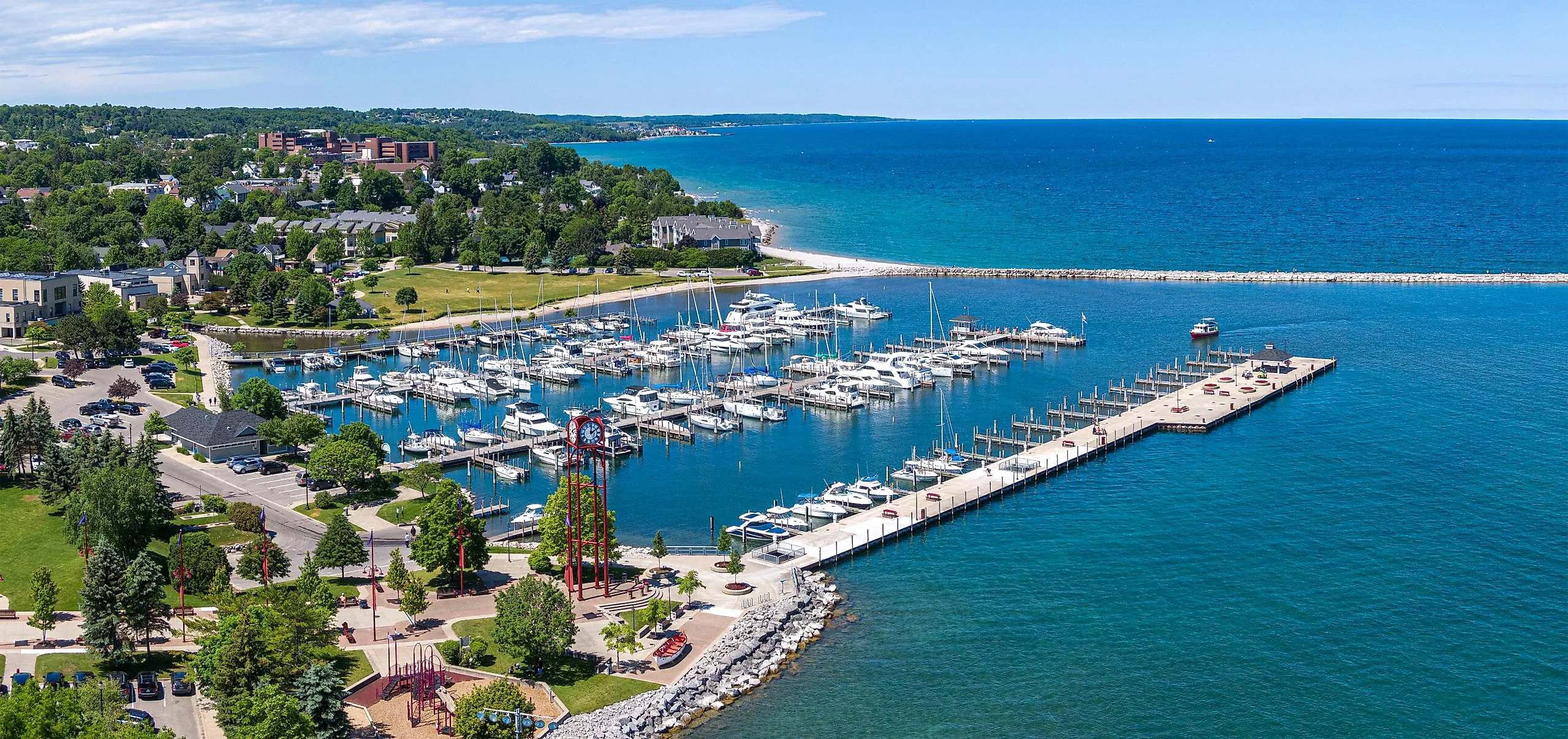
Petoskey State Park protects the dunes and beaches north of town, where beachcombers hunt the fossilized coral known as the Petoskey stone, Michigan's state stone. The town faces west over the bay, so the sun sets straight out over the water most evenings.
What the Lakes Give Each Town
These eleven towns share one teacher: the lake in front of them. Superior gave Grand Marais and Bayfield their cold clear harbors and their fishing calendars. Lake Michigan handed Saugatuck its dunes and Leland its working docks. Lake Huron let Mackinac Island keep the horse. Erie brought Put-in-Bay its ferry pace and Geneva-on-the-Lake its old resort strip. Out east, the St. Lawrence gave Clayton a front-row seat on an ocean highway.
Visit one and you learn its lake. Visit several and you start to read the whole system, the way the water changes color and temper as you move from the deep north down to the shallow warm south. That is the reward for slowing down on these coasts, and it is the kind of trip a person remembers for years.