11 Amazing New Mexico Day Trips That Are Worth The Drive
New Mexico whisks visitors away to its magical mesas, tent-shaped rock formations, and ancient Pueblo towns. You can spend one day exploring ancient petroglyphs carved into volcanic rocks. You can spend another wandering through one of the world's largest folk art museums. Another trip might take you to a quirky museum built from recycled bottles. These 11 amazing New Mexico day trips are all worth the drive.
Starting City: Albuquerque
ABQ BioPark (Within the City)

For those who have trouble spelling the name of the city, Albuquerque, the abbreviation "ABQ" works just fine, just like the ABQ BioPark. This park acts as an outdoor destination for families living in or coming through Albuquerque, with multiple attractions within its borders.
The 64-acre ABQ BioPark Zoo is home to more than 250 species, including great horned owls and Mexican wolves. Nearby, the ABQ BioPark Botanic Garden features about 1.5 miles of trails with highlights such as a Japanese Garden and Butterfly Pavilion. The BioPark doesn't neglect marine life either: the aquarium's centerpiece is a massive shark tank with multiple shark species. There's also Tingley Beach on the shores of the Rio Grande, which has three fishing ponds with trout and catfish.
Rio Grande Nature Center State Park (Within the City)

Hikers will love Albuquerque, especially its 338-acre urban state park: the Rio Grande Nature Center State Park. Founded in 1982, it's an important stop on the Rio Grande flyway, a path that migratory birds take as they go north and south depending on the weather.
In the park, discerning birdwatchers can spot many of the 250-plus species recorded along the Rio Grande corridor, including roadrunners, hummingbirds, sandhill cranes, and wood ducks. The park sits right on the Rio Grande, with 2 miles of forested nature trails that go past cottonwood trees, willow thickets, and sand flats. At the park's visitor center, there's a nature shop with little nature-inspired trinkets and gifts to take home. Staff also lead guided bird and nature walks on a regular schedule.
Petroglyph National Monument (Within the City)

One of Albuquerque's most intriguing sites is the tens of thousands of petroglyph images that were left behind on the western edge of the city in the basalt rocks. These rocks were formed over multiple volcanic eruptions, which are ideal for carvings. Many of the petroglyphs were created by Ancestral Pueblo peoples between roughly 1300 and the late 1600s, with some Spanish-era markings added later.
Many of these petroglyphs sit along short trails, making it easy to see a lot of them in one day trip. For example, the Rinconada Canyon 2.2-mile loop trail with roughly 300 petroglyphs, or the Piedras Marcadas Canyon 1.5-mile loop with around 400 petroglyphs. These drawings often depict wildlife such as cranes or nesting birds. There are other hiking spots that don't have petroglyphs but are worth exploring, such as cinder cone volcanoes along the Volcanoes Trail.
National Museum of Nuclear Science & History (Within the City)

New Mexico played a critical role in the development of the atomic bomb, as the Manhattan Project was centered at Los Alamos, New Mexico. The National Museum of Nuclear Science & History provides artifacts and educational materials on not just the Manhattan Project, but the development of nuclear energy in general.
As a Smithsonian affiliate, it's a world-class museum with exhibits on many nuclear topics, ranging from the Cold War to the impact of the atom bomb on Hiroshima and Nagasaki, plus Radiation 101. It's not all serious here in the museum. There's also an exhibit on Atomic Culture/Pop Culture with cute toys, games, appliances, and cars from the Atomic Age. The museum offers kid-friendly programs for families.
Indian Pueblo Cultural Center (Within the City)

Before leaving Albuquerque to travel to the pueblo towns and beyond, visitors can learn about the rich cultural heritage of the Pueblos at the Indian Pueblo Cultural Center. Collectively owned by the 19 Pueblos of New Mexico, it acts as the primary gateway to learn about Pueblo architecture, pottery, and culture.
One of the museum's permanent exhibits is called "We Are of This Place: The Pueblo Story," which allows Pueblo people to tell their own stories. The museum also features a Mural Collection and a collection of Pueblo pottery. The Indigenous Freeways: Southwest Wildstyle from North to South exhibit captures modern Native expression through graffiti. Before leaving the museum, visitors can try indigenous meals like stews and bakery items at the Indian Pueblo Kitchen.
Tinkertown Museum (30 Minutes)

The Tinkertown Museum is a roadside attraction just 30 minutes outside of Albuquerque, designed by folk artist Ross Ward over four decades starting in the 1960s. The museum walls are made of more than 50,000 glass bottles bound together by concrete. Inside is an entire old western miniature town made of wooden figures hand-carved by Ward.
The carved figures are placed within many different scenes, ranging from a circus to a toy store, and even a 35-foot sailboat named Theodora. For Ross Ward, everything was a potential piece of art, even his Jeep Cherokee, which he covered with pennies and bottle caps and displayed at the museum. The museum also has several quirky coin-operated machines like Esmeralda the Fortune Teller.
Kasha-Katuwe Tent Rocks National Monument (1 Hour)

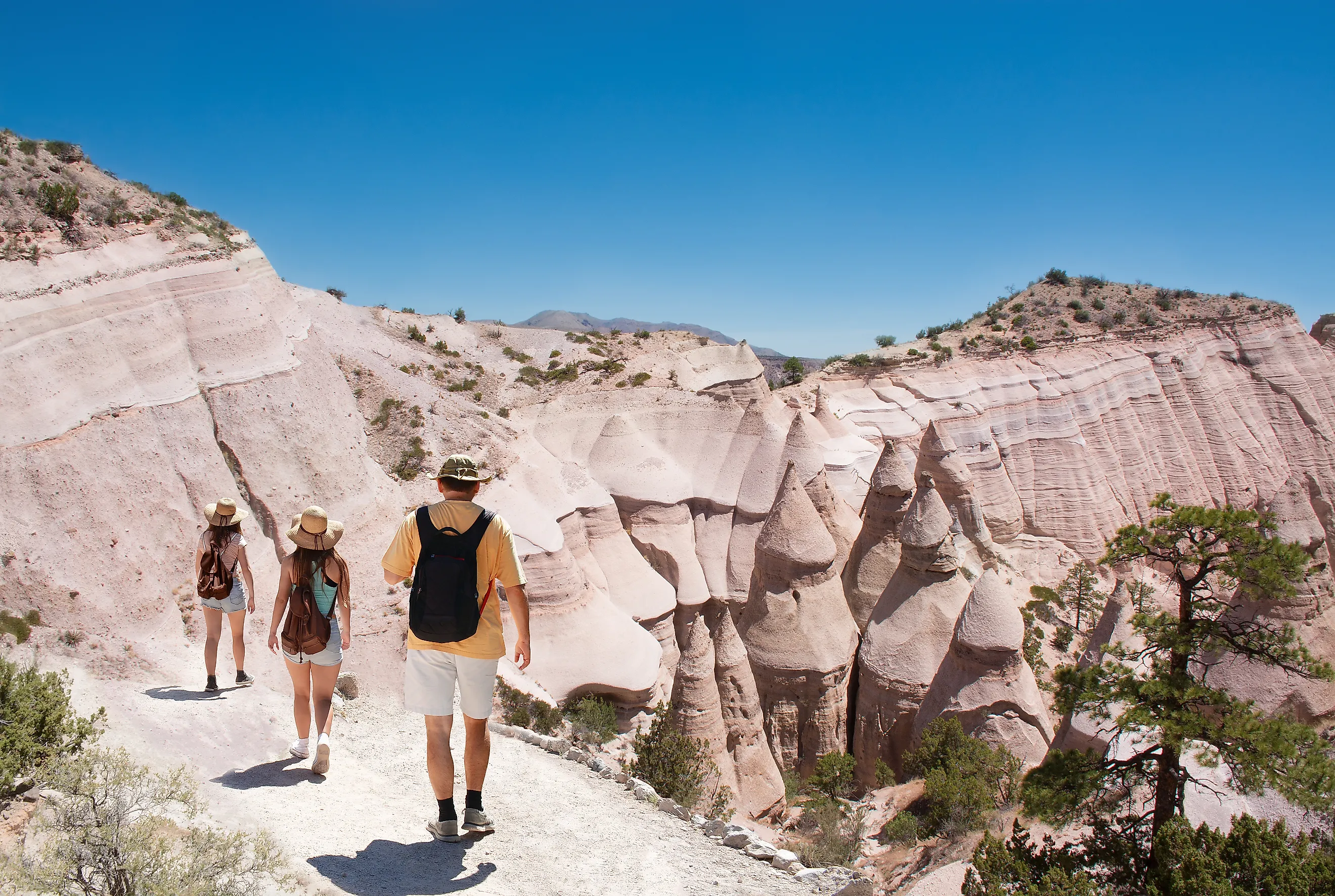
Volcanic eruptions have shaped much of the land of New Mexico, including the fascinating cone rock formations of Kasha-Katuwe Tent Rocks National Monument. These cones formed from eruptions that piled up ash, tuff, and pumice together, creating a network of rocks that resemble tents.
Caprocks sit on top of the cones that protect the pumice and tuff beneath, although some have begun to fall apart after losing their caprocks. The tent rocks can be quite tall, up to 90 feet. The national monument requires a reservation from the Bureau of Land Management to enter. Entry times are between 8 a.m. and 1 p.m. Mondays through Thursdays, with all guests having to exit by 4 p.m.
Acoma Pueblo (1 Hour, 15 Minutes)

Known as Sky City, Acoma Pueblo is one of the oldest continuously inhabited communities in North America, with origins dating back to around the 1100s AD. It was built atop a 367-foot sandstone mesa for its defensive properties, with the original main entrance a hand-cut staircase. Members of the tribe still live in these earthen homes and offer tours of Sky City. On the roughly hour-and-a-half tour, travelers can walk through the ancient village or purchase pottery from the Gaits'i Gift Shop.
There are several other cultural experiences in the Acoma Pueblo as well, from watching videos about Acoma's culture at the Ts'ikinum'a Theater or trying out Acoma food at the Yaak'a Café. The site reminds guests to be respectful when visiting this ancient Pueblo site.
Starting City: Santa Fe
Georgia O'Keeffe Museum (Within the City)

Georgia O'Keeffe lived for almost 100 years (1887-1986). During her long life, she became one of America's most celebrated artists with her modernist style, often incorporating flowers and landscapes into more abstract pieces.
In Santa Fe, travelers can see a collection of her artwork at the Georgia O'Keeffe Museum. First opened in 1997, the museum includes not just her paintings but also her painting supplies and personal items. The museum also operates her Abiquiú Home and Studio, 53 miles away from Santa Fe. Some current exhibits at the museum examine how Georgia used shapes, like the circle, to add symbolism to her work. For example, the "A Circle that Nothing Can Break" exhibit analyzes the circles and spirals in her art, including pieces that were never put on display during her lifetime.
Museum of International Folk Art (Within the City)

There's something about the beautiful desert of New Mexico that inspires folk art. The Museum of International Folk Art aims to celebrate not just folk art from the state but also from around the world. Operated by the New Mexico Department of Cultural Affairs, it holds around 150,000 pieces, making it one of the largest folk art museums in the world.
The museum includes major collections like the Girard Collection, assembled by architect and designer Alexander Girard, which fills the Girard Wing with more than 10,000 folk art objects from over 100 countries. Other galleries include the Hispanic Heritage Wing, which showcases toys, dolls, and other folk art objects. The diversity of the art on display is the museum's real strength, stretching from Scandinavia to the Balkans and across many other cultures.
Carson National Forest (1 Hour, 50 Minutes)

At 1.5 million acres, the Carson National Forest is an astonishingly large place, crossing the Sangre de Cristo Mountains, San Juan Mountains, and the San Juan Basin. Much of it is high elevation, going up to 13,000 feet. This vast landscape includes tundra, sagebrush, and many other habitats.
The forest contains New Mexico's highest peak: Wheeler Peak, at 13,161 feet, reached via the Williams Lake Trail. Anglers can go fishing at Eagle Rock Lake, and skiers can try the Enchanted Forest Cross Country Ski Area. Drivers can experience most of the forest from their cars on the 84-mile Enchanted Circle Scenic Byway, which loops around Wheeler Peak.
Enchanting Art, Towns, and Landscapes
There's something about New Mexico that's different from other Southwestern states. Georgia O'Keeffe clearly believed this, as she was reported to have said, "If you ever go to New Mexico, it will itch you for the rest of your life." Even a quick day trip through the state may create that feeling, whether that's appreciating folk art from around the world in Santa Fe or going on a Pueblo cultural tour. Visitors can experience much of that New Mexico "itch" for themselves with these fun and memorable day trips.