10 Prettiest Main Streetscapes In The Southern United States
Plenty of Southern Main Streets are worth a photo. These ten are worth a whole day. One ends at a 300-year-old Spanish fort. One has a waterfall thundering under a footbridge a block off the shops. One circles a courthouse packed with gold coins minted right in town. The pretty storefronts are just the hook. What sits a step past them is the reason nobody leaves before dinner.
Front Street, Natchitoches, Louisiana

Front Street follows Cane River Lake through the oldest part of Natchitoches, with red brick paving, iron balconies, live oaks, and rows of narrow commercial buildings facing the water. Several facades date to the 19th century, and the mix includes restrained brick storefronts alongside more decorative cast-iron work. The riverbank sits directly across the street, so the downtown view includes both the historic buildings and the long stretch of water.
Kaffie-Frederick General Mercantile has operated in the city since 1863 and is still one of the most interesting places to browse downtown. The Louisiana Sports Hall of Fame and Northwest Louisiana History Museum sits nearby in a striking modern building beside the historic district. Cane River Lake is especially lively during the Natchitoches Christmas Festival, when lights fill the riverfront and fireworks draw crowds into the center of town.
Main Street, Franklin, Tennessee

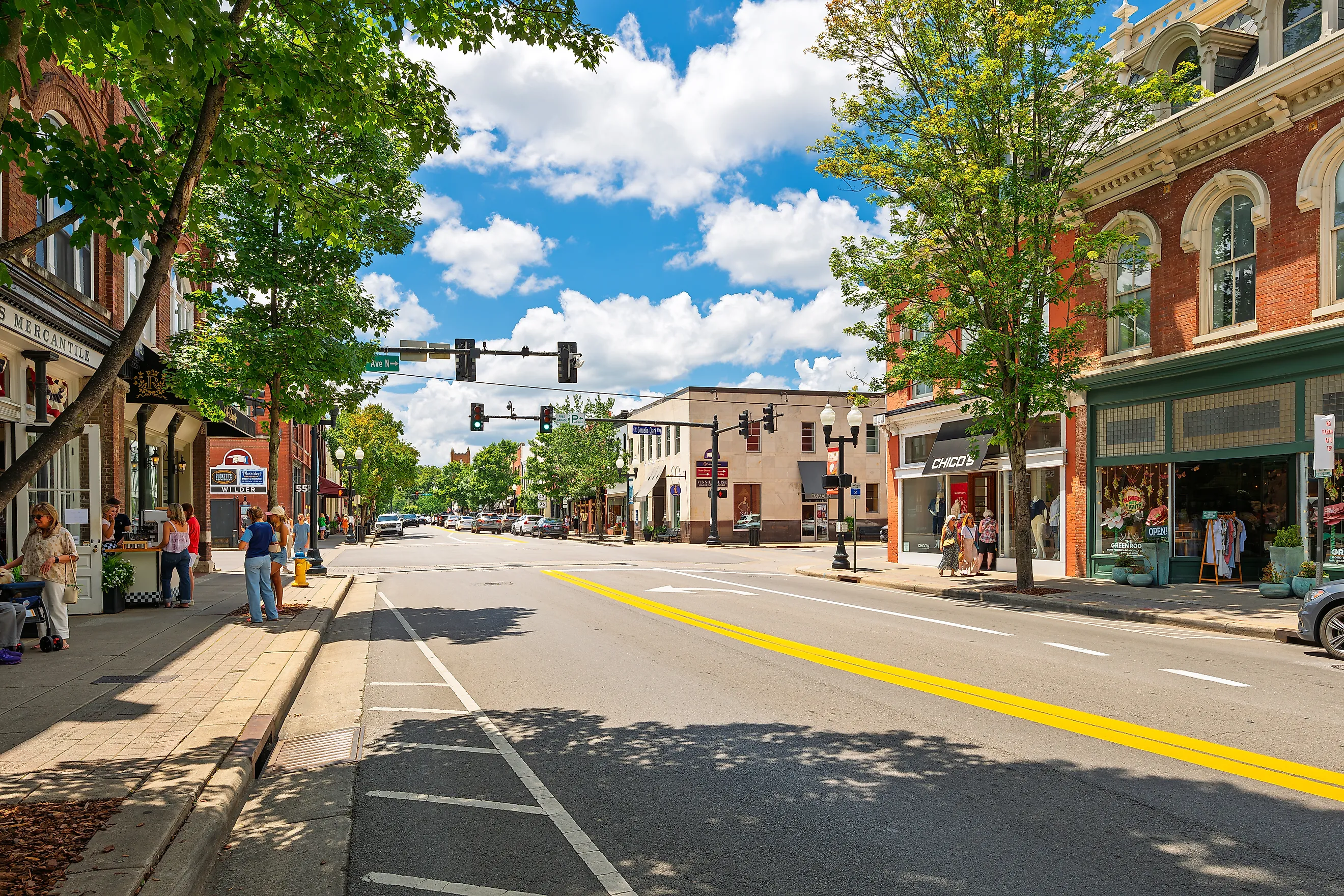
Franklin's Main Street is lined with restored brick buildings, mature trees, flower planters, benches, and broad sidewalks leading into the public square. Many of the storefronts date to the late 19th and early 20th centuries, with tall windows, decorative cornices, and and painted facades set a strong visual rhythm across the blocks. The square sits at the center of downtown, and the historic district stays compact enough to explore entirely on foot.
The Franklin Theatre, opened in 1937, remains one of Main Street's most recognizable landmarks and still screens films and stages concerts and live performances. A short drive away, Carter House and Carnton mark two major sites connected to the Battle of Franklin. Downtown itself is packed with independent shops, restaurants, and galleries. The Main Street Festival draws artists and vendors to the center each spring, while Dickens of a Christmas brings costumed performers and holiday stalls to the same streets in December.
Main and Spring Streets, Eureka Springs, Arkansas

Main Street and Spring Street twist through steep Ozark terrain, passing limestone walls, Victorian storefronts, balconies, staircases, and buildings squeezed into sharply sloping lots. Downtown Eureka Springs developed around the hills rather than across a flat grid, so one block may sit noticeably higher than the next. Native stone appears throughout the district, mixed with brick facades, cast-iron details, and ornate late-19th-century commercial architecture.
Basin Spring Park sits near the heart of downtown and regularly fills with musicians, festivals, and community events. Spring Street climbs past galleries, small hotels, and some of the city's best-preserved historic buildings. Higher on the ridge, the 1886 Crescent Hotel is worth visiting for its architecture and views across the Ozarks. Eureka Springs also has dozens of stairways and footpaths between streets, which make it possible to see the downtown roofs, stone walls, and balconies from several different heights.
Beverley Street, Staunton, Virginia

Beverley Street runs through downtown Staunton beneath church spires, clock towers, brick cornices, and rows of two- and three-story commercial buildings. The hilly terrain shifts the sightline block by block, especially around the older Italianate facades that fill much of the district. Brick sidewalks, granite curbs, traditional lamps, and carefully restored storefronts hold the street close to its 19th-century appearance.
The Blackfriars Playhouse is one of the strongest reasons to spend an evening downtown. The American Shakespeare Center built the theater as a recreation of the type of indoor playhouse Shakespeare's company used in London. The Woodrow Wilson Presidential Library is also nearby, occupying the house where Wilson was born in 1856. Staunton has a strong independent restaurant scene within the same few blocks, and the surrounding hills open several side streets to clear views back toward the downtown churches and rooftops.
King Street, Charleston, South Carolina

King Street cuts through Charleston's historic peninsula with a long sequence of Georgian, Federal, Greek Revival, Italianate, and Victorian buildings. Narrow facades sit close together along the sidewalk, broken up by palms, window boxes, awnings, and occasional church steeples. Lower King has some of the corridor's most elegant architecture, while the blocks farther north contain a denser concentration of shops, restaurants, and cafes.
Antique stores have long been associated with the southern portion of King Street, and several still occupy handsome historic buildings. The Charleston City Market is only a few blocks east, followed by Waterfront Park and its Pineapple Fountain. Farther south, visitors can continue toward Rainbow Row and The Battery, where grand houses face Charleston Harbor. Walking one or two blocks off King is also worthwhile because Broad, Church, and Meeting streets contain many of the city's best-preserved churches, civic buildings, and residential facades.
St. George Street, St. Augustine, Florida

St. George Street runs through the oldest part of St. Augustine as a narrow pedestrian corridor filled with wooden balconies, stucco walls, shaded courtyards, palms, and small historic buildings. The street follows a route established during the colonial period, and the surviving architecture carries centuries of Spanish, British, and American influence. Shops and cafes occupy many of the old structures, while side passages lead into gardens and enclosed courtyards.
The City Gates mark the northern end of the street and sit just west of Castillo de San Marcos, the massive 17th-century masonry fort overlooking Matanzas Bay. The Colonial Quarter holds reconstructed workshops and buildings that lay out daily life during the city's Spanish era. Farther south, the Cathedral Basilica of St. Augustine dates its parish history to the 16th century. Early evening is a good time to explore the district, when the stone, wood, and stucco surfaces catch the warmer light.
Main Street, Hendersonville, North Carolina

Hendersonville's Main Street curves gently through downtown instead of following a straight roadway. The curve opened up broad pedestrian areas set with shade trees, planted medians, benches, flowers, and cafe seating. Historic brick and stone commercial buildings line both sides, most dating to the late 19th or early 20th century. The street feels especially leafy in summer, when mature trees cover much of the sidewalk and storefront signage shows through the branches.
The Appalachian Pinball Museum has dozens of playable machines and is an easy stop in the middle of downtown. The Henderson County Heritage Museum occupies the 1905 courthouse and covers local history from early settlement through the 20th century.
Over Labor Day weekend, the North Carolina Apple Festival takes over Main Street with growers, food stalls, entertainment, and a parade. Henderson County remains one of the state's major apple-producing areas, so the festival has deep local roots rather than functioning as a generic street fair.
Main Street, Greenville, South Carolina

Main Street in Greenville has one of the densest tree canopies of any major downtown corridor in the South. Wide sidewalks, brick crossings, planted beds, outdoor dining areas, public art, and closely spaced shade trees run through the commercial center. The architecture includes older brick storefronts, renovated warehouses, offices, hotels, and newer buildings that maintain a pedestrian-friendly scale along the main blocks.
Falls Park on the Reedy sits directly off Main Street and contains gardens, walking paths, the Reedy River, and a series of waterfalls below the curved Liberty Bridge. The bridge is one of the best vantage points in downtown Greenville. Fluor Field is within walking distance and was designed with several details inspired by Boston's Fenway Park, including its own Green Monster. Restaurants and patios stay busy well into the evening, while overhead lights pick out extra detail on the tree-lined blocks after sunset.
Broughton Street, Savannah, Georgia

Broughton Street has long been one of Savannah's principal commercial corridors. Tall brick facades, ornate cornices, arched windows, awnings, and narrow storefronts run through the center of the historic district. Many upper stories retain 19th-century architectural details even where the ground floors now hold modern shops. Side streets quickly open into Savannah's network of squares, churches, and residential blocks, so the commercial center sits close to some of the city's quietest historic scenery.
The Lucas Theatre for the Arts opened in 1921 and remains one of Broughton's major landmarks, with a restored interior used for films, concerts, and special events. City Market is a short walk away, filled with restaurants, galleries, and pedestrian courtyards. River Street lies several blocks north along the Savannah River, where old cotton warehouses now hold shops and restaurants.
Nearby Chippewa Square, Jones Street, and the Cathedral Basilica of St. John the Baptist are easy additions to a downtown walk and show three very different sides of Savannah's historic architecture.
Main Street and Public Square, Dahlonega, Georgia

Dahlonega's downtown centers on the old Lumpkin County Courthouse, a red-brick building completed in 1836 and now occupied by the Dahlonega Gold Museum. Low historic storefronts surround the square, with covered entrances, balconies, brick sidewalks, trees, and small restaurants packed into a few compact blocks. The courthouse is the focal point of nearly every approach to the square, while the surrounding North Georgia hills rise just beyond downtown.
The Gold Museum lays out Dahlonega's role in the Georgia gold rush that began in 1828. Consolidated Gold Mine, a short drive from the square, runs underground tours through tunnels connected to a later period of local mining. Dahlonega is also surrounded by wineries, and several tasting rooms now operate within the historic center.
Gold Rush Days brings crafts, music, food, and large crowds downtown each October. Fall color reaches the nearby Blue Ridge foothills in the same season, making the drive into town particularly scenic.
Streets Worth the Walk
What links these ten streets is not a single architectural period or a shared building material, but the way each one holds together as a whole. Front Street reads against the water, Beverley Street against its hills, and King Street against the long peninsula grid, yet all of them keep their historic scale and their pedestrian pace. The strongest of them reward more than a single pass: an evening at the Blackfriars Playhouse in Staunton, a fall Saturday during the Apple Festival in Hendersonville, or a slow climb through the stairways of Eureka Springs turns a good streetscape into a full day. For anyone weighing where to spend a weekend close to home, the deciding factor is less which street looks best in a photograph than which one gives the most to do once the walk is over.