10 Main Streets Where Virginia Comes Alive
Virginia does not do sleepy downtowns. Up in the Blue Ridge and down on the Chesapeake, these main streets still have a pulse. There is a show tonight, a ferry loading for the bay, a clerk upstairs stamping county paperwork a president once signed. Eight of the country's presidents were born in this state, and half its towns have a cannonball story, but the good part is what is still open for business. Twelve of them, coming up.
Staunton

Shakespeare himself would know his way around the room. On Market Street, a step off Beverley, the American Shakespeare Center plays inside the Blackfriars Playhouse, the world's only re-creation of the Bard's indoor theater, and here the actors and the audience share one light with nothing dimmed between them. The company opened the building in 2001 after years spent studying the original London design, and it fills the calendar with a full season of plays. You can catch a matinee and still have the whole afternoon.
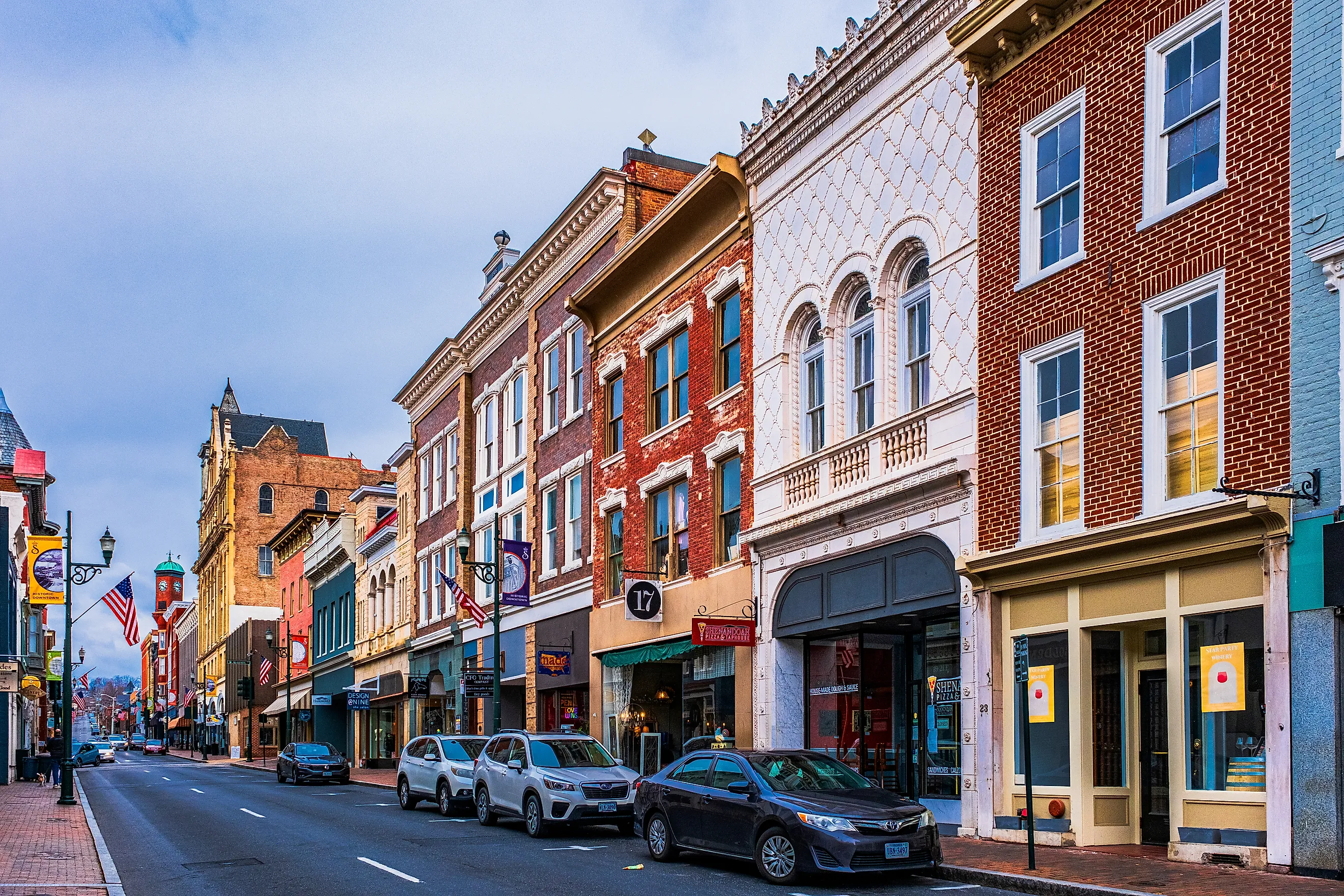
Beverley Street is worth the time either way. Booksellers, galleries, and cafes have moved into the restored brick storefronts, and the sidewalks are wide enough to drift between them without a plan. A block over, the R.R. Smith Center for History and Art has a handful of exhibits on the region's past, and down at the lower end of the street the old Wharf District still has its 19th-century warehouses, left over from the years when rail and freight ran through town. Few downtowns this size pack in as much.
Abingdon

In 1933, with the Depression at its worst, an out-of-work actor named Robert Porterfield came home to Abingdon and opened a theater where his neighbors could pay their way in with vegetables, ham, and the occasional pig. The Barter Theatre caught on, and it never closed. Today it is the longest-running professional Equity theater in the country, and it has held the title of official State Theatre of Virginia since 1946. Gregory Peck and Ernest Borgnine both worked the stage before Hollywood found them, and the resident company still puts up a full slate of shows on Main Street every year.
The 20 blocks around the theater keep that same unhurried rhythm. Along the brick walkways stand Federal-era buildings given over to restaurants, boutiques, and galleries, and up the hill the William King Museum of Art occupies a schoolhouse that dates to 1913. A little way off Main Street, the Abingdon Muster Grounds mark the spot where Revolutionary War militia gathered before their march to the Battle of Kings Mountain. Here the old and the everyday keep the same address, and nobody makes a fuss about it.
Lexington

Two colleges set the tempo in Lexington, and you feel it the moment you reach Main Street. Washington and Lee University and the Virginia Military Institute both sit at the edge of downtown, so students and faculty share the sidewalks with residents out running the day's errands. The red-brick storefronts around them go back to the late 1700s, when the town first grew up around its courthouse and its schools, and bookshops, boutiques, and restaurants keep those old rooms busy now.
The landmarks cluster close. The Stonewall Jackson House, the only home Thomas J. Jackson ever bought, opens for guided tours that cover the years he spent teaching at VMI before the Civil War. The Rockbridge County Courthouse holds the center of town, and at the south end of Main Street the columns of Washington and Lee's Colonnade rise at the top of a carefully kept lawn. For a place you can cross in a few minutes, Lexington carries a great deal of the Shenandoah Valley's history.
Culpeper

The railroad is why Culpeper exists, and Davis Street still shows it. Once the tracks arrived in the mid-1800s, farmers across central Virginia shipped their crops from here, and the brick commercial buildings that went up in the boom now hold restaurants, coffee shops, and specialty stores. The original depot still stands at the edge of downtown, the centerpiece of a Depot District that keeps the rail years in plain sight.
A few doors down, the Museum of Culpeper History is the place to learn the town's early settlement and its punishing Civil War years, when armies tramped across this ground again and again. Nearby, the restored State Theatre, a 1938 art-deco movie house, runs concerts, films, and live performances right through the year. Past and present trade the same storefronts here so easily you stop noticing the seam.
Bedford

No American town lost more on D-Day than Bedford. On the morning of June 6, 1944, 19 of its men were killed in the first minutes of the landing at Omaha Beach, with a 20th lost later that day, the highest known per-capita loss of any community in the country. That is why the National D-Day Memorial rises on a hill just outside downtown, its sculpted arch set above grounds laid out to follow the planning and the execution of the invasion. People come from across the country to stand there.
Downtown is where the town's longer life shows. Bedford grew fast once the railroad arrived in the late 1800s, and the restored storefronts on Main Street now belong to local restaurants, antique dealers, and specialty shops. The Bedford Museum and Genealogical Library keeps the deeper records for anyone who wants to trace the area back, and the old train depot still stands beside the line that first built the commercial district. It is a small place holding a piece of history far larger than itself.
Fredericksburg

Forty blocks of colonial and antebellum buildings still stand along Caroline Street and the blocks around it, which is a lot of intact history for a city you can cross on foot. Fredericksburg started as a colonial trading port on the Rappahannock, and George Washington grew up just across the river. The Rising Sun Tavern at 1304 Caroline dates to about 1760, built as a home by Washington's youngest brother Charles, and it opened as a tavern in 1792.
Costumed guides run the tavern now, along with the nearby Hugh Mercer Apothecary Shop, where the 18th-century medical tools are not for the squeamish. The James Monroe Museum holds the largest collection of the fifth president's papers and belongings anywhere. Four Civil War battlefields ring the city, but the walkable part is downtown, where the coffee shops and bookstores sit inside buildings older than the country.
Middleburg

Travelers have stopped at the Red Fox Inn on Washington Street since 1728, which makes it one of the oldest continuously operating inns in the country and the reason there is a Middleburg at all. The town grew up as a stagecoach halt on the road between the Shenandoah Valley and the young capital, with the inn planted at the crossroads. The same brick buildings now hold independent boutiques, cafes, and galleries, and old trees shade the sidewalks in front of them.
This is the middle of Virginia's horse country, and the evidence turns up everywhere you look. The National Sporting Library and Museum, a research collection and art gallery built around horse and field sports, stands a short block off the main strip. At the Middleburg Museum, the staff lay out the two-plus centuries of local history behind the storefronts. Come on a clear weekend, and the whole place runs at the pace of a good long lunch.
Smithfield

Smithfield is a ham town, and its people will be the first to tell you so. On Main Street, the Isle of Wight County Museum keeps the world's oldest edible cured ham, a Gwaltney ham first hung in 1902, and the staff throw it a birthday party every July. The other exhibits follow the colonial trade that raised Smithfield on the banks of the Pagan River, where merchants once loaded tobacco and, in time, the cured hams that carried the town's name around the world.
That river trade is what set the downtown in place, and the century-old storefronts along it now hold restaurants, bakeries, and antique shops. At the east end of Main Street, Windsor Castle Park opens onto trails and quiet stretches of the Pagan. Four miles south, the 17th-century St. Luke's Church, the oldest church of brick construction in British North America, is well worth the drive for anyone who has come this far with history on the mind.
Warrenton

Warrenton has been a county seat since the early 1800s, and you can still read that history in the streets. The courthouse and the trade of the surrounding farms gave Fauquier County's seat its shape, and the evidence is all along Main Street. Independent restaurants, boutiques, and coffee shops have taken over the restored storefronts, while the courthouse keeps its old place above the district.
The town's past is not hard to find. The Fauquier History Museum occupies the Old Jail, an 1808 building that locked up prisoners for more than 160 years, with exhibits on the county's Revolutionary and Civil War history. Set in the rolling Piedmont horse country, the brick blocks of Old Town make good company on a slow morning, the galleries and cafes gathered around the courthouse square.
Onancock

Onancock has worked as a port since 1680, when the colony chartered it as one of the Eastern Shore's official points of trade under King James. Market Street runs straight down to the water and stops at Onancock Wharf, where watermen still tie up their boats and the passenger ferry to Tangier Island casts off for a fishing community out in the Chesapeake you cannot reach any other way. Take away the water and there is no town.
The blocks that lead down to the wharf hold galleries, bookshops, and cafes, and the old port has grown a genuine arts streak because of them. Ker Place, a Federal-style mansion built between 1799 and 1806, houses the Eastern Shore of Virginia Historical Society and its collection. Local actors have staged live theater at the North Street Playhouse since the 1990s. This is a town that has always looked out toward the bay, and it looks out there still.
Cape Charles

A railroad executive drew Cape Charles onto blank farmland in 1884, laid a grid of streets named for fruits and Virginia statesmen, and pointed the whole town at a harbor where railcars rolled onto barges bound for Norfolk. Mason Avenue was the business strip then, and it still is. When the Chesapeake Bay Bridge-Tunnel opened in 1964, the ferries stopped and the town went quiet for decades, which is exactly why so much of the original streetscape survived.
Those old storefronts along Mason Avenue now hold galleries, restaurants, and a good bookstore or two, and the harbor still works a few blocks away. At the Cape Charles Museum, the staff keep the town's railroad and steamer history, right down to a diesel locomotive parked out front. Walk two blocks past the shops and the Chesapeake opens up at a wide public beach, which not many downtowns can say.
Orange

James Madison's country begins just outside Orange, and you feel that connection all through downtown. On Main Street, a short walk from the courthouse, the James Madison Museum of Orange County Heritage has exhibits on the fourth president as well as the farming and daily life of the surrounding county, while Madison's Montpelier estate sits a few minutes' drive away. After the railroad reached Orange in the 1800s, the town became a regional shipping point, and the brick buildings from those years still stand along the street.
Restaurants, antique dealers, and cafes fill those storefronts now. Above Main Street, give the Orange County Courthouse a second look for its architecture, the work of William B. Phillips, a builder who learned his trade under Thomas Jefferson at the University of Virginia. The old depot marks the rail line the town grew up along. A founding father left his fingerprints all over this county, and downtown is a fine place to go looking for them.
Twelve Streets, Still In Use

What links these towns is not the brick or the age but the fact that each one still does the work it was made for. Abingdon still fills a Depression-era theater every night of a run. Onancock still sends a boat across the bay to an island with no bridge. Bedford still keeps watch over the men it lost on a beach in France. Cape Charles still runs Mason Avenue straight down to the harbor it was built to serve. Some grew up around a courthouse and some around a rail line, one around a wharf and one around a cured ham, and every last one of them kept the thing that mattered close by. That is the real draw here: not a past under glass, but a present still running, and all of it within a few blocks you can cross on your own two feet.