Freshwater Crocodile
Freshwater crocodiles are widespread across Australia's north, where they live in rivers, wetlands, billabongs, and other freshwater inland waterways. The species is smaller and more slender than its saltwater relative, with snouts perfectly adapted for gripping a variety of prey, namely fish. But despite their still intimidating reptilian appearance and predatory habits, they are generally timid and avoid confrontation. Across their range, they also help regulate freshwater food webs by keeping fish, crustaceans, and other aquatic animal populations in check.
Their life cycle is deeply tied to the seasons, with nesting concentrated along sandy banks during dry times and young emerging after weeks of incubation, dispersing and flourishing when water levels rise as rains eventually become more consistent. Overall, while often overlooked compared to the larger saltwater crocodiles, freshwater crocs remain a vital presence in Australia's wildernesses and a key component of the continent's sometimes delicate ecosystems.
Taxonomic Classification

Freshwater crocodiles belong to the family Crocodylidae, the group that contains what are known as "true crocodiles" (unlike the broader order Crocodylia, which also includes alligators, caimans, and gharials, species that share a common evolutionary ancestry but belong to different families).
They were first officially described in 1873 and are endemic to northern Australia. Their scientific name is Crocodylus johnstoni, although older scientific literature sometimes used Crocodylus johnsoni due to a historical spelling error. Still belonging within the broader order Crocodylia, freshwater crocodiles are closely related to saltwater crocodiles (Crocodylus porosus) and several other crocodile species distributed across Africa, Asia, and the Americas.
Physical Description

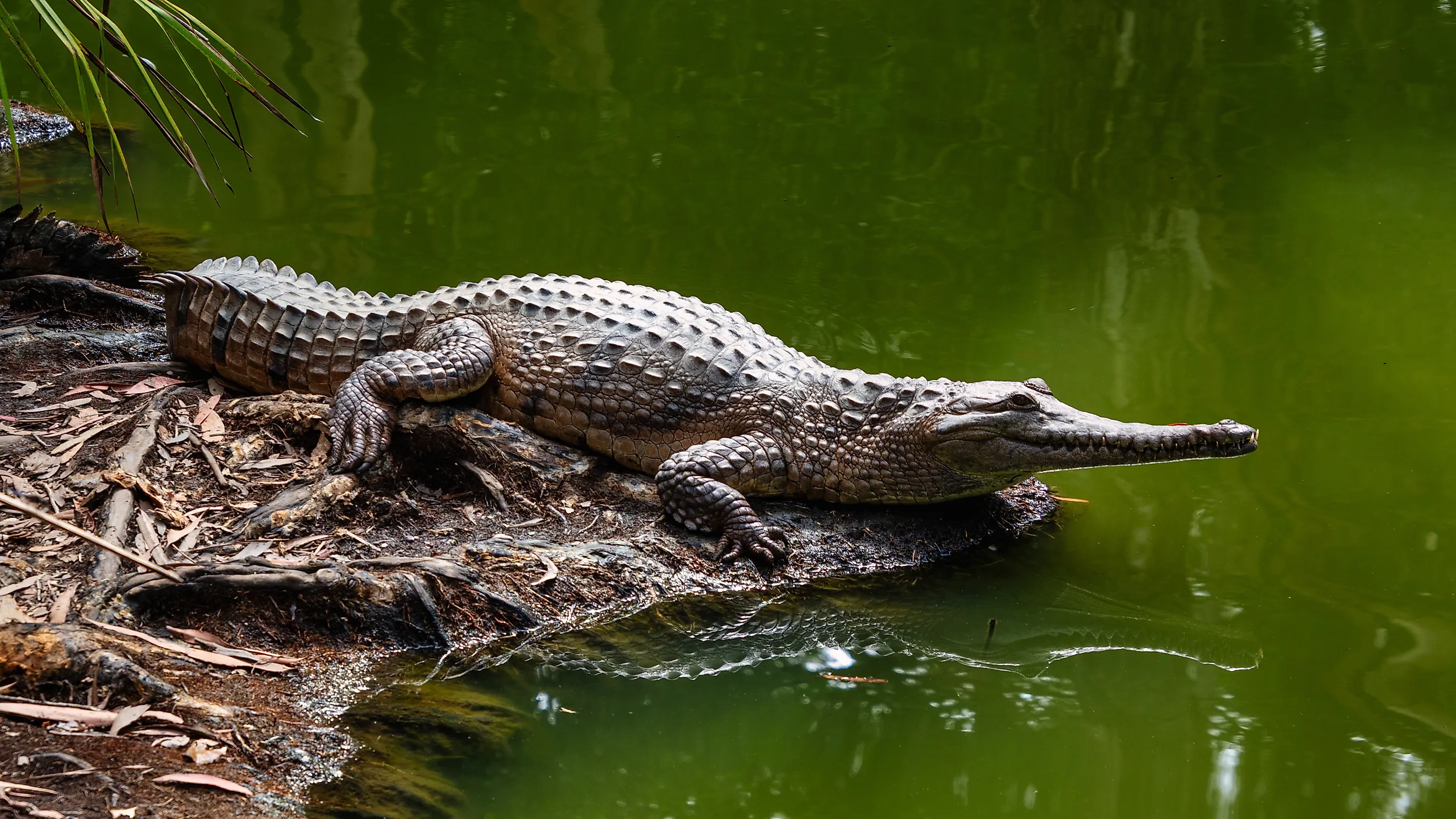
These crocodiles are relatively slender, distinguished by their narrow, elongated snouts and streamlined bodies. Adult males typically reach lengths of around 7 to 10 feet (2.1 to 3 meters), or over in some cases. Females are considerably smaller, often measuring less than 7 feet. As mentioned, they are much less sizable than saltwater crocodiles, which can reach lengths of over 17 feet (5.2 meters).
Their most distinctive feature is their notably narrow snout, which bears numerous sharp, needle-like teeth designed to grip slippery prey such as fish. Freshwater crocodiles also possess powerful tails that aid propulsion through water and muscular limbs that allow efficient movement on land. Spending much of their life in the water, their eyes, ears, and nostrils are positioned on top of the head, enabling them to remain largely submerged while observing their surroundings.
Coloration generally ranges from light brown to olive-gray, with darker bands across the body and tail, and heavily armored scales forming protective rows of bony plates, known as osteoderms, along their backs. Juveniles display more pronounced markings, which help provide extra camouflage among submerged vegetation and riverbank habitats.
Range And Habitat

This reptile is native to Australia, occurring across large portions of Western Australia, the Northern Territory, and Queensland. Their range more specifically extends from the Kimberley region in the west to the Gulf of Carpentaria and the Cape York Peninsula in the east.
Whereas saltwater crocodiles regularly inhabit coastal waters and estuaries, freshwater crocodiles are, of course, primarily associated with inland freshwater systems. Remote, rocky river networks are particularly important because they provide necessary basking sites, nesting areas, and refuge from larger crocodilians.
Many populations inhabit waterways that also experience dramatic seasonal fluctuations, with heavy rains during the wet season followed by prolonged dry periods. During such drought conditions, individuals often concentrate in shrinking pools that continue to provide food and shelter but may increase territoriality. Although they strongly prefer freshwater environments, freshwater crocodiles can actually tolerate brackish water and occasionally move through estuaries to reach new habitats. This adaptability has allowed the species to remain widespread across much of Australia's distinctively tropical northern half.
Behavior

Freshwater crocs are generally shy, cautious reptiles that prefer to avoid confrontation. When disturbed, they often slip quietly into the water and swim away rather than stand their ground. This behavior contrasts with the more territorial and aggressive tendencies associated with larger crocodile species, particularly saltwater crocodiles. However, they are still primarily ambush predators, spending long periods motionless near the water’s surface before striking at passing prey or threats when cornered.
Communication includes various body postures, vocalizations, and water movements used to signal dominance, courtship, or potential threats. Individuals establish home ranges and display heightened territorial behavior during the breeding season, particularly males competing for access to females. Freshwater crocodiles are also ectothermic and rely on external heat sources to regulate body temperature (also known as being "cold-blooded"). With that, they frequently bask on riverbanks, rocks, and sandbars before returning to the water to cool down and/or feed.
Diet

These are opportunistic carnivores that eat a wide variety of aquatic and terrestrial prey. As said before, their narrow snouts and sharp teeth are particularly well-suited for catching fish, which form a significant portion of the adult diet, while they also consume crustaceans, frogs, waterbirds, reptiles, and small mammals when the opportunity arises. On the other hand, their slender jaws are less suited to handling large mammals than those of larger crocodile species, reflecting their specialization as hunters within smaller, more confined aquatic environments.
Diet varies with age and size, too. Hatchlings and juveniles primarily feed on insects, spiders, small crustaceans, and other invertebrates. As they grow, they gradually shift toward larger prey.
Reproduction

Freshwater crocodiles breed during the dry season in the Southern Hemisphere. Courtship and mating generally occur between July and September in Australia. Females construct nests by digging burrows into sandy riverbanks and laying clutches that generally contain between 4 and 20 eggs. Incubation then lasts around 65 to 95 days, depending on environmental conditions and temperature. Nest sites are also carefully selected above normal water levels to reduce the risk of flooding.
After hatching, young crocodiles use vocal calls to communicate with their mother and siblings. But unlike some other crocodilian species, maternal care is relatively limited, though females may remain near the nest and assist hatchlings as they emerge. Juvenile mortality is quite high, too, with birds, fish, reptiles, and even other, larger crocodiles posing significant threats. Because of that, freshwater crocs are fairly prolific breeders, with females often laying hundreds of eggs throughout their lifetime.
Threats

Populations are generally considered stable across much of their native northern Australian range, but as with most flora and fauna, they still face several natural and human-related threats. For one, habitat degradation is a significant concern in some areas, particularly where water extraction, land clearing, livestock activity, and altered river systems near towns or cities can affect the overall stability of freshwater habitats. Illegal killing and accidental entanglement in fishing equipment occur occasionally, too, although they are not considered major population-level threats.
On the natural side of things, eggs and hatchlings are especially vulnerable to predation. Monitor lizards, birds, fish, and larger crocodiles can destroy nests or prey upon young crocodiles before they reach maturity. Moreover, some introduced species present additional challenges. For example, the invasive cane toad is toxic when consumed, posing a risk to unaware juvenile crocodiles that mistake it for a tasty treat.
Also, flooding during the wet season has been observed to inundate nests, reducing hatching success. Climate change may create future pressures like this by altering rainfall patterns, river flows, and the availability of suitable nesting habitat.
A Keystone Species in Australia's Waterways
Playing a highly important ecological role in Australia's freshwater ecosystems, freshwater crocodiles are vital to the life cycles around them. As predators, they help regulate populations of fish, birds, small mammals, amphibians, and crustaceans, contributing to a balanced food web.
Their presence is considered an indicator of healthy river and wetland systems, since they depend on relatively intact aquatic habitats to survive and reproduce, and by helping maintain the health of these environments, freshwater crocodiles indirectly support the many other species that share their range. Freshwater crocs also contribute to scientific understanding of crocodilian evolution. Researchers have extensively studied the species over the last couple of centuries to gain insights into topics such as predator-prey relationships, reptilian physiology, and the proper management of wetland ecosystems.
Beyond their ecological value, freshwater crocodiles hold cultural significance for many Indigenous Australian communities, where they commonly feature in traditional stories and ways of life. They are also an important part of Australia's natural heritage, attracting wildlife enthusiasts from around the world to see these impressive creatures up close.