Sphinx in Romania’s Bucegi Mountains
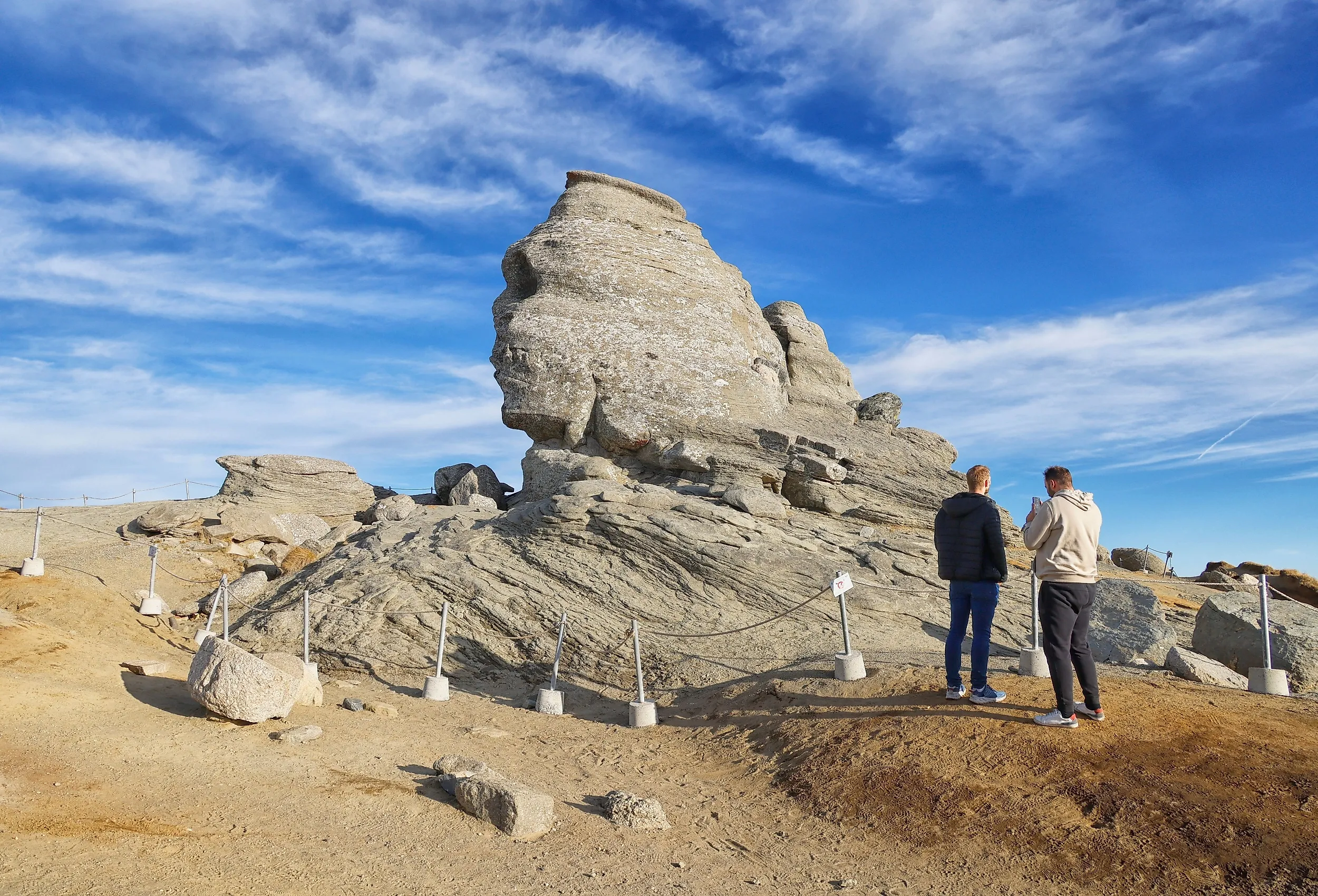
Fixed atop Romania's sheer Bucegi Mountains, the anomalous rock formation known as "The Sphinx" (Sfinxul) stands guard over the touristic town below. So-called because of its resemblance to the icon of Giza, this photogenic feature is joined by additional enigmas known as "The Old Women" (Babele), a record-setting memorial cross, and the various marked trails that connect this slice of the Southern Carpathians. Armed with a windbreaker, a few hundred Lei, and a running belt stuffed with Snickers bars, I boarded a train out of Bucharest, transferred to a panoramic gondola, pranced about the alpine, got to know the base town of Bușteni, and doubled back to the capital before day's end. Join me for this vicarious and easy-to-mimic day-trip to Romania's mysterious mountaintop Sphinx.
Begin in Bucharest

The Bucharest North (Gara de Nord) train station is your ticket to a string of Central Romanian mountain towns. If you want to go skiing in Sinaia, hit the trails in Predeal, explore the Transilvanian citadel of Brașov, or, in this case, visit the Sphinx above Bușteni, then pretty much every stop along this northbound railway will be of value.
Since both national and private trains operate in Romania, buying a ticket can be a bit confusing. English is spoken only sporadically, and if so, through those muffled ticketbooth speakers. You might wait in a ten-deep line only to be pointed toward the private window when your turn arrives. With that second queue concluded, you could again be denied if the next train is another private company, one that only sells tickets on board. To cut through all of this, and to better serve spontaneity, I have taken to simply scanning the departures board for a pertinent train (anything destined for Brașov will stop in Bușteni) and waiting for the attendant to come by a few stops down the line (cash and card are both accepted).

The only drawback to this board-and-wait strategy is the uncertainty of seats. Romanians love hiking, and since this was one of the last fair-weather weekends of the year, the down-jacket-wearing, trekking-pole-wielding, Quecha-backpack-slinging army was out in full force. Thus, the first train I got on filled up so intensely that I decided to jump off and pick one that left half an hour later. On the bright side, that gave me enough time to cram a coffee and a covrig (i.e., a pretzel)—a ubiquitous specialty in these parts. The next train was also filled to near capacity, but I managed to secure a spot in the row of non-reserved seats.
Babele Cable Car

The train from Bucharest to Bușteni takes about an hour and forty minutes, and in the case of my private train, costs 50 Lei ($11 USD). Thanks to the emergence of the Southern Carpathians' initially verdant, then snowy peaks, the second half of this ride is exceptionally scenic, so try to snag a seat on the left-hand side.
Hopping off at the rustic, Soviet-esque station, my next task was to walk through the just-awakening highway town to the cable car (Telecabină Bușteni-Babele), which begins behind Hotel Silva. Climbing to over 7,500 feet-above-sea-level (2,290m), this 12(ish) minute ride is as steep physically as it has become financially. A round-trip ticket now costs 200 Lei, which converts to approximately $45 USD. Of course, there is always the option to hike up, but Bușteni has a bit of a bear reputation (in fact, most of Romania does).
A Note About Bears:

Romania's 2025 brown bear population was estimated to be around 13,000. That's more than double what authorities previously thought, and significantly more than any other country in Europe (save for Russia). As a Canadian with thousands of miles logged in the Rocky Mountains, I'm no stranger to ursines, but the high density here, combined with the habituation that occurs around tourist towns, makes for an unusually dangerous scenario.
During my previous trip to Bușteni, I saw a hefty brown bear directly on the trail beneath the gondola. And just last year, a 19-year-old hiker was mauled to death on this very trail system (making Romania's 20-year bear report: 26 killed, 274 injured). As an avid trail runner, one of the reasons I splurge on the Bușteni cable car is that it allows me to get safely above the treeline and then enjoy the network of signed and well-trodden trails atop the Bucegi Plateau.
The Old Women

From Babele Station, the first personified landmarks to appear are The Old Women. Depending on who you ask, these hunched, sometimes mushroom-like stone pillars are either the result of irregular erosion or ancient humans frozen in time by the mountain's mystic forces. As with all of the unique formations spread across this plateau, pictures are welcomed, but touching is discouraged. In fact, some of the more impressive monuments are roped off.
In the cable car chalet and at multiple locations near Babele, you may notice signs requesting a 10 Lei admission fee for Bucegi Natural Park (Parcul Natural Bucegi). There's a QR Code to scan, but when I asked one of the employees about it, he (through pantomime and a few words of English) explained that since I paid for the ride up, the extra admission wasn't necessary. With that said, this sub-three-dollar voluntary admission is (upon further digging) valid for three months and helps conserve the land, maintain trails, etc.
The Sphinx

Just a few minutes beyond Babble, the Sphinx shows its face…well, from the west, anyway. Looking head-on, or from the opposite side, it's more of a big cool rock. But as the morning shadow starts to lift, a distinct, eight-meter-high, twelve-meter-wide humanoid visage really does emerge. There weren't too many people up there at 9 a.m., but after I returned from my alpine run, the lunch crowd had amassed.
The Sphinx is popular among Romanians not only because of its pareidolia-inducing effect, but also because, like The Old Woman, local lore has flourished since it was first photographed and named back in the early 1900s. Stories of Dacian religious practices, energy corridors, aliens, and mystical healing properties (my girlfriend's aunt specifically collects rocks from up there for this last reason) all enhance The Sphinx's profile.
Caraiman Cross

Those wading deeper into this expressive plateau will be well-served by Bucegi Natural Park's marked hiking trails. There are a host of color-coded posts indicating direction and approximate walking times. For instance, I took the red trail to Caraiman Cross (named after the mountain it tops), which takes an hour (one way) to hike or about 20 minutes to run.

Built between 1926 and 1928, "Heroes' Cross," also known by this name, commemorates Romanian soldiers who fought and died during World War I. Standing nearly 40 meters high (giving it the Guinness World Record for the tallest summit cross), its construction required a heroic effort in and of itself. Nowadays, the Caraiman Cross clearly maintains religious significance (I saw several people praying on a ridge above), but for casual visitors, its stone platform also provides an arresting bird's-eye view of Bușteni.
Caraiman Monastery

Speaking of Caraiman and Christianity, back in Bușteni, the enormous Caraiman Monastery (Mănăstirea Caraiman) is as much a monument to its namesake mountain as it is the Orthodox faith. Though the work of man pales in comparison to the tectonic forces that raised the massive (or should I say massif) backdrop, visiting the monastery and its corresponding garden is a worthwhile cultural experience and a lovely add-on after a full morning in the mountains.

To get there, take the cable car back down, and then look for the signed forest trail on your right as you descend toward town (if you reach the grocery store, you've gone too far). From there, ascend the staircase through the woods, then veer right on the top road (Strada Palanca). To be clear, you can drive up the monastery, just as you can to Bușteni and the Bucegi Plateau, but today I'm highlighting the more adventurous and eco-friendly approach.
Bum Around Bușteni

Before boarding your return train, take some time to peruse Bușteni proper. The residential back roads of this spritely mountain town preserve a traditional aesthetic, while its highwayside shops, restaurants, and Clătite huts (i.e., Romanian crepes) service the regular influx of sightseers. Having worked up quite an appetite, I took a seat at Bistro Floare de Iris - an alleyside joint in view of Caraiman's summit that has the local bear-themed beer, Ursus, on tap.
There And Back Again

With a full belly, light buzz, and sweat-stained apparel, I was ready to get back to Bucharest. As it turns out, so was everyone else who had come up that morning, and by the looks of things, a good deal of the Friday overnight crowd. Defying basic physics, we all crammed onto one of those three-car private trains, but this time, there was no hope of getting a seat. Instead, I balled myself into one of those luggage cutouts and used the dusk window scenery as a distraction from my escalating back spasms. Thankfully, after a few stops, a seat did free up.
And just like that, some 12 hours after leaving my accommodation, I stepped into a hot shower and joyously recounted the day's doings. Mental images of enigmatic stones, mountaintop trails, arresting panoramas, quirky trains, and small-town culture all affirmed that another epic adventure was in the books.