This Florida Downtown Is Made For Strolling
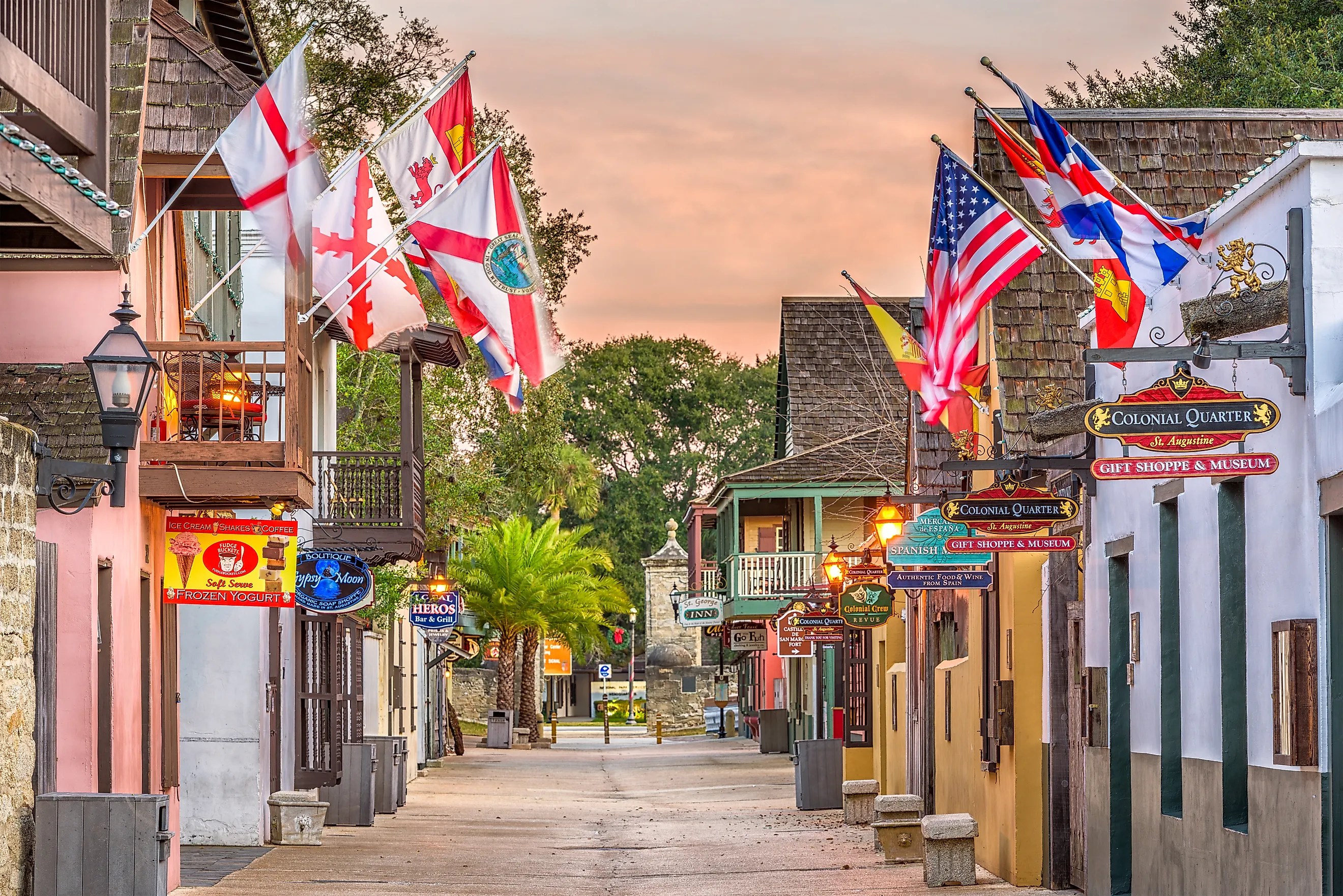
Not only is St. Augustine’s historic downtown the oldest in America, but it’s also immensely walkable. Established by Spain in 1565, when you go for a stroll here, it’s remarkable to think that you’re treading the very same narrow streets that Conquistadors, explorers, and Gilded Age elites all trod before you.
Located on Florida’s Atlantic coast, St. Augustine is very much the gold standard for walkable downtowns in the United States. Compact, with centuries-old city walls and brick-paved streets, its pedestrian-only downtown district reveals architectural splendor at every turn. Wander this 50-block historic downtown, and you’ll see the influences of the town’s more than 200 years as the capital of Spanish Florida. You’ll also see evidence of British rule here during the Revolutionary War era, followed by classic American designs once Florida achieved statehood in 1845.
Park and Walk to Castillo de San Marcos

Getting to St. Augustine’s historic downtown core is a breeze. The best option is to park in one of the handy public parking spots just outside downtown. Further from the central area, parking at the Old Jail Museum is free, though spaces are limited, so you’ll need to get there early. From here, you’ll need to hop aboard one of the regular Old Town Trolleys, which can deposit you right downtown in minutes.
Better still, park at the massive Historic Downtown Parking Facility. Not only is it just a pleasant two-minute stroll from the Old City Gates where downtown begins, but it’s also next to the St. Augustine and St. Johns County Visitor Information Center. Here you can get tips and tactics, free maps, and talk to local staff who know the area well. There are also displays about Pedro Menéndez de Avilés and the first Spaniards to settle here, and the center is also a stop on the Old Town Trolley route.

It’s a great place to park for its proximity to the Castillo de San Marcos. Strategically set overlooking the Matanzas River, this impressive structure is the oldest masonry fortification in the continental United States. Completed in 1695, it withstood a two-month British siege in 1702 and again for a month in 1740, and has never fallen to an enemy.
Now part of the National Park Service and Downtown St. Augustine, you can explore rooms that once stored munitions, food, and people during these sieges. Be sure to also climb to the gun deck for superb views of Matanzas Bay.
St. George Street and the Historic Downtown Quarter

The heart of pedestrian St. Augustine begins at the Old City Gate. From the fort, use the crosswalk opposite the St. Augustine Pirate & Treasure Museum and carry on along Fort Alley to St. George Street. With your back to the Colonial Oak Music Park amphitheater, you’ll see the Old City Gate to your right. Grab a photo of this and pop into the Oldest Wooden Schoolhouse.
Adding to the overall experience is the knowledge that St. George Street dates all the way back to the 1700s. Stretching from the Old City Gate all the way to the Plaza de la Constitución, you’ll pass a mix of authentic colonial structures and faithful reconstructions built upon original foundations.

The food scene on St. George Street is also worth exploring. Highlights include Columbia Restaurant, part of the Tampa-based chain founded in 1905 that serves traditional Spanish and Cuban dishes (try their famous Roast Pork A la Cubana). And if you need to whet your whistle, the Prohibition Kitchen gastropub can help.
Cross Over to Aviles Street

You’ll enjoy an equally interesting but quieter historic downtown experience along Aviles Street. Accessible by cutting through Plaza de la Constitución and passing through an archway off King Street, this brick-paved lane has served as the city's arts district since the 1930s.
Today, the street hosts several art shops, including the Plum Gallery and D.R. Abbott Gallery, as well as several attractions. The Spanish Military Hospital Museum provides fascinating 40-minute tours detailing the building’s role along with 18th-century medical practices, while the Ximenez-Fatio House Museum is set in a well-preserved former home built in 1798.

Several cafés feature outdoor tables along this car-free street, adding to a sense that you could well be sitting in Europe rather than Florida. You can't go wrong with the super-friendly Forgotten Tonic, a classy bistro with tasty bites and great cocktails.
Flagler College and America’s Gilded Age

The transformation of St. Augustine from sleepy colonial relic to Gilded Age resort town began when Henry Flagler brought his railway here in the 1880s. His first and grandest project was the opulent Hotel Ponce de León. Constructed between 1885 and 1887, the building was the first major poured-in-place concrete structure in the country and used local coquina stone as aggregate.
Flagler hired the same firm that would later design the New York Public Library and the Senate Office Buildings flanking the U.S. Capitol. Today, this beautiful building is the centerpiece of Flagler College and is something visitors can experience through Historic Tours of Flagler College.

Just a short walk from the Cathedral Basilica of St. Augustine, these student-led tours visit the magnificent courtyard, the Grand Lobby, and the former dining room with its Tiffany-stained glass windows. You’ll also learn about the hotel’s notable guests, including Presidents Grover Cleveland, Theodore Roosevelt, and Warren G. Harding, as well as John D. Rockefeller Jr. and Mark Twain. If you can’t make a tour work for you, the courtyard and rotunda are open to the public during regular hours.
The Lightner Museum

Head across King Street from Flagler College, and you’ll see the equally elegant Lightner Museum, once the Hotel Alcazar. This magnificent structure was built by Flagler in 1887 in a Spanish Renaissance Revival style that fits in well. You can still see what was once the world’s largest indoor swimming pool, now used as restaurant seating, steam baths, a gymnasium, tennis courts, and even a bowling alley.
Today, its collections feature everything from Tiffany glass and mechanical musical instruments to cut glass and curiosities, including a shrunken head and an Egyptian mummy. Be sure to spend time in the spectacular courtyard with its koi pond and stone arch bridge.

Round off your walking tour with a visit to the splendid Casa Monica Resort & Spa. Built in 1888 and located directly across from the museum and college, it even boasts a massive four-story penthouse that offers panoramic views of Matanzas Bay. And if you can’t swing that opulent accommodation, you can at least enjoy its Cordova Coastal Chophouse & Bar, which is open to the public.
Another good option if you do decide to stay in St. Augustine’s historic downtown is the St. Francis Inn. Built in 1791 and handily located on St. George Street, this boutique-style B&B features a cozy walled courtyard garden and complimentary bicycles, all within easy reach of the north end of pedestrian St. George Street.
More Historic Downtowns in Florida

St. Augustine isn't alone when it comes to walkable Florida downtowns! Like St. Augustine, Fernandina Beach is fun to explore on foot. Located less than two hours to the north along the iconic A1A Scenic & Historic Coastal Byway, historic downtown Fernandina Beach features many Victorian-era buildings along its main street. Book a stay at the lovely Blue Heron Inn, a beautifully restored 1904 B&B, and you can walk to downtown fixtures like The Palace Saloon, Florida's oldest continuously operating bar, which has been serving drinks since 1903.

Located at the opposite end of the AIA highway, 550 miles south of Amelia Island, Key West is the southernmost town in the contiguous U.S., and it’s entirely different architecturally from its Florida peers. Here, tropical Caribbean and colonial styles line Key West’s main drag, Duval Street, running northwards from the Gulf of Mexico to the Atlantic Ocean. Stroll along this mile-long road, and you’ll pass Bahamian and Spanish-influenced Victorian mansions, wood-clad homes, and elegant red-brick buildings that wouldn’t look out of place in the northern states.
Mallory Square is a must-visit. Located at the top of Duval Street, here you can participate in the nightly Sunset Celebration, a tradition dating to the 1960s when locals began gathering to applaud the sun as it sank below the Gulf horizon. Today, you’ll find more tourists than locals, as well as street performers, food vendors, and artisans.
A Downtown Built for Discovery
St. Augustine certainly deserves its reputation as Florida’s most walkable downtown. Nowhere else in America can you wander through nearly five centuries of fascinating history, past structures built by two of the largest empires the world has ever known. For those willing to trade their car keys for a pair of comfy walking shoes, St. Augustine is undoubtedly Florida’s most fascinating place for an urban stroll. So grab your sandals and your camera, and take a stroll through history in this captivating town!