The Largest Churches In Europe
Europe has been continuously building large church buildings for roughly 1,700 years, and the residue of that effort dominates almost every old European city skyline. Christianity remains the largest religious affiliation across the continent (about 71 per cent of Western Europeans still identify as Christian, per the Pew Research Center's 2018 survey, though regular attendance has fallen substantially), and the historical building stock reflects centuries when Catholic, Orthodox, Lutheran, Anglican, and Reformed congregations all competed to build the most ambitious houses of worship they could afford. The fifteen largest churches in Europe by interior floor area, listed below, span from a 4th-century Roman basilica rebuilt after fire damage to a circular Portuguese pilgrimage church completed in 2007. Together they range from 7,914 to 15,160 square metres and represent a thousand years of architectural development.
1. St. Peter's Basilica - 15,160 m² (Vatican City)

St. Peter's Basilica is the largest church in Europe and the largest in the world by interior floor area at approximately 15,160 square metres, with an interior volume of about 5 million cubic metres. It is the centre of the Roman Catholic Church and stands on Vatican Hill in the independent Vatican City state, traditionally regarded as the burial site of Saint Peter, the first Pope. Construction on the present building began in 1506 under Pope Julius II, replacing the original 4th-century basilica built by the Emperor Constantine, and finished in 1626 under Pope Urban VIII, who consecrated it on November 18 of that year.
Five successive chief architects shaped the design: Donato Bramante began with a Greek-cross plan in 1506, Raphael revised it toward a Latin cross after Bramante's death in 1514, Michelangelo Buonarroti returned to the Greek cross in 1547 and designed the dome (rising 136 metres above the floor, the tallest in the world for centuries), Carlo Maderno extended the nave back to a Latin cross between 1607 and 1614, and Gian Lorenzo Bernini designed the surrounding St. Peter's Square between 1656 and 1667. Vatican City, including the basilica, was inscribed as a UNESCO World Heritage Site in 1984.
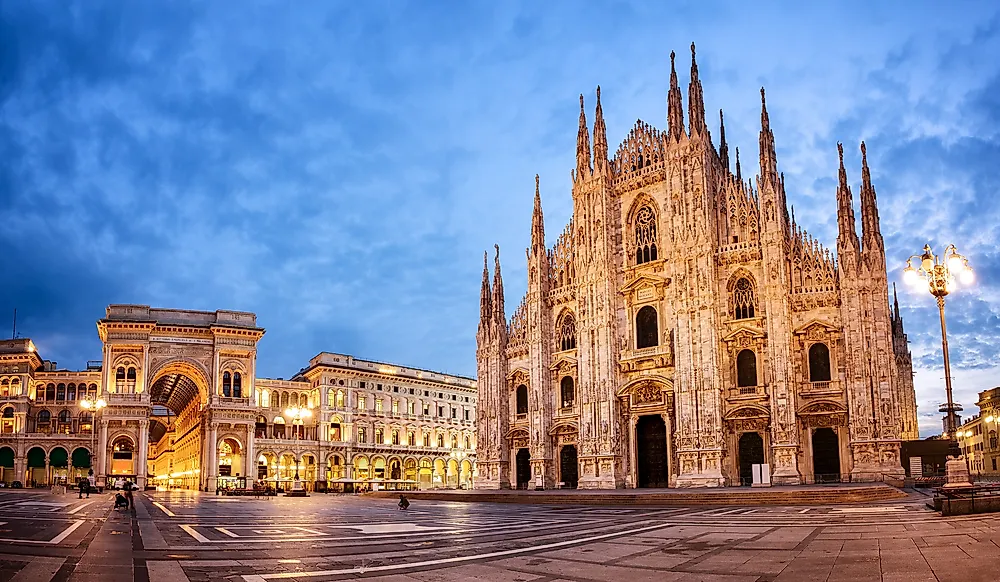
2. Milan Cathedral - 11,700 m² (Italy)

The Cathedral of the Nativity of Saint Mary (Duomo di Milano) is the seat of the Archdiocese of Milan and covers approximately 11,700 square metres of interior space, making it the largest church in Italy (Saint Peter's being technically in the Vatican). Construction began in 1386 under Archbishop Antonio da Saluzzo and continued for nearly six centuries, with the main structural work completed by 1813 and the final architectural details (including some statues on the spires) only finished in 1965. It is one of the most extreme examples of Italian Gothic architecture, with 135 spires, 3,400 statues, and an exterior almost entirely clad in pink-white Candoglia marble brought down by purpose-built canals from quarries in the Lake Maggiore region.
The cathedral's most famous feature is the Madonnina, a 4.16-metre gilded copper statue of the Virgin Mary installed atop the highest spire in 1774. By long-standing local tradition, no building in central Milan should rise above her; the city's mid-20th-century skyscrapers all carry small replicas of the Madonnina to honour the convention. The Duomo can accommodate up to 40,000 worshippers, more than the population of the city when construction began.
3. Seville Cathedral - 11,520 m² (Spain)

The Cathedral of Saint Mary of the See in Seville is the largest Gothic cathedral in the world and the third-largest church in Europe at approximately 11,520 square metres. It was built between 1402 and 1506 on the site of a 12th-century Almohad mosque, of which the 105-metre Giralda bell tower (originally the mosque's minaret) and the orange-tree-filled Patio de los Naranjos courtyard survive. The cathedral's planners reportedly told their architects "let us build a church so beautiful and so great that those who see it finished will think we are mad," and they delivered on the brief. The interior holds a 23-metre-tall altarpiece, the Capilla Mayor, which contains 45 carved scenes from the lives of Christ and the Virgin and reportedly used more than three tonnes of gold leaf.
The cathedral houses a tomb attributed to Christopher Columbus, whose remains were repatriated from Havana in 1899 (though Santo Domingo in the Dominican Republic also claims to hold his bones, with DNA analysis from 2006 confirming at least some of the Seville remains are his). Seville Cathedral, the adjacent Alcázar, and the Archivo General de Indias were jointly inscribed as a UNESCO World Heritage Site in 1987.
4. Basilica of Our Lady of Licheń - 10,090 m² (Poland)

The Basilica of Our Lady of Licheń is the largest church in Poland and one of the newest churches in Europe's top tier, with an interior area of approximately 10,090 square metres. It was built between 1994 and 2004 in the village of Licheń Stary in the Konin district of central Poland to accommodate the millions of pilgrims drawn to the Marian shrine that grew up around a 19th-century apparition site. The basilica was funded entirely by pilgrim donations rather than diocesan or state funds and was consecrated on June 12, 2004.
The building's design draws on classical, Renaissance, and Baroque precedents rather than the contemporary architecture more typical of late-20th-century European churches. Its 141.5-metre bell tower is the third-tallest in the world, the dome rises 103 metres, and the bell ("Maryja Bogurodzica") weighs 14,777 kilograms, making it the largest bell in Poland. Pope John Paul II visited the site in 1999 to bless the not-yet-completed structure, and the basilica has become one of the most-visited Catholic pilgrimage sites in Eastern Europe.
5. Abbey of Santa Giustina - 9,717 m² (Italy)

The Abbey of Santa Giustina in Padua is a Benedictine monastery and basilica with origins reaching back to a 6th-century memorial chapel dedicated to Saint Justina, an early Christian virgin martyr executed in 304 AD under the Emperor Diocletian. The current building, covering about 9,717 square metres, was constructed between 1521 and 1606 to designs by Andrea Briosco and Andrea Moroni, replacing earlier medieval structures damaged by earthquakes. The Latin-cross plan is crowned by eight cupolas (a central dome flanked by smaller domes over the transept arms and the side chapels), giving the basilica a recognisable silhouette in the Padua skyline.
Santa Giustina holds relics traditionally attributed to several major early Christian figures, including Saint Luke the Evangelist (transferred to Padua from Constantinople in the 11th century), Saint Matthias, and Saint Prosdocimus (first bishop of Padua). Paolo Veronese's "Martyrdom of Saint Justina" (1575) hangs above the main altar. The abbey is also one of the major centres of Benedictine monastic scholarship; the Congregation of Santa Giustina, established in 1419, became the model for centralised Benedictine governance across early modern Europe.
6. Liverpool Cathedral - 9,687 m² (United Kingdom)

The Cathedral Church of Christ in Liverpool is the largest church building in the United Kingdom (about 9,687 square metres of floor area) and the largest Anglican cathedral in the world. It was designed by Giles Gilbert Scott in 1903, when he was a 22-year-old architect with no completed buildings to his name, after winning an open competition against more than a hundred established candidates. Construction began in 1904 and continued for 74 years through both World Wars and the postwar British economic crisis, with the cathedral finally completed in 1978. Queen Elizabeth II attended the formal completion ceremony.
The total length of 189 metres makes Liverpool Cathedral one of the longest churches in the world, and its 100.8-metre central tower contains the highest and heaviest peal of ringing bells anywhere on Earth (a thirteen-bell peal whose tenor weighs 4.2 tonnes). The cathedral is also notable for the Great George organ, built by Henry Willis & Sons between 1912 and 1926, which has 10,268 pipes and was the largest pipe organ in the world for several decades. Despite its scale, the cathedral was funded almost entirely by Liverpool merchants and shipping families rather than by central church or state resources.
7. Church of the Most Holy Trinity - 8,700 m² (Portugal)

The Church of the Most Holy Trinity stands at the Sanctuary of Fátima in the Portuguese town of Cova da Iria, in the Santarém District. The building was constructed between 2004 and 2007 to accommodate the growing crowds (sometimes hundreds of thousands at a time) who visit the Marian shrine commemorating the 1917 Fátima apparitions, in which three local shepherd children reported seeing the Virgin Mary on six occasions between May and October. The Greek architect Alexandros N. Tombazis designed the circular structure, which seats 8,633 worshippers and covers an interior of 8,700 square metres.
The building was deliberately conceived to contrast with the older neo-Baroque basilica across the sanctuary's main esplanade. It uses simple white stone facing on a low circular plan with a 95-metre crucifix outside the main entrance, designed by German sculptor Robert Schad. The church received the Outstanding Structure Award from the International Association for Bridge and Structural Engineering in 2009 for engineering achievements including its 80-metre clear-span concrete roof. Pope Benedict XVI consecrated it in October 2007.
8. Basilica of Saint Paul Outside the Walls - 8,515 m² (Italy)

The Basilica of Saint Paul Outside the Walls (San Paolo fuori le Mura) is one of the four major papal basilicas of Rome, along with St. Peter's, St. John Lateran, and St. Mary Major. The original 4th-century basilica was commissioned by the Emperor Constantine in 324 AD over the traditional burial site of Saint Paul the Apostle, executed under Nero around AD 67. The basilica was largely destroyed by a catastrophic fire on July 15, 1823, and was rebuilt over the following 31 years by architects Pasquale Belli and Luigi Poletti, reconsecrated by Pope Pius IX in 1854. The reconstruction preserved the original 5th-century plan including the long nave flanked by 80 monolithic granite columns.
The basilica is administered by the Holy See under the 1929 Lateran Treaty and holds extraterritorial status despite sitting two kilometres outside Vatican City along the ancient Via Ostiense. Its most distinctive feature is the unbroken series of medallion portraits of every Pope, running around the entire interior at clerestory height (Saint Peter at one end, the current pontiff at the other); tradition (probably without basis) holds that when the medallions run out, the world will end. The 19th-century cloister, with its twisted Cosmatesque columns, is one of the few major elements that survived the 1823 fire.
9. Basilica-Cathedral of Our Lady of the Pillar - 8,318 m² (Spain)

The Basilica-Cathedral of Our Lady of the Pillar in Zaragoza is one of two cathedrals serving the Archdiocese of Zaragoza (the other being La Seo, a few hundred metres away), and the larger of the pair at approximately 8,318 square metres. The basilica was built in stages between 1681 and 1872 in the Spanish Baroque style, with the four octagonal corner towers and the central dome completed in the early 20th century. The basilica's name refers to the Pillar of the Virgin Mary, a pre-Christian Roman jasper column on which, according to Aragonese tradition, the Virgin Mary appeared to Saint James the Apostle in AD 40, making it the earliest Marian apparition recorded anywhere in Christianity.
The basilica's frescoes include important early works by Francisco Goya, who was born just outside Zaragoza and painted the Regina Martyrum cupola fresco in 1772 when he was 26 and Adoration of the Name of God in 1774. The Pillar itself, encased in marble in the Holy Chapel, remains the basilica's primary devotional focus and draws roughly two million pilgrims a year. October 12, the feast day of Our Lady of the Pillar, is one of Spain's most important religious holidays.
10. Florence Cathedral - 8,300 m² (Italy)

The Cathedral of Saint Mary of the Flower (Santa Maria del Fiore) is the seat of the Archdiocese of Florence and covers about 8,300 square metres. Construction began in 1296 under Arnolfo di Cambio and the main shell was completed in 1436 with the consecration ceremony performed by Pope Eugene IV. The cathedral is best known for the dome added in 1418-1436 by Filippo Brunelleschi, a brick and stone double shell spanning 45.5 metres at the base, which remains the largest masonry dome ever constructed. Brunelleschi solved the engineering problem of building a self-supporting dome of that span without a wooden centring scaffold, an achievement widely credited as one of the founding works of Renaissance architecture and engineering.
The Florence Cathedral's polychrome marble facade, in white Carrara, green Prato, and red Maremma stone, dates only from 1887; the original 14th-century facade was demolished in 1587 and the church spent three centuries with a blank stone front. Inside, the dome's interior is covered by Giorgio Vasari and Federico Zuccari's fresco "The Last Judgment" (1568-1579), one of the largest fresco cycles ever painted. The cathedral, along with the adjacent Baptistery of San Giovanni and Giotto's Campanile, anchored the inscription of Florence's Historic Centre as a UNESCO World Heritage Site in 1982.
11. Ulm Minster - 8,260 m² (Germany)

Ulm Minster (Ulmer Münster) is a Lutheran parish church in the Baden-Württemberg city of Ulm, covering about 8,260 square metres. Despite the name "minster," it has never been the seat of a bishop and is not technically a cathedral. Construction began in 1377 with the laying of the foundation stone by Mayor Ludwig Krafft, was interrupted in 1543 during the Reformation when Ulm's population voted to become Protestant, and resumed only in 1844 under municipal funding. The church was finally completed in 1890.
The minster's main steeple rises 161.53 metres above ground, making it the tallest church in the world; it has held that record since the 1890 completion, edging the previous record-holder Cologne Cathedral by about four metres. Visitors who climb the 768 steps to the upper viewing platform reach an elevation of 143 metres. The Lutheran reforms in Ulm in 1531 led to the removal of most of the church's pre-Reformation imagery, but several major late-Gothic artworks survived, including a 1474 sacrament tabernacle, the 1469 choir stalls carved by Jörg Syrlin the Elder, and a 15th-century main altar. The minster also holds one of Europe's largest pipe organs, built in 1969 with 8,920 pipes.
12. Basilica of the Sacred Heart - 8,167 m² (Belgium)

The Basilica of the Sacred Heart at Koekelberg in northwestern Brussels is the largest Art Deco building in the world and the fifth-largest church in Europe by area at approximately 8,167 square metres. Its construction history reflects the difficulties of building a major modern church in 20th-century Europe: King Leopold II laid the foundation stone in 1905 to commemorate Belgium's 75th anniversary of independence, but the original Neo-Gothic design was abandoned during World War I; a new Art Deco plan by Albert Van Huffel was approved in 1925; both World Wars and the Belgian economic depression interrupted construction; and the church was only completed and dedicated in 1969 after 64 years of intermittent work.
The building's distinctive green copper dome rises 89 metres and offers a panoramic view of Brussels from a public observation gallery just below the lantern. The basilica also contains the National Museum of Trains, a Catholic theatre, a Buddhist meditation centre, and a restaurant, an unusual mixed-use programme that reflects modern church management practice as religious attendance has declined. Belgian census data show that fewer than 10 per cent of self-identifying Catholics in Brussels now attend services monthly, and the basilica's operating model relies heavily on tourism revenue.
13. Cathedral of Our Lady - 8,000 m² (Belgium)

The Cathedral of Our Lady (Onze-Lieve-Vrouwekathedraal) in Antwerp is the largest Gothic church in the historic Low Countries and the seat of the Antwerp diocese, with an interior area of about 8,000 square metres. Construction began in 1352 and continued through 1521, when the north tower reached its full 123-metre height (still the tallest church spire in Belgium). The intended south tower was never finished; its truncated stump is visible at the cathedral's southwestern corner, an unintended asymmetry that has become part of Antwerp's visual identity.
The cathedral holds four major paintings by Peter Paul Rubens commissioned in the early 17th century: "The Elevation of the Cross" (1610), "The Descent from the Cross" (1612), "The Resurrection of Christ" (1612), and "The Assumption of the Virgin Mary" (1626). All four remain in their original positions in the cathedral, an unusual survival given how many Flemish church paintings were removed by Napoleonic confiscations in the 1790s. The cathedral's bell tower was inscribed as part of the UNESCO Belfries of Belgium and France World Heritage Site in 1999, and the carillon of 49 bells is still played in regular weekly concerts.
14. San Petronio Basilica - 7,920 m² (Italy)

The Basilica of San Petronio in Bologna covers about 7,920 square metres and is the largest brick-Gothic church in the world. Construction began in 1390 under the direction of Antonio di Vincenzo, who designed the basilica to be larger than Saint Peter's in Rome; the Vatican intervened to block the original plan, instructing local authorities to redirect funds to the construction of the Archiginnasio (Bologna's old university building) on what would have been San Petronio's transept site. The basilica is therefore unfinished: only the lower third of the facade was completed in red Verona marble, and the upper two-thirds remain as rough brick, an architectural cliffhanger that has been in place for more than six hundred years.
San Petronio holds the longest indoor sundial in the world, a 67-metre meridian line installed by the astronomer Giovanni Domenico Cassini in 1655. Sunlight enters through a small hole in the basilica roof and tracks across the floor, marking the solar noon and the seasons; Cassini used the installation to refine measurements of the solar year and inadvertently contributed to the case for heliocentrism. The basilica also contains the 1487 funerary chapel of King Enzio of Sardinia and several major 14th-century frescoes attributed to Giovanni da Modena.
15. Cologne Cathedral - 7,914 m² (Germany)
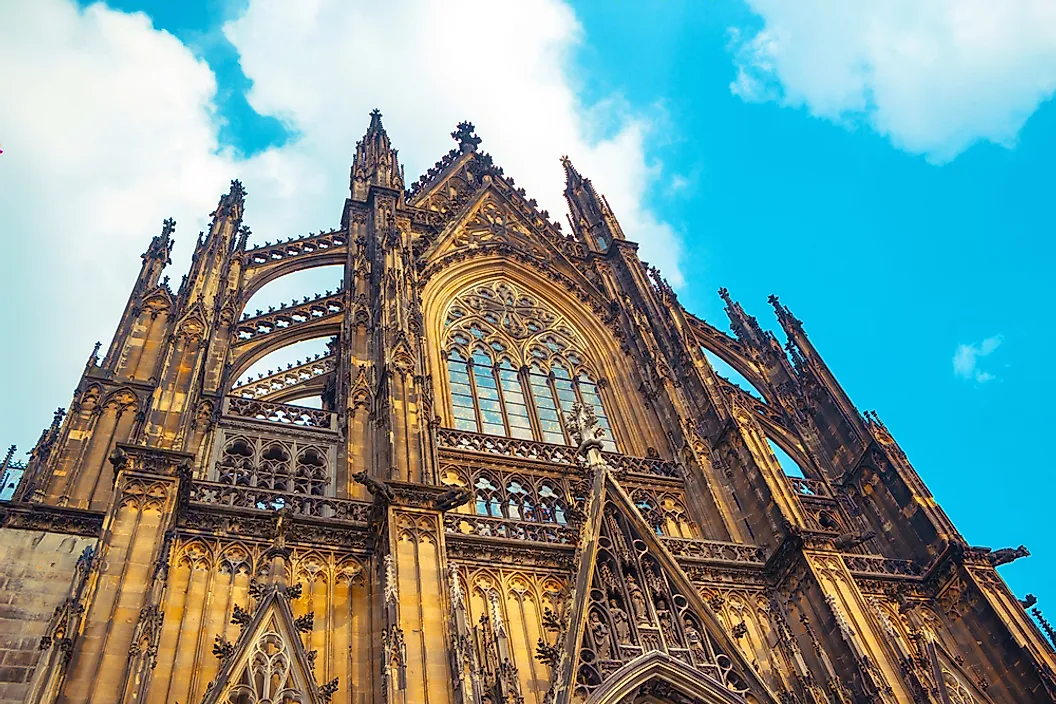
Cologne Cathedral (Kölner Dom) is the largest Gothic church in Northern Europe and the seat of the Archbishop of Cologne, with an interior of about 7,914 square metres. Its construction history is unusually long even by European cathedral standards: foundation stone laid August 15, 1248; medieval construction halted in 1473 with the south tower at only one-third its planned height; building work resumed in 1842 after public campaigns to complete the cathedral as a national symbol of German unity; and the cathedral was finally finished on October 15, 1880, in a ceremony attended by Kaiser Wilhelm I, 632 years after the first stone. The 157-metre twin spires made it the tallest building in the world from 1880 until the completion of the Washington Monument in 1884.
The cathedral's most important relic is the Shrine of the Three Kings, a gilded reliquary completed around 1225 by goldsmith Nicholas of Verdun, which holds bones traditionally identified as the remains of the Magi. The bones were brought to Cologne from Milan in 1164 by Holy Roman Emperor Frederick Barbarossa and the shrine has been the cathedral's primary pilgrimage focus for nearly 900 years. Cologne Cathedral survived 14 direct bomb hits during World War II (the surrounding city was levelled around it) and was inscribed as a UNESCO World Heritage Site in 1996.
Why Europe's Largest Churches Are Mostly Catholic
Twelve of the fifteen largest churches in Europe are Roman Catholic; only Liverpool Cathedral (Anglican) and Ulm Minster (Lutheran) fall outside the Catholic tradition, and Ulm Minster was Catholic for the first 150 years of its construction. The pattern reflects two historical facts: Catholic medieval and early-modern church-building peaked at scales (cathedral, archcathedral, papal basilica, pilgrimage shrine) that simply did not exist within Protestant ecclesiology, and the Reformation-era reorganisations across northern Europe between 1517 and 1648 did not generally produce new large church construction. The major Protestant additions to the European list have been Anglican Liverpool (built deliberately to match Catholic scale in a 20th-century industrial city) and Ulm Minster (continued under Lutheran auspices but designed in the Catholic era).
Italian dominance is also striking: five of the fifteen (St. Peter's, Milan, Santa Giustina, St. Paul Outside the Walls, Florence Cathedral, and San Petronio counts as six though some lists merge them) are in Italy, reflecting both the Papacy's historical concentration of resources in Rome and the medieval Italian city-state tradition of competitive cathedral-building. Spain contributes two (Seville and Zaragoza), Belgium and Germany two each, and the United Kingdom, Poland, and Portugal one each. The most recent entries (Licheń in 2004 and Fátima in 2007) are both Marian pilgrimage churches built to handle modern pilgrim volumes rather than as parish or cathedral churches, suggesting that any future additions to this list will probably follow the same pilgrimage-shrine model.
The Fifteen Largest Churches in Europe by Interior Area
| Rank | Church | City / Country | Denomination | Area (m²) |
|---|---|---|---|---|
| 1 | St. Peter's Basilica | Vatican City | Roman Catholic | 15,160 |
| 2 | Milan Cathedral | Milan, Italy | Roman Catholic | 11,700 |
| 3 | Seville Cathedral | Seville, Spain | Roman Catholic | 11,520 |
| 4 | Basilica of Our Lady of Licheń | Licheń Stary, Poland | Roman Catholic | 10,090 |
| 5 | Abbey of Santa Giustina | Padua, Italy | Roman Catholic (Benedictine) | 9,717 |
| 6 | Liverpool Cathedral | Liverpool, United Kingdom | Anglican | 9,687 |
| 7 | Church of the Most Holy Trinity | Fátima, Portugal | Roman Catholic | 8,700 |
| 8 | Basilica of Saint Paul Outside the Walls | Rome, Italy | Roman Catholic | 8,515 |
| 9 | Basilica-Cathedral of Our Lady of the Pillar | Zaragoza, Spain | Roman Catholic | 8,318 |
| 10 | Florence Cathedral | Florence, Italy | Roman Catholic | 8,300 |
| 11 | Ulm Minster | Ulm, Germany | Lutheran | 8,260 |
| 12 | Basilica of the Sacred Heart | Koekelberg, Belgium | Roman Catholic | 8,167 |
| 13 | Cathedral of Our Lady | Antwerp, Belgium | Roman Catholic | 8,000 |
| 14 | San Petronio Basilica | Bologna, Italy | Roman Catholic | 7,920 |
| 15 | Cologne Cathedral | Cologne, Germany | Roman Catholic | 7,914 |