8 Most Famous Streets In America
Say "Wall Street" and you are talking about money, not a road. Say "Broadway" and nobody pictures asphalt. A handful of American streets have pulled off that same trick, becoming shorthand for an entire industry, a city, or a way of life. Some earned it with bright lights and blackjack tables, others with Art Deco hotels or a century of opening nights, and one with a literal wooden wall. What they share is that you have probably heard of them long before ever setting foot on the pavement. Here are eight of the most famous streets in the country, and the stories behind how each one got that way.
Bourbon Street, New Orleans, Louisiana

Here is the first surprise: New Orleans' rowdiest street was not named after the whiskey. Bourbon Street took its name in 1721 from the French royal House of Bourbon, long before anyone was pouring Sazeracs along it. It runs about a dozen blocks through the French Quarter, between Canal Street and Esplanade Avenue, its balconies and shuttered facades left over from the city's French and Spanish colonial days. By daylight it can look almost sleepy. After dark, the upper eight-block stretch nearest Canal Street becomes a wall of neon, brass bands, and daiquiri shops, and during Mardi Gras the crowds get so thick the street is nearly impossible to cross. You can carry your drink right out the door and down the sidewalk, too, thanks to the city's famous go-cup rule, which lets you drink in public around the Quarter as long as the cup is plastic and not glass.
Broadway, New York City, New York

Broadway is famous enough to go by a single word, but a couple of things about it tend to catch people off guard. It is one continuous street, not a patchwork of avenues and boulevards, and it is the oldest north-south route in the city, running the length of Manhattan and then some. Before the Dutch or the English arrived, it began as the Wickquasgeck trail, a footpath worn into the island by its Native American inhabitants; the English later renamed it Broadway for its unusual width. The stretch through Midtown is the one the world pictures, the heart of the American theater industry. Its 41 professional theaters are the only houses where a show can qualify for a Tony Award, though here is the kicker: only three of them actually sit on Broadway itself.
Fifth Avenue, New York City, New York

Fifth Avenue is where flagship stores go to show off, Tiffany & Co. and Saks among them, alongside Prada, Gucci, Versace, and Louis Vuitton. For years it reigned as the most expensive retail street on Earth. It has slipped a notch or two lately, passed by Milan's Via Montenapoleone and London's New Bond Street in Cushman & Wakefield's latest rankings, but rent on upper Fifth still runs around $2,000 per square foot, which buys a lot of window shopping and not much else. The avenue cuts across Manhattan between Greenwich Village and Harlem, and its window displays, especially around the holidays, are worth the walk on their own.
Some of the street's best entertainment is the architecture around it. Rockefeller Center fronts Fifth, and the Top of the Rock deck on its 70th floor serves up a 360-degree view of the skyline. Central Park runs along the avenue's western edge between 59th and 110th Streets, with the Central Park Zoo sitting just inside the park near East 64th. One heads-up if you are bringing kids: the polar bears are gone, since Gus, the zoo's beloved last one, died in 2013, but the snow leopards, snow monkeys, grizzly bears, sea lions, and penguins still draw a crowd.
Hollywood Boulevard, Los Angeles, California

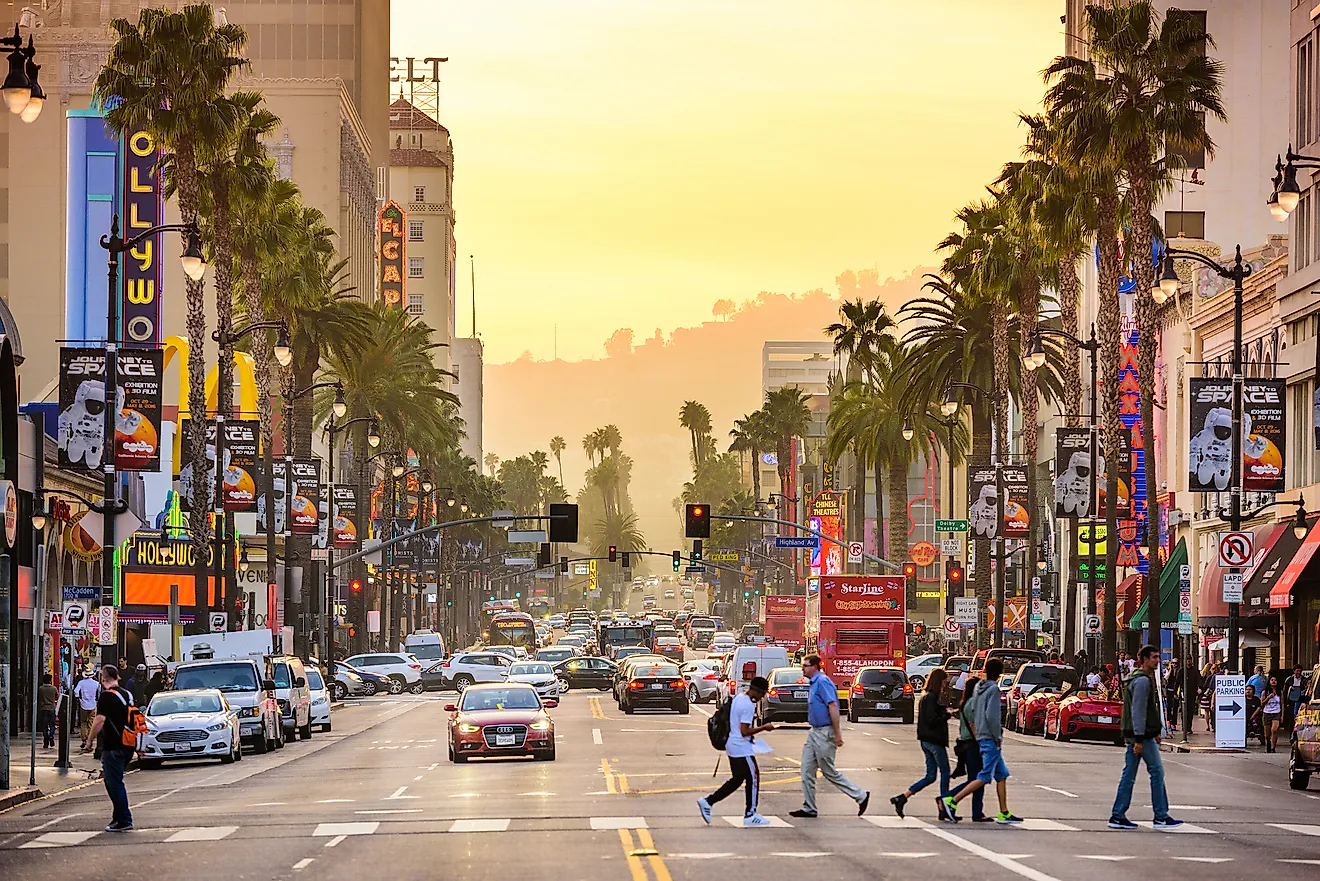
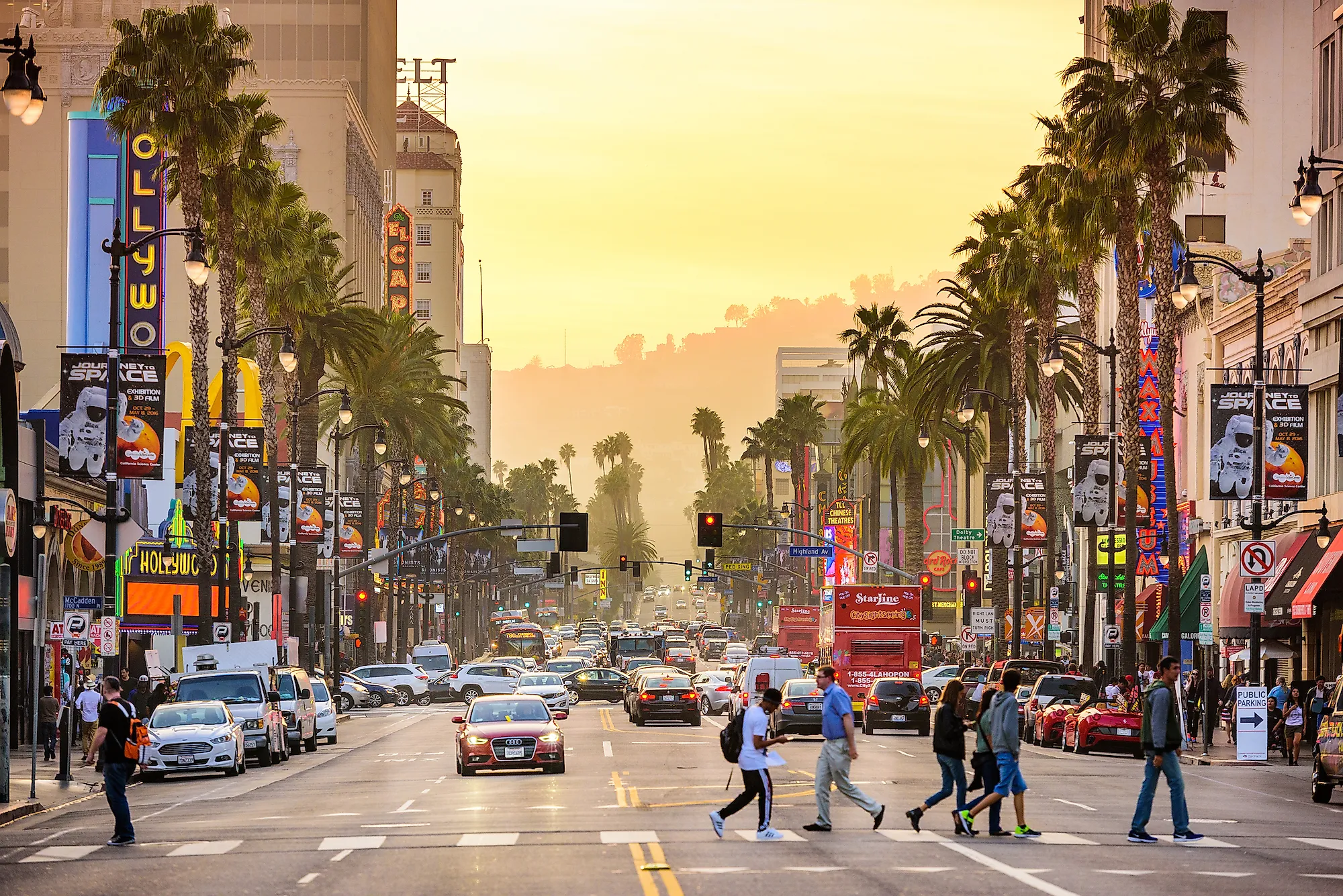
On Los Angeles' Hollywood Boulevard, the sidewalk is the main attraction. The Hollywood Walk of Fame stretches for more than a mile and holds over 2,800 brass-and-terrazzo stars honoring actors, directors, musicians, and even a few fictional characters, with the Chamber of Commerce adding roughly 30 more every year. Each star carries a name and a small emblem for its category; the famous handprints and footprints pressed into wet concrete are a block away, in the forecourt of the TCL Chinese Theatre, worth a look even if you skip a premiere. Around 10 million people a year come to shuffle along and hunt for their favorites. Madame Tussauds and a Ripley's Believe It or Not! sit on the same strip, and the Hollywood Sign hovers in the distance from plenty of vantage points along the way.
Las Vegas Boulevard, Las Vegas, Nevada

The Las Vegas Boulevard, better known as the Strip, is so bright you can pick it out from a plane. It got its start in 1941, when the El Rancho Vegas opened with 63 bungalows as the first resort on the Strip, borrowing the western look of the casinos that had been packing them in downtown on Fremont Street during the Hoover Dam construction years. It took about five more years for the Strip to become the glittering name it is now. That turn came in December 1946, when mobster Bugsy Siegel opened his Flamingo, the first truly glamorous resort out there. Other underworld figures followed his lead, pouring money into ever-flashier casinos and importing bigger and bigger headline acts.
Ocean Drive, Miami, Florida

Miami Beach's Ocean Drive packs a lot of glamour into barely a mile, running along the sand between South Pointe and 15th Street. It is the showcase strip of South Beach's Art Deco Historic District, which holds the largest concentration of Art Deco architecture in the country, more than 800 pastel-and-neon buildings from the 1930s and 1940s. The 1935 Colony Hotel, with its cobalt-blue neon sign, is often called the most photographed Art Deco hotel anywhere; it has popped up in movies and TV shows, including the series "Dexter," and on more postcards than anyone can count. Down the block, the Carlyle stood in for the drag club in "The Birdcage," and the "Scarface" chainsaw scene was filmed on this very street.
Ocean Drive is also where the late Italian designer Gianni Versace kept his mansion, Casa Casuarina, now a boutique hotel and restaurant. The whole point of the patio tables lined up along the sidewalk is less about the food than about being seen, ideally while a convertible or two rolls slowly past. Cap the night at the Clevelander, a 1930s Art Deco hotel whose rooftop and poolside bars are built for people-watching, with the Atlantic just across the road.
The Magnificent Mile, Chicago, Illinois

Chicago's Magnificent Mile is the 13-block run of North Michigan Avenue between the Chicago River and Oak Street, lined with skyscrapers, hundreds of shops and restaurants, and dozens of hotels. The look was no accident. Daniel Burnham's 1909 Plan of Chicago called for turning the avenue into the city's answer to the Champs-Elysees, a grand boulevard where a warehouse-lined stretch of old Pine Street used to sit.
The project that made it possible was the Michigan Avenue Bridge, which opened in 1920 and finally stitched the old south side of the river to the new north side; it was renamed the DuSable Bridge in 2010 for Jean Baptiste Pointe DuSable, the city's first non-Native settler. A boom of skyscrapers and shops followed, and the strip kept growing to the roughly 450 stores it counts today. The name that stuck came later, in 1947, when developer Arthur Rubloff coined "the Magnificent Mile" as he set out to remake the avenue after the war.
Wall Street, New York, New York

Wall Street is less a street than a symbol, standing in for American finance, big money, and every boom and bust that comes with it. The road itself is short, about seven-tenths of a mile across Lower Manhattan between Broadway and South Street. Its most famous tenant is the New York Stock Exchange at 11 Wall Street, the largest exchange in the world by the value of its listed companies. Despite what you might assume, most of the other big exchanges are not here: the Nasdaq's signature tower is up in Times Square, the mercantile exchange sits over at Brookfield Place, and the old American Stock Exchange was folded into the NYSE back in 2008. When people blamed "Wall Street" for the 2008 crash and the Great Recession, this narrow lane is the one they meant.
The name is literal. In the 1650s, the Dutch settlers of New Amsterdam, worried about an attack by the English or by Native tribes, built a wooden defensive wall along what is now Wall Street. Long after the wall came down, a different piece of history took root on the same block: in 1792, a group of brokers signed the Buttonwood Agreement beneath a buttonwood tree, a kind of sycamore, and planted the seed of the New York Stock Exchange.
It is no accident that New York City lays claim to three of these eight. But the rest prove you do not need the biggest city to leave a mark; sometimes a single street, a mile or so of pavement, is enough to tell the whole story of a place. Next time you find yourself on one of them, look past the crowds and the neon, and you will spot the history hiding in plain sight.