4 Most Venomous Spiders in Missouri
Missouri’s venomous spiders share a habit that surprises many people: they thrive on stillness. Cardboard boxes stored for months, stacked firewood near a deck, and the quiet corners of garages create the sheltered microclimates these species prefer.
The brown recluse (Loxosceles reclusa) draws attention because it hunts on the move, crossing floors at night in search of insects instead of relying on a web to do the work. Widow spiders, including the southern black widow (Latrodectus mactans), take the opposite approach, building tough, irregular cobwebs that act like trip lines for prey. Understanding how each spider lives (wanderer versus web-dweller) makes it easier to recognize where encounters happen and why bites occur.
Brown Recluse (Loxosceles reclusa)

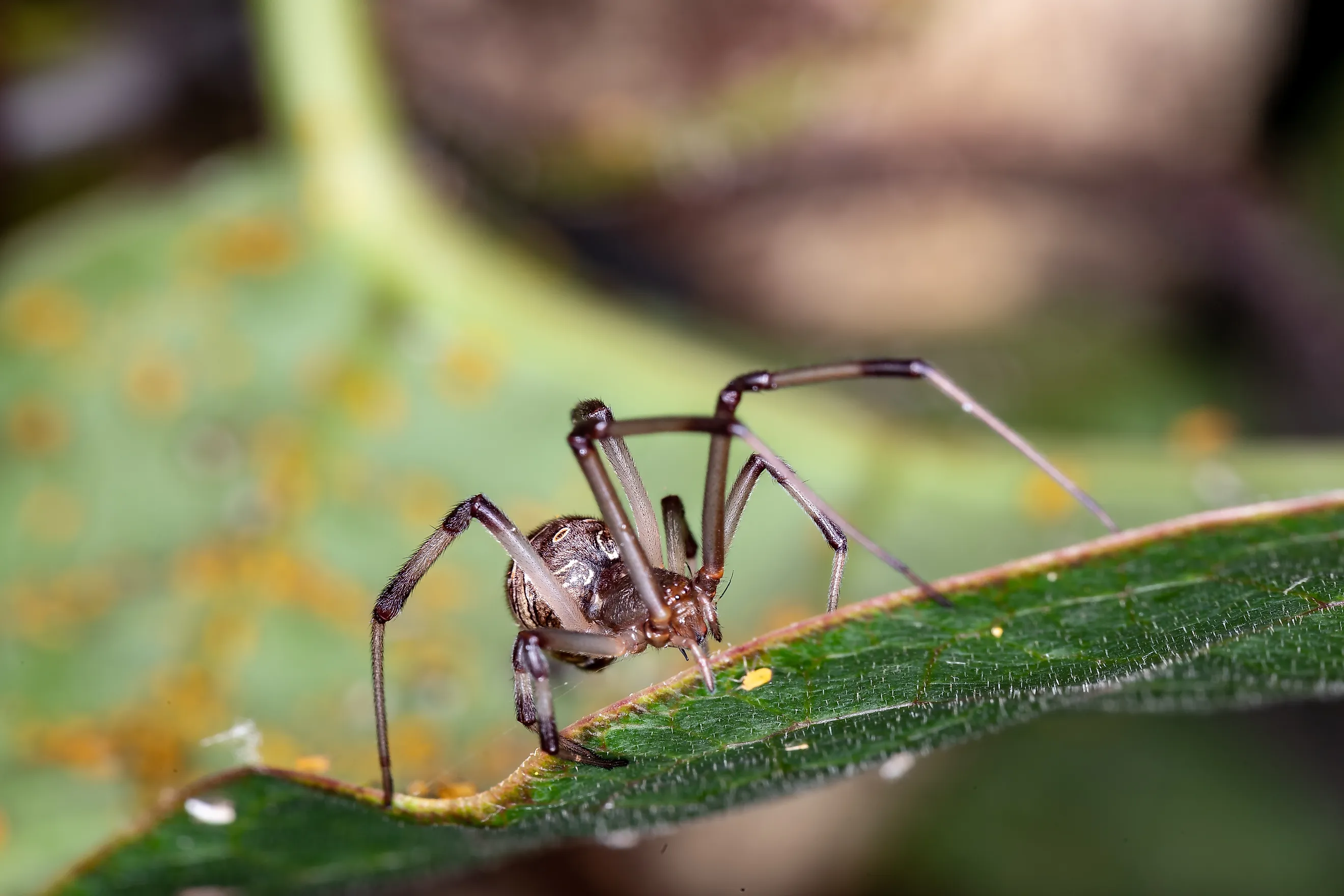
Of the 11 Loxosceles spiders in the United States, Loxosceles reclusa is the only one found in Missouri. These spiders are rarely found outside their range in the south-central and central midwestern states. The brown recluse is the most well-known common venomous spider to venture indoors. In Kansas City, brown recluse spiders are spotted mostly in older homes and businesses. They become more active between March and October, especially at night. Extreme heat can cause them to escape their undisturbed living areas (like attics and under porches) to more tolerable conditions inside the home. They are rarely out in the open, making it important to be cautious when handling items like boxes, piles of clothing, or shoes that are left untouched for long periods.
The Brown Recluse has several aliases. It is also known as the “violin spider,” “fiddleback spider,” or “fiddler spider” for the distinct violin-shaped dark brown marking on its head. Brown recluses hunt actively instead of waiting for prey to wander into their web, which is why humans more frequently encounter them. They are nocturnal, which decreases the odds of coming across them as they try to avoid human contact whenever possible.
If bitten, medical attention is neccessary and can cause severe necrosis. Symptoms at the bite site may start with pain, redness, swelling, itching, and burning. Within 1 to 3 days, the bite may resemble a “bull’s eye” appearance, but it can take up to 14 days to see the full effects of the bite. Seek medical attention if fever, rash, or flu-like symptoms occur.
Southern Black Widow (Latrodectus mactans)

The southern black widow is widespread throughout the eastern United States, especially in the southeast. Latrodectus mactans is found across Missouri, with common sightings in St. Louis. Its web differs from typical spider webs; it looks more like a cobweb made of strong white silk. These webs are often found beneath rocks, logs, or in large cracks and crevices—places that offer protection from weather.
Southern black widows are nocturnal and active at night. During daytime, they usually hang upside down in their web, making their characteristic hourglass shape clearly visible. These spiders are shiny, jet-black, with bright red hourglass markings on the underside of their abdomen. Usually, the hourglass is complete.
They are generally not aggressive and tend to hide when disturbed. If threatened, they may bite defensively, especially when guarding their web during egg sac presence. The bite often causes pain within 30 minutes to 2 hours, along with muscle twitching near the bite area, which can result in cramps in the shoulders, back, or stomach. Symptoms like nausea, headache, anxiety, and blood pressure changes may also appear. Bites from venomous black widows can cause necrosis if untreated, so medical attention is recommended.
Northern Black Widow (Latrodectus variolus)

The northern black widow shares a similar habitat with the southern black widow but is more frequently found in the northern United States. Externally, northern black widows are commonly encountered in sheltered locations such as beneath firewood, decks, hollow stumps, and rodent burrows. The female northern black widow constructs an irregularly shaped, somewhat tangled web in old stumps, hollow logs, beneath fallen fence posts, or in abandoned animal burrows. This web features a small funnel into which the spider can retreat when disturbed. Indoors, they are typically located in seldom-used areas of basements, crawlspaces, shed corners, and garages.
Latrodectus variolus resembles Latrodectus mactans closely, with a key distinguishing feature. The hourglass marking on the underside of their abdomen is usually incomplete, with its lower and upper halves separated. In addition to this broken hourglass, they display red or white spots on the dorsal side of the back, which may be faint or prominent.
Although widow spiders are quite common, bites are rare because these shy arachnids tend to escape when disturbed. Venom from a bite may affect the central nervous system; however, the severity of the bite depends on factors such as the victim's age, the depth of the bite, and the timing since the spider's last venom injection. Bite victims experience pain almost immediately, which intensifies over 1 to 3 hours but can persist for up to 24 hours.
Brown Widow (Latrodectus geometricus)

The brown widow is not native to the United States and was previously restricted to central and southern Florida. Its range has since expanded to include every southern state and some midwestern states like Missouri. Latrodectus geometricus constructs its web in concealed, protected areas around homes, such as among woody vegetation and branches. Common outdoor web sites include empty plant pots, mailboxes, storage sheds, and garages. They also hide in the recessed handles of plastic garbage cans, beneath outdoor furniture, and in the corners of wrought iron railings.
Unlike its black and red relatives, the brown widow has a fairly plain appearance: mottled brown and tan with black markings. It bears an orange hourglass-shaped mark, and it is smaller than a black widow.
Latrodectus geometricus tends to be at a higher risk of human encounters because it favors more exposed locations compared to black widows. Its venom is less potent, so a bite is usually minor, causing pain and a red mark at the bite site similar to a typical house spider bite.
Missouri’s landscape hosts two primary venomous spider genera: the recluse spiders (Loxosceles) and widow spiders (Latrodectus). The brown recluse, Loxosceles reclusa, is the only species of its genus in Missouri, known for hiding in undisturbed areas of homes and venturing out mostly at night. Identified by a violin-shaped mark, it may cause severe necrosis if it bites. Missouri is also home to several widow spiders, including the southern black widow (Latrodectus mactans), with its signature red hourglass marking, and the brown widow, an introduced species with a subtler bite. Despite their venom, encounters are rare, and bites are seldom fatal.